
Quick Read
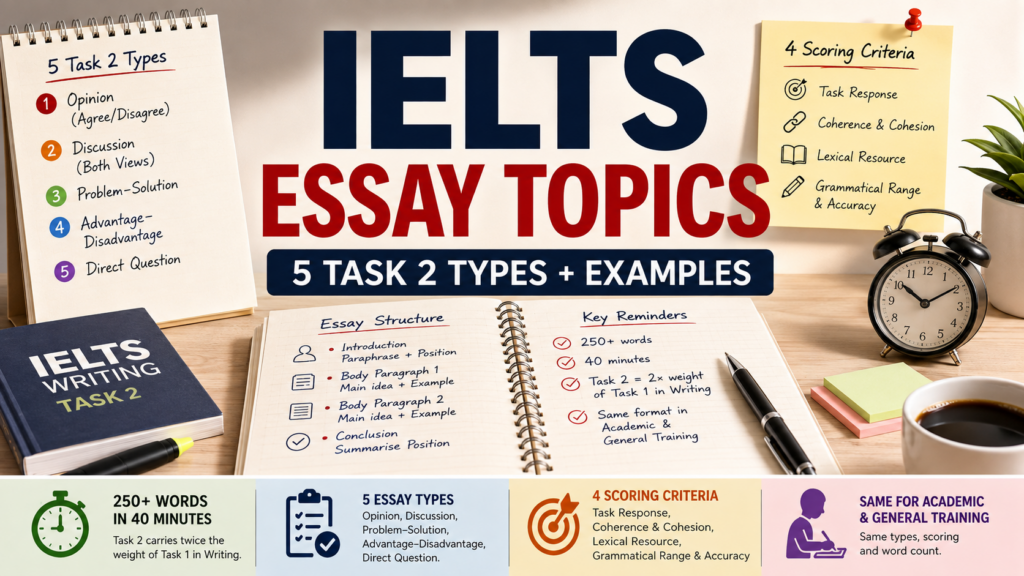
- 5 Task 2 types: Opinion, Discussion, Problem-Solution, Advantage-Disadvantage, Direct Question.
- 4 scoring criteria: Task Response, Coherence and Cohesion, Lexical Resource, Grammatical Range and Accuracy.
- 250+ words in 40 minutes: Task 2 carries twice the weight of Task 1 in Writing.
- Same Task 2 format: Academic and General Training use the same types, scoring, and word count.
IELTS Essay Topics: The 5 Writing Task 2 Types
Every IELTS essay topic falls into one of five types. Recognizing the type in the first 30 seconds of reading the prompt determines your whole approach, since each expects a different essay shape.
| Type | What the prompt asks | Example |
| Opinion (Agree/Disagree) | State and defend a clear position on a statement | Some people believe technology has made communication less personal. To what extent do you agree? |
| Discussion (Both Views) | Present both sides of a debate, then give your own view | Some think students should choose their subjects; others believe schools should decide. Discuss both views and give your opinion. |
| Problem-Solution | Identify causes of a problem and propose realistic fixes | What are the causes of traffic congestion in cities, and what solutions can address it? |
| Advantage-Disadvantage | Weigh the pros and cons of a trend or policy | What are the advantages and disadvantages of remote working becoming permanent for many employees? |
| Direct Question | Answer one or two specific questions directly, without a for-and-against structure | Why do some students choose to study abroad, and what challenges do they face? |
Counselor insight: Discussion and Opinion prompts get confused most often. A Discussion essay must genuinely explore both sides before you give your view in the conclusion; jumping straight to your opinion and only mentioning the other side in passing is marked down under Task Response.
Agree or Disagree Essays: What Examiners Expect
“Do you agree or disagree” is the most common way an Opinion essay is phrased. The prompt gives you one statement and asks how far you agree or disagree, not a menu of positions to summarize.
- Pick one side in your introduction: full agreement, full disagreement, or a clearly defined partial agreement.
- Defend that exact position through both body paragraphs.
- Don’t switch sides midway, and don’t hedge so much that no position is identifiable.
Switching positions or over-hedging is the single most common Task Response error on agree-or-disagree IELTS writing topics.

Excel in IELTS with India’s Top Online Coaching
Leap has helped more than 1 Lakh students achieve 7+ IELTS band.
Latest IELTS Essay Topics by Theme
Below is a list of IELTS writing topics, examples, and ideas grouped by theme, covering both IELTS Academic writing essay topics and General Training. The latest and most recent IELTS essay topics still draw from a small, recurring set of themes rather than an unlimited pool of subjects, so preparing vocabulary and ideas by theme is a far better use of study time than memorising full essays, since the exact wording of a prompt is unpredictable even when the theme is familiar.
- Education: university funding, online versus classroom learning, standardized testing, vocational versus academic tracks, the role of homework.
- Technology: artificial intelligence and jobs, social media’s effect on relationships, screen time in childhood, automation and employment, data privacy.
- Environment: climate change responsibility (individual versus government), renewable energy, plastic waste, urbanization’s effect on wildlife.
- Health and lifestyle: diet and public health policy, mental health awareness, aging populations, access to healthcare.
- Work and society: the gig economy, work-life balance, income inequality, immigration’s economic effects.
Practise writing a plan, not a full essay, for two or three prompts in each theme using the IELTS Writing practice test. A plan takes five minutes and tests whether you have enough ideas to support a position, which is the more common weakness than vocabulary or grammar.
Counselor insight: Don’t chase “predicted” topics for a specific test date circulating on forums. Examiners write fresh prompts constantly; what’s genuinely predictable is the theme, not the exact question.
Excel in IELTS with India’s Top Online Coaching
Leap has helped more than 1 Lakh students achieve 7+ IELTS band.
How IELTS Essay Topics Are Actually Scored?
Every Task 2 response is marked against four official criteria, each contributing exactly 25% to your Task 2 band.
| Criterion | What it measures |
| Task Response | Whether you’ve addressed every part of the question and developed a clear, well-supported position |
| Coherence and Cohesion | Whether your ideas are logically organized and clearly linked between sentences and paragraphs |
| Lexical Resource | The range and precision of your vocabulary |
| Grammatical Range and Accuracy | The variety of sentence structures you use and how accurately you use them |
At Band 7, examiners expect a clear position held consistently, ideas that are extended and supported rather than just stated, a logically organized argument with a range of linking devices, and a mix of simple and complex sentences with only occasional errors. At Band 9, that same structure runs with no noticeable strain, precise vocabulary, and error-free grammar.
A common mid-band gap is an essay that states a position clearly but doesn’t extend the reasoning behind it, a weakness scored under Task Response, not vocabulary or grammar. Run your practice essays through LeapScholar’s IELTS Writing Band Score Calculator to see how each criterion contributes to your overall band.
Source: IELTS, Writing Key Assessment Criteria
IELTS Essay Topics: Structure That Scores Well
The same four-paragraph structure works across all IELTS essay topics, regardless of type:
- Introduction: Paraphrase the question in your own words, then state your position or preview both sides you’ll discuss.
- Body paragraph 1: One main idea, explained and supported with a specific example, not a general statement.
- Body paragraph 2: A second main idea, following the same pattern.
- Conclusion: Summarise your position without introducing new ideas.
Use linking words like “however,” “for instance,” and “as a result” to connect ideas, but don’t force one into every sentence; overusing connectors mechanically is penalized under Coherence and Cohesion just as much as using too few.
For a full breakdown of Task 1 and Task 2 formats side by side, see LeapScholar’s IELTS Writing Module overview.
Sample IELTS Essay Topic and Response
Here’s a full IELTS writing prompt example with a model response, useful as a reference for structure and tone rather than something to memorize.
Prompt (Discussion): Some people think zoos are cruel and should be banned, while others believe they play an important role in wildlife conservation. Discuss both views and give your opinion.
Sample response:
Zoos have long divided opinions. Critics argue that confining animals to artificial enclosures denies them the space and freedom they would have in the wild, while supporters see zoos as essential tools for conservation and public education. This essay examines both views before giving my own.
Those opposed to zoos point out that even well-run facilities cannot replicate a natural habitat and that confinement can cause visible signs of distress in some species. Critics also argue that a minority of zoos prioritize ticket revenue over animal welfare, which undermines the conservation argument entirely.
Supporters, however, highlight that many endangered species now survive largely because of captive breeding programs; giant pandas and several rhino species are commonly cited examples. Zoos also expose millions of visitors to wildlife they would otherwise never encounter, which can build public support for conservation funding.
On balance, I believe well-regulated zoos serve a genuine conservation purpose that outweighs the ethical concerns, provided welfare standards are enforced and continually improved rather than treated as optional.
This sample reflects the structure covered above for IELTS essay topics: a clear position from the first paragraph, two developed body arguments, and a conclusion that doesn’t introduce new content.
Counselor insight: Notice that this response takes a position in the introduction and holds it consistently. Essays that only reveal their opinion in the final line, after describing both sides neutrally throughout, are commonly marked down under Task Response for an unclear position.
Common Mistakes in IELTS Essay Topics
These mistakes on IELTS essay topics show up across every essay type, not just one.
- Not answering every part of the question is another common mistake. A prompt with two questions needs both answered, not just the one that’s easier to write about.
- Revealing your position only in the conclusion. State it in the introduction and hold it throughout, even in Discussion essays.
- Underdeveloped ideas. A single sentence per point reads as a list, not an argument; extend each idea with an example or a consequence.
- Inventing statistics. Examiners aren’t persuaded by fabricated numbers; a general, logical example is more credible than a made-up one.
- Overgeneralizing. Claims like “everyone agrees” or “this always happens” invite pushback; hedge with “many,” “often,” or “in some cases.”
If you’ve already taken IELTS and your Writing score fell short, read expert answers on what to do when your IELTS score isn’t good enough before deciding whether to retake the full test or use a One Skill Retake.
How to Practice IELTS Essay Topics by Target Band?
- Targeting Band 6.5: Focus on completeness first. Practise addressing every part of multi-part prompts and finishing within 40 minutes, with 250+ words. At this stage, a fully finished, adequately argued essay scores higher than a partial essay with more ambitious vocabulary.
- Targeting Band 7.5 and above: Completeness is assumed; focus on depth. Practise extending each main idea with a specific example or consequence rather than a general statement, and review your essays for repeated linking words and vocabulary, since range is scored separately from accuracy at this level.
Not sure where you’re starting from? Take a free IELTS mock test or see what our counselors say about free IELTS band prediction tests to get a baseline before you commit to a study plan.
Counselor insight: Time yourself from the first practice session, not the week before your test. Students who practice untimed consistently misjudge how much they can develop an idea in 40 minutes and run out of time on the conclusion.
3 Key Takeaways on IELTS Essay Topics
- Identify the type before you plan. Opinion, Discussion, Problem-Solution, Advantage-Disadvantage, and Direct Question each need a different essay shape, and misreading the type costs marks under Task Response.
- Scoring is four separate criteria, not one overall impression. A strong vocabulary doesn’t offset an unclear position, and vice versa, so practice needs to target each criterion specifically.
- Prepare by theme, not by memorized essay. Education, technology, environment, health, and work cover most prompts; ideas and vocabulary for these themes transfer even when the exact question is unfamiliar.
Verified by: LeapScholar’s IELTS counseling team, with hands-on experience guiding Indian students through Writing Task 2 preparation, band score improvement plans, and mock test feedback.
Have questions about your current IELTS Writing band and what’s holding it back? Book a free session with a LeapScholar counselor.
Frequently Asked Questions About IELTS Essay Topics
-
What are the five main types of IELTS essay topics?
The five Task 2 types are Opinion (Agree/Disagree), Discussion (Both Views), Problem-Solution, Advantage-Disadvantage, and Direct Question. Each expects a different essay structure, so identifying the type before you start planning is the first real decision in your response.
-
How do I answer an “agree or disagree” IELTS essay question?
State one clear position, full agreement, full disagreement, or a specific partial agreement, in your introduction, and defend that same position throughout both body paragraphs. IELTS writing task 2 agree-or-disagree questions are marked down under Task Response if the essay hedges between positions or reveals a different opinion only in the conclusion.
-
Which IELTS essay topic type appears most often?
Opinion and Discussion prompts are generally the most frequently tested types across recent exam reports, with Problem-Solution and Advantage-Disadvantage also appearing regularly. Exact frequency isn’t published by IELTS itself, so treat any specific percentage you see online as an estimate rather than an official figure.
-
Are IELTS essay topics repeated?
The exact wording of a prompt is rarely identical between test sittings, but the underlying themes, education, technology, environment, health, and work, repeat consistently. Preparing ideas and vocabulary by theme is more useful than trying to memorize a specific past question.
-
How is an IELTS essay topic scored?
Task 2 is marked against four criteria, each worth 25%: Task Response, Coherence and Cohesion, Lexical Resource, and Grammatical Range and Accuracy. A high score in vocabulary can’t compensate for a weak or unclear position, since each criterion is assessed independently.
-
What is the minimum word count for an IELTS essay topic?
Task 2 requires a minimum of 250 words, written in 40 minutes. Writing under the limit is penalized under Task Response matters as much as the argument itself, regardless of how well-argued the content is, so word count discipline is important.
-
How can I get Band 7 in IELTS essay topics?
Band 7 requires a clear position held consistently, ideas that are extended and supported rather than simply stated, a logically organized argument with appropriate linking devices, and a mix of sentence structures with only occasional grammatical errors. Regular timed practice against these specific criteria beats general vocabulary study alone.
-
Do IELTS essay topics differ between Academic and General Training?
No. Writing Task 2 uses the same five essay types, the same four scoring criteria, and the same 250-word minimum for both Academic and General Training. Only Task 1 differs between the two versions.
-
How many IELTS essay topics should I practice before my test?
There’s no fixed number that guarantees a score, but practicing at least one full essay per theme, alongside timed planning drills for the others, covers the range most tests draw from.








Have Questions? Get Guidance to reach your Dream University
Connect with India's finest counsellors and biggest study abroad community.
Get Guidance