Indian enrollment hit 69,816 in winter 2025/26, even as the UK, Canada, and Australia tightened rules.
Tuition is free in 14 of 16 states; living costs and the €11,904 blocked account are the real expense.
Students can work 140 days a year; graduates get 18 months to find a job.
Best fit: a shortage field, plus genuine willingness to learn German.
Germany is becoming one of the most sought-after destinations among study abroad aspirants. Nearly 60,000 Indian students are already in Germany.
The reasons are practical;
Germany offers little to no tuition fee at most public universities
Legal part-time work while you study
An 18-month permit to look for a job after you graduate
A written-into-law route to permanent residency
Although Germany's economy has been flat for three years, with registered unemployment hitting 6.3 percent in mid-2026, the highest annual average since 2010, jobs are still going unfilled, but only in a specific list of occupations. Jobs are still going unfilled, but only in a specific list of occupations. That means your outcome in Germany depends far more on what you study, whether you learn German, and where you look for work than on simply getting admitted.
Why choose Germany?
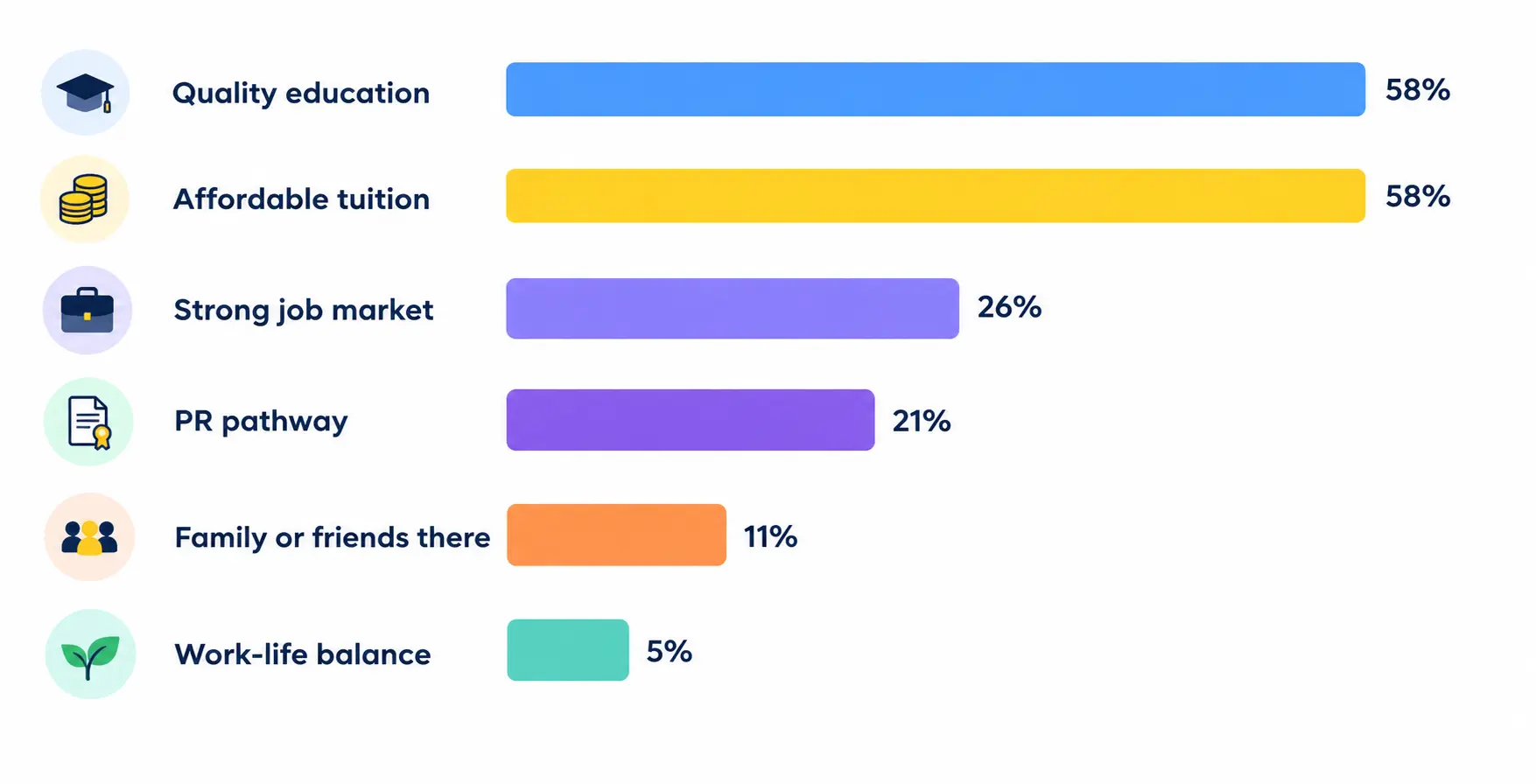
What LeapScholar’s survey found: Among survey respondents, quality of education and affordable tuition were cited equally often (58% each, 11 of 19) as the reason they chose Germany, well ahead of the job market (26%, 5 of 19) and the PR pathway (21%, 4 of 19). The pitch isn't just cheap; it's cheap and good, in roughly equal measure.
Ask an Indian student why they are considering Germany, and the answer usually starts with tuition. Ask what actually made them choose it, and the real answer is usually something else: a job market that everyone said was closing everywhere at once and one country that seemed to still want them.
That is not a slogan. Between 2023 and 2026, the major English-speaking study destinations moved in the same direction at the same time. The UK cut its post-study Graduate Route from two years to eighteen months for bachelor's and master's graduates applying on or after 1 January 2027. Canada capped study permits and tied post-graduation work rights to a narrower list of eligible programmes. Australia raised financial requirements and slowed processing for entire tiers of institutions. None of this is a German story. It is a worldwide tightening, and it means the honest version of this decision was never "which country is best." It is the easy version of studying abroad; it no longer exists anywhere, so which set of trade-offs can you actually live with?
Germany's own labour market is not immune to strain, and we won't pretend otherwise. But Indian enrolment in Germany kept climbing through the same years that other destinations were pulling back. That is worth taking seriously, and it is also worth interrogating rather than repeating as a marketing line. The rest of this section does both.
A Shortage That Won't Fix Itself in a Year
A cooling economy and an acute skills shortage sound like they shouldn't coexist. In Germany right now, they do, because the shortage is demographic and occupational rather than cyclical, a different problem on a different clock than a normal downturn.
Here's where it gets confusing if you're reading this from India: you'll see two very different unemployment numbers thrown around for Germany, and both of them are technically correct.
The data. Germany's own Federal Employment Agency put the seasonally adjusted rate at 6.3 percent in June 2026, around 3.05 million people, the highest annual average since 2010. Switch to the internationally comparable ILO measure, and it drops to 3.9 percent, among the lowest in the EU-27, against an EU average of 6.0 percent. Youth unemployment, at 7.1 percent, was the lowest in the EU on that same basis. Neither number is wrong. They're counting different things: the German figure includes people in partial job-seeking activation; the ILO figure counts only active search and availability. Most Indian study-abroad content just quotes whichever one fits the story it's telling. Worth holding both.
Underneath the weak headline number sits a genuinely tight occupational picture. Germany's Federal Employment Agency identifies over 160 occupations with qualified-worker bottlenecks going into 2026. That gap is real: a large pool of unemployed workers exists, but it is not qualified for the specific roles that are unfilled, and retraining an entire workforce at scale takes a decade Germany does not have, because its baby-boom generation is retiring now. This is precisely why Germany wrote the shortage into immigration law rather than treating it as a passing wobble: shortage occupations get a legally lower salary threshold for the EU Blue Card, Germany's route to fast-track residency for skilled workers. That is a government putting policy weight behind its own labour forecasts.
The practical implication for you is important and easy to miss: Germany is not a country where any degree leads to a shortage-driven opportunity. Instead, it is a country where only a specific list of fields leads to a shortage-driven opportunity. Field choice carries more weight in Germany than in almost any comparable destination, which is why choosing what to study deserves its own careful process rather than a default to whichever course looks familiar.
What Do the Numbers Really Show?
Indian students are now the single largest international group at German universities.
69,816 Indian students were enrolled in Winter Semester 2025/26, per DAAD.
That's up from 28,905 in 2020, roughly 2.4 times higher in four years.
A figure of ~69,816 for 2025/26 circulates in press coverage, but we couldn't trace it to a stable primary source. Treat it with the same skepticism you'd give any uncredited number.
You'll also come across a claim that Indian applications to German universities surged 370 percent year-on-year. As per the Leap to Germany report 2026 by LeapScholar, that figure is the company's own data, covering the January-June application cycle, and the same report also found demand for AI-related courses among Indian applicants jumping 600 percent over the same period. Even taken at face value, most people who quote the 370 percent figure get it backwards. An application surge isn't a hiring signal. It's a competition signal. It shows the seats are harder to win, not that the jobs on the other side are easier to get. Read the enrollment growth for what it actually proves: the pipeline is real, the Indian student community in Germany is now large enough that you won't be studying in isolation, and Germany hasn't throttled Indian intake the way some other destinations have throttled theirs. What it doesn't prove is that outcomes are good. Enrollment measures who went in, not who found a job, and we keep those two facts separate throughout. As per the Leap to Germany report 2026 by LeapScholar, that application growth is drawn from counseling and application data covering more than 1,24,000Indian study-abroad aspirants between January and June 2026. Within that pool, interest in computer science rose 273 percent, and combined data science and AI programs rose 173 percent, while MBA interest fell 13 percent, a clear tilt toward specialized technical degrees. Postgraduate programs now account for 82 percent of all Germany applications, and course-level interactions rose 72 percent year-on-year, both signs that students are moving from broadly exploring Germany to targeting a specific program. None of that changes the competition math: only 12 percent of applicants in the same period received a university offer, so a growing applicant pool is making admission more selective, not less.
The Real Advantages
Start with the money, because that's usually the first thing anyone mentions, then work through what actually holds up once you dig past it.
Tuition is close to zero in most of the country. Fourteen of sixteen states charge nothing at public universities. Baden-Württemberg is the exception at €1,500 a semester for non-EU students, and so is TUM in Bavaria for many of its newer non-EU master's programs. Everywhere else it's a modest semester contribution, usually €120 to €430, with a transport ticket included.
You get real time to find work after graduating. §20 of the Residence Act gives you an 18-month, non-renewable permit purely to search, and any job counts toward keeping yourself afloat while you look, not just work in your field.
The route to permanence is fast once you're employed. From an EU Blue Card, settlement takes 21 months with B1 German or 27 months with only A1, which is genuinely quick by global standards.
You're legally allowed to earn while studying. You can work up to 140 full days or 280 half-days a year, or 20 hours a week during term time. The Werkstudent contract within that allowance is a real opportunity, not just a token perk.
The policy posture is built around keeping you, not just letting you in. Germany's immigration system right now favors retention over a temporary, conditional stay, which isn't true everywhere on a shortlist right now.
One caution worth stating early: choosing Germany for tuition alone is a common and expensive mistake. Tuition is usually the smallest line in the annual budget. Living costs and the funds you need to prove upfront dominate the real number, covered next.
Policy Is Moving in Your Favour
This development is not incidental. Over 2024 and 2025, Germany passed a series of changes under the Skilled Immigration Act (Fachkräfteeinwanderungsgesetz) specifically to widen, not narrow, the pipeline of international graduates. The student work-day allowance was raised from 120 to 140 full days a year (or 280 half days), with a parallel 20-hours-a-week model running alongside it, giving students more legal room to earn while they study. The EU Blue Card salary threshold was set lower for shortage occupations and, separately, for anyone whose most recent degree was obtained within the last three years, which in practice means most recent graduates qualify for the reduced threshold regardless of their specific occupation. And the Chancenkarte (Opportunity Card) now provides a route back into Germany for up to 12 months of job searching, even for graduates who left the country after finishing their degree, using their German qualification directly rather than a points system. As per the Leap to Germany report 2026 by LeapScholar, the Opportunity Card's points-based route requires proof of funds of about €1,091 a month to cover the job search period.
What changed, and what it means for you
Change
What it means for an Indian student
Student work limit raised from 120 to 140 full days a year (280 half-days)
Meaningfully more legal room to earn while studying, on top of the 20 hours a week term-time option
EU Blue Card threshold: €50,700 standard, but only €45,934.20 for shortage occupations and for anyone whose degree was completed in the last 3 years
Most recent graduates clear the lower bar automatically, regardless of whether their occupation is on the shortage list
Chancenkarte (Opportunity Card): up to 12 months' residence to search for work
Graduates who have already left Germany can return specifically to job-search, using their German degree directly
§20 post-study permit: 18 months, non-renewable, any job permitted while searching
A genuinely long runway to find work, not a token grace period
Route to settlement permit: 21 months with B1 German, 27 months with only A1
One of the fastest legislated paths to permanent residency among Germany's peer study destinations
Who's opening up, who's closing down
Destination
Direction
What changed
Germany
Opening
Work-day limit raised; Blue Card threshold lowered for recent grads and shortage fields; Chancenkarte added as a return-to-search route
UK
Tightening
Graduate Route cut from 24 to 18 months for bachelor's and master's graduates, effective for applications from 1 January 2027
Canada
Tightening
Study permit caps introduced; post-graduation work rights tied to a narrower list of eligible programmes
Australia
Tightening
Financial requirement thresholds raised; processing slowed across entire tiers of institutions
None of these changes happened by accident. It's a government matching its immigration law to its own labour-market forecasts of a structural, demographic skills gap that domestic retraining can't close on its own timeline. We'd treat Germany's intake policy as durable rather than a temporary opening, too: the reforms are aimed at retention, not a one-time recruitment push, at the same time that policy in comparable English-speaking destinations has been moving the other way.
What Does Studying in Germany Really Cost?
Public universities are close to tuition-free for most students, but the honest answer has two footnotes worth knowing before you build a budget around it.
Germany's reputation for affordability is not a myth, but it is frequently oversimplified into "free education," and that simplification causes real financial planning mistakes. Here is the distinction that matters most: some of what you will need to show is money you will never see again, and some of it is your own money that is simply being held and released to you over the year. Indian families routinely add the two together and conclude that Germany costs far more than it does, or budget for tuition and forget the living costs that actually decide whether the year is comfortable.
Tuition, by institution type
Situation
Tuition per year
Public university, 14 of 16 states
€0
Public universities in Baden-Württemberg (Heidelberg, Stuttgart, KIT, Freiburg, Tübingen, Mannheim, Konstanz)
€3,000 (€1,500 per semester) for non-EU students
TUM, Bavaria: newly enrolled non-EU students since Winter 2024/25
€8,000 to €12,000 for many master's programmes
Private university
€10,000 to €40,000+ total, for the full degree
LMU Munich, in the same state as TUM, has kept tuition at effectively zero. "Bavaria charges tuition" is not a safe generalisation. Always check the specific university. And if budget is the deciding factor, it's worth comparing against Germany's genuinely cheapest universities before ruling anything out.
Every student at a public university also pays a semester contribution, typically €120 to €430, which covers student services, administration, and in most cases a nationwide transport ticket. That ticket is worth pausing on: the Deutschlandticket rose to €63 a month from 1 January 2026, and the student version is fixed by law at 60 percent of that, giving students unlimited regional and local transport across the entire country for well under €40 a month. It is one of the genuinely good deals available to any student anywhere, and it is part of why living slightly outside an expensive city remains a workable choice rather than a hardship.
What a Blocked Account Really Is
The blocked account (Sperrkonto): to get a student visa, Indian applicants must deposit €11,904, released to them at €992 a month once they arrive. This is not a fee paid to a university or the government. It is the student's own year of living money, held and released on a schedule. Families frequently fold this figure into "the cost of studying in Germany" and arrive at a number that looks far larger than it should. The blocked account deposit is returnable to the student throughout the year as living funds; it is not lost.
Monthly living costs by city, against the €992 released each month
In a moderate city, that monthly budget typically breaks down roughly as: rent, €400 to €550; health insurance, €140 to €152; food, €200 to €250; the amortised semester contribution, around €40; phone and internet, €20 to €35; the mandatory broadcasting fee (Rundfunkbeitrag), at €18.36; and €80 to €120 for everything else. City choice, in other words, is one of the single biggest levers a student has over whether the year feels financially comfortable or constantly tight, and it is worth choosing deliberately rather than defaulting to the city with the most name recognition.
The Costs Nobody Warns You About
The blocked account isn't the whole bill. Two other chunks of spending surprise most families, but both are easy to plan for once you know they're coming.
Before you even land: the blocked-account provider fee, APS certification, language and English proficiency tests, application fees, document attestation, the visa fee, bridging insurance, and flights. Together these typically run ₹1.8 to ₹3.5 lakh, separate from your returnable blocked-account deposit.
Your first month on the ground: a rent deposit (capped by law at three months' rent), the first month's rent itself, two to eight weeks of temporary accommodation at €40 to €70 a night while you flat-hunt, and furniture for what's usually an unfurnished flat. Total: €2,000 to €4,000, against the €992 your blocked account releases that month.
Arrive with only the blocked-account amount and nothing else, and that first month gets genuinely tough. Keep an extra €2,500 to €3,500 in an internationally usable account, and it won't be hard. That single piece of planning matters more than almost anything else on this list.
Add it all up, and a public university in a moderate-cost city runs roughly ₹15 to ₹18 lakh for year one, all in. Most of that is your own returnable living fund, not money that is spent and gone. That's the number worth comparing against other countries, not the tuition line by itself.
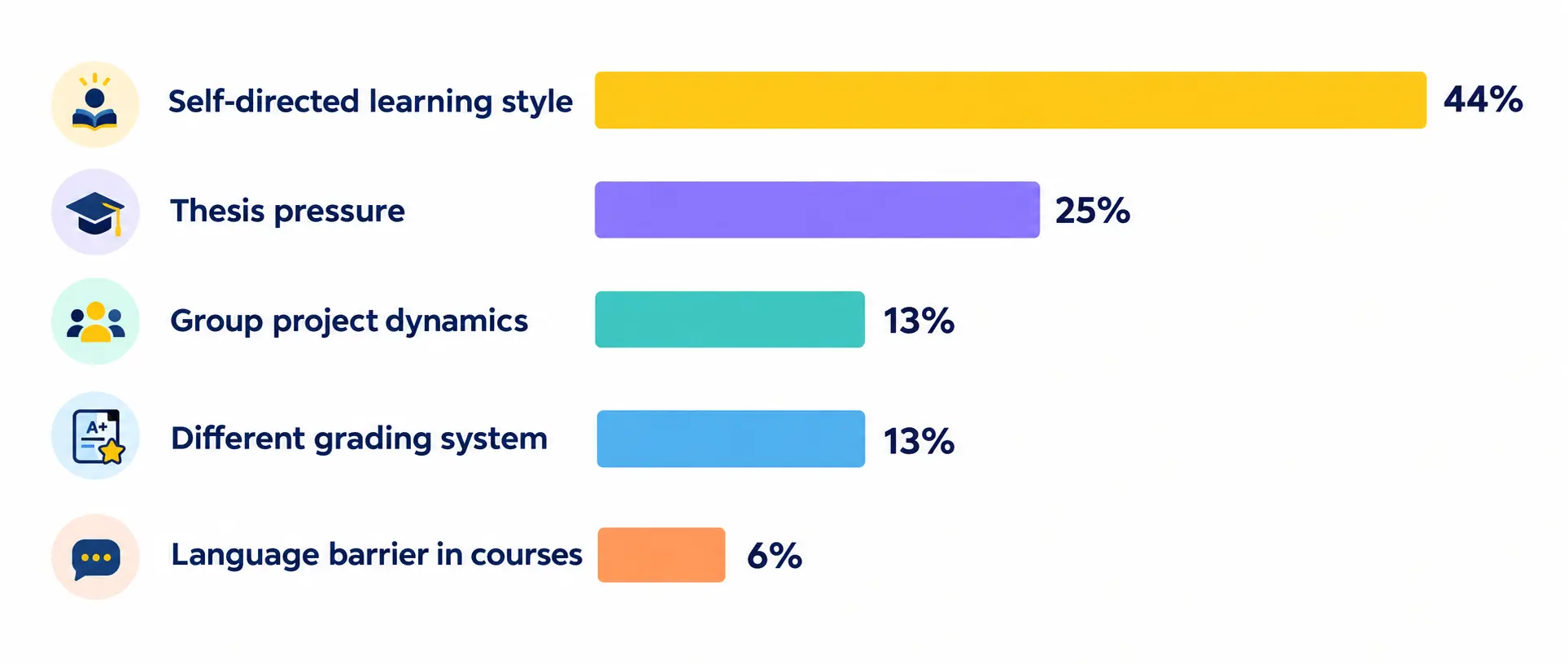
What LeapScholar’s survey found: Among the respondents, adjusting to a self-directed learning style (44%, 7 of 16 who answered) came up far more often than language barriers in coursework (6%, 1 of 16) as the hardest academic adjustment. For this mostly English-taught, technical sample, independence is the real learning curve, not German.
Germany's higher education system is organised differently from India's, and the difference matters more than most guides admit. There is no informal "tier" system in the Indian sense. A degree from any German public university, whether a research university (Universität or Technische Universität) or a university of applied sciences (Fachhochschule or Hochschule für Angewandte Wissenschaften, commonly FH or HAW), is a state-recognised qualification. Employers distinguish between the two by orientation rather than prestige: a Universität or TU degree leans towards research, a PhD track, and R&D careers, while an FH degree leans towards integrated industry placement and applied practice, and for many industrial roles employers actively prefer the FH graduate.
The closest thing Germany has to a recognisable brand hierarchy is TU9, the alliance of nine leading technical universities, including RWTH Aachen, TU Berlin, TU Munich, KIT and Universität Stuttgart, among others, which German employers do recognise. Beyond that, the more reliable filters are Germany's own Hochschulkompass (the official database of every accredited institution and programme), the DAAD's database of English-taught programmes, and subject-specific rankings such as the CHE Hochschulranking, which rates by supervision quality, equipment, and study organisation rather than research citation counts. International rankings such as QS or THE are a weaker starting filter for this purpose than the German system's own tools.
On structure, a German bachelor's degree runs three to four years, is mostly German-taught, and for Indian applicants coming straight from a 12th-standard qualification usually requires a preparatory Studienkolleg year first. The master's degree, which is the main route most Indian students take, runs one and a half to two years and is where the large majority of English-taught programmes sit. A PhD in Germany is worth flagging separately because it works differently than most applicants expect: it is typically structured as an employment contract rather than a student enrolment, meaning doctoral researchers are paid, pay tax and social contributions, and hold a work residence permit rather than a student one, which changes the financial picture entirely and removes the need for a blocked account.
Life After Graduation
Two narratives circulate about hiring in Germany. One says the country is desperate for talent and hiring is easy. The other says Germany is in recession and not worth it. Neither survives contact with the data.
The data. The macro labour market is genuinely weak: three consecutive years of stagnation or contraction, and employment declining by roughly 19,000 to 23,000 people a month over the first half of 2026. At the same time, the occupational picture is genuinely tight: over 160 bottleneck occupations, and an estimated 369,000 vacancies in 2025 that could not be filled at all, down from about 487,000 in 2024, but still concentrated overwhelmingly in the same shortage occupations that immigration law privileges. Put the two together, and the real state of the market is this: fewer total vacancies than a few years ago, but the vacancies that remain sit in exactly the fields the system is built to fast-track, and they are hardest to fill at the mid-level, not necessarily at entry level.
You'll also see the figure "Germany is short 109,000 IT specialists" attributed to the industry association Bitkom. It's a directionally useful number, but it's an extrapolated industry-survey estimate, not an official government statistic, so we're not treating it as a headline fact. A more useful, less quoted finding from the same body of research: roughly one in four German companies advertising an IT position gets effectively no usable applications at all. The role doesn't fail at the shortlist stage. It fails before a shortlist exists, usually because the posting is in German, the company is a mid-sized specialist firm nobody outside Germany has heard of, and it's located in a town no international applicant is searching in. That single fact changes where a smart job search should look, and we go into it further in later chapters covering the university and city shortlist.
None of this amounts to a guarantee. Competition is fiercest exactly where Indian students tend to cluster: entry-level software roles at recognisable brands in Berlin and Munich, English-only graduate programmes at the largest listed companies, and anything advertised in English generally. It is noticeably milder at German-speaking, mid-sized industrial firms in second-tier cities and in roles that pair a technical field with German at a working level. That is not a coincidence so much as the same barrier appearing in three forms: language, brand familiarity, and geography, each of which is something a student can actually change.
From Graduate to Permanent Resident
Graduates who do not have an offer at graduation can apply for the 18-month, non-renewable residence permit under §20 of the Residence Act, during which any job, not only qualified work, is permitted to support themselves while they search. Once an offer is in hand, most Indian graduates move onto the EU Blue Card, which as of 2026 requires a gross annual salary of €50,700 in standard occupations, or the reduced threshold of €45,934.20 for shortage occupations and for anyone whose most recent degree was obtained within the last three years. That last detail is worth underlining: a recent graduate qualifies for the lower threshold regardless of whether their occupation sits on the official shortage list, which for many business, life science, or civil engineering graduates is the practical difference between qualifying for a Blue Card and not.
From the Blue Card, the route to a settlement permit (permanent residency in effect) takes 21 months with B1-level German, or 27 months with only A1. This is one of the faster, more clearly defined routes to long-term settlement among Germany's peer destinations, and it is written into law rather than left to case-by-case discretion.
On earnings: expect to keep roughly 60 to 65 percent of a gross salary as a single person with no children after income tax, pension, health insurance, and the other statutory deductions. A graduate earning the reduced Blue Card threshold of €45,934 can expect to take home somewhere in the region of €28,000 to €30,500 a year net, and one earning €55,000 gross can expect roughly €33,000 to €35,500 net. Those deductions are not simply lost: they buy comprehensive healthcare. a state pension entitlement, unemployment insurance, and statutory paid leave of at least 20 days, benefits that are out-of-pocket costs in many other systems. A German salary cannot be compared to an equivalent-looking Indian salary based solely on the gross number.
For context, Germany's national median gross salary is around Rs.59.5 lakh (EUR 54,066) a year, according to Destatis. IT and engineering graduates with an in-demand specialisation typically start between Rs.55 lakh and Rs.66 lakh (EUR 50,000-60,000), and higher in Munich or Frankfurt.
The numbers above answer what a first job in Germany can pay. They do not answer what makes a career here continue to grow beyond that first offer. We put that question to Eric Schüler, a Senior Platform Engineer working in cloud infrastructure, Kubernetes, and DevSecOps in Germany.
The biggest difference between engineers who grow into senior or staff-level roles and those whose careers plateau is the ability to move from solving individual tasks to taking ownership of bigger problems and influencing solutions beyond their immediate responsibilities.
Technical skills are only one part of career growth. Technical impact also needs communication. If you solve important problems but nobody understands the impact, it's difficult for others to recognise your contribution.
- Eric Schüler, Senior Platform Engineer
Part-Time Jobs in Germany While Studying
Working while studying is genuinely realistic in Germany, and it is one of the areas where the country is stronger than most comparable destinations, provided a student treats it as a career strategy rather than a source of pocket money.
The Werkstudent (working student) contract: International students may work up to 140 full days or 280 half days a year, or 20 hours a week during term time, without additional permission. Within that allowance sits the Werkstudent role, designed specifically for enrolled students, pairing relevant, career-track work with reduced social-security contributions. Industry reporting suggests a high conversion rate from Werkstudent roles into full-time offers at the same employer, though we couldn't verify an exact official figure, so treat any specific percentage as directional rather than fact. The underlying pattern holds regardless of the precise number: internal candidates get hired at far higher rates than external applicants, because German companies frequently hire from inside first.
The strongest version of this path looks like a campus job or research assistant role in the first semester, a Werkstudent role in the student's own field from the second semester onward, a master's thesis supervised jointly with that same company in the final year, and an offer negotiated before graduation. A student who follows that sequence typically never needs the 18-month post-study permit at all, because they have secured work before finishing their degree, which removes the single largest source of uncertainty in the entire plan. Finding these roles generally means searching in German, using the terms "Werkstudent," "Praktikant," and "Abschlussarbeit" alongside a subject term, and going directly to company career portals and the federal job board rather than relying on English-language listings alone.
Do You Need German or Not?
To study, English is genuinely enough for most programmes. To build a life and a career here, German is close to non-negotiable, and this is the single most expensive misunderstanding in Indian study-abroad planning for Germany.
Roughly 1,800 degree programmes in Germany are taught entirely in English, and it is genuinely possible to be admitted, study, and graduate without German. The gap is what happens around the degree. Renting a flat, opening a bank account, dealing with the local registration office, understanding a Werkstudent contract, and eventually building a career are all areas where German is still mostly required.
Where German is, and is not, required
Situation
Level typically needed
English-taught master's, admission
None. IELTS or TOEFL instead.
German-taught master's, admission
C1
Registration, residence office, bank, insurance paperwork
A1 to B1 in practice
Flat hunting
B1 helps decisively
Werkstudent role in IT, data or R&D
Often none to B1
Werkstudent role in business, HR, sales, operations
B2 typically
Full-time role, Mittelstand engineering or industry
B2
Full-time role, client-facing, consulting, healthcare, law
C1
Settlement permit, standard route
B1
One fact is worth holding onto above the rest: A1-level German, which takes roughly 80 to 100 hours to reach, is what unlocks the faster 27-month settlement route on a Blue Card rather than the standard one. Measured purely in time saved against effort invested, that's about the highest-return use of a student's time you'll find anywhere here, and it costs nothing more than showing up to a beginner course before departure.
IELTS isn't always needed for English-taught programmes. Each university sets its own English requirement, and over 200 German universities accept a Medium of Instruction (MOI) certificate from an English-medium Indian bachelor's instead. If your degree was partly in a regional language, use TOEFL iBT (minimum 80-88) or PTE Academic (minimum 60).
More companies are opening up to English-speaking engineers, especially in international environments.
However, it would be misleading to say that English is enough everywhere. Many companies still require German, and international engineers should be aware of this reality when planning their move.
- Eric Schüler, Senior Platform Engineer
Bachelor's, Master's, PhD
Most of the research and student experience we've drawn on, and most of Germany's own applicant pool from India, centres on the master's route, so this section is written with that reader most directly in mind. It's worth saying this plainly rather than assuming the same conclusions apply equally to every stage of higher education.
For bachelor's-level applicants coming straight from Indian schooling, the path looks structurally different: a German bachelor's typically requires a Hochschulzugangsberechtigung (higher education entrance qualification), and Indian 12th-standard qualifications commonly require a preparatory Studienkolleg year before admission, adding time and complexity that a master's applicant, coming in with a completed Indian bachelor's degree, does not face. The bachelor's route also tends to be more heavily German-taught, which brings the language question in earlier and more forcefully. Later sections on eligibility, admissions, and field choice go into that route in more depth; the short version worth carrying into this decision is that Germany can work well for bachelor's-level applicants, but the practical runway to admission is longer and the language requirement is less avoidable than it is at the master's level.
Separately, anyone considering a doctorate should know that a German PhD is generally structured as a paid employment contract rather than a student enrolment, which removes the blocked-account requirement entirely but changes the visa, tax, and long-term planning picture in ways this section does not have room to unpack fully.
Accommodation: Housing, Bureaucracy and Student Life In Germany
Recurring themes in Indian student community discussion, treated here as directional patterns worth taking seriously rather than as official statistics, point consistently to four things that shape the first year more than academics do.
Accommodation, not the visa, is usually the hardest part. Germany has a structural housing shortage in almost every university city, worst in Munich, Frankfurt, Stuttgart, Hamburg, and Cologne, and student dormitory waiting lists routinely run one to three semesters in high-demand cities. Applying to student housing the day admission arrives, rather than the day the visa is granted, and budgeting for four to eight weeks of temporary accommodation materially changes how this part of the year goes.
Bureaucracy is slow in a way that is genuinely difficult to plan around casually. Registering an address, opening a bank account, and applying for a residence permit are sequenced dependencies rather than parallel tasks, so knowing the order in advance matters more than most students expect.
Academic independence is a real adjustment. German master's programmes generally assume self-directed study, optional attendance, and assessment concentrated in a single high-stakes exam rather than continuous internal assessment, and students coming from Indian systems built around ongoing assessment sometimes misjudge their first semester as a result.
Isolation in the first semester is common and under-discussed, particularly in smaller cities and for students who arrive in the winter intake, meeting a German winter and a slower-forming German social culture at the same time.
None of these are reasons not to go. They are reasons to plan for the actual first year, rather than the frictionless version that marketing content tends to describe.
You Won't Be the Only One
With roughly 69,816 Indian students enrolled as of Winter Semester 2025/26, and Indians now the largest single international nationality at German universities, most students will find an existing Indian student association at their university before they even land. Most major university cities have Indian grocery shops, temples, gurdwaras, and mosques, and Diwali and Holi events are common on campus calendars. For the practical questions that official guidance never quite answers, from which landlord actually rents to internationals to how a specific Ausländerbehörde office behaves, this community is usually the fastest and most reliable source.
The honest caveat is worth stating plainly: the students who struggle most with German, with the local job search, and with genuinely settling in are consistently the ones whose entire social world in Germany stays Indian. The ones who do best treat the Indian community as a landing pad for the first few months, not as the whole plan, and deliberately build the other side too: a Verein, a Lerngruppe, or a Tandem language partner. Both things can be true. The community will be there. Using it well still requires a deliberate choice to not stop there.
What If Things Go Wrong
Germany is a strong option for many students, but no destination is frictionless, and it is not the right choice for everyone weighing it. Knowing the real risks in advance is the best way to prepare for them, and none of these is a reason to stay away if you plan well.
The language ceiling. The degree itself goes fine in English. The career and daily life afterward generally do not, and eighteen months is not a long runway to discover that the hard way.
An unsustainable loan. If the required loan exceeds roughly your expected first-year gross German salary, with no other financial buffer, the risk sits with you long after the degree is done.
The independence gap. German programmes are built around self-directed study. Anyone who needs heavy academic structure and close supervision to perform well will find that structure is simply not provided.
A field with no pull. Choosing a field with no connection to Germany's shortage occupations and no other specific reason to be in the country is a weaker bet here than an English-speaking destination may be.
Chasing tuition alone. Low tuition combined with a difficult job search is, in the end, more expensive than higher tuition combined with a successful one.
Regulated professions. Medicine, nursing, teaching, law, and architecture carry licensing requirements on top of C1-level German. In those fields, the degree is rarely the real barrier. The license is.
Medicine is the clearest case. C1 German is non-negotiable and is tested before clinical placements, and applicants who complete an FSJ (voluntary social year) or a hospital internship before applying have a significantly stronger profile for competitive medical schools.
Germany against the other options on the table
Germany
UK
US
Canada / Australia
Stay in India
Tuition, 2-year master's
€0 in most states
High
Very high
High
Low to moderate
Upfront proof of funds
€11,904 blocked account, returnable
Maintenance funds
I-20 funding proof
Savings plus tuition proof
None
Post-study work
18 months, any job permitted, non-renewable
18 months from 2027 (bachelor's/master's)
OPT 12 months, lottery-dependent extension
Programme- and points-tied
n/a
Route to permanence
21 to 27 months on a Blue Card
5 years to settlement
Lottery, multi-year backlog for Indians
Points-based, variable
n/a
Language barrier
Real, B1 to B2 for most careers
None
None
None
None
Choosing Germany tends to make sense for students whose field sits in or near a shortage occupation, whose family can fund roughly ₹15 to 18 lakh for year one without unmanageable debt, who are genuinely willing to learn German to a working level, and who value a predictable, legally defined path to long-term settlement more than the highest possible first-year salary. The UK or Ireland tends to suit students who are unwilling to learn another language, want the shortest total time to a Western job, and can absorb higher tuition. The US tends to suit students targeting research or a specific compensation ceiling who can tolerate the H-1B lottery and a long green-card backlog. Canada or Australia tends to suit students for whom permanent residence itself is the primary goal. And staying in India is, for a meaningful number of students, the genuinely correct answer, particularly where a strong role already exists, or where the loan required would exceed the expected first-year salary abroad with no other cushion.
Weighing Italy as well? Italy's post-study permit gives graduates 12 months (against Germany's 18), long-term EU residency there needs 5 years of continuous legal residence, and its proof of funds (EUR 10,179.85 a year) is shown through bank statements, a sponsor letter or a scholarship rather than a locked account.
Have a field that sits in or close to Germany's official shortage list, or another concrete reason to be in Germany specifically.
Can realistically fund roughly ₹15 to 20 lakh for the first year without taking on debt you could not service if the job search runs long.
Are genuinely willing, not just theoretically open, to learn German to a working level over your first two years.
Value a clearly defined, comparatively fast legal path to long-term settlement more than the highest possible starting salary.
Reconsider If...
You are choosing Germany primarily because tuition is low, without having priced out the living costs that actually decide your budget.
You are unwilling to engage with German beyond the classroom.
You need continuous structure and assessment to perform academically.
Your field has no connection to Germany's shortage occupations and no other specific pull towards the country.
The loan required would exceed your realistic first-year earnings with no other financial buffer in place.
None of this is a verdict on whether you, specifically, should go. It's the set of questions worth answering honestly before you do. The remaining sections, on choosing what to study and how to choose between a course and a university, are built to help you answer them with the same standard of evidence applied here: what the data actually shows, not what the loudest version of the story online tends to claim.
We asked Eric Schüler, a Senior Platform Engineer who built his career in Germany, how he would answer this question for a young engineer today. His answer is worth ending on, precisely because he is careful not to oversell it:
I want to be transparent: I have not worked as an engineer in multiple countries, so I do not want to pretend that I can make a direct comparison. My perspective is based on my experience building my career in Germany.
What I appreciate is the opportunity to work on complex technical projects, grow through responsibility, and continuously develop my skills. However, moving to Germany alone does not automatically create career growth. Engineers still need to invest in themselves, stay curious, and actively search for opportunities to contribute.
For engineers who enjoy learning, taking responsibility and building things long-term, Germany still offers many opportunities to build a meaningful technology career.
- Eric Schüler, Senior Platform Engineer
A note on the figures in this section: German policy on visas, work rights,, and salary thresholds is revised on a fixed annual cycle. Every statistic here reflects the most current confirmed data available at the time of writing. Figures drawn from official German or EU sources are treated as reliable; figures drawn from industry surveys or press reporting, including the Werkstudent conversion-rate figure, are flagged in the text and should be treated as directional rather than exact. The 370% application growth figure is based on the Leap to Germany Report 2026.
Sources and Further Reading
Every figure used in this section is drawn from the Complete Guide's own research base, which in turn cites German federal authorities, EU institutions, and official statistical offices wherever a primary source exists and flags clearly where only a secondary or self-reported source was available. The links below are grouped by topic so you can verify anything directly or dig deeper before you act on it. German policy on visas, work rights, and salary thresholds is revised annually, so treat the date of your check as important as the figure itself.
We're grateful to the professionals who generously shared their real-world experience to make this guide richer than what you'd find on official portals alone.
HB
Harit Bhasin
Product Leader, SAP
Bengaluru, Karnataka, India
Contribution: Harit is a Product Leader in enterprise software at SAP, focused on tech leadership within enterprise product teams. Earlier in his career, he worked in Germany as a Technology Analyst at EXA AG in Walldorf (2016) and as a Solution Architect at SophisTex GmbH in Brühl (2016–2017). He has since built expertise in AI and product management through executive programs at the Indian School of Business and UC Berkeley's Haas School of Business, and mentors colleagues and co-chairs the Pan-Asians@SAP network at SAP.
Founder, 1IB Hub & CEO, 1IB International Business
Author: Doing What Matters: The Power of Purposeful Productivity
Frankfurt, Germany
Contribution: Mario is a Frankfurt-based business development expert who founded 1IB Hub and serves as CEO of 1IB International Business, helping entrepreneurs and pharma companies scale and expand internationally. He previously spent six years as Managing Director at Azeta Pharma (2019–2025).
Contribution: Eric is a software professional based in the Nuremberg area of Germany, with a strong cloud and DevOps skill set spanning AWS (Solutions Architect, Security Specialty, and Developer Associate), Azure, and Terraform. He trained through Germany's dual vocational system as a Fachinformatiker (application development), and previously served as Deputy Youth and Apprenticeship Representative at infoteam Software AG.
Contribution: Dr. Stefan Gröner runs his own consulting practice, Dr Stefan Gröner Consulting, based in Munich. He is a state-certified naturopath (Bavaria, 2022) and completed further studies at Colorado State University (2022–2024). He speaks German natively, alongside English, French, and Spanish.
Senior Software Engineer, Lufthansa Digital Hangar
Author: React.js Design Patterns
Germany
Contribution: Anthony is a Senior Software Engineer at Lufthansa Digital Hangar, also working as a fullstack developer, and holds a CPSA-F software architecture credential.
What CGPA or percentage do I need to get admission to a German university?
There is no single national cut-off. What matters is your institution's recognition status in anabin and your CGPA or percentage converted through the Modified Bavarian Formula, then checked against that specific program's own historical cut-off, typically 2.0 to 2.5 for selective TU9 programs and 2.5 to 3.0 for many other good technical and business programs. A recognized institution with a workable CGPA and no undisclosed backlogs clears most shortlists.
Will a backlog in my degree affect my chances of getting into a German university?
Not automatically. What matters is whether the backlog is cleared before you apply and honestly declared, since APS verifies your academic record directly with your university, and an undisclosed backlog discovered at that stage causes far more damage than the backlog itself. One or two cleared backlogs, honestly declared, are routinely accepted; a pattern of many, or hiding one, is the real risk.
What is APS, and why is it required for German university admissions?
The Akademische Prüfstelle, run through the German Embassy in New Delhi, verifies the authenticity of your academic documents directly with your university. It is a prerequisite for the student visa and, in most cases, the university application itself, regardless of your field of study. It officially takes several weeks, but plan for 8 to 10 weeks in practice, and start it before you have any university offers, since it only needs to be done once.
Does my work experience matter if I'm applying for a master's in Germany?
Yes, generally it helps. Relevant work experience is a genuine asset for German master's programs, particularly at a Fachhochschule, which tends to favor practical, industry-facing profiles over pure research orientation. It strengthens your Statement of Purpose but does not replace the core eligibility checks: your institution's recognition and your CGPA.
Can I apply to a German university if I'm not from an engineering background?
Yes. Commerce, accounting, business administration, finance, and economics graduates are a large and well-established group among Indian applicants to Germany, typically applying to master's programs in finance, business analytics, or management. The same eligibility checks apply regardless of stream, and none of these backgrounds need a bridging course to be considered.
Is tuition really free in Germany, or are there hidden costs?
Tuition, at 14 of 16 public-university states, is €0, with exceptions at Baden-Württemberg (€1,500 per semester for non-EU students) and TUM in Bavaria (€8,000 to €12,000 a year for many non-EU master's programmes). The cost that catches most families off guard is separate from tuition: a mandatory blocked account, plus a semester contribution, health insurance, and visa and APS fees.
Can I get a scholarship to study in Germany?
It is possible but competitive and not something to count on. DAAD is the best-known scholarship body, but its awards go disproportionately to applicants with a strong, well above-average academic record and a clear research or leadership angle. LeapScholar's own post-arrival student survey found that none of the surveyed students who had studied in Germany were scholarship-funded; most fund their year through family savings, the blocked account, and an education loan.
Can I work part-time while studying in Germany?
Yes, generally up to 140 full days or 280 half-days a year, roughly 20 hours a week during term time. A Werkstudent (working-student) contract within that allowance is a genuine opportunity, not just a token part-time job, and is often the fastest route into a full-time offer after graduation.
How long can I stay in Germany to look for a job after I finish my degree?
Eighteen months, under a non-renewable post-study work permit, and any job counts toward supporting yourself while you search, not only work in your field. Securing a Werkstudent role from early in your degree meaningfully shortens or removes the need for that search altogether.
Should I choose Germany or the UK for my master's?
It depends on what matters most to you. Germany tends to make sense if your field is at or near an official shortage occupation, your family can fund the first year without unmanageable debt, you are willing to learn German over time, and you value a clearly defined, comparatively fast route to long-term settlement. The UK tends to suit applicants who want the shortest total time to a Western job and are unwilling to learn another language, usually at a higher tuition cost.
Which courses are most popular among Indian students studying in Germany?
Business and finance-related fields (finance, MBA, and business analytics) and technology fields (computer science, data science, AI and machine learning, cyber security) are the two largest clusters among Indian applicants, well ahead of core engineering branches or life sciences.



 Blogs
Blogs  Leap Digest
  Events
  About Us