
Quick Read
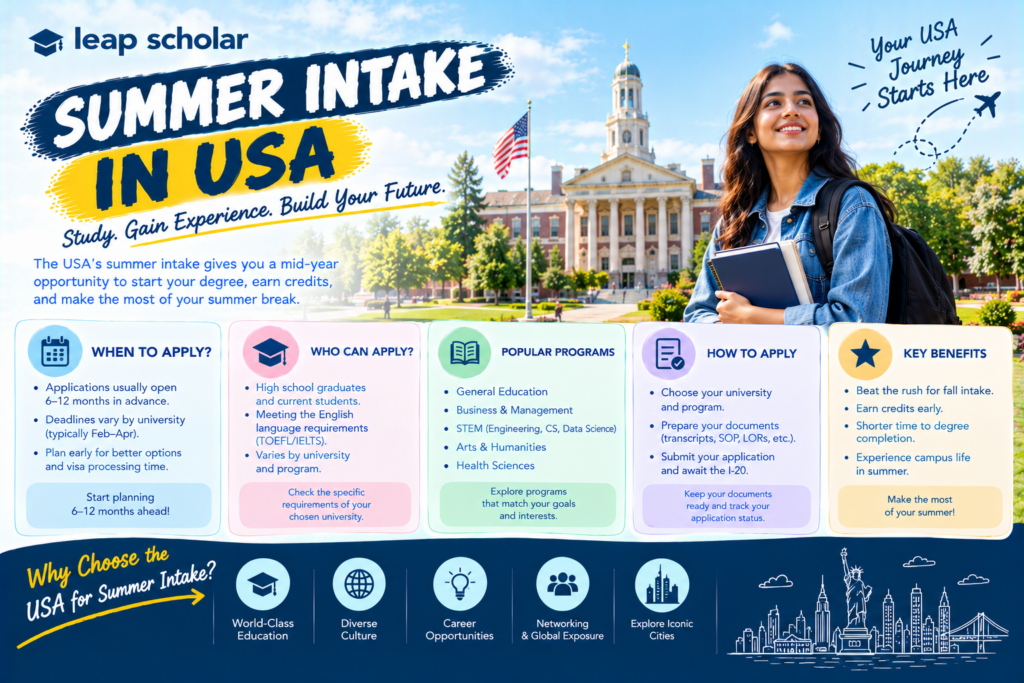
- Summer intake in USA (also called May intake) typically opens applications in November-December and closes between January and March for a May 2027 start.
- Harvard, Berkeley, NYU, and Michigan summer sessions sponsor F-1 for credit courses only.
- Degree-level summer intake exists at fewer schools, like Dayton and Salem State.
- At ₹95 per USD, summer-term tuition for Indian students typically runs ₹2.85 lakh to ₹14.25 lakh depending on the program and credit load.
What Is Summer Intake in USA?
If you’ve missed the fall or spring application window, or you want to get a head start on coursework before the main academic year begins, summer intake in USA is worth a serious look. It’s the smallest of the three US intakes, so it comes with fewer university options and fewer scholarships but also less competition for the available seats.
Summer intake, sometimes called May intake, is the third and smallest admission cycle at US universities, after fall (August-September) and spring (January). It usually runs from May to August and is commonly used for short certificate programs, summer courses that count toward a full degree, and bridge or foundation programs for students who need extra preparation before joining a fall cohort.

Choose your dream country
 UK
 USA
 Germany
 Australia
 Ireland
 Canada
 UAE
 France
 Sweden
 Italy
 Other
When do you want to study abroad?
What's your highest level of education?
Have you completed Class 12th?
What was your Class 12 CGPA/percentage?
Are you a student or a parent/guardian?
What do you want to study?
Select your current city
How Leap will help you

Personalised University Shortlist

Express Applications with Quicker Admits

End-to-End Application Support
Compared to spring intake in USA applications, summer intake usually has an earlier and shorter application window, as the term itself is compressed into 8 to 12 weeks.
If you’re still deciding between options, it helps to compare all three in LeapScholar’s guide to intakes in the USA, or to see how the fall intake in USA deadlines line up against summer if you have the flexibility to wait.
Universities With Summer Intake in USA (2027 Cycle)
Most of what gets called “summer intake” at well-known universities isn’t a degree-admission cycle at all. Harvard Summer School, UC Berkeley Summer Sessions, NYU’s summer sessions, and the University of Michigan’s visiting-international program are non-degree summer sessions: you register for courses rather than apply for admission, and there’s no GRE, GMAT, or SOP involved. They do sponsor an F-1 visa, but only for students enrolled full-time in-credit, on-campus coursework; shorter or non-credit options fall under a B-2 visitor visa or the Visa Waiver Program instead.
If you specifically want a degree program that starts in the summer, far fewer universities offer such programs. University of Dayton admits international graduate students for a May-to-July summer term, with applications due by March 1 each year. Salem State University admits international graduate students for a Summer 2027 (May) start, with applications due by March 22, 2027.
Non-degree summer sessions (visa, not admission):
| University | Program Type | F-1 Visa | Reference Dates |
| Harvard Summer School | Non-degree summer session | Yes, only for full-time, for-credit, on-campus courses. | 2026 cycle: pre-registration from mid-February, final registration and I-20 eligibility deadline April 20, 2026, and documents due April 30, 2026. 2027 dates not yet posted; check summer.harvard.edu |
| UC Berkeley Summer Sessions | Non-degree, visiting student | Yes, only for full-time, mostly in-person enrollment. | Check summer.berkeley.edu for session dates; not published here |
| NYU Summer Sessions | Mostly non-degree/non-matriculated study | Case by case; confirm with NYU’s international student office | Check NYU’s summer session page directly |
| University of Michigan (visiting international) | Non-degree, visiting international student | Yes, under visiting-student terms | Check LSA’s visiting international admissions page |
Actual degree programs with a summer/May intake:
| University | Program | Summer Term | Application Deadline |
| University of Dayton | International graduate degree programs | May-July | March 1 (confirm per program) |
| Salem State University | International graduate degree programs | Summer 2027, May start | March 22, 2027 |
Stanford and USC aren’t included above: their summer offerings are short non-degree sessions too, and neither publishes a degree-admission summer cycle for international students, so don’t plan documents around them as if they did.
Should You Do a Non-Degree Summer Session at All?
Before registering for a non-degree summer session, check two things. First, check whether the university will allow those credits to transfer into a future degree there, since this isn’t automatic. Second, OPT (work authorization after your degree) requires completing a full academic year in a degree program; non-degree students are not eligible to apply for OPT, so a summer session alone won’t get you there.
A number of other universities, including Virginia State University, Illinois State University, Lamar University, University of Oregon, and University of Michigan-Dearborn, also run summer intake programs with smaller applicant pools. If you want a wider shortlist beyond the well-known names, LeapScholar’s list of public universities in the USA is a good starting point.
Counselor insight: Before you register for a summer session anywhere, confirm in writing from the university’s international office whether it’s a non-degree or degree-admission program and whether it sponsors F-1 or expects a B-2/ESTA visitor visa. These are two different visa pathways, and getting it wrong at the embassy stage can cost you the whole term.
Eligibility Criteria for Summer Intake in USA
Eligibility depends on which path you’re taking. For a non-degree summer session (Harvard, Berkeley, NYU, Michigan), you need proof of English proficiency, transcripts showing you can handle the course level, full-time enrollment in for-credit on-campus courses, and the funds to support the I-20. There’s no GRE, GMAT, or SOP.
Actual degree programs with summer admission, such as those at Dayton or Salem State, require the same materials as any graduate application: transcripts, English proficiency scores, a statement of purpose, letters of recommendation, and standardized test scores if the program requires them.
- Academic transcripts and a minimum GPA set by the program (varies by university and course)
- English proficiency scores: IELTS, TOEFL, PTE, or Duolingo, depending on what the university accepts
- Standardized test scores where required: SAT/ACT for undergraduate programs, GRE/GMAT for most graduate programs
- A statement of purpose and 2-3 letters of recommendation
- Proof of funds for the I-20 and visa process
One difference worth knowing: because summer cohorts are smaller, some universities are more flexible on GRE/GMAT waivers for summer-only certificate or bridge programs than they are for their full fall intake. Always confirm this information directly with the admissions office rather than assuming it applies.
When Should You Apply for Summer Intake in USA?
For a May 2027 start, here’s a realistic planning timeline:
| Month | What to Do |
| August-October 2026 | Shortlist universities and programs, and start IELTS/TOEFL and SAT/GRE prep if not already done |
| November-December 2026 | Most summer intake applications open; submit SOP, transcripts, and recommendation letters as soon as the portal is live |
| January-March 2027 | Application deadlines close for most universities (confirm the exact date per university) |
| March-April 2027 | Admission decisions, I-20 issuance, and F-1 visa interview scheduling |
| May 2027 | Summer term begins |
The booking window for F-1 visa interview slots is tighter because summer intake deadlines close earlier than fall intake deadlines in relation to the term start. It’s worth checking F-1 visa interview questions and preparation tips as soon as your I-20 comes through, rather than after your visa interview is already scheduled.
Cost of Summer Intake in USA
At ₹95 per USD, short certificates or single-course summer sessions typically cost ₹2.85 lakh to ₹5.7 lakh ($3000-$6000), and this figure applies specifically to non-degree sessions, not the degree programs at Dayton or Salem State, whose per-semester cost follows their regular graduate tuition. Verify the live USD-INR rate before budgeting, since it moves daily.
- Short certificate or single-course programs: approximately $3,000-$6,000 (₹2.85 lakh-₹5.7 lakh)
- Full summer-term coursework (credit-bearing, counting toward a degree): approximately $8,000-$15,000 (₹7.6 lakh-₹14.25 lakh), depending on credit load and university
- Housing and living costs for the 8-12 week term: typically $2,000-$4,000 (₹1.9 lakh-₹3.8 lakh), though this varies sharply by city
For a full year-round cost breakdown, including tuition, living expenses, and health insurance for a complete US degree, see LeapScholar’s guide to the cost of studying in the USA.
Pros and Cons of Summer Intake for Indian Students
Advantages:
- Smaller class sizes and more individual attention from faculty
- A head start on credits, which can shorten your overall time to degree
- Lower competition for seats compared to the much larger fall intake pool
- A useful bridge option if your IELTS/GRE scores or documents weren’t ready in time for fall or spring
Disadvantages:
- Far fewer university and course options than fall intake
- Scholarships are rarely available for summer-only terms; most merit and need-based aid is tied to fall admission. LeapScholar’s guide to scholarships for Indian students in the USA is built around the fall cycle for this reason
- Limited on-campus housing and support services compared to the main academic year
- If you’re continuing into fall at the same or a different university, you may end up paying for housing twice
If you’re weighing fall intake vs summer intake in USA as a straight trade-off and have no urgent reason to start early, fall intake usually gives you more university choice and a real shot at scholarships. Summer intake makes more sense if you’ve already missed fall or spring, or you specifically want the smaller-cohort experience.
Tips for a Successful Summer Intake Application
- Apply the moment a university’s portal opens. Summer intake seats fill up faster relative to capacity than fall intake seats do.
- Call the admissions office directly to confirm whether 2027 deadlines are out, rather than relying only on the university website, which is sometimes slower to update for the smaller summer cycle.
- Keep your SOP focused on why a summer start specifically fits your plans, not a generic rewrite of a fall-intake SOP.
- Start your F-1 visa documentation as soon as your I-20 arrives, since summer intake leaves a shorter runway between decision and term start.
3 Takeaways on Summer Intake in USA
- Apply for summer intake in USA the moment a university’s 2027 application opens, since the window closes faster than fall intake once it does.
- Budget for summer-term costs without assuming a scholarship, since most US universities tie aid to the fall cycle.
- If you have no urgent reason to start in May, weigh summer intake against fall intake honestly: fall usually gives Indian students more universities, more courses, and a better shot at funding.
Planning your summer intake in USA application? Talk to a LeapScholar counselor and get your shortlist and deadlines sorted today.
Frequently Asked Questions About Summer Intake in USA
-
How many intakes are available in the USA?
US universities run three intakes: fall, spring, and summer. Fall is the largest and most common, spring is the second option, and summer is the smallest, with the fewest universities and courses available.
-
Which intake is best for USA?
Fall intake is best for most Indian students. It offers the widest course choice, the most scholarship opportunities, and the full orientation and placement cycle that spring and summer intakes don’t always match.
-
Which intake is better, fall or summer?
Fall is better if you want more universities, more funding, and a complete academic year ahead of you. Summer only makes sense if you’ve missed fall or spring or want an early head start on credits.
-
Can I go to the USA without IELTS?
Many US universities accept TOEFL, PTE, or Duolingo instead of IELTS or waive the English test if you’ve studied in an English-medium school or college. Check the details with each university, since policies differ.
-
Which universities in the USA offer summer intake?
Harvard, Berkeley, NYU, and Michigan offer non-degree summer sessions, not degree admission. For an actual degree program starting in summer, University of Dayton and Salem State University are confirmed options.
-
When does summer intake start in the USA?
Most summer intake programs begin in May and run through July or August, though exact dates vary by university and program length.
-
What are the eligibility criteria for summer intake in USA?
Eligibility mirrors fall and spring intake for the same program level: transcripts, English proficiency scores, SAT/ACT or GRE/GMAT where required, an SOP, and recommendation letters.
-
When should Indian students apply for summer intake in USA?
Start preparing documents by August-October the year before, and apply as soon as applications open, typically November-December, since most deadlines close by January-March.










Have Questions? Get Guidance to reach your Dream University
Connect with India's finest counsellors and biggest study abroad community.
Get Guidance