
Quick Read
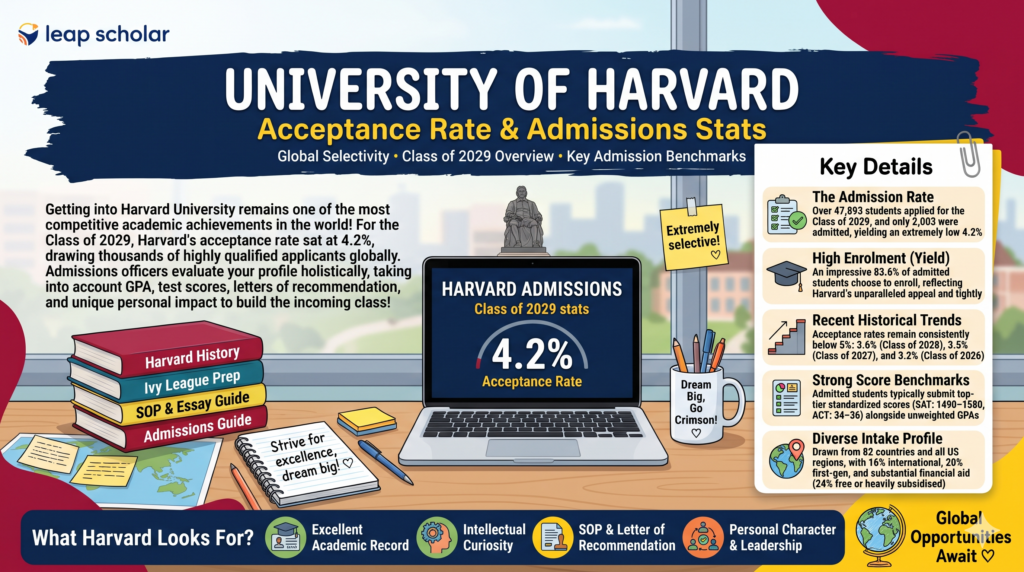
- University of Harvard acceptance rate for the Class of 2030 was about 3.7 percent.
- Harvard admitted 2,037 of 55,104 applicants, with no quota for Indians.
- The application fee is INR 8,901, or a waiver if needed.
- Harvard decides admission without looking at whether you need aid.
Is the University of Harvard acceptance rate a reason not to apply from India?
Harvard admitted 2,037 of 55,104 applicants for the Class of 2030, about 3.7 percent, so your worry is fair. If you are in Class 12 and want to study in the USA, Harvard is probably on your list, so first check whether applying is realistic.
The University of Harvard acceptance rate is the share of all applicants admitted from every country, so it isn’t your personal chance. It’s very hard, but a low number alone is no reason to skip Harvard. Harvard says the application and aid work the same way for every nationality, with no quotas, and everyone is read in one pool.

Choose your dream country
 UK
 USA
 Germany
 Australia
 Ireland
 Canada
 UAE
 France
 Sweden
 Italy
 Other
When do you want to study abroad?
What's your highest level of education?
Have you completed Class 12th?
What was your Class 12 CGPA/percentage?
Are you a student or a parent/guardian?
What do you want to study?
Select your current city
How Leap will help you

Personalised University Shortlist

Express Applications with Quicker Admits

End-to-End Application Support
This page explains the numbers; the route to join Harvard from India after Class 12 is covered on its own page.
What is the University of Harvard acceptance rate for the Class of 2030?
The University of Harvard acceptance rate for the Class of 2030 is about 3.7 percent: 2,037 admitted divided by 55,104 applicants. Harvard provides counts, not percentages, so the 3.7 percent is our calculation based on those counts.
Harvard's latest published data, on its official Admissions Statistics page, is the Class of 2030.
| What Harvard reports | Class of 2030 | What it means |
| Applicants | 55,104 | Everyone who applied |
| Admitted | 2,037 (this includes 103 admitted from the waiting list) | Students offered a place |
| Enrolling | 1,648 | Admitted students who joined |
| University of Harvard acceptance rate | About 3.7 percent | 2,037 divided by 55,104 |
| International share | 15 percent of the enrolled class | Counted by permanent address |
| First-generation share | 17 percent of the class | Parents did not go to college |
A waitlist is a list of applicants not admitted at first who may get a seat if admitted students decline. The 103 students Harvard took from the waitlist are already included in the 2,037, so the University of Harvard acceptance rate counts them only once, not twice. First-generation students are those whose parents did not go to college.
The 15 percent international figure goes by permanent address at the time of applying, not citizenship, so US citizens living abroad count too, and it describes who enrolled.
Fact-check (Nov 12, 2026): confirmed directly against Harvard's live Admissions Statistics page, which now shows "A Brief Profile of the Class of 2030" with Applicants 55,104, Admitted 2,037, Enrolling 1,648, Admitted from the waiting list 103, first-generation 17%, and International 15%, an exact match for every figure in the table above, including the 3.7 percent. A different 3.2%/57,800 figure circulating on some third-party sites does not match Harvard's own published data and should not be used.
My insight: Read the 3.7 percent as the share of all applicants who were admitted, not as your personal chance; it cannot tell you how your profile will be judged.
Is there a University of Harvard acceptance rate for Indian or international applicants?
Harvard reports that 15 percent of its enrolled class is international, but it gives no acceptance rate for India or any other country. So any India-specific University of Harvard acceptance rate you see online did not come from Harvard.
Restrictive Early Action is Harvard's early round: you apply by November 1 and hear by mid-December. Regular Decision is the main round, with a January 1 deadline.
- Shared: shares of the class by geography, intended field of study, and race or ethnicity.
- Not shared: a rate for India or any single country.
- Not shared: separate early and regular rates, because Harvard no longer releases data after each round.
The University of Harvard acceptance rate is a statistic for one pool with no country quotas, and it doesn't change with any one choice you make.
My insight: Use Harvard's silence on India as a reason to plan, not worry: build a list in which Harvard is one of several choices.
What does Harvard say it looks for in an application?
Harvard's apply page says there is no typical Harvard student and no ideal Harvard applicant. The University of Harvard acceptance rate tells you how many got in; this list tells you what they were judged on.
Its first-year applicants page says the Admissions Committee, the group that decides applications, considers:
- Academic accomplishment: how you have done in school.
- Contribution: what you could add to the Harvard community.
- Special talents: abilities that stand out.
- Life experience: perspectives formed by what you have lived through.
- Openness: willingness to engage respectfully with differing ideas.
- Use of resources: how well you would use what Harvard offers.
The list sets no minimum marks or class rank. Harvard may assign an interview with local alumni (Harvard graduates near you) at its discretion. You can't request one, and your application is complete without it.
For a closer look at how an Indian student's profile is weighed against this list, see LeapScholar's Q&A on what an Indian applicant's Harvard profile should look like.
What must an Indian applicant submit, and by when?
Every first-year applicant to Harvard submits the Common App, which is one online form many US colleges accept, plus Harvard's own short questions. Your documents, not the University of Harvard acceptance rate, are what you control.
| Item | What Harvard asks for |
| Common App | The main online application, open from August 1 |
| Harvard College Questions | Five short answers, up to 150 words each |
| Application fee | INR 8,901 (USD 95), or a fee waiver |
| School report | Counselor letter and transcript (your marks record) |
| Teacher recommendations | Two letters |
| Midyear report | School update after your first-semester grades |
| SAT or ACT | One score; other exam results only in exceptional cases |
| Restrictive Early Action (this cycle) | Deadline was November 1, 2026, and it was already closed for Fall 2027 entry |
| Regular Decision | Apply by January 1, 2027, the only deadline still open for Fall 2027 entry |
If you're reading this after November 1, Restrictive Early Action for this cycle is closed; Regular Decision (January 1) is your only route for Fall 2027 entry. The next REA window opens around November 1, 2027, for Fall 2028 entry.
Amounts are converted at 1 USD = INR 93.69 as of November 2026 and will shift with the exchange rate, so check the latest rate before budgeting.
A fee waiver means Harvard drops the fee when it is a hardship and you plan to apply for aid; asking won't count against you.
The SAT and the ACT are US college admissions tests, and Harvard requires one of them. In exceptional cases, Advanced Placement (AP), International Baccalaureate (IB), GCSE or A-Level, or national leaving exam results or predictions can meet it. TOEFL, IELTS, and Duolingo can't replace it, and first-year applicants need no English test.
- Harvard accepts either, so choose the ACT or the SAT by the one you score better on in practice.
- For the score range, see the Harvard SAT range and what it means for Indian applicants.
- Budget for SAT fees in India early, because non-US citizens at schools outside the US are not typically eligible for fee waivers.
- If you're unsure what counts as a good SAT score, check how scores compare before you book a retake.
My insight: Book the SAT or ACT before anything else, because a test date is the one item you can't finish at your desk; essays can be edited later.
Does Harvard give aid to Indian students, and does asking hurt your chances?
Harvard says it decides admission without regard to whether you applied for financial aid, even if you are a foreign citizen. This practice is called being need-blind, and Harvard is one of the need-blind universities, so asking for aid does not weaken your application.
All its aid is need-based. Demonstrated need is the gap between the cost and what Harvard calculates your family can pay, and Harvard says it meets it. Foreign students get no US federal funding but receive Harvard's own aid on the same basis, and 39 percent of the class attends tuition-free.
The table shows what Harvard says it covers for families with typical assets.
| Family situation | What Harvard says it covers |
| Income up to INR 93.7L (USD 100,000) a year | Free: aid covers all billed expenses |
| Income up to INR 1.87 crore (USD 200,000) a year | Free tuition, plus aid for other costs by circumstances |
| Income above INR 1.87 crore (USD 200,000) | Tailored aid for many families |
| Personal expenses | Students are expected to cover INR 3.28L (USD 3,500) a year |
These limits use average US living costs and taxes. So don't convert your salary and assume a result: run Harvard's Net Price Calculator. It is an online tool that estimates what your family would pay. No figure here is a promise for any family.
For colleges without Harvard's aid, the cost of studying in the USA can look very different, so compare before you apply.
My insight: If your income sits near a limit, trust the Net Price Calculator over any conversion.
Is there a University of Harvard acceptance rate for master's or MBA programs?
Harvard College, the undergraduate school these numbers describe, does not admit anyone who already holds a bachelor's or other first university degree. Harvard University has 12 graduate schools for study beyond the bachelor's degree.
The University of Harvard acceptance rate on this page covers first-year undergraduates only, so it gives no figure for a master's or MBA. If your goal is a Harvard MBA, funding works differently, and Harvard MBA scholarships are handled separately.
How should an Indian student build a college list around the University of Harvard acceptance rate?
Counselor advice, not Harvard data: with about 3.7 percent of applicants admitted, Harvard belongs on your list as a reach, a college where admission is unlikely for almost anyone. A low University of Harvard acceptance rate is why one application should never be your whole plan.
- Reach: admission is unlikely even for strong students. Treat Harvard as one of several reach choices and read about the other Ivy League schools before you finalize.
- Target: your marks and scores sit close to those of admitted students.
- Safety: admission is likely. Add target and safety colleges, including US universities with higher acceptance rates, so one decision does not carry your plan.
If you're also weighing Harvard's UK counterpart, this comparison helps:
- If you are also considering the UK, you can find a page on Oxford and Harvard for Indian students.
My insight: Put real effort into every college on your list, and apply to Harvard as one reach choice, not as the whole plan.
What if Harvard rejects, defers, or waitlists you?
Deferred means your early application moves to Regular Decision undecided, and you send a midyear report and transcript in February or when your grades are available. What each one means:
- Deferred: make sure your school sends the midyear report on time.
- Waitlisted: Harvard reports 103 admissions from its waiting list for the Class of 2030, inside the 2,037 total. That's a count, not a chance. Counselor advice: keep your other offers open while you wait.
- Rejected: counselor advice, not a Harvard rule: move your focus to the colleges on your list that you already applied to.
Once you have an offer from any US college, the next step is the F-1 student visa, which is a separate process.
This is general information, not admission or financial advice; Harvard College and the Common App are the sources of record, so check their pages before you apply. Talk it through with your school counselor, and if you want a LeapScholar perspective, also talk to a LeapScholar counselor.
3 Takeaways on the University of Harvard Acceptance Rate
- Read the University of Harvard acceptance rate as a pool statistic: about 3.7 percent of 55,104 applicants were admitted, and that can't predict your result.
- Apply on the same footing as everyone: no quotas and need-blind admission mean asking for aid is safe.
- Build a full list: apply to Harvard by January 1 as one reach, alongside target and safety colleges.
Talk to a Leap Scholar counselor to plan a balanced US college list around the University of Harvard acceptance rate.
Frequently Asked Questions About University of Harvard Acceptance Rate
-
Where does the University of Harvard acceptance rate stand right now?
The latest University of Harvard acceptance rate is about 3.7 percent for the Class of 2030. Harvard admitted 2,037 of 55,104 applicants, and the 3.7 percent is our arithmetic based on those counts. This rate describes the entire pool of applicants, not your individual chance of admission.
-
Is there a separate University of Harvard acceptance rate for international students?
Harvard does not publish one. It reports that 15 percent of the enrolled Class of 2030 is international, counted by permanent address rather than citizenship. Everyone applies through the same process in one pool, with no quotas for any country.
-
Does Harvard publish how many Indian students it admits?
Harvard's statistics page gives shares by geography, intended field of study, and race or ethnicity, but does not provide a figure for India or any single country. Treat any India-specific University of Harvard acceptance rate you find elsewhere with care, because Harvard did not publish it.
-
Can I find separate early and regular University of Harvard acceptance rates?
Harvard no longer releases data after each round. It shares admissions data once a year, in the October/November timeframe, beginning with the Class of 2029. So Restrictive Early Action and Regular Decision have no official separate acceptance rates that you can compare.
-
Does applying for financial aid lower my chances at Harvard?
Harvard says it decides admission without regard to whether you applied for aid, even as a foreign citizen. That is need-blind admission. All aid is need-based, Harvard meets each student's demonstrated need, and 39 percent of the class attends tuition-free.
-
Do I need the SAT or ACT for Harvard?
Harvard requires the SAT or ACT. In exceptional cases, AP, IB, GCSE, or A-Level, or national leaving exam results or predictions can meet the requirement. TOEFL, IELTS, and Duolingo cannot replace it, and first-year applicants need no English test at all.
-
Which marks or GPA does Harvard expect?
The criteria Harvard lists do not specify any minimum marks, GPA (grade point average), or class rank. It weighs academic accomplishment with your contribution, talents, life experience, and openness to differing ideas. The University of Harvard acceptance rate shows the pool is large, not which marks get in.
-
Is there a University of Harvard acceptance rate for an MBA or master's degree?
This page covers Harvard College, which is for first-year undergraduates and does not admit anyone who already holds a bachelor's degree. Harvard University has 12 graduate schools for study beyond the bachelor's degree, so the undergraduate University of Harvard acceptance rate does not apply.
-
Does Harvard accept CBSE, ISC, or IB students on an equal footing?
Harvard names no preferred secondary school board or curriculum. CBSE, ISC, state-board, and IB students are all evaluated in the context of what their school offered, so your board doesn't decide the outcome; your record within it does.
-
Is IELTS or TOEFL required for Indian applicants to Harvard?
Harvard requires no separate English test from first-year applicants of any nationality. The SAT or ACT is still mandatory, and TOEFL, IELTS, or Duolingo scores cannot substitute for it.











Have Questions? Get Guidance to reach your Dream University
Connect with India's finest counsellors and biggest study abroad community.
Get Guidance