
Quick Read
- UK living-cost funds rise on 30 November 2026: your application date decides the rate, not your CAS date.
- Canada asks one student for INR 15.58L in living funds before tuition.
- Australia’s Subclass 500 now asks most applicants already in Australia to apply from outside it.
- US applicants need a Form I-20 and a paid SEVIS fee.
Which Student Visa Application Documents Do You Need First?
Most countries sort documents for student visa applications into the same four groups, and each country’s official page is the final list. A student visa is the permission a country gives you to study there for longer than a visit allows. Worried you’ll forget one paper and lose your appointment slot? That’s a fair worry, and a simple system fixes it.
Compare the UK student visa steps with the F-1 visa route, which is the US student visa, and you’ll see the lists look different but follow one pattern. Proof of funds shows you, your family, or a lender can pay your costs while you study. Here are the four groups:

Choose your dream country
 UK
 USA
 Germany
 Australia
 Ireland
 Canada
 UAE
 France
 Sweden
 Italy
 Other
When do you want to study abroad?
What's your highest level of education?
Have you completed Class 12th?
What was your Class 12 CGPA/percentage?
Are you a student or a parent/guardian?
What do you want to study?
Select your current city
How Leap will help you

Personalised University Shortlist

Express Applications with Quicker Admits

End-to-End Application Support
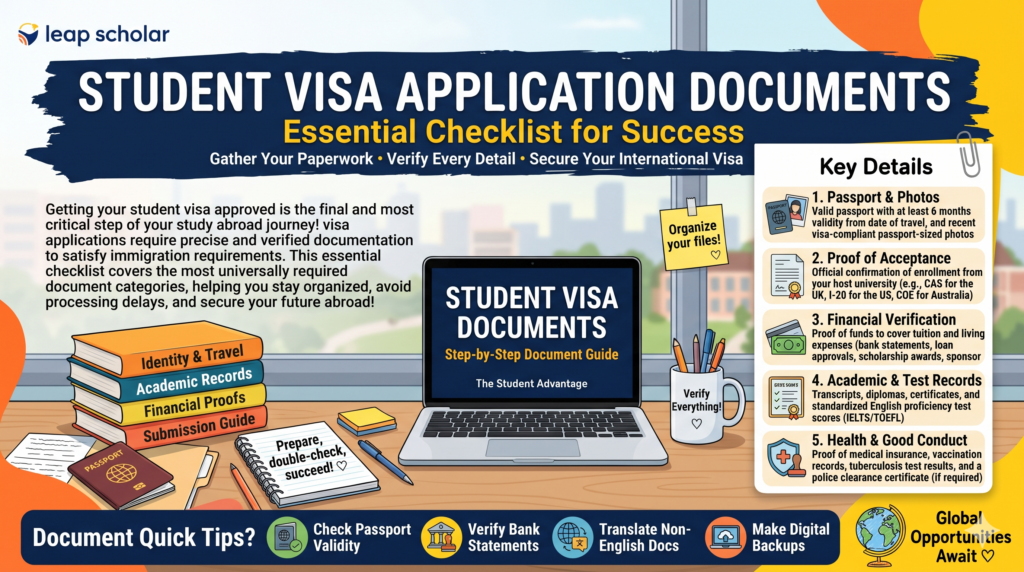
- Identity: a valid passport, with enough life left for your course.
- Admission: the offer or acceptance document your school gives you.
- Money: bank, loan, or sponsor proof that covers what the country asks.
- Health and character: a medical test or police certificate, only when the country asks.
Each country's official page is the final word, and a counselor can read your file against it before you submit your student visa application documents.
Student Visa Application Documents by Country: The Comparison Table
This table compares student visa application documents for 6 countries, one row each. Each row shows what the visa is called, the paper your school sends, the money you show or pay, and the extra paper to plan for.
| Country | Visa or permit | Admission paper | Money to show or pay | Extra paper to plan for |
| United Kingdom | Student visa | CAS (Confirmation of Acceptance for Studies) from your course provider | The CAS (Confirmation of Acceptance for Studies) from your course provider costs INR 13.29L (GBP 10,539) for 9 months outside London now, and this amount will rise to GBP 10,827 (INR 13.65L) for applications made on or after 30 Nov 2026. | ATAS or TB test if required |
| USA | F-1 student visa | Form I-20 from your school | I-901 SEVIS fee paid before the visa is issued | DS-160 confirmation page, social media set to public |
| Canada | Study permit | Letter of acceptance plus a provincial attestation letter | INR 15.58L (CAD 23,448) for one student | Letter of explanation (recommended), biometrics |
| Australia | Student visa (Subclass 500) | Confirmation of Enrollment (CoE) | INR 19.46L (AUD 29,710) a year for living costs, on top of tuition and travel | Genuine Student statement, OSHC health cover; most new applicants apply from outside Australia from 2 Oct 2026 |
| Germany | National visa for study | Admission letter | INR 12.54L (EUR 11,904) in a blocked account | APS certificate, German or English language proof |
| Ireland | Long Stay D visa for courses over 90 days | Letter of enrollment | Course fees paid | Registration after arrival if you stay over 90 days |
Converted as of November 2026: 1 GBP = INR 126.08, 1 CAD = INR 66.45, 1 AUD = approximately INR 65.50, and 1 EUR = INR 105.33 (ECB-based, 10 Nov 2026); AUD is a market-rate approximation, not ECB. Rates will shift, so check the latest rate before you pay.
What does this conversion mean for you? Start with the money proof, because it takes the longest. The UK wants funds held for 28 days in a row, Canada accepts bank statements covering the past 6 months, and Germany wants money locked in a German bank account before you apply.
My insight: Build one folder per country in the order its official page lists documents, and put the money proof on top, because it's the paper that needs the most lead time.
UK Student Visa Application Documents
The UK Student visa is for you if a licensed student sponsor has offered you a place. You also need enough money to support yourself and pay for your course. Your course provider issues the CAS letter, which is the Confirmation of Acceptance for Studies. It's the reference you need before you apply. Then gather these:
- Passport: a current passport or other valid travel document.
- Monthly money: INR 1.48L (GBP 1,171) a month outside London, or INR 1.93L (GBP 1,529) in London, for up to 9 months.
- Holding period: the money must stay in your account for at least 28 days in a row, ending within 31 days of your application.
- Course fee: enough money to pay for 1 academic year (up to 9 months) of your course; the amount is on your CAS.
- Only if they apply to you: an ATAS certificate, which is the approval the UK asks for when your course and nationality need it; a TB test, which is a tuberculosis screening result; and written consent from a financial sponsor who funded you in the past 12 months.
- Fee and time: INR 70,350 (GBP 558) from outside the UK, with a decision usually within 3 weeks.
Rate change from 30 November 2026: the monthly living cost amount is going up. If you apply on or after 30 November 2026, you need GBP 1,203 a month outside London or GBP 1,570 a month in London: about GBP 10,827 (~INR 13.65L) or GBP 14,130 (INR 17.82L) for a 9-month course. If you apply before 30 November 2026, the lower GBP 1,171 / GBP 1,529 rates still apply, even if your CAS was issued under the new rules. What decides your rate is your application date, not your CAS date or your course start date, so fix your intended application date before you start the 28-day holding period. This change comes from the Statement of Changes to the Immigration Rules (HC 584).
Fees change from time to time, so compare the UK student visa fees before you pay.
USA Student Visa Application Documents
Get your Form I-20 first, because every other US step depends on it. The F-1 visa covers full-time study, and the US paperwork runs in a fixed order:
- Form I-20: the Form I-20 is the form your school issues, and it carries your SEVIS ID and the school code.
- SEVIS: SEVIS stands for Student and Exchange Visitor Information System, and your SEVIS ID is the number printed on your Form I-20.
- I-901 fee: the I-901 is the SEVIS fee payment, and you must pay it before the visa can be issued.
- DS-160: the DS-160 is the online visa application; complete the DS-160 form when you book your appointment, and keep its confirmation page.
- Social media: the embassy asks F visa applicants to set their social media accounts to public.
For anything beyond this list, follow the US Embassy India visa page, which is the final word.
Canada Student Visa Application Documents
A study permit is the document that lets you study in Canada, and you apply for it with the papers below. Ask your school about the attestation letter early, as it usually comes only after you accept the offer and pay part or all of your tuition.
- Letter of acceptance (LOA): The LOA is the offer letter from your school, and post-secondary schools are asked to validate it.
- PAL or TAL: PAL stands for provincial attestation letter and TAL for territorial attestation letter; you need one in most cases. If you're studying in Quebec, you need a CAQ, which is the Quebec Acceptance Certificate.
- Identity: a copy of your passport information page and 2 recent passport-size photos with your name and date of birth on the back.
- Proof of funds: INR 15.58L (CAD 23,448) for one student for applications made on or after 1 September 2026, not counting tuition and travel. Bank statements for the past 6 months, a GIC (an investment certificate from a Canadian financial institution) or an education loan letter can count; read up on the GIC amount before you buy one.
- Letter of explanation: recommended; it's a short SOP (statement of purpose) on why you chose this course, and a Canada SOP sample shows the format.
- Also, you may need a medical exam or police certificate, but only if asked, and you will need to provide biometrics, which include your fingerprints and photo, for most applicants. The study permit fee is INR 9,970 (CAD 150).
See the IRCC document checklist and IRCC's proof-of-funds page for the full, personalized list.
Australia Student Visa Application Documents (Subclass 500)
For Australia, you apply for the Student visa (Subclass 500) through the Department of Home Affairs' ImmiAccount, using the official Subclass 500 page as your checklist. One recent change matters before you start: from 2 October 2026, most people who hold a visitor, working holiday, or certain other temporary visa can no longer lodge a Subclass 500 application while they are inside Australia, and most new applicants can no longer add a partner or child to the visa after it has been granted. If you are applying for your first student visa from India, you are already applying from outside Australia, so this particular rule mainly affects students already in Australia on a different visa who want to switch. Confirm your own situation on the official change page before you enroll or pay a deposit.
Gather these before you start your ImmiAccount application:
- Confirmation of Enrolment (CoE): issued by your education provider once you accept your offer and it's registered on CRICOS, Australia's register of courses for overseas students.
- Genuine Student statement: a written answer, with supporting evidence, on why you chose this course, the provider, and Australia, and what you plan to do after you finish. This requirement replaced the older Genuine Temporary Entrant test.
- Financial capacity: evidence of at least AUD 29,710 a year (about INR 19.46L) for living costs, separate from tuition and return travel; add AUD 10,394 for an accompanying partner and AUD 4,449 for each accompanying child.
- Overseas Student Health Cover (OSHC): health insurance for the whole length of your visa, arranged before you apply.
- You will also need to provide English language evidence and, for some nationalities or courses, a health examination.
- Visa application charge: about AUD 2,000 (INR 1.31L) for the main applicant. This fee has changed more than once in 2026, so check the current amount on the official page before you pay.
- Passport and, if you're under 18, evidence of your guardianship or accommodation arrangements in Australia.
My insight: the October 2026 onshore-application rule rarely affects a first-time applicant from India, since you're already applying from outside Australia. It matters most if you're already in Australia on a visitor, working holiday, or graduate visa and want to switch into the Subclass 500.
Germany Student Visa Application Documents
Germany's student route is a national visa for study. You apply through the Consular Service Portal, which is the online system that opens with a questionnaire. Answer it carefully: your answers must match your real situation, or you'll be asked to delete the process and start again.
- Passport: issued within the last 10 years, with at least 2 empty pages.
- School and degree papers: Class 12 and Class 10 mark sheets for a bachelor's or preparatory course; your previous degree and semester mark sheets for a master's or PhD.
- Language proof: a recognized German or English certificate; Duolingo, Pearson PTE, and TOEFL home edition tests aren't recognized for applications in India.
- APS certificate: the APS certificate is the Akademische Prüfstelle certificate that applicants with Indian school or degree records almost always need, unless an exemption applies, such as PhD study or a stipend from EU or German public funds.
- Money: a blocked account, which is a German bank account that releases your money monthly, holding INR 12.54L (EUR 11,904) for the first year, with at most INR 1.04L (EUR 992) withdrawn a month. A sponsor's formal declaration, a German or EU scholarship or stipend, or an education loan, can take its place.
- Also: your admission letter, a letter on why you want to study, a CV in table form, and a health insurance certificate.
One caution: a full set of papers doesn't by itself secure the visa, and incomplete papers or skipping an interview can lead to a refusal.
Source: German Missions in India, student visa checklist.
Ireland Student Visa Application Documents
Ireland asks a student from outside the European Economic Area (the EEA, which does not include India) for a letter of enrollment from the college and proof that the fees are paid. If your course runs over 90 days, you need a Long Stay D visa, which is the long-stay entry visa for study; for a shorter course, it's a Short Stay C visa.
- After you arrive: register with immigration if you stay over 90 days.
- Online form: the official site has a step-by-step guide to the online visa application, and the Ireland visa guide walks through it too.
- Police certificate: if the visa office asks for a police certificate, request it early.
For anything beyond this list, follow the Irish Immigration study pages, which are the final word.
Student Visa Application Documents Indian Families Should Start Early
Start these 5 papers early, because they come from your parents, your bank, or your old college, not the university. Which ones take longest?
- Sponsor money proof: if a parent pays, Canada asks for a letter from that person with your relationship, their dependents, and the amount, plus their ID; Germany accepts a sponsor's formal declaration.
- Study plan letter: Canada recommends a letter of explanation and Germany asks for a letter on why you want to study; your statement of purpose can be the base for both.
- Mark sheets: Germany asks for Class 10 and 12 mark sheets or degree records, so request your mark sheets and transcripts from your college early.
- Gap papers: if you took a break between studies, keep your gap certificate with your other papers.
- Loan letter: Canada accepts proof of a student or education loan from a bank, and Germany lists a loan as funding proof, so compare education loan options before you ask for a sanction letter.
Put a copy of each one in your country folder the day it arrives, so your student visa application documents grow in one place.
Student Visa Application Documents: What Paperwork Help Is Realistic?
The best paperwork test is simple: ask any helper to show you the official page for each paper they request, whatever city you live in. A study abroad consultant can read your student visa application documents against the official list, spot mismatches, and tell you what's missing.
What a helper can't do matters just as much. No one can change what an official page asks for, and only the visa office decides your visa. Germany's portal wants answers that match your real situation, and Canada asks post-secondary schools to validate your letter of acceptance, so nobody can shortcut those steps.
A good paperwork check covers:
- The official list: every paper on your country's page, in the order the page gives.
- Matching details: names, dates, and amounts that match across passport, admission paper, and money proof.
- Money timing: the age of your bank statements and any holding period, such as the UK's 28 days.
- Copies and translations: originals, copies, and any translation the official page asks for.
Weigh the reasons to use a counselor before you pay anyone, and go in with a short list of questions worth asking any study abroad consultant so you can tell a genuine document check from a sales pitch.
My insight: Choose a helper who points you to the official page for each document, not one who tells you a requirement can be skipped.
What If Your Student Visa Application Documents Fall Short?
Fix the gap first, then resubmit, because one missing paper slows every step after it. Here's what the official pages say happens and what you can do next:
- Paper missing or late: Canada can't finalize your permit until your application is complete, and waiting to send papers causes delays.
- School letter not validated: if your school doesn't respond by the deadline, Canada returns the application and refunds the processing fee; ask the school to validate the letter before you apply again.
- Wrong portal answers: Germany asks you to delete the process and start again because the visa subtype can't be changed.
- Refusal: read the reasons first, then talk to your university's international office and your counselor. For the US, read the 214(b) refusal reasons before you reapply; for Ireland, the Ireland refusal reasons show which document gaps cause trouble.
Reapply only after you've closed the exact gap named in the refusal, and recheck all your student visa application documents first.
3 Takeaways on Student Visa Application Documents
- Start with money proof: the UK wants INR 13.29L held for 28 days outside London (rising to INR 13.65L for applications from 30 Nov 2026), Canada wants INR 15.58L, Australia wants INR 19.46L, and Germany wants INR 12.54L in a blocked account.
- Work from the official page: build one folder per country in the order its page lists documents.
- Check every name and amount before you upload: one wrong portal answer in Germany sends you back to the start.
Talk to a Leap Scholar counselor to review your student visa application documents against your country's official list.
Frequently Asked Questions About Student Visa Application Documents
-
What student visa application documents do I need?
Plan for four groups: a valid passport, the admission paper your school issues, proof that you can pay your costs, and country extras such as a TB test for the UK or an APS certificate for Germany. Each country's official page is the final list, so follow its order.
-
How much money must I show for my student visa application documents?
For the UK, show INR 1.48L a month outside London for up to 9 months, about INR 13.29L, plus the course fee for 1 academic year shown on your CAS. This rises to about INR 13.65L for applications made on or after 30 November 2026. Canada asks for INR 15.58L for one student before tuition. Australia asks for about INR 19.46L a year. Germany asks for INR 12.54L in a blocked account.
-
Can a consultant prepare my student visa application documents?
A consultant can check and organize your papers against the official list and spot names or amounts that don't match. They can't change what a country requires or decide your visa, so ask them to show the official page behind every paper they request from you.
-
Do visa offices accept scanned or translated copies, or do I need the originals?
Most online portals, including the UK, Canada, and Germany's Consular Service Portal, want clear color scans at the upload stage, but you should carry original documents to your biometric appointment or interview for verification. Any document not in English, French, or German requires a certified translation for that country, not a plain translation you do yourself.
-
How early should I start collecting student visa application documents?
Begin with the slowest papers. UK funds must sit in your account for 28 days in a row, Canada's attestation letter usually comes only after you accept your offer and pay some tuition, and Germany's APS certificate is one of the papers you upload, so start it early.
-
What happens if a paper is missing from my file?
Canada can't finalize a permit until the application is complete, and late papers cause delays. In Germany, wrong portal answers mean deleting the process and starting again. If you're refused, close the exact gap in the refusal before you reapply with your student visa application documents.
-
Which student visa application documents are different for Germany?
Germany adds four items most countries skip: an APS certificate that applicants with Indian records almost always need, a blocked account of INR 12.54L, a portal questionnaire that must match your situation, and strict language rules, since Duolingo, Pearson PTE, and TOEFL home edition tests aren't recognized in India.
-
Do I need an SOP for my student visa application documents?
It depends on the country. Canada recommends a letter of explanation, and Germany lists a letter on your intention to study; for any other country, follow its official list. Your statement of purpose for admission is a good base for either letter, but tailor it to the visa.











Have Questions? Get Guidance to reach your Dream University
Connect with India's finest counsellors and biggest study abroad community.
Get Guidance