
Quick Read
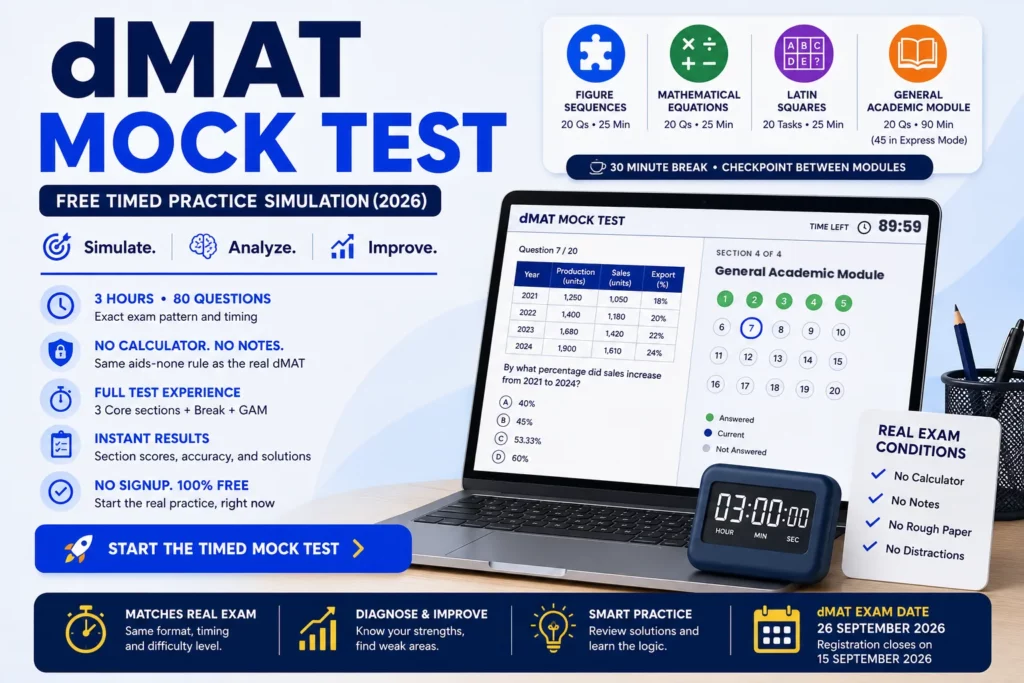
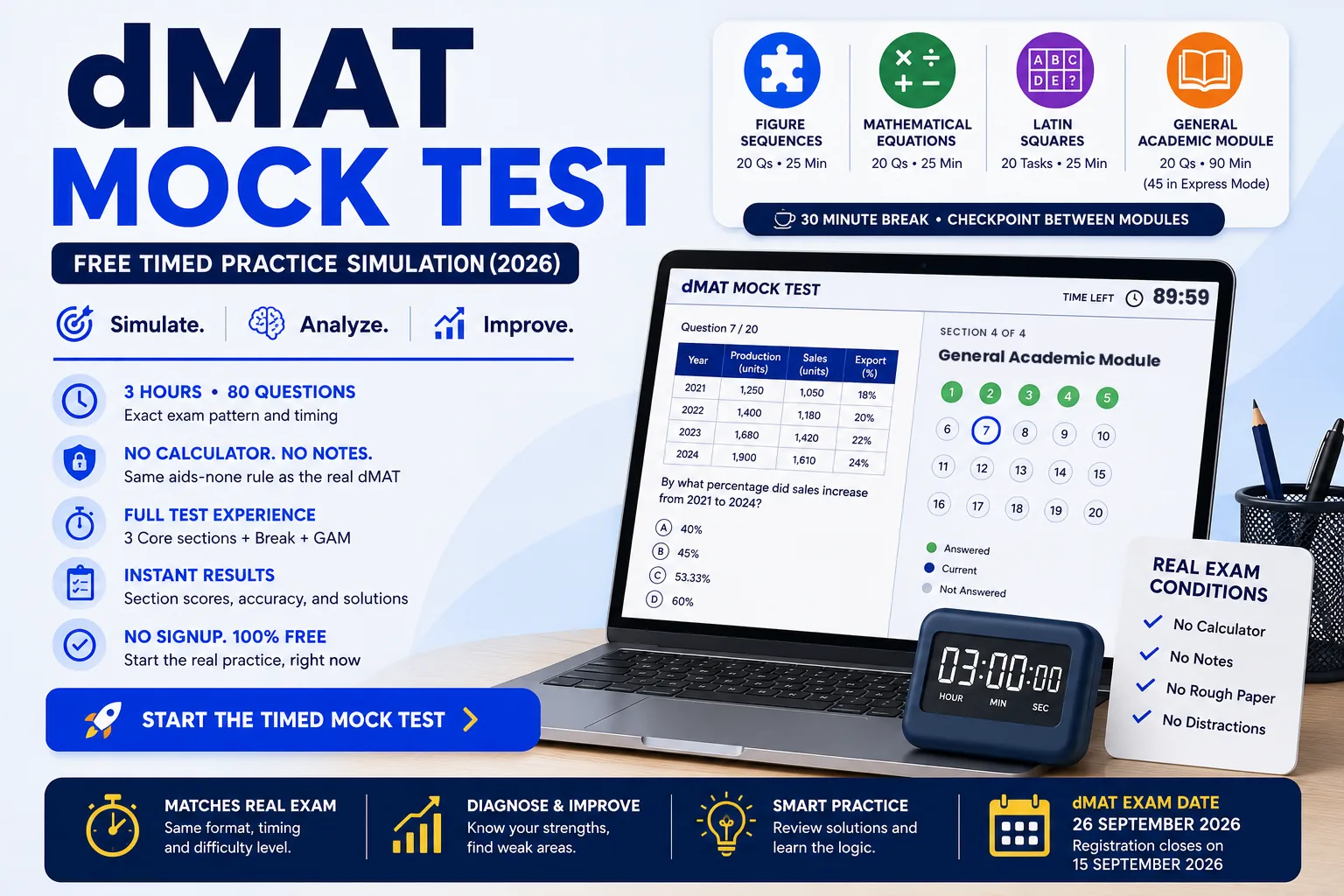
- Free timed simulation of the real dMAT: 80 original questions across all four sections, with instant section scores and full solutions
- Matches official timing exactly: three 25-minute Core Module sections, a break checkpoint, then a 90-minute General Academic Module (45 in Express mode)
- No calculator, notes, or rough paper; same aids-none rule as the real exam, enforced by the player
- Before you start: block 3 hours, sit in one continuous run, phone on silent; the conditions are part of the test, not optional
- Press start below, then review by section split, error type, and time used, not just your raw score
What This Free dMAT Mock Test Covers
There are no dMAT past papers and no official full-length mock, so a format-accurate simulation is the closest you can get to test day before test day. This dMAT mock test rebuilds the structure of the real digital exam: three timed Core Module sections, a break checkpoint, and the General Academic Module, with 80 original questions whose answers have all been independently verified.
Every question follows the official formats described in the full dMAT exam pattern, and the whole run works on your phone with no signup.
| Feature | This mock test | Real dMAT |
|---|---|---|
| Figure Sequences | 20 questions, 25 minutes | 20 questions, 25 minutes |
| Mathematical Equations | 20 questions, 25 minutes | 20 questions, 25 minutes |
| Latin Squares | 20 tasks, 25 minutes | 20 tasks, 25 minutes |
| Second part | General Academic Module, 20 questions, 90 minutes (45 in Express mode) | Subject module or General Academic Module, 90 minutes |
| Break | Checkpoint between the two parts | 30-minute break between the two parts |
| Aids | None. No calculator, no notes | None. No calculator, no notes |
| Result | Raw score per section, instant solutions | Standardised score and percentile |
One honest difference: the real exam reports a standardized score and percentile, while a dMAT mock test can only give you a raw mark. That is fine, because the mock’s job is diagnosis, not prediction. If you want the questions section by section first, start at the dMAT practice test hub and come back here for the full rehearsal.
How to Take This dMAT Mock Test Like the Real Exam
A dMAT mock test only transfers to test day if the conditions match. Run through this checklist before you press start:
| Condition | Set it up like this |
|---|---|
| Aids | No calculator, no rough paper, no second tab. Mental arithmetic only |
| Sitting | One continuous run. Sections cannot be paused |
| Break | Stand up at the break checkpoint, five minutes minimum |
| Time of day | At least one mock in the afternoon, when the real second half lands |
| Device | Once on your phone is fine; your final mock should be on a laptop |
| Environment | Phone on silent, door closed, 3 hours blocked in your calendar |
Take the dMAT Mock Test Online
Press start, pick Full or Express mode, and the first 25-minute section of the dMAT mock test begins. Each section is timed separately and submits itself when time runs out, exactly like the real thing.
Free dMAT Mock Test: Timed Full Simulation
The real exam structure: three timed Core Module sections, then the General Academic Module. 80 original questions with verified solutions. No signup, works on your phone.
| Section | QuestionsQs | Time |
|---|---|---|
| 1. Figure Sequences | 20 | 25 minutes25 min |
| 2. Mathematical Equations | 20 | 25 minutes25 min |
| 3. Latin Squares | 20 | 25 minutes25 min |
| 4. General Academic Module | 20 | 90 minutes (45 in Express mode)90 min (45 Express) |
Full mock
Real exam timing, about 2 hours 45 minutes of test time. Best in your final two weeks.
Real timing, ~2 h 45 m
Express
Same questions, General Academic Module shortened to 45 minutes. About 2 hours.
Shorter GAM, ~2 h
Exam rules and how the timer works
Rules, exactly like the real dMAT: no calculator, no notes, answer on screen only. Each section is timed separately and submits itself when time runs out. Keep this tab open; refreshing the page restarts the mock. In the real exam a 30-minute break follows the Core Module, and this simulation pauses there too. The only difference between the two modes is section 4: the General Academic Module runs 90 minutes in the Full mock and 45 minutes in Express.
How to Review Your dMAT Mock Test Score
The score itself is the least useful part of your result. The review is where a dMAT mock test earns its time. Work through three layers:
Layer 1: the section split. Your four section scores tell you where the next fortnight goes. A weak first section sends you to dMAT Figure Sequences practice; a weak third section means the elimination method in dMAT Latin Squares needs drilling.
Layer 2: the error type. Read the solution path for every wrong answer and name the mechanism. In the General Academic Module the four traps are the wrong percentage base, averaged averages, extrapolation beyond the data, and answering from knowledge instead of the input. In the Core Module it is usually a missed bounce, a lost candidate pair, or a substitution in the wrong order.
Layer 3: the clock. The player shows time used per section. Finishing Latin Squares with eight minutes to spare while missing six questions means you are rushing; running out of time in Mathematical Equations with high accuracy means you need pacing drills, not more theory.
Remember that the real exam is not pass or fail: your standardized score appears on the APS certificate, and each university weighs it in its own admission process, as explained in our guide to dMAT and APS certification.
dMAT Mock Test Strategy for Each Section
Use these pacing targets in the dMAT mock test, and carry them unchanged into the real sitting.
Figure Sequences (target: 75 seconds per question). Identify each figure’s rule separately before looking at the options. If two figures move, check the options against the figure you are most confident about first and eliminate.
Mathematical Equations (target: 75 seconds per question). Find the anchor equation, the one with a single unknown or a direct value, and substitute outward from it. If no anchor exists, express every variable in terms of one letter and collapse.
Latin Squares (target: 75 seconds per task). Read the cross first: the row and column meeting at the question mark. Four visible letters end the task immediately. Two candidates mean one forced neighbor away.
General Academic Module (target: 4 minutes per question). Read the questions before the input so you know which numbers matter. Anchor every percentage to its base, and pick only the conclusions that the data forces.
Section pacing is trainable in isolation, and the dMAT General Academic Module page includes the full input-reading method and 15 additional questions.
dMAT Mock Test Plan Before 26 September 2026
The dMAT is on 26 September 2026, and registration closes on 15 September.
Confirm your slot against the dMAT exam dates and registration deadline, then book your mocks.
| Weeks before test | Mock test action |
|---|---|
| 6 | Full mock baseline. Record section scores and time used |
| 5 to 3 | No mocks. Section drilling on your two weakest areas |
| 2 | Full mock at 2 pm. Compare every section against the baseline |
| 1 | Final Full mock, laptop, exam-day conditions end-to-end |
| Test week | Short daily warm-ups only. Nothing new after Wednesday |
Frequently Asked Questions About the dMAT Mock Test
Where can I take a free dMAT mock test?
The timed simulation on this page is free, requires no signup, and runs in the browser on any device. It mirrors the official structure: three 25-minute Core Module sections and a 90-minute General Academic Module, with instant scoring and a worked solution for all 80 questions.
Are there official dMAT mock tests or past papers?
The TestDaF Institute publishes preparatory PDFs and instructional videos on d-mat.de with solved sample tasks, but no full-length timed mock and no past papers, since exam content is confidential. Format-accurate original simulations like this one are the realistic substitute, used alongside the official materials.
How many mock tests should I take before the dMAT?
Two to three full sittings serve almost everyone: a baseline about six weeks out, a progress check two weeks out, and a final rehearsal in test week. Improvement comes from reviewing errors between mocks, so more than four sittings usually crowds out the review that actually moves scores.
How long does a full dMAT mock test take?
The full mode runs about 2 hours 45 minutes of test time: three 25-minute Core sections plus 90 minutes for the General Academic Module, with a break checkpoint in between. The real exam day totals about three and a half hours including its 30-minute break, so block an afternoon.
What is a good score on a dMAT mock test?
There is no published pass mark because the real dMAT reports a standardized score and percentile rather than a raw total. As a working rule, clearing 70% in every section with time to spare means your preparation is on track; any section below 50% deserves a dedicated week of drilling.
Can I take the dMAT mock test on my phone?
The simulation is built mobile-first: options are tap-sized, matrices scale to the screen, and the timer stays visible. One practical tip: sit your final mock on a laptop or desktop, since the real exam is taken on a computer at a test centre.
Is the real dMAT harder than a mock test?
The question formats and timing here match the official preparatory materials, so difficulty per question is comparable. What usually feels harder on test day is the environment: exam-centre nerves, the identity checks, and the long sitting. That is precisely why full-length rehearsal under strict conditions matters more than extra question volume.
When should I take my first dMAT mock test?
Take your first dMAT mock test after one to two weeks of section-level practice, not on day one. A mock before you know the three Core formats measures unfamiliarity rather than ability. Learn the formats first on the practice pages, then use your first full sitting to set an honest baseline.







Have Questions? Get Guidance to reach your Dream University
Connect with India's finest counsellors and biggest study abroad community.
Get Guidance