Every question has a set of 7 rules: colour change, rotation, movement, the x+1 step-growth rule, no vanishing/overlap, bounce at borders, or slide along borders
To solve: isolate one figure at a time, confirm its rule across all four matrices, then project and match
No notes, rough paper, or calculator is allowed, all rule-tracking happens mentally
Attempt 15 free practice questions below, then open the solution path only after you’ve committed to an answer
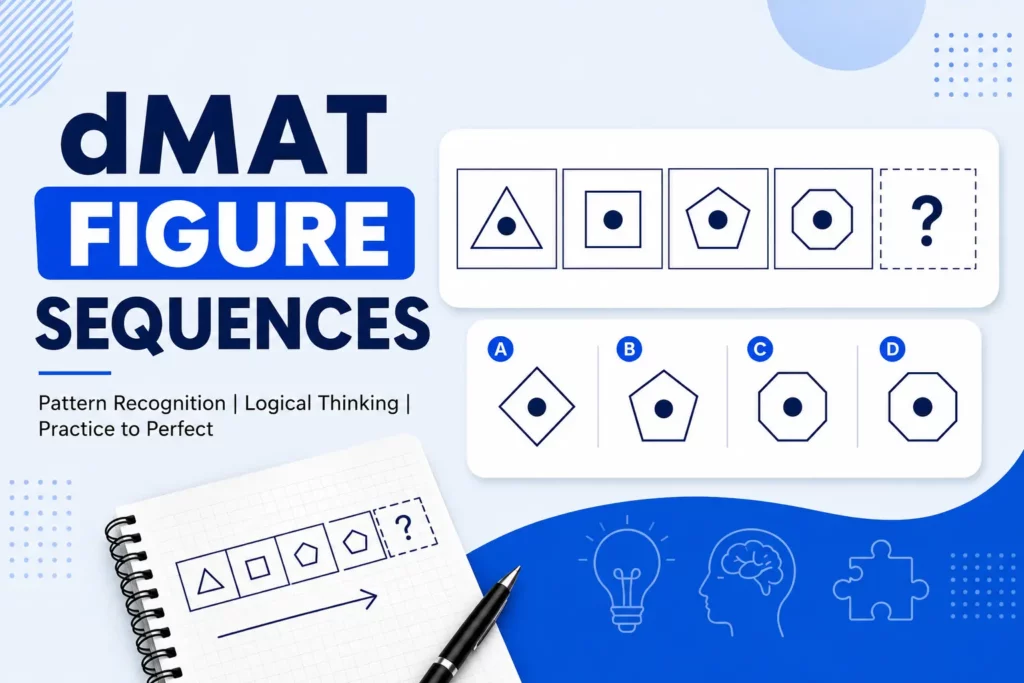
Figure Sequences is the first subtest of the dMAT Core Module, which every test taker sits for regardless of background. You see a series of four matrices in which small figures change position, colour or orientation according to fixed rules, and you select what the next matrix looks like. According to the official preparatory materials, you get 20 questions in 25 minutes, which works out to 75 seconds per question.
The subtest measures pattern recognition, not knowledge, so there is no syllabus to memorize. You can learn the limited set of rules the figures follow and train your speed on them.
The 7 Rules Behind Every dMAT Figure Sequences Question
The official materials define a closed set of behaviors. Every dMAT Figure Sequences question, from the easiest to the hardest, combines some of these seven rules.
A figure alternates or cycles colours from one matrix to the next
2
Rotation
A figure rotates around its own axis, typically 90 degrees per step
3
Movement
Vertical, horizontal or diagonal steps; a figure never switches from a diagonal to a different movement type mid-series
4
The x + 1 rule
The step size grows: 1 step, then 2, then 3, and so on
5
No vanishing, no overlap
Figures never disappear and never share a cell
6
Bounce at boundaries
At the matrix edge, a figure can bounce back the way it came
7
Slide along boundaries
Or it can keep moving along the outer border, clockwise or counter-clockwise
Difficulty comes from stacking: an easy question uses one figure and one rule; a hard question can run three figures with different rules at the same time, including the x + 1 rule combined with border movement.
dMAT Figure Sequences Practice Questions with Answers(Free)
There are no dMAT past papers, so format-accurate practice is the only realistic preparation. The 15 original questions below mirror the official preparatory materials: the same matrix format, the same seven rules, and the same difficulty ladder of low, medium, and high. Attempt each question first, then open the solution path to compare your reasoning.
Question 1 Low
Look at the series below. The figures change by fixed rules from one matrix to the next. Choose the matrix that comes next.
●
●
●
●
?
●
A
●
B
●
C
✦View Solution PathHide Solution Path▼
Answer: B. The blue circle moves one field to the right in row 2 each time. At the right boundary it cannot leave the matrix, so it bounces off and moves one field back to the left, landing on column 3.
Question 2 Low
Look at the series below. The figures change by fixed rules from one matrix to the next. Choose the matrix that comes next.
■
■
■
■
?
■
A
■
B
■
C
✦View Solution PathHide Solution Path▼
Answer: C. The green square moves one field down in column 3 each time. At the bottom boundary it bounces off and moves back up one field, to row 3.
Question 3 Low
Look at the series below. The figures change by fixed rules from one matrix to the next. Choose the matrix that comes next.
▲
▲
▲
▲
?
▲
A
▲
B
▲
C
✦View Solution PathHide Solution Path▼
Answer: A. The triangle moves diagonally down and to the right. At the corner it bounces and returns along the same diagonal, so the next position is row 3, column 3.
Question 4 Low
Look at the series below. The figures change by fixed rules from one matrix to the next. Choose the matrix that comes next.
◆
◆
◆
◆
?
◆
A
◆
B
◆
C
✦View Solution PathHide Solution Path▼
Answer: C. The diamond moves one field to the left in row 3 each time. At the left boundary it bounces off and moves one field back to the right, to column 2.
Question 5 Low
Look at the series below. The figures change by fixed rules from one matrix to the next. Choose the matrix that comes next.
●
●
●
●
?
●
A
●
B
●
C
✦View Solution PathHide Solution Path▼
Answer: B. The circle moves one field up in column 2 each time. At the top boundary it bounces off and moves one field back down, to row 2.
Question 6 Medium
Two figures, two rules. Choose the matrix that comes next.
★
■
★
■
★
■
★
■
?
★
■
A
★
■
B
★
■
C
✦View Solution PathHide Solution Path▼
Answer: B. The star moves right along the top row and bounces off the right boundary, back to column 3. The square stays in place but alternates its colour blue, red, blue, red, so next it is blue again. One distractor shows the right position but the wrong colour.
Question 7 Medium
Watch the orientation of the arrow. Choose the matrix that comes next.
▶
▼
◀
▲
?
▼
A
▲
B
▶
C
✦View Solution PathHide Solution Path▼
Answer: C. The arrow does not move. It rotates 90 degrees clockwise from matrix to matrix: right, down, left, up. After up, the rotation continues to the right again.
Question 8 Medium
The figure moves along the outer border. Choose the matrix that comes next.
●
●
●
●
?
●
A
●
B
●
C
✦View Solution PathHide Solution Path▼
Answer: A. The circle slides along the outer border clockwise by one field at a time. From row 2, column 4 it continues down the right edge to row 3, column 4.
Question 9 Medium
Two figures, two rules. Choose the matrix that comes next.
▲
■
▲
■
■
▲
■
▲
?
■
▲
A
■
▲
B
■
▲
C
✦View Solution PathHide Solution Path▼
Answer: C. The triangle moves down column 1 and the square moves up column 4, one field each. Both reach a boundary in the fourth matrix, so both bounce: the triangle back up to row 3, the square back down to row 2.
Question 10 Medium
Watch the position and the colour. Choose the matrix that comes next.
●
●
●
●
?
●
A
●
B
●
C
✦View Solution PathHide Solution Path▼
Answer: B. The circle moves one field right along row 4 and bounces off the right boundary, back to column 3. Its colour cycles blue, green, red, blue, so the next colour is green. One distractor has the right position but repeats red.
Question 11 High
The diamond moves along the outer border. Choose the matrix that comes next.
◆
◆
◆
◆
?
◆
A
◆
B
◆
C
✦View Solution PathHide Solution Path▼
Answer: B. This is the x + 1 rule combined with border movement. The diamond travels clockwise 1 step, then 2, then 3. The next move is 4 steps: from row 3, column 4 it goes down to the corner, then 3 fields left along the bottom row, landing on row 4, column 1.
Question 12 High
The step size changes. Choose the matrix that comes next.
★
★
★
★
?
★
A
★
B
★
C
✦View Solution PathHide Solution Path▼
Answer: C. The x + 1 rule with a bounce: the star moves right along row 1 by 1 step, then 2 steps. The third move is 3 steps: one step to the boundary is impossible, so it travels column 4 to 3 to 2 to 1 after bouncing, ending at column 1. The fourth move is 4 steps to the right: columns 2, 3, 4, then bounce back to column 3.
Question 13 High
Three figures, three rules. Choose the matrix that comes next.
●
▲
■
●
▲
■
●
▲
■
●
▲
■
?
●
▲
■
A
●
▲
■
B
●
▲
■
C
✦View Solution PathHide Solution Path▼
Answer: A. The circle slides counter-clockwise along the border: left along the top row, then down the left edge to row 2, column 1. The triangle stays in place and alternates yellow and green, so next it is yellow. The square moves right along row 4 and bounces: columns 2, 3, 4, 3, and next 2.
Question 14 High
The arrow moves and rotates. Choose the matrix that comes next.
▶
▼
◀
▲
?
▲
A
▶
B
▶
C
✦View Solution PathHide Solution Path▼
Answer: C. Two rules at once. Position: the arrow moves one field down column 3 and bounces off the bottom boundary, back up to row 3. Orientation: it rotates 90 degrees clockwise each time, and after up comes right. So the next matrix shows a right-pointing arrow at row 3, column 3.
Question 15 High
Watch the position and the colour. Choose the matrix that comes next.
◆
◆
◆
◆
?
◆
A
◆
B
◆
C
✦View Solution PathHide Solution Path▼
Answer: B. The diamond moves diagonally down-right and bounces at the corner, so the next position is row 3, column 3. The second rule: each time the figure touches a boundary, it changes colour. It touches the corner in matrix 4, so it returns red, not blue. The distractor in blue ignores the colour rule.
How to Solve dMAT Figure Sequences in 75 Seconds
Isolate one figure at a time. Never read the whole matrix at once. Pick one figure and name its rule out loud in your head: “Circle, right one step, bounces.”
Confirm on matrices 3 and 4. A rule guessed from two frames is a hypothesis; a rule confirmed on four frames is an answer.
Project, then match. Work out the next position, colour and orientation before looking at the options so the distractors cannot anchor you.
Decide in 75 seconds, then move. If two options differ, the difference is usually colour or orientation, so check those last and pick.
Since the exam allows no aids, your checklist for test day is short:
Exam-day rule
What it means for you
No notes or rough paper
All rule-tracking happens mentally
No calculator or tools
Not needed for this subtest
The timer runs per section
Unanswered questions score zero
No negative marking
Guess on every question you cannot solve
dMAT Figure Sequences Study Plan Before 26 September 2026
The dMAT is on 26 September 2026, and registration closes on 15 September.
Learn the 7 rules; solve low-difficulty questions untimed
4 to 3
Medium difficulty; start 75-second-per-question pacing
2
High difficulty, x + 1 and multi-figure sets; classify errors
1
Two full-time 20-question sets; review only your weakest bucket
Test week
One light set to stay sharp; no new question types
Frequently Asked Questions About dMAT Figure Sequences
How many Figure Sequences questions are there in the dMAT?
The Core Module opens with 20 Figure Sequences questions to be solved in 25 minutes, which gives you about 75 seconds per question. Every dMAT candidate answers this subtest, whatever their degree background or chosen subject module.
What rules can the figures follow?
The official preparatory materials define seven behaviors: colour change, rotation, movement in straight or diagonal lines, growing step sizes under the x + 1 rule, no vanishing or overlapping, bouncing off boundaries, and sliding along the outer border. Every question combines rules from this closed set.
What is the x + 1 rule in dMAT Figure Sequences?
A figure’s step size can grow by one with each transition: it moves 1 field, then 2, then 3, and so on. Combined with bouncing or border movement, this method produces the hardest questions in the section, so always measure step distance between consecutive matrices.
Are dMAT Figure Sequences the same as Raven’s matrices?
They are related but not identical. Raven’s puzzles show one static 3×3 grid with a missing cell, while the dMAT shows a moving series of four matrices and asks what comes next. The transformation logic overlaps, but the tracking-over-time skill is specific to the dMAT format.
Can I use rough paper during this section?
The dMAT permits no notes, rough paper, or aids of any kind, and this rule applies to the entire exam. All rule tracking has to happen mentally, which is why practicing without pen and paper from day one matters more than raw question volume.
Do wrong answers lose marks?
There is no negative marking in the dMAT, so an unanswered question and a wrong answer cost you the same. If the clock is running out, eliminating one option and guessing between the rest is always the mathematically correct move.
Can a figure move and change colour at the same time?
A single figure can move, rotate, and change colour simultaneously, and harder questions combine two or three figures, each running their own rules. The method stays the same: isolate one figure, name its rule, confirm it across all four matrices, then repeat.
Do commerce and business students also face Figure Sequences?
The Core Module is identical for every candidate, so commerce, finance, and business graduates taking the dMAT for APS purposes answer the same 20 questions as engineers. If you are unsure whether the dMAT applies to you, see how dMAT and APS certification fit together.
Swastika Ghosh
Swastika Ghosh is Leap Scholar's Destination Counsellor for Germany, with nearly a year at Leap and over 5 years of experience in overseas admissions counselling. A specialist in the German public university system, DAAD scholarships, and APS certification, Swastika has guided 300+ Indian students into universities like TU Munich, RWTH Aachen, Heidelberg, and the Technical University of Berlin, at the Bachelor's, Master's, and PhD levels. She previously served as Senior Admissions Counsellor at Frame Learning Overseas Education, advising students across 8+ destinations. At Leap, she authors and reviews all German study abroad content to help Indian students find accurate, decision-ready information.
Great support from Leap team, got my US visa approved. Huge thanks from the bottom of heart to my Visa Counselor Raksha mam, because of Raksha mam guidance and continuous support i got my Visa. Very good understanding of the individual profile and giving support accordingly is the best part from the Leap Visa team.
Arya Andrade
Band Score: 8
2024-06-25
I was part of 2 weeks coaching for IELTS.
Mr. Mohammed Hasan Naqvi conducted our batch and I must thank him for the detailed approach in teaching. He taught us various strategies for each module which enhanced our confidence.
Thank you Leapscholar.
Sam
Band Score: 8
2024-06-25
Good Online facility with very live tutors at a reasonable price.
Rohit Ranit
Band Score: 8
2024-06-24
Great experience,
I was lacking in confidence, Lovepreet ma'am really helped me overcome it and boosted my confidence.
Thankyou ma'am & leapscholar team
Renuka Rana
Band Score: 8
2024-06-22
Good about the decision,my tutor Mrs. Neha Jain is so helpful,calm .She has done tremendous job during my course period.I highly recommend this app for everyone.
Karanbeer Brar
Band Score: 8
2024-06-22
I’ve joined leap scholar three weeks ago. It was an amazing experience and learnt a lot. My tutor was Neha Jain. She is such a knowledgeable and dedicated person. The strategies you learn while learning are phenomenal. I’m thankful to have a tutor like her.
Sunaina J
Band Score: 8
2024-06-22
Soumya Shetty
Band Score: 8
2024-06-22
It's amazing just don't think before joining. My instructor was Neha mam and it's nothing more which I can expect.She is best.
CUBEING KIDDO
Band Score: 8
2024-06-22
The classes was very good and had interactive sessions as well.. such as drills and doubt clearing sessions, I had a really good time in the classes and was hyped before attending each class.
The teaching was wonderful 😊.
Rubab Salman
Band Score: 8
2024-06-21
Alhumdullilah I have got above my desire bands!
All thanks to Miss Lovleen! She is been too kind and supportive! Always looking best to serve her students! She is amazing 🤩 her teaching style is so friendly that anyone can ask questions without hasitation! Practicing during sessions is the best part of her class! Always giving homework and make sure we are doing best out of it 💕
Thank you Mam Lovleen ❤️ it wouldn’t be possible without your support , I am honored to be coached by best of the best 💕
And ofcourse leap scholars! The whole team is very supportive! Specially Khushi Salot, she helped me in terms of test booking also making sure my IELTS journey is going smooth !
Thank you LEAP SCHOLAR -Best platform for IELTS coaching 🌸
Mohan
Band Score: 8
2024-06-25
Great support from Leap team, got my US visa approved. Huge thanks from the bottom of heart to my Visa Counselor Raksha mam, because of Raksha mam guidance and continuous support i got my Visa. Very good understanding of the individual profile and giving support accordingly is the best part from the Leap Visa team.
Arya Andrade
Band Score: 8
2024-06-25
I was part of 2 weeks coaching for IELTS.
Mr. Mohammed Hasan Naqvi conducted our batch and I must thank him for the detailed approach in teaching. He taught us various strategies for each module which enhanced our confidence.
Thank you Leapscholar.
Sam
Band Score: 8
2024-06-25
Good Online facility with very live tutors at a reasonable price.
Rohit Ranit
Band Score: 8
2024-06-24
Great experience,
I was lacking in confidence, Lovepreet ma'am really helped me overcome it and boosted my confidence.
Thankyou ma'am & leapscholar team
Renuka Rana
Band Score: 8
2024-06-22
Good about the decision,my tutor Mrs. Neha Jain is so helpful,calm .She has done tremendous job during my course period.I highly recommend this app for everyone.
Karanbeer Brar
Band Score: 8
2024-06-22
I’ve joined leap scholar three weeks ago. It was an amazing experience and learnt a lot. My tutor was Neha Jain. She is such a knowledgeable and dedicated person. The strategies you learn while learning are phenomenal. I’m thankful to have a tutor like her.
Sunaina J
Band Score: 8
2024-06-22
Soumya Shetty
Band Score: 8
2024-06-22
It's amazing just don't think before joining. My instructor was Neha mam and it's nothing more which I can expect.She is best.
CUBEING KIDDO
Band Score: 8
2024-06-22
The classes was very good and had interactive sessions as well.. such as drills and doubt clearing sessions, I had a really good time in the classes and was hyped before attending each class.
The teaching was wonderful 😊.
Rubab Salman
Band Score: 8
2024-06-21
Alhumdullilah I have got above my desire bands!
All thanks to Miss Lovleen! She is been too kind and supportive! Always looking best to serve her students! She is amazing 🤩 her teaching style is so friendly that anyone can ask questions without hasitation! Practicing during sessions is the best part of her class! Always giving homework and make sure we are doing best out of it 💕
Thank you Mam Lovleen ❤️ it wouldn’t be possible without your support , I am honored to be coached by best of the best 💕
And ofcourse leap scholars! The whole team is very supportive! Specially Khushi Salot, she helped me in terms of test booking also making sure my IELTS journey is going smooth !
Thank you LEAP SCHOLAR -Best platform for IELTS coaching 🌸
Have Questions? Get Guidance to reach your Dream University
Connect with India's finest counsellors and biggest study abroad community.









Have Questions? Get Guidance to reach your Dream University
Connect with India's finest counsellors and biggest study abroad community.
Get Guidance