
Quick Read
- The dMAT Exam syllabus has no fixed chapters; it tests reasoning across two modules.
- Core Module has three subtests: Figure Sequences, Equations, Latin Squares.
- Subject Module varies by field: technical, business, or social-science problems.
- Fee is Rs.16,562 (€150), separate from the Rs.18,000 APS certificate fee.
- First India test date is 26 September 2026; registration closes 15 September.
- BCA, standalone computer science, and B.Sc Data Science degrees are exempt.
What Is the dMAT Exam Syllabus for Indian Students Applying to Germany?
The dMAT (Digital Master Assessment Test) syllabus is not a subject-wise list you can revise from a textbook. It is an aptitude test that measures how you reason and solve problems, not how much you have memorized. APS India introduced it on 29 June 2026 as an added document inside the existing APS verification process for select Master’s applicants.
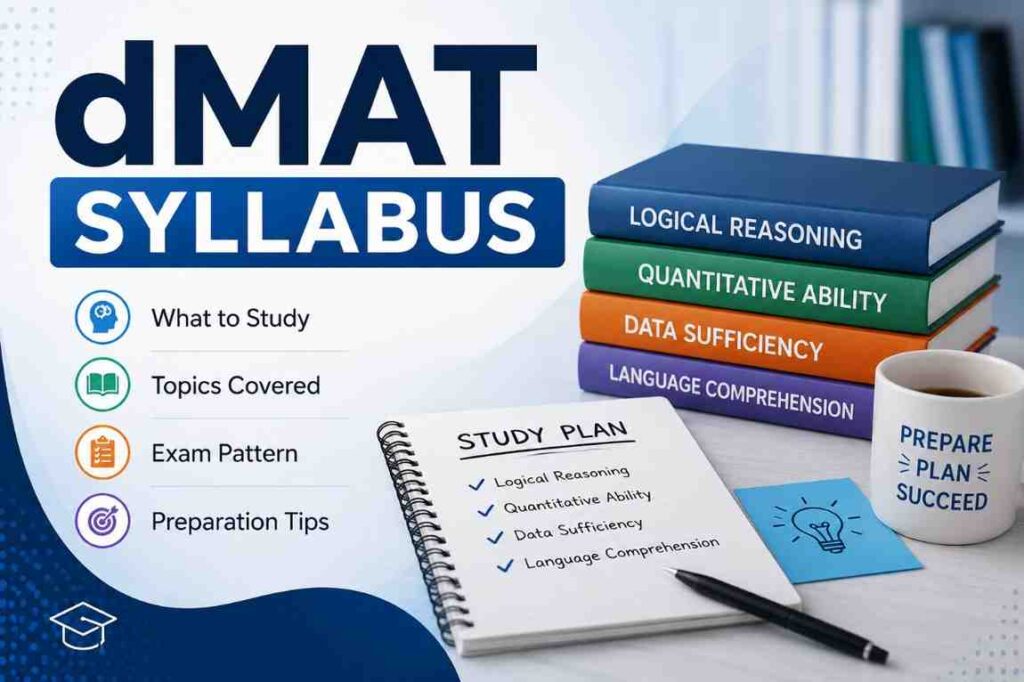
The dMAT syllabus is built from two parts:
| Module | What it tests | Duration |
|---|---|---|
| Core Module | General reasoning across three subtests | ~75 minutes |
| Subject Module (General Academic Module) | Applied problem-solving in your broad field | 90 minutes |
There is a 30-minute break between the two, so the full dMAT syllabus runs about 3.5 hours on a computer, in English, at a licensed test centre. Every question is single-choice, and you are not allowed to take notes during the exam.
Counselor insight: Per DAAD India’s own 2025 enrollment data, 60% of Indian students in Germany are in engineering-related fields, with a further 21% in social sciences, economics, and management. That means the vast majority of Indian students currently studying in Germany would fall inside the dMAT’s affected groups if they were applying today. This is not a niche rule; it touches most of the Indian applicant pool.
Read the dates, fee, and eligibility basics on our dMAT dates and fee guide if you have not already. This article goes deeper into what the dMAT Exam actually asks.
Free dMAT Practice Tests
Every section of the exam, with solution paths for all questions. Start with a section, finish with the full timed mock.
dMAT Mock Test
Full timed simulation · 80 questions · instant section scores
The dMAT is just one piece of the puzzle, check our complete Germany study guide for university list, costs, visas, and scholarships.
Do you actually need the dMAT Exam syllabus for 2026? Check Your Field First
The dMAT syllabus requirement does not apply to every Master’s applicant. It applies only if all of the following are true:
- You are applying for a Master’s program, not a Bachelor’s or PhD.
- Your intake is Summer Semester 2027 or later. Winter 2026/27 is not affected.
- Your bachelor’s degree falls in engineering, commerce/accounting/finance/economics, or business/management.
- You started your APS process on or after 29 June 2026.
- You are not on an official exchange, double-degree, or university-partnership program.
Decision framework: which situation matches you?
- If you are a final-year B.Tech Computer Science and Engineering student graduating in May 2027, applying for an MS in Germany for Summer 2027, and you have not yet registered for APS, you are required to take the dMAT syllabus’s General Academic Module before your APS certificate can be issued.
- If you are a BBA graduate applying for an MS in International Business for Summer 2027 and your APS registration is new, you also fall under the Business/Management group and need the dMAT.
- If you completed a BCA or a standalone B.Sc Data Science degree, you are not automatically covered. APS India’s official field list explicitly excludes standalone Computer Science, BCA, Data Science, and Artificial Intelligence degrees unless the official title is classified as Engineering.
Counselor insight: The single biggest mistake students make is judging their eligibility by what a consultant or college brochure calls their course, not by the official degree title on their marksheet. A “B.Tech in Computer Science and Business Systems” and a “B.Sc in Computer Science” can look similar on a resume but land on opposite sides of the dMAT requirement.
The full lists of what counts and what does not are in the APS India Affected Fields document, which is linked in the Sources section below.
See what our counselors say on which German universities suit a BTech Computer Engineering graduate applying for MBA International Business, a common profile that lands squarely in the dMAT’s affected group.
dMAT Exam Syllabus: Core Module Breakdown (What the Three Subtests Actually Look Like)
The dMAT core module topics are fixed and identical for every applicant, regardless of field. There are three subtests, each 25 minutes and 20 items:
| Subtest | What you do | Example rule |
|---|---|---|
| Figure Sequences | Continue a pattern of shapes across a series of matrices | Shapes can rotate, move, or change colour by a fixed or increasing step |
| Mathematical Equations | Solve a system of equations for unknown letters | Each letter is an integer from 1 to 20; only one valid solution exists |
| Latin Squares | Fill a 5×5 grid so each letter appears once per row and column | Work backward from cells with the most information first |
A worked example (Mathematical Equations, official low-difficulty level): 7 + A = 14, and B − 3 = A. Solving the first equation yields A = 7. Substituting into the second equation gives B = 10.
A worked example (Latin Squares): if a column is missing only two letters, and one of them already appears in the target row, the other letter must go in the empty cell. Most Latin Square items are solved by this kind of elimination, not by trial and error.
No calculators, scratch paper, or notes are allowed for any Core Module subtest. Guessing is encouraged over leaving an answer blank, since there is no negative marking.
Counselor insight: Students often over-prepare for the core module and under-prepare for the subject module because “logic puzzles” feel more approachable to revise for. In practice, the subject module is twice as long (90 minutes vs 75) and carries a separate score. Split your practice time accordingly rather than defaulting to core module drills.
dMAT Core Module Topics vs Subject Module: What Engineering, Commerce and Business Students Actually, See.
The Subject Module, called the General Academic Module for APS India, does not test your specific degree syllabus. It tests whether you can apply reasoning to a short academic scenario, drawn from a mix of fields.
| Subject area in official prep material | Sample topic seen | Who is more likely to see this type |
|---|---|---|
| Mathematics and computational sciences | Vector calculations (scalar product, cross product) | Engineering graduates |
| Natural sciences and engineering | Applied physics scenarios (hydrostatics, pressure, buoyancy) | Engineering graduates |
| Business administration and economics | Optimal order quantity, inventory cost models | Commerce, Finance, Business graduates |
| Social sciences and humanities | Research design: qualitative vs quantitative methods | Business/Management graduates with research components |
Per g.a.s.t.’s own preparatory materials, the subject module draws from “mathematics, computational sciences, natural sciences, engineering, business administration, economics, social sciences and humanities,” and every question comes with the input text needed to solve it. You are not expected to recall your undergraduate coursework from memory.
If your undergraduate degree is interdisciplinary (business analytics, industrial engineering, or financial technology), APS India determines your subject module category based on your official degree title, not your course description. Check your documents against the documents required for APS, GMAT, and BMAT in Germany list before assuming either way.
Counselor insight: A BBA graduate applying for an MS in Data Analytics will usually sit the business/economics-style subject module questions, not engineering ones, since APS India classifies the module by your previous degree field, not your target Master’s program.
dMAT Syllabus Documents and Registration Checklist
| Document | India-specific detail |
|---|---|
| dMAT registration (g.a.s.t. portal) | Create an account via the official gast.de portal; payment is in EUR |
| Passport-size photo | Same specification as your APS photo, not older than 6 months |
| Degree certificate and marksheets | Official title must match the APS Affected Fields List wording exactly |
| APS application form | Filed separately, dMAT certificate can be submitted after APS documents if not yet available |
| Proof of dMAT fee payment | Rs.16,562 (€150), paid to g.a.s.t., separate from the Rs.18,000 APS fee |
Registration, payment, test-centre booking, and certificate issuance are all handled by g.a.s.t., not APS India. If you have questions about the APS certificate fees and documents, that process runs on a separate track from dMAT registration, though both certificates must eventually sit in the same APS file. See what our counselors say on the tentative total fee and payment structure for a Master’s in Germany, so your dMAT and APS costs sit inside your wider budget rather than surprising you later.
Counselor insight: You do not need to wait for your dMAT certificate before submitting the rest of your APS paperwork. APS India can start verifying your other documents in advance, but your APS certificate itself will not be issued until the dMAT certificate is submitted and checked.
dMAT Exam Syllabus 2026 Prep Calendar for the Indian Academic Year
| Month | What to do |
|---|---|
| July 2026 | Confirm your degree field against the official Affected Fields List; register on the g.a.s.t. portal if affected |
| August 2026 | Work through the official Core Module and Subject Module preparatory PDF (see Sources); do 2-3 timed practice runs |
| Early September 2026 | Book your test centre before your preferred city fills up (first-come, first-served) |
| 15 September 2026 | Registration deadline for the first sitting |
| 26 September 2026 | Test day: budget the full morning or afternoon for 3.5 hours plus check-in |
| 12 October 2026 | Certificate available via the g.a.s.t. test-takers’ portal |
| October 2026 onward | Submit the dMAT certificate with your APS documents; continue university applications in parallel |
This calendar assumes a Summer 2027 intake target. If you are a final-year student with board exams or university semester-end exams clashing with late September, register early and confirm your test date does not overlap with your institution’s exam schedule.
What to Do If You Miss the dMAT Deadline or Score Low
Missed the registration deadline (15 September 2026): You will need to wait for the next scheduled dMAT sitting in India. Check gast.de for the next announced date, and build in an extra buffer for your APS and university deadlines, since a missed cycle can push your intake back by a semester.
Scored lower than expected: A low dMAT score does not automatically block your APS certificate. Per APS India’s own FAQ, the dMAT “is not a stand-alone pass/fail test for the APS certificate,” and a low score “does not automatically lead to a refusal.” Universities decide independently how much weight to give the score.
APS timing conflict: If you registered for APS online before 29 June 2026 or shipped your APS documents before that date, you are exempt from dMAT for that specific APS procedure, even if verification is still ongoing.
Certificate delay while your university deadline is close: Submit your APS application documents first; APS India can begin verification while your dMAT certificate is still pending, though the APS certificate itself will not be issued until the dMAT result is in.
Related reading: our blocked account Germany guide covers a similar situation, where one missing document can hold up an otherwise-complete visa file.
3 Takeaways on dMAT Exam Syllabus
- Check your exact degree title against the official APS India Affected Fields List, not your course nickname or what a consultant calls it.
- If the dMAT syllabus requirement applies to you, register before 15 September 2026, and do not wait for your dMAT certificate to start your other APS paperwork.
- Budget Rs.16,562 for the dMAT separately from the Rs.18,000 APS fee, and plan for both in your pre-departure costs.
Verified by: LeapScholar’s Germany counselling team, with hands-on experience guiding Indian students through APS certification, Uni-Assist applications, and German student visa processes.
Have questions about the dMAT syllabus or your APS timeline? Book a free session with a LeapScholar counselor.
Frequently Asked Questions About dMAT Exam Syllabus
-
What is a good dMAT score?
The dMAT score is standardized on a 0-200 scale with a mean of 100, reported separately for the Core Module and Subject Module plus a combined total. There is no fixed “good” score since there is no pass/fail cut-off. A score above 100 places you above the average test-taker; competitive programs may look for a higher percentile rank.
-
Does the dMAT certificate expire?
No. The dMAT certificate is valid indefinitely once issued, and most applicants sit the test only once. There’s no need to retake it for a later intake unless you want to try for a higher score.
-
Is the dMAT the same as TestAS?
No. TestAS is a separate, often optional aptitude test for Bachelor’s-level applicants, also run by g.a.s.t. The dMAT is new, Master’s-specific, and sits inside the APS documentation process for the affected Indian applicant groups.
-
When is the dMAT exam in 2026?
The first India sitting has registration open from 29 June to 15 September 2026, the test itself on 26 September 2026, and certificates available from 12 October 2026 via the g.a.s.t. test-takers’ portal.
-
What is the dMAT exam fee in INR?
The dMAT fee is €150, which is Rs.16,562 at a conversion rate of 1 EUR = Rs.110.41. This is paid directly to g.a.s.t. during registration and is separate from the Rs.18,000 APS certificate processing fee charged by APS India.
-
What happens if I score low in the dMAT?
A low score does not automatically get your APS certificate refused. APS India has confirmed the dMAT is not a pass/fail gate for APS purposes. Your score and percentile rank (0-200 scale, mean 100) appear on your APS certificate for universities to consider, but each university weighs it independently.
-
Is a BCA or B.Sc Data Science degree exempt from the dMAT?
Yes, in most cases. APS India’s official field list explicitly states that standalone computer science, BCA, data science, artificial intelligence, and cybersecurity degrees are not automatically covered unless your official degree title is classified as engineering by APS India based on your academic documents.
-
Is the dMAT compulsory for Indian students applying to Germany?
It is compulsory only for Master’s applicants whose previous degree falls in engineering, commerce/accounting/finance/economics, or business/management, applying for the Summer 2027 intake or later. Bachelor’s, PhD, and exchange program applicants are not affected, nor are students outside these three field groups.
-
What is the syllabus for the dMAT exam?
There is no chapter-wise dMAT syllabus. The core module tests general reasoning through figure sequences, mathematical equations, and Latin squares. The Subject Module (General Academic Module) tests applied problem-solving across mathematics, natural sciences, business, economics, and social sciences, using a short academic scenario plus questions.
-
What is the full form of dMAT?
dMAT stands for Digital Master Assessment Test, sometimes written as digital Master Test. It is a computer-based academic aptitude test introduced by APS India and administered by g.a.s.t. as an additional document inside the APS verification process for select Master’s applicants from the Summer Semester 2027 onward.











Have Questions? Get Guidance to reach your Dream University
Connect with India's finest counsellors and biggest study abroad community.
Get Guidance