
Quick Read
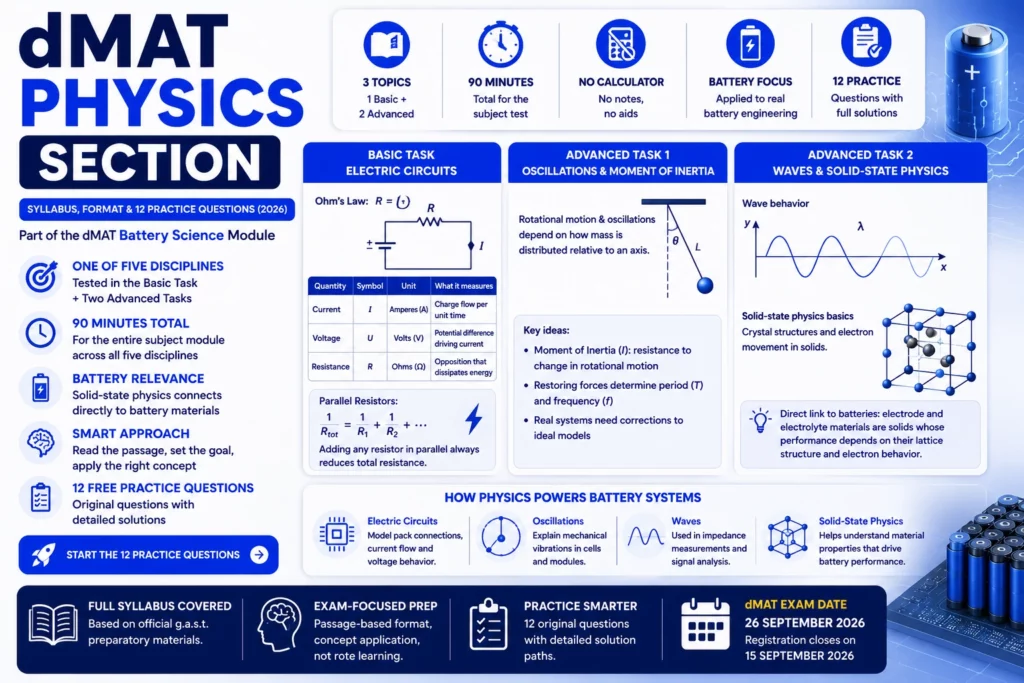
- Physics is one of five disciplines in the dMAT Battery Science module, not a standalone test, tested in the Basic Task plus two Advanced Tasks
- Basic Task: electric circuits and Ohm’s law. Advanced Tasks: oscillations/moment of inertia, then waves and solid-state physics
- 90 minutes covers the whole subject module across all five disciplines together, not 90 minutes for Physics alone
- Solid-state physics is the most direct link to batteries: electrode and electrolyte materials are solids whose performance depends on lattice structure and electron behavior
- Method: treat the passage as your data sheet, write down exactly what you’re solving for before touching a formula, watch for conceptual questions disguised as calculations
- Attempt 12 free practice questions below using this method
This guide sets out what this module covers and who it is really for and gives you 12 original free practice questions with full solutions.
What Is the dMAT Physics Section?
The dMAT Battery Science and Technology in Engineering subject module is one of two dMAT tracks, alongside the General Academic Module. It exists so German universities running battery-focused Master’s programs, such as RWTH Aachen’s MSc in the field, can assess applicants from very different undergraduate systems on the same footing. The module was built by g.a.s.t. with partner German universities and is scored centrally at the TestDaF Institut in Bochum.
Basic Task: Electric Circuits.
Ohm’s law ties three quantities together: R = U ÷ I.
| Quantity | Symbol | Unit | What it measures |
|---|---|---|---|
| Current | I | Amperes | Charge passing a cross-section per unit time |
| Voltage | U | Volts | The difference driving that charge to move |
| Resistance | R | Ohms | Opposition that converts electrical energy to heat |
First Advanced Task: Oscillations and Corrections
Advanced Task 1 moves into rotational motion, centred on moment of inertia, how a body’s mass is distributed relative to a chosen axis. It applies these concepts to oscillating systems: restoring forces, period and frequency, and how rotation changes oscillation versus straight-line motion. It also covers corrections engineers apply to idealized models so predictions match real behavior.
Second Advanced Task: Waves and Solid States
Advanced Task 2 covers wave behavior and solid-state physics basics: crystal structure, lattices, and electron movement within them. This is where the battery connection is most direct, electrode and electrolyte materials are solids, and their performance depends on exactly this lattice structure and electron behavior.
How to Solve dMAT Physics Questions
The Physics section rewards a specific kind of reading, not raw formula recall.
Treat the passage as your data sheet. Every passage supplies the definitions and formulas you need. Read it once for structure, noting where the key relationship sits, so you can return to it fast rather than holding it in memory.
Do the algebra the question actually asks for. Many questions hinge on one substitution into a single formula. Write down exactly what you are solving for and what values you already have before you touch a formula.
Watch for conceptual questions disguised as calculation questions. Some ask what happens to a quantity when another one changes, such as total resistance when a branch is added, or current when voltage and resistance both double. These reward understanding the relationship, not plugging numbers in.
Use elimination on harder Advanced Task questions. Waves and solid state questions can often be answered by ruling out options that misstate a basic fact, such as claiming electrons in a lattice can hold any energy rather than being restricted to bands.
Pace yourself across the whole subject module. You have 90 minutes for all five disciplines combined, not Physics alone. If a passage is not landing, mark your best guess and move on.
dMAT Physics Practice Questions with Answers (Free)
The 12 questions below cover all three rows above, built from original scenarios rather than the official exercises. Each one includes a full solution path so you can see the reasoning, not just the correct letter.
Work through them without notes and without a calculator, the way you will on test day.
📄 Input 1 · Electric Circuits: Current, Voltage and Ohm's Law
Current intensity I, measured in amperes, is the rate at which charge flows past a point in a circuit. Voltage U, measured in volts, is the electrical push between two points that drives that flow. When current meets opposition inside a conductor, that opposition is resistance R, measured in ohms, and resistance turns some of the electrical energy into heat. The three quantities are linked by Ohm's law: R = U ÷ I, which can be rearranged to find any one of the three once the other two are known. Questions 1 to 3 refer to this input.
Question 1 Easy
A resistor has 9 V across it and carries a current of 3 A. What is its resistance?
- a) 3 ohms
- b) 12 ohms
- c) 27 ohms
- d) 6 ohms
✦View Solution PathHide Solution Path▼
Answer: a. Ohm's law gives R = U ÷ I, so R = 9 ÷ 3 = 3 ohms.
Question 2 Medium
An immersion heater with resistance 22 ohms is connected across a 220 V supply. What current does it draw?
- a) 22 A
- b) 10 A
- c) 0.1 A
- d) 242 A
✦View Solution PathHide Solution Path▼
Answer: b. Rearranging Ohm's law gives I = U ÷ R, so I = 220 ÷ 22 = 10 A.
Question 3 Hard
In a circuit, the voltage across a resistor and the resistance itself are both doubled at the same time. What happens to the current?
- a) It doubles
- b) It is halved
- c) It stays the same
- d) It quadruples
✦View Solution PathHide Solution Path▼
Answer: c. Current is found from I = U ÷ R. If U and R both double, the factor of two in the numerator cancels the factor of two in the denominator, so I is unchanged.
📄 Input 2 · Electric Circuits: Resistors in Parallel
Resistors connected in parallel each provide a separate branch for current between the same two points. The total resistance of a parallel network is found from 1 ÷ Rtot = 1 ÷ R1 + 1 ÷ R2 + ... rather than by simple addition. Because every extra branch adds another term on the right-hand side, the total resistance of a parallel combination is always smaller than the smallest individual resistor in it, whatever the value of the added resistor. Questions 4 to 6 refer to this input.
Question 4 Easy
Two 8 ohm resistors are connected in parallel. What is the total resistance?
- a) 16 ohms
- b) 8 ohms
- c) 2 ohms
- d) 4 ohms
✦View Solution PathHide Solution Path▼
Answer: d. Using 1 ÷ Rtot = 1÷8 + 1÷8 = 2÷8 = 1÷4, so Rtot = 4 ohms. For two equal resistors in parallel, the total is always half of one of them.
Question 5 Medium
A 6 ohm resistor and a 3 ohm resistor are connected in parallel. What is the total resistance?
- a) 2 ohms
- b) 9 ohms
- c) 4.5 ohms
- d) 3 ohms
✦View Solution PathHide Solution Path▼
Answer: a. 1 ÷ Rtot = 1÷6 + 1÷3 = 1÷6 + 2÷6 = 3÷6 = 1÷2, so Rtot = 2 ohms. Note the total is smaller than either individual resistor, as parallel networks always are.
Question 6 Medium
A parallel network already has two resistors. A technician adds a third resistor, of a much higher value than the existing two, in parallel with them. What happens to the total resistance of the network?
- a) It increases slightly, since the new resistor impedes flow
- b) It decreases slightly, because every additional branch still adds a term to 1 ÷ Rtot
- c) It stays exactly the same, since a large resistor contributes almost no current
- d) It is impossible to say without doing the calculation
✦View Solution PathHide Solution Path▼
Answer: b. Adding any resistor in parallel adds another positive term to the sum 1 ÷ R1 + 1 ÷ R2 + ..., so 1 ÷ Rtot always grows and Rtot always falls, however large the added resistor is. A very large added resistor only makes the drop small, it does not stop it happening.
📄 Input 3 · Oscillations and Moment of Inertia
Rotational motion is described using the moment of inertia I of a rigid body, defined as an integral over the body's mass distribution about a chosen axis: mass located further from the axis contributes more to I than the same mass located close to the axis. A physical pendulum is a rigid body that oscillates about a pivot under a restoring torque, and the moment of inertia of the swinging body about that pivot governs how quickly it oscillates, in the same way that the inertia of a mass on a spring governs the frequency of that oscillation. Idealised oscillator models are often corrected for real effects, such as the mass of the pivot arm itself, before their predictions are compared with measurement. Questions 7 to 9 refer to this input.
Question 7 Easy
The moment of inertia of a rigid body about a given axis depends most directly on:
- a) The colour of the material
- b) The total force applied to the body
- c) How the body's mass is distributed relative to the axis
- d) The period of oscillation alone
✦View Solution PathHide Solution Path▼
Answer: c. The moment of inertia is defined as an integral over the mass distribution of the body about the axis, so it depends on how far each part of the mass sits from that axis, not on unrelated properties like colour or applied force.
Question 8 Medium
Two discs have identical mass. Disc X has its mass concentrated near the rim; disc Y has the same mass concentrated near the centre. Both rotate about the same central axis. Which has the larger moment of inertia?
- a) Disc Y, since mass near the centre resists rotation more
- b) Both are equal, since the total mass is the same
- c) Neither has a moment of inertia, since both have equal mass
- d) Disc X, since mass farther from the axis contributes more to the moment of inertia
✦View Solution PathHide Solution Path▼
Answer: d. Mass located further from the axis contributes more to the moment of inertia than the same mass located close to the axis. Since disc X has its mass concentrated near the rim, farther from the axis, it has the larger moment of inertia even though both discs have equal total mass.
Question 9 Hard
A student models a pendulum by assuming all its mass sits at a single point at the end of a massless string. The pendulum is then rebuilt using a rigid rod of the same length, which has its own distributed mass. Why does the point-mass model need correction for the rod version?
- a) Because the rod's own mass adds to the moment of inertia about the pivot, changing the restoring behaviour the idealised model ignored
- b) Because a rigid rod cannot oscillate about a pivot
- c) Because moment of inertia only applies to point masses
- d) Because the restoring force disappears once the string is replaced by a rod
✦View Solution PathHide Solution Path▼
Answer: a. The point-mass idealisation ignores that real bodies have mass distributed along their length. A rigid rod's own mass, spread out from the pivot, adds to the total moment of inertia about that pivot, which changes how the system oscillates compared to the idealised prediction. This is exactly the kind of correction the passage describes being applied to idealised models.
📄 Input 4 · Waves and Solid State Basics
In a crystalline solid, atoms sit in a repeating three-dimensional arrangement called a lattice. The way electrons are permitted to move through this lattice, restricted to certain bands of energy rather than any energy at all, determines whether a solid behaves as a conductor, a semiconductor or an insulator. Wave behaviour, including how waves reflect, interfere and are described by wavelength and frequency, underlies the same physics used to describe how electrons move through a periodic lattice. Because electrode and electrolyte materials in a battery are solids whose performance depends on exactly this lattice and electron behaviour, solid state physics is a direct foundation of battery science. Questions 10 to 12 refer to this input.
Question 10 Easy
In a crystalline solid, atoms are arranged:
- a) Randomly, with no repeating pattern
- b) In a repeating, periodic arrangement called a lattice
- c) In a single layer only
- d) Only along one axis
✦View Solution PathHide Solution Path▼
Answer: b. The passage defines a lattice as the repeating, periodic three-dimensional arrangement of atoms in a crystalline solid. This is the opposite of a random arrangement.
Question 11 Medium
What primarily determines whether a solid behaves as a conductor, a semiconductor or an insulator?
- a) The colour of the crystal
- b) The total mass of the sample
- c) The energy bands available to electrons moving through the lattice
- d) The wavelength of visible light striking it
✦View Solution PathHide Solution Path▼
Answer: c. The passage states that electrons in a lattice are restricted to certain bands of energy, and it is this restriction that determines whether a solid conducts, partially conducts or insulates. Mass, colour and incident light are not the deciding factor.
Question 12 Hard
Why does solid state physics, rather than chemistry alone, help explain the performance of a battery electrode material?
- a) Because chemistry cannot describe any solid materials
- b) Because wave behaviour is unrelated to electron motion in solids
- c) Because electrode materials are always liquid at operating temperature
- d) Because an electrode's performance depends on the lattice structure and electron energy bands of the solid, which is what solid state physics describes
✦View Solution PathHide Solution Path▼
Answer: d. The passage states that electrode and electrolyte materials are solids whose performance depends on exactly the lattice structure and electron behaviour that solid state physics describes. Composition alone, the chemistry side, does not capture how electrons actually move through that structure.
Who Must Take the dMAT Physics Section?
Everyone assigned the module sits in the Physics Basic Task, alongside the other four disciplines’ basic tasks. This is deliberate; no graduate is penalized by an unfamiliar passage outside their field, and Basic Task content stays undergraduate-foundation level with most of what you need supplied in the passage.
Your background matters in the Advanced Tasks. Physics or physics-heavy engineering graduates should concentrate prep there; they’re the harder, more discriminating questions. Everyone else still attempts them if assigned but should weight their study plan toward their own discipline instead.
dMAT Physics Syllabus: Basic and Advanced Tasks
| Task | Topic |
|---|---|
| Basic Task | Electric circuits: current, voltage, resistance and Ohm’s law, including resistors in parallel |
| Advanced Task 1 | Oscillations and Corrections: moment of inertia, rotational oscillators, corrections to idealised models |
| Advanced Task 2 | Waves and Solid States: wave behaviour, crystal lattices, electron behaviour in solids |
dMAT Physics Study Plan Before 26 September 2026
With dMAT registration closing on 15 September 2026 and the exam itself on 26 September 2026, a focused four-week run-up works well for the Physics section specifically.
| Week | Focus |
|---|---|
| 1: Diagnose | Attempt the 12 practice questions under timed, no-notes conditions. Note whether circuits, oscillations, or solid state slows you down most |
| 2: Rebuild Basic Task | Refresh current, voltage, resistance, Ohm’s law, and parallel resistor networks, usually one evening if you have an electrical or mechanical background |
| 3: Go deep | If Physics is close to your background: moment of inertia, oscillators, waves, and solid state. If not: your own discipline’s advanced content instead |
| 4: Rehearse conditions | Timed, full mixed set across all five disciplines (not Physics alone), no notes, no calculator, on screen |
Frequently Asked Questions About the dMAT Physics Section
Is the Physics section a separate exam from the rest of the Battery Science module?
No. Physics is one of five disciplines inside the single 90-minute subject module, with no separate timing of its own.
Do I need a physics or engineering physics degree to do well on this section?
Not for the Basic Task, which is accessible from any of the five engineering backgrounds. The two Advanced Tasks are where a physics-heavy background gives a real advantage.
How does physics connect to battery science specifically?
Most directly through the Waves and Solid States task. Electrode and electrolyte materials are solids, and their performance depends on the same lattice structure and electron behavior this task covers
Are formulas like Ohm’s law provided in the exam, or do I need to memorize them?
The reading passage typically states the relevant formula before the questions on it. Still, you should know the formulas well enough to recognize and apply them quickly, since the exam rewards speed as much as knowledge.
Where can I find official Physics practice material?
The g.a.s.t. dMAT Preparatory Materials are free to download from d-mat.de and include worked examples across all three Physics topics at three difficulty levels.









Have Questions? Get Guidance to reach your Dream University
Connect with India's finest counsellors and biggest study abroad community.
Get Guidance