
Quick Read
- Each OET sub-test gets its own score from 0 to 500.
- The NMC wants Grade B in three sub-tests and C+ in Writing.
- Indian paper test results can arrive in as little as 5 days.
- Indian nurses can start with OET’s free Intro to OET (Nursing) course.
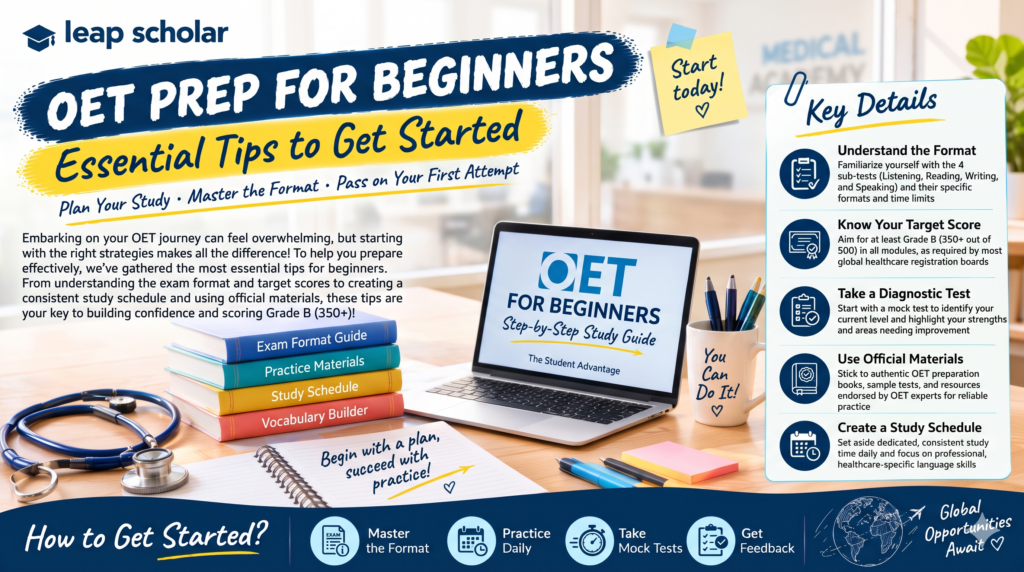
Is OET too hard? OET preparation tips for beginners start here
OET (Occupational English Test) is an English test built around real healthcare situations, and the Writing and Speaking tasks are specific to your profession. So is it too hard for a beginner? It’s a test you can prepare for step by step, and these OET preparation tips for beginners lay out that order.
Before you open a single practice test, learn how the OET exam is booked and delivered in India. Then work through the OET preparation tips for beginners below, one step at a time.

Choose your dream country
 UK
 USA
 Germany
 Australia
 Ireland
 Canada
 UAE
 France
 Sweden
 Italy
 Other
When do you want to study abroad?
What's your highest level of education?
Have you completed Class 12th?
What was your Class 12 CGPA/percentage?
Are you a student or a parent/guardian?
What do you want to study?
Select your current city
How Leap will help you

Personalised University Shortlist

Express Applications with Quicker Admits

End-to-End Application Support
Some nurses ask whether OET is easier than IELTS (IELTS is a general English test, not a healthcare one) for their background, and which test you take often depends on what your regulator accepts. If you want a fuller answer on how hard OET really is, read that page after this one.
What OET Tests and How It Is Scored
OET has four sub-tests: Listening, Reading, Writing and Speaking. A sub-test is one of these four parts, and each one is scored on its own. The first OET preparation tip for beginners is simple: learn what each part asks before you practice it.
You can take the OET on paper, on a computer, or at home through OET@Home, the online version you take at home. Read the table below row by row; it is the map that the rest of these OET preparation tips for beginners follow, and the full OET exam pattern has the marking rules.
| Sub-test | Time | Parts and marks | What you do |
| Listening | About 40 minutes | Parts A, B, and C: 24, 6, and 12 marks (42 in total) | Hear health recordings once and answer |
| Reading | 60 minutes | Parts A, B, and C: 20, 6, and 16 marks (42 in total) | Read health texts and answer questions |
| Writing | 45 minutes, including 5 minutes of reading | One letter task | Write a formal letter from case notes |
| Speaking | About 20 minutes | Two role-plays of 5 minutes each | Role-play with a patient in two scenes |
What this means for you: Listening and Reading reward exact answers, while Writing and Speaking are judged against published criteria you can study in advance. Here's how the scoring works:
- Scale score: your scale score is a number from 0 to 500, in steps of 10, given for each sub-test.
- Letter grades: grades run from A (highest) to E (lowest), and Grade B is the letter that matches a scale score of 350.
- Grade B in Listening and Reading: it typically means at least 30 of 42 answers are correct.
- Results: computer and OET@Home results can arrive within 48 hours of finishing all four sub-tests, while paper results can arrive in as little as 5 days in India.
Sources: OET: results and scoring, OET: the four sub-tests
My insight: Learn the answer rules for Listening and Reading before you practice for speed, because an answer in the wrong form or in the wrong place loses the mark even when you understood the text.
What OET Score Nurses Need
Your target score is set by the regulator, which is the official body that decides who can register to work as a nurse, not by OET. If you plan on nursing in the UK, that body is the NMC (Nursing and Midwifery Council), the UK nursing regulator. Know your target first, because it shapes every one of the OET preparation tips for beginners that follow.
- Listening, Reading, and Speaking: the NMC asks for Grade B, a scale score of 350 or above, in each one.
- Writing: C+ is the Writing grade the NMC accepts, which means a scale score of 300 or above.
- All four count: you need the required grade in each of the four sub-tests.
- Validity: scores are valid for two years, and the test must fall within two years before the NMC assesses your complete application.
Sources: NMC: accepted English language tests
Other regulators set their own grades, so read about OET for nurses for nurse-specific details, and check the score validity rules before you book. Not sure you need the test at all? Check whether you need OET as a healthcare professional. If you're still choosing a degree, BSc nursing in the UK has the course details.
How to Check Your OET Level
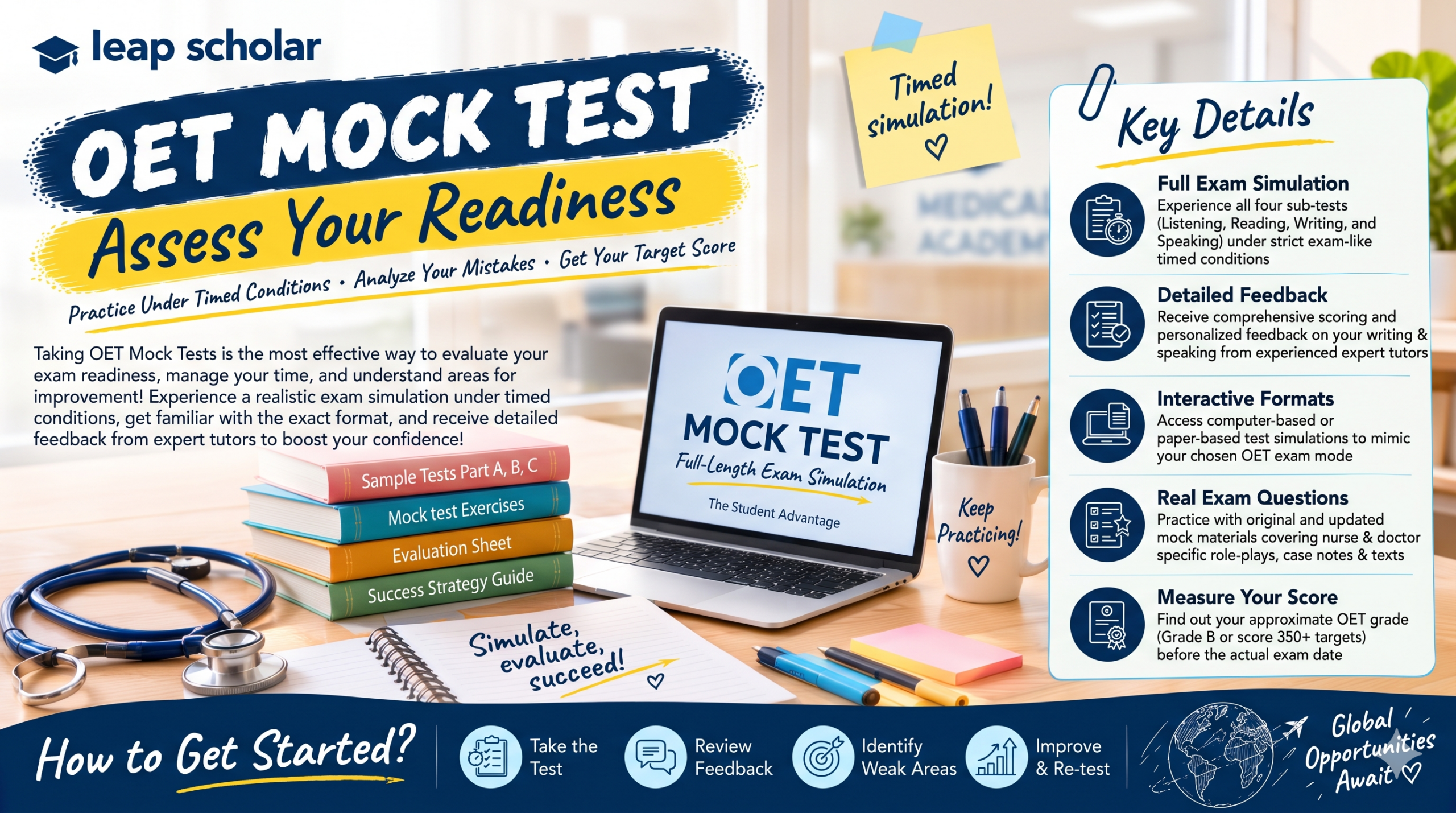
Once you know the test format, take one official OET sample test before you build your study plan, because your mistakes tell you where to start. A guess about your level wastes weeks; a marked test gives you a list of things to fix, which is why it sits early in these OET preparation tips for beginners.
- Self-mark a sample test: sit one official sample test in full, mark it with the answer key, and compare your Listening and Reading marks with the Grade B guide above.
- Try OET Pulse for a second view: OET Pulse is a short, paid online placement test of listening, reading, and language knowledge, and it's optional.
- Sort mistakes by cause: review every wrong answer and name the skill behind it, such as spelling, vocabulary, or reading speed.
- Build skills, not only test scores: OET advises working on the language skills underneath, not just taking practice tests after practice tests.
- Be realistic about time: your study time depends on your level and the hours you can give each week, so no fixed number of weeks fits everyone.
Sources: Get OET Ready, OET: best way to prepare
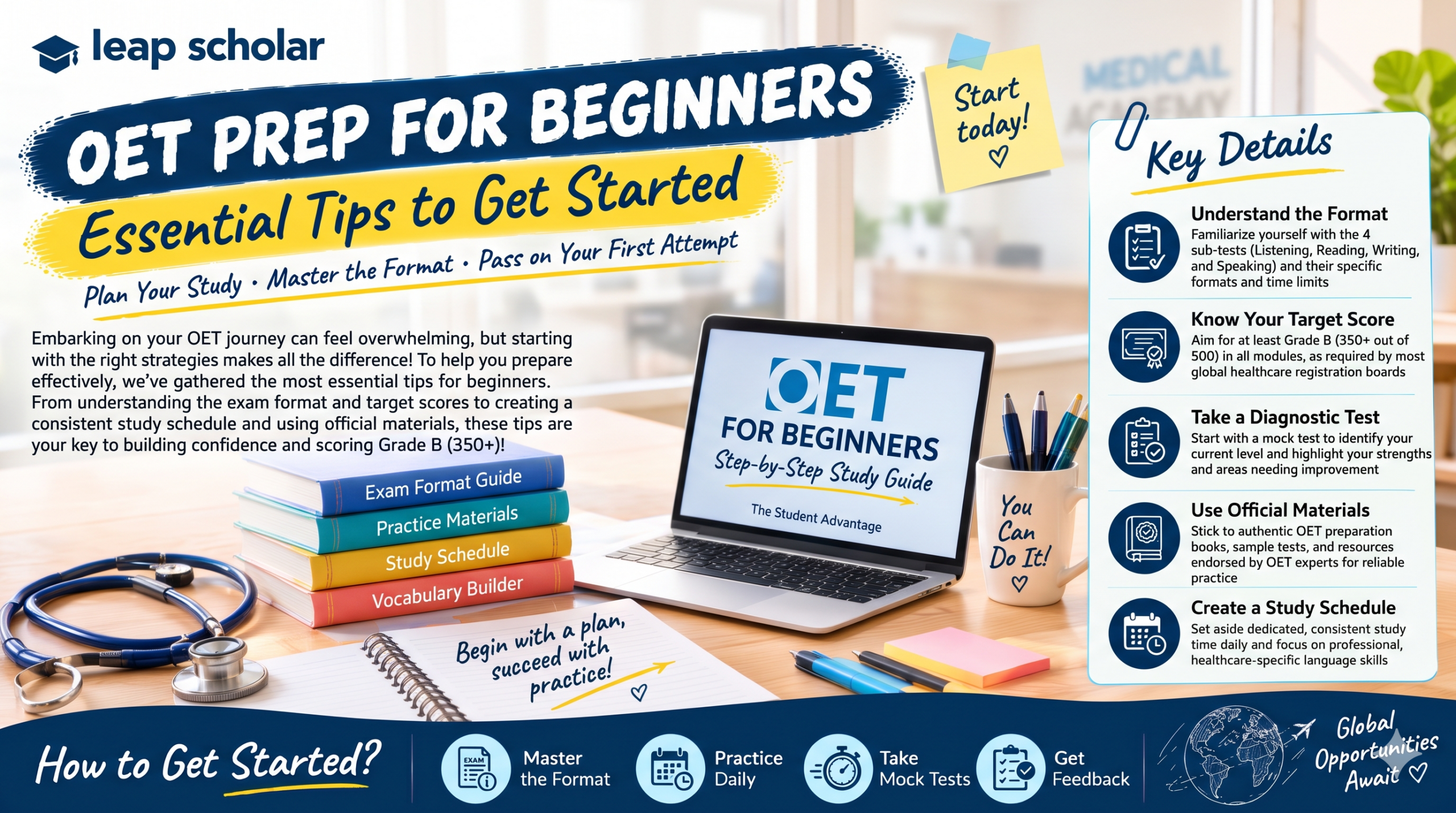
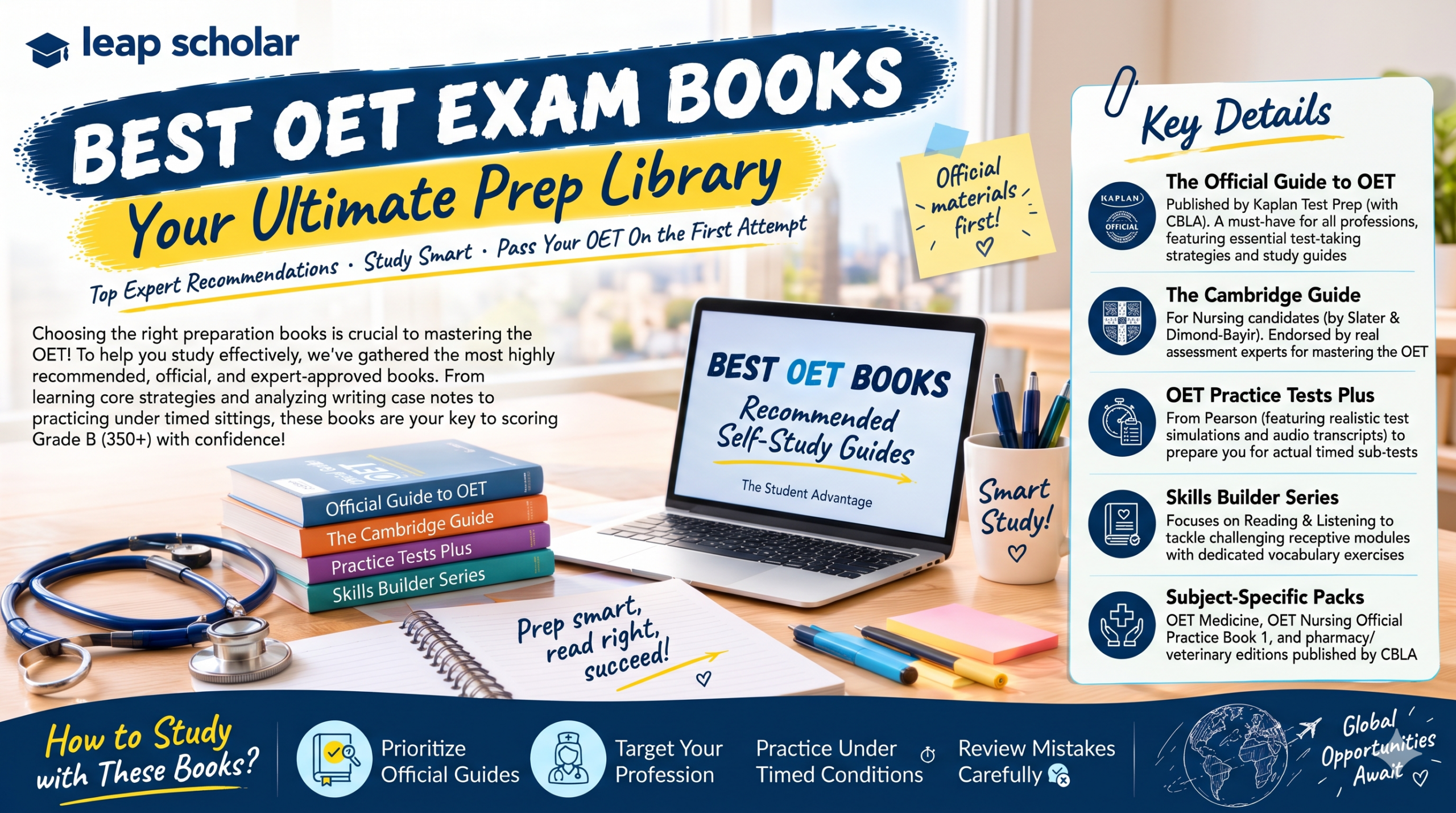
OET preparation tips for beginners: free official resources
OET publishes free official material, so use it first, in this order, before you pay for anything. These OET preparation tips for beginners only name resources that OET publishes itself, so you know the format and marking match the real test.
- Intro to OET (Nursing): Intro to OET is OET's free online starter course, and it has a Nursing version.
- OET Study Guide: the OET Study Guide is a free download with resources for each part of the test.
- Official sample tests: free sample tests are on oet.com for the paper test and for the computer and OET@Home versions.
- Lessons and webinars: on-demand lessons and Prep for Success Webinars are free on YouTube.
- Language and Speaking practice: there are five free Mini Language Lessons, and the Speaking Booster Course is a free OET mini course for Speaking.
- Graded sample booklets: OET's graded sample booklets are real candidates Speaking and Writing answers, shown with grades and assessor feedback.
- Q&A sessions: OET runs regular Q&A sessions you can join through Facebook or YouTube, where you can ask about the test.
Sources: OET: free study resources, OET: top study materials, OET: graded sample booklets
My insight: Finish the free official steps before you pay for a course or a teacher, because a paid hour helps most once your sample-test mistakes show exactly what to fix.
OET preparation tips for beginners: a 4-week plan
Week 1 starts now: block out four weeks and set your daily hours, since your level and schedule will determine the pace. Treat the time as a first block, not a promise that you'll be test-ready in a month.
Read each row as one week, and use the last column to check that week's work in these OET preparation tips for beginners before moving on.
| Week | Focus | What to do | How you know it worked |
| Week 1 | Learn the test | Finish Intro to OET (Nursing) and read the OET Study Guide | You can explain what each sub-test asks |
| Week 2 | Find your level | Take one full official sample test and mark it | You have a list of mistakes sorted by cause |
| Week 3 | Fix your weakest sub-test | Practice that sub-test daily with official material | The same mistake types appear less often |
| Week 4 | Writing and Speaking against the criteria | Write letters and record role-plays, then compare with graded samples | You can point to each criterion in your own work |
If a week's check fails, repeat that week rather than rushing ahead. In week four, look at booking and test dates so your practice has a target, and the OET exam fees page lists the current costs. OET's own advice is not to rush into booking until you feel confident.
My insight: If your first sample test is uneven, give the extra hours to your weakest sub-test, not your favorite one, because each sub-test gets its own score.
OET Listening Tips for Beginners
Listening runs for about 40 minutes, and you hear each part only once. Part A of the Listening sub-test rewards exact note completion, so train your ear and spelling together. One of the OET preparation tips for beginners that matters most here: write what you hear, not what you think the speaker meant.
- Heard once: each part plays only once, so practice with official audio, and don't pause it.
- Part A notes: you lose marks for repeating words already in the notes or adding information that isn't in the recording.
- Spelling counts: spelling mistakes can cost marks, so keep a list of medical words you tend to misspell.
- Answer in the right place: answers written anywhere apart from the answer space aren't marked.
Sources: OET: Listening sub-test
OET Reading Tips for Beginners
Reading lasts 60 minutes across three parts, and the Reading sub-test starts with a strictly timed part. Part A papers are collected after 15 minutes, so your first job is to be fast on that part. Apply the OET preparation tips for beginners here by timing Part A on its own until 15 minutes feels comfortable.
- No extra time: there's no extra time at the end to copy or fix answers.
- Exact word forms: Part A answers must use exactly the word form that appears in the texts.
- Spelling: misspelled answers get no marks, although US or UK spelling is accepted.
- Abbreviations: avoid abbreviations that don't appear in the texts.
Sources: OET: Reading sub-test
OET Writing Tips for Beginners
The Writing task gives you case notes, which are the patient details you must turn into a formal letter in 45 minutes, including 5 minutes of reading time. A referral letter is a letter that passes a patient's care to another professional, and it's one of the letter types you may be asked to write, so learn its order first. The OET preparation tips for beginners for Writing start with reading good letters, not with writing your own.
- Study models first: read two or three sample letters for nurses before you draft your own.
- Aim for 180-200 words: that's OET's guide, and there's no automatic penalty for going a little under or over.
- Learn the criteria: your letter is marked against six assessment criteria, so read them before you write.
- Plan during the reading time: use the 5 minutes to decide what the reader needs and what to leave out.
- Check your language: spelling, punctuation, and grammar are all assessed under Language.
Sources: OET: Writing sub-test
My insight: Write one letter, then compare it with the criteria, not with a friend's letter, because the criteria are what the assessor marks.
OET Speaking Tips and Test Day
Speaking takes about 20 minutes and has two role-plays. A role-play is a short spoken scene with a patient, and each one lasts 5 minutes. The Interlocutor is the person you speak with in the role-play. Read a few role-play samples so you know how a role card works, and treat the OET preparation tips for beginners below as your rehearsal list.
- Two kinds of criteria: you're marked on Linguistic and Clinical Communication criteria, so how you talk with the patient counts alongside your grammar.
- Use the role card: you may write notes on the role card, but you hand it back to the Interlocutor.
- Record yourself: record one role-play, then compare it with the graded Speaking samples.
- Prepare for the day: before your test, read up on test day expectations at the center so nothing surprises you.
Sources: OET: Speaking sub-test
What if your OET preparation is not working?
If your practice scores aren't rising, change your method before changing your goal, and return to the OET preparation tips for beginners above with a fresh perspective. Here's what to do in the most common situations:
- One sub-test stays low: review those mistakes by cause again and spend your next block on that skill alone.
- Writing or Speaking feels stuck: compare your work with the graded sample booklets and the criteria, or work with an OET-trained teacher.
- Your score is close to expiring: check your regulator's validity rule before you rebook.
- You need a retake: check your regulator's rules and the booking page before you book again.
- OET may be the wrong test: if OET feels wrong for you, compare OET vs IELTS before you decide.
If you're unsure which route fits, your counselor can help you compare them. This is general information, not legal or registration advice; check the regulator's page for your case.
3 Takeaways on OET Preparation Tips for Beginners
- Start free and official: finish Intro to OET (Nursing) and the OET Study Guide before you pay for anything.
- Know your target grades: for the NMC, that means Grade B in Listening, Reading, and Speaking and C+ in Writing.
- Follow the 4-week first block: these OET preparation tips for beginners work best when every week ends with a check on your weakest sub-test.
Talk to a Leap Scholar counselor to build an OET study plan around your nursing goals and pick the right time to book your test.
Frequently Asked Questions About OET Preparation Tips for Beginners
-
How long does OET preparation take for beginners?
There's no fixed number of weeks, because the time depends on your current level and the hours you can study each week. A sensible rule from these OET preparation tips for beginners is that you should finish a first four-week block, test again, and book only once you feel confident.
-
Is there free OET preparation material for nurses?
OET publishes several free resources: the Intro to OET (Nursing) course, the OET Study Guide, official sample tests, YouTube lessons, and the Speaking Booster Course. Use these OET preparation tips for beginners as a simple rule: finish the free official material before you buy anything else.
-
Which OET sub-test is hardest for beginners?
The hardest one is the one where you score lowest, and that differs from nurse to nurse. One of the most useful OET preparation tips for beginners is to find it with a full sample test, then give that sub-test the extra hours in your plan.
-
Can I prepare for OET on my own without coaching?
Self-study with the materials on OET's own website is one of the routes OET lists, and an OET-trained teacher is optional. Follow the OET preparation tips for beginners in order: free course, Study Guide, sample tests, then mistake review. Consider a teacher if Writing or Speaking stays stuck.
-
What OET score do nurses need for the NMC?
The NMC asks for Grade B, a scale score of 350 or above, in Listening, Reading, and Speaking. For Writing, it accepts C+, a scale score of 300 or above. You need these grades in each sub-test, and the scores stay valid for two years.
-
How much does the OET exam cost for Indian test-takers?
OET charges a single fee for all four sub-tests, set in Australian dollars, so the INR amount you pay depends on the exchange rate on the day you book. The fee is the same across all 12 professions and every Indian test city. Check the OET exam fees page for the current INR figure before you budget, since the rupee amount shifts with the AUD rate.
-
Is OET harder than IELTS for Indian nurses?
Neither test is generally harder; they assess different skills. OET is built around healthcare scenarios in Writing and Speaking, which suits nurses who think in clinical language, while IELTS is general English. Which one feels easier depends on your background and, more importantly, which test your regulator accepts, so check that first.
-
Should I take OET on paper, computer, or OET@Home?
All three formats test the same four sub-tests to the same standard, so you should base your choice on logistics rather than difficulty. Computer and OET@Home results arrive within 48 hours of finishing all four sub-tests, while paper results in India can take up to 5 days. If you're in a hurry to book your next step with a regulator, computer, or OET@Home gets you your scores faster; if you prefer writing by hand, paper is still a valid option.












Have Questions? Get Guidance to reach your Dream University
Connect with India's finest counsellors and biggest study abroad community.
Get Guidance