
Quick Read
- The OET listening test plays every recording once, so you answer live.
- The 42 marks split 24, 6, and 12 across three parts.
- India paper results can arrive in as little as 5 days.
- All three modes cost INR 39,200 (AUD 587) per sitting.
Is the OET listening test harder because you hear every recording only once?
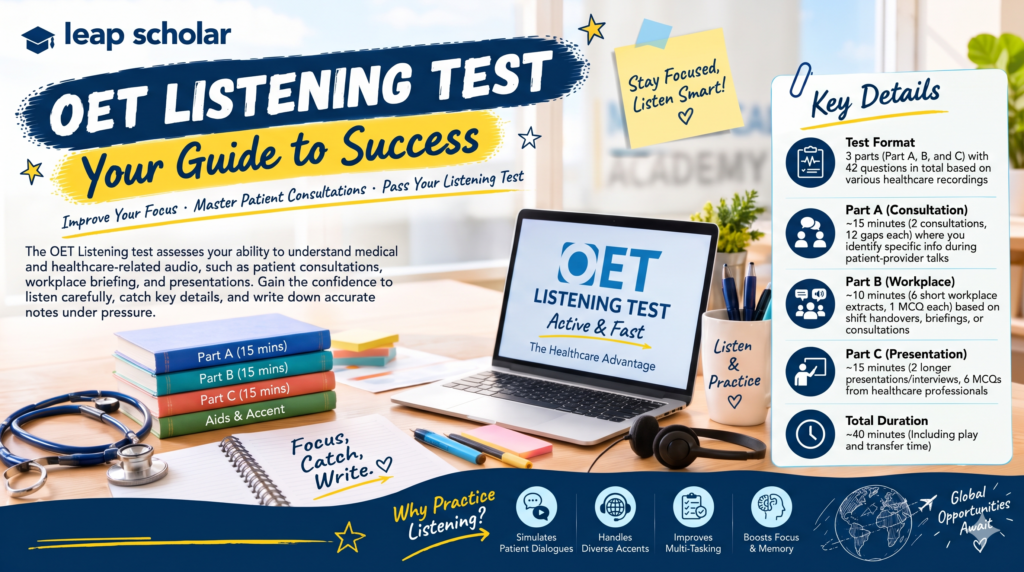
The OET listening test plays each part once only, so you write your answers as you listen, and the whole sub-test runs approximately 40 minutes across 42 questions.
OET is an English test for health professionals. A subtest is one of its four parts: Listening, Reading, Writing, and Speaking. A recording is one audio extract you hear in a part of the test.

Choose your dream country
 UK
 USA
 Germany
 Australia
 Ireland
 Canada
 UAE
 France
 Sweden
 Italy
 Other
When do you want to study abroad?
What's your highest level of education?
Have you completed Class 12th?
What was your Class 12 CGPA/percentage?
Are you a student or a parent/guardian?
What do you want to study?
Select your current city
How Leap will help you

Personalised University Shortlist

Express Applications with Quicker Admits

End-to-End Application Support
There's no replay button, but there is good news: the OET listening test is common to all professions and checks your English, not your medical knowledge. A doctor on the doctor route to the UK hears the same kind of audio as a nurse does. So "hard" mostly means the one-play rule.
Sources: OET Listening sub-test page, OET test overview
OET listening test at a glance: three parts, 42 marks, about 40 minutes
People often picture three equal parts, but the OET listening test puts 24 of its 42 marks in Part A.
Part A is the consultation section, where you fill gaps in a health professional's notes. A mark is one point for each correct answer. Read each row as one part, from what you hear to what it's worth.
| Part | What you hear | How you answer | Marks |
| A | Two consultations between a health professional and a patient, about 4 to 5 minutes each | Complete the notes with a word or short phrase you hear: 12 questions per recording | 24 |
| B | Six short workplace recordings with one or two speakers, about 45 seconds each | One 3-option multiple-choice question per recording | 6 |
| C | Two longer recordings, an interview or a presentation, about 4 to 5 minutes each | Six 3-option multiple-choice questions per recording | 12 |
| Total | Three parts in approximately 40 minutes | 42 questions | 42 |
What this score means for you: Part A alone is worth more than Parts B and C together. The Part B and C details come from OET's guides to those parts.
My insight: Part A is 24 of the 42 marks, so protect Part A first: a careless gap there costs more than a slip in Part B.
Sources: OET Listening Part A guide
What happens in Listening Part A, and why do exact words matter?
A neat paraphrase feels like good listening, but in Part A OET asks you to complete the notes with the same words you hear, not your own.
Each Part A recording is a consultation, and the notes belong to the health professional in it. Here's what will decide your marks:
- Gaps, not essays: you fill each gap with a word or short phrase from the recording.
- Thirty seconds first: you get 30 seconds to look at the notes before each recording starts.
- Marks you can lose: repeating words already in the notes, adding information the recording never gave, contradicting yourself, or making your meaning unclear.
- Spelling and grammar: OET allows more flexibility on spelling here than in Reading, but spelling mistakes may still cost marks, and so can grammar mistakes.
- Medical words: spell the terms the public commonly uses; OET's examples are "diabetes" and "cholesterol."
- Marked by people: OET's Part A guide says human assessors mark Part A, so write clearly on paper. If you miss an answer, the guide says to move on with the audio rather than dwell on it.
My insight: In a Part A gap, write what you heard, not what you think the speaker meant; a tidy paraphrase can cost you the mark.
How do Listening Parts B and C work, and how long can you read first?
Many candidates see Parts B and C as easy marks because they are multiple choice, but OET gives you only 15 seconds before each Part B recording.
OET's Part B guide adds that the options paraphrase the audio, so listen for meaning rather than for matching words. The table shows the reading time you get before the audio in each part of the OET listening test.
| Part | Time to read before the audio |
| A | 30 seconds to look at the notes before each recording |
| B | 15 seconds to read the question and options, then about 5 seconds to choose after each recording |
| C | 90 seconds to read all six questions and options before each recording |
What this time means for you: those seconds are your only preview, so use them on the question in front of you. In Parts B and C you shade an answer on paper or click it on a computer.
Sources: OET Listening Part B guide, OET Listening Part C guide
How is the OET listening test marked and scored?
Candidates often hunt for a marks-to-score chart, but OET publishes none: each correct answer earns 1 mark, and your score out of 42 converts to OET's 500 scale.
In the OET listening test, that scale runs from 0 to 500 in ten-point steps, and each sub-test also gets a letter grade from A (highest) to E (lowest). Since OET gives no conversion table, this page doesn't print one either.
- Scale score: a scale score is your converted result on the 0 to 500 scale.
- Grade B: grade B is a scale score of 350. OET says people awarded it typically have at least 30 marks, but each session uses a new Listening test, so boundaries shift slightly and the marks needed vary.
- Spelling and grammar: both can cost marks, as the Part A rules above show.
- Re-mark: a re-mark means asking OET to mark one or more sub-tests again, and you can request one within 72 hours of receiving your results.
IELTS Listening band scores work on a different scale, so don't carry IELTS maths into OET.
My insight: Read 30 marks as a rough marker, not a promise: if your practice results sit near 30, you are still gambling on the boundary.
Sources: OET results and scoring
OET Listening on paper, computer, or OET@Home: what changes?
Some candidates think the computer version is an easier test, but OET on Paper and OET on Computer follow the same structure, content, length, and marking.
OET@Home is OET taken online on your computer, with a remote supervisor. A remote supervisor is the person who supervises your test online and can help when something fails. Each row shows what changes for the OET listening test.
| Mode | How you answer | Headphones | Time to check |
| Paper, at a venue | Write Part A in the booklet space; shade the lozenge for B and C | Noise-cancelling headphones provided | 2 minutes at the end, all parts |
| Computer, at a venue | Type Part A answers; click an answer in B and C | Noise-cancelling headphones provided | A short pause after each question |
| OET@Home | Answer on screen, on your own computer | Your own wired headset; no Bluetooth | A short pause after each question |
What this means for you: on paper, a lozenge is the small circle you shade next to an answer, and answers written anywhere else in your booklet aren't marked. All three modes cost INR 39,200 (AUD 587) per sitting.
The fee is converted at 1 AUD = INR 66.7 as of October 2026 and will shift with the exchange rate, so check the latest rate before you pay.
OET@Home is offered where a venue test is unavailable, and some regulators do not accept it. A regulator is the official body that registers health professionals in a country and decides which English proof it accepts.
My insight: Pick the mode whose answering method you have used before, shading or typing, and confirm your regulator accepts it before you book.
Sources: OET Test on Paper page, OET Test on Computer page, OET@Home page
Which accents and audio setup should Indian candidates expect in OET Listening?
You don't need to learn a British or Australian accent: OET uses a range of accents across all three parts, mainly Australian, British, and American.
Others include New Zealand, Irish, Canadian, and South African, chosen to reflect the global healthcare workforce. So the skill the OET listening test checks is understanding several accents, not speaking one. Your audio setup matters too:
- At a centre: noise-canceling headphones are provided.
- At home: use a wired headset, plugged in the whole time; Bluetooth isn't allowed.
- Live help: on OET@Home, Listening is the first sub-test, and you can message or speak to your remote supervisor when you need help.
- Part B pace: OET's Part B guide says the pace is close to natural and may be faster than you're used to.
Sources: OET@Home test day guide, Part 2
What do regulators ask for in OET Listening, and when do results arrive?
Each regulator sets its own Listening line, and the NMC (Nursing and Midwifery Council) asks UK nurses for at least grade B (350).
Grade C+ is a scale score of 300 to 340, one step below B.
- The NMC line: for nursing in the UK, the NMC wants at least B (350) in Listening, Reading, and Speaking and at least C+ (300) in Writing.
- Two sittings: the NMC lets you combine two OET sittings if, between them, you reach B in Listening, Reading, and Speaking and C+ in Writing, and every Listening score in both is at least C+ (300).
- Modes: the NMC accepts paper, computer, and OET@Home.
- Other countries: nursing in Australia has its own regulator, so read its rules before you book.
- Results timing: paper results for candidates tested in India can arrive in as little as 5 days after the test date. Computer and OET@Home results, including the OET listening test, can arrive within 48 hours of all four sub-tests, with 95 percent of results arriving within 6 calendar days.
My insight: When you combine sittings, one Listening score under C+ (300) in either sitting sinks the combination at the NMC, so protect your weaker sitting.
Sources: NMC OET page
Which mistakes cost marks in the OET listening test?
OET's own rules show four ways to lose a mark in the OET listening test even when you heard the right answer.
- Paraphrasing in Part A: your own wording instead of the speaker's.
- Repeating or adding: copying words already in the notes or writing information the recording never gave.
- Answering in the wrong place: anything outside the answer space or a Part B or C lozenge left unshaded.
- Misspelling common medical words, such as diabetes, which the public uses, is another common mistake.
If your regulator accepts both tests, OET vs IELTS compares them.
What if your OET listening test score is low or the audio goes wrong?
Don't rush to rebook after a low OET listening test score: first compare it with your regulator's line, such as B (350) at the NMC.
- Your score is low: if you think the marking is wrong, ask OET for a re-mark within 72 hours of receiving your results. A new sitting costs INR 39,200 (AUD 587).
- You narrowly miss: ask whether your regulator combines sittings, as the NMC does under the rules above.
- The audio or headset fails on OET@Home: use live help to reach your remote supervisor straight away.
To hear these tasks for yourself, start with OET's free sample tests.
This page is general information, not registration or medical advice, so confirm details on oet.com and your regulator's page before you decide.
3 Takeaways on OET Listening Test
- One play only: each part is heard once, and Part A holds 24 of the 42 marks.
- Exact words, no chart: 1 mark per answer feeds a 500 scale, and Part A wants the words you hear.
- Check before you book: match your mode to your regulator and its Listening line, such as B (350) at the NMC.
Talk to a Leap Scholar counselor to plan your OET Listening around your regulator's score.
Frequently Asked Questions About OET Listening Test
-
How long is the OET listening test, and how many questions does it have?
The OET listening test runs approximately 40 minutes and has 42 questions across three parts. On paper you get 2 minutes at the end to check all three parts. On a computer or OET@Home, a short pause at the end of each question gives you time to check.
-
How is the OET listening test scored?
Each correct answer earns 1 mark, so the OET listening test is marked out of 42. That score is converted to OET's 0 to 500 scale in ten-point steps, and you get a letter grade from A to E. OET publishes no table converting marks to scale scores.
-
How many marks do you need for grade B in OET Listening?
Grade B is a scale score of 350, and OET says people awarded it typically have at least 30 of 42 marks. Boundaries shift slightly with each new test, so the exact number varies. Your regulator sets the grade you need; the NMC wants B for nurses.
-
Can you hear the OET listening test audio twice?
Each part of the OET listening test plays once only, so you write your answers while you listen. There is no second play available. Your checking time depends on the mode: 2 minutes at the end on paper or a short pause after each question on screen.
-
What are Parts A, B, and C of the OET listening test?
Part A of the OET listening test has two consultations where you complete a health professional's notes, worth 24 marks. Part B has six short workplace recordings with one question each, worth 6 marks. Last comes Part C: two longer interviews or presentations with six questions each, worth 12 marks.
-
Which accents are used in the OET listening test?
The main accents are Australian, British, and American, and OET also uses others, including New Zealand, Irish, Canadian, and South African. They appear across all three parts to reflect the global healthcare workforce. You need to understand them, not copy them when you speak.
-
Is the OET listening test the same on computer and on paper?
OET on Paper and OET on Computer follow the same structure, content, length, and marking, so the OET listening test itself doesn't change. What changes are typing or shading your answers, and who supplies headphones. Not every regulator accepts OET@Home, so check yours.
-
Can you use abbreviations in OET Listening Part A?
Yes. Standard medical abbreviations common in your profession, such as BP for blood pressure or ECG, are generally accepted as answers in Part A. If you're unsure an abbreviation is widely recognized, spell the word out instead, since assessors mark for clarity, not brevity.









Have Questions? Get Guidance to reach your Dream University
Connect with India's finest counsellors and biggest study abroad community.
Get Guidance