
Quick Read
- The OET referral letter format has no fixed layout, only clarity.
- Use the 5 reading minutes to select case notes and plan your answer.
- GMC registration asks Indian doctors for at least grade B in Writing.
- Booking OET once costs INR 39,200 (AUD 587) on paper or computer.
Is there one OET referral letter format you must memorize?
OET does not require one OET referral letter format: its Writing page says a clear, suitable layout is what matters, and the task gives you the reader’s title and address.
If you’re worried about memorizing a template, you don’t need one. OET (the Occupational English Test) is an English test for health professionals. A sub-test is one part of it, such as Writing. A referral letter asks another professional to take over or add to a patient’s care. Case notes are the short patient details you write from.

Choose your dream country
 UK
 USA
 Germany
 Australia
 Ireland
 Canada
 UAE
 France
 Sweden
 Italy
 Other
When do you want to study abroad?
What's your highest level of education?
Have you completed Class 12th?
What was your Class 12 CGPA/percentage?
Are you a student or a parent/guardian?
What do you want to study?
Select your current city
How Leap will help you

Personalised University Shortlist

Express Applications with Quicker Admits

End-to-End Application Support
In Writing, you get 45 minutes for one formal letter from case notes, and the task depends on your profession: a referral, transfer, discharge, or advice letter.
- Word range: 180-200 words, with no automatic penalty for going over or under.
- Layout freedom: several layouts are accepted, so a clear OET referral letter format is what counts.
How do you read the case notes before writing an OET referral letter?
Step 1 happens in the 5 reading minutes: the Writing task sits at the end of the case notes and often names the letter type, topic, and reader. Use the reading time in this order:
- Read the task first. It gives the reader's title, address, and the letter's aim.
- Check the last case note if the task is thin. OET points you there when the type or topic is missing.
- Ask OET's two content questions. Does the reader know the patient? Which part of care will they handle?
- Pick out what is new to the reader. Keep details that support their care.
- Spot the printed reminders. They ask for complete sentences, not note form.
The notes stay with you for all 40 writing minutes, so don't memorize them. Settling the reader and purpose first is the habit behind every clean OET referral letter format.
My insight: Before you pick a single note, name the reader's role in three words. Every note you keep should change what that reader does next.
What does the OET referral letter format look like, part by part?
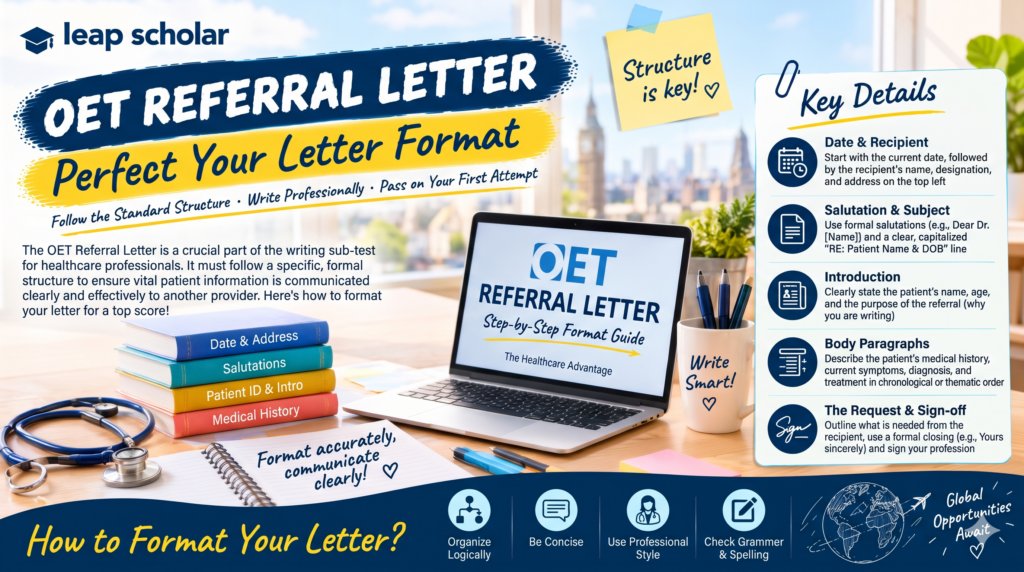
OET's Writing page says no particular layout is required, so read this table as one clear practice layout. The right column shows whether a point comes from OET or is practice advice.
| Part | What goes there | Practice note |
| Reader's title and address | Exactly as the task gives them | OET rule |
| Date | The task's date, if it states one | Otherwise today's practice advice |
| Greeting | "Dear" plus title and name | Practice habit |
| Opening | Why you're writing and what you ask | Reason clear at once (OET) |
| Body paragraphs | One time period or theme each | No paragraph limit (OET) |
| Closing | A line offering contact or thanks | OET style guidance |
| Sign-off | Polite close, your name and role | Practice advice |
What this section means for you: in the OET referral letter format, only the reader details are fixed, so put your effort into the opening and the body. As a fictional practice skeleton, not an official OET sample:
- Reader's title and address, from the task
- Date, the task's own if it gives one
- Dear reader's title and name,
- Opening: purpose and request
- Paragraph 2: the main facts the reader needs
- Paragraph 3: background that affects care
- Closing: an offer of more information
- Yours sincerely, your name and role
Treat this OET referral letter format skeleton as one option; OET accepts several. A Re: line (a subject line with the patient's name and age) is a common habit, not an OET rule, and the salutation (the "Dear" greeting line) and "Yours sincerely" are practice advice too. All capitals are fine if consistent.
My insight: If the task gives you the reader's title and address, copy them exactly and spend your thinking on the opening line, not on a fancier OET referral letter format.
How do you choose and order what to include in an OET referral letter?
OET's content guide says to include what is new to the reader and supports their care, so steps 3 and 4 of your plan choose the notes; ordering comes next.
- Keep: details that are new to the reader and help them continue their care.
- Leave out: anything the reader already knows or doesn't need.
- Stay accurate: keep each note's meaning and time frame when you rephrase it.
Then pick an order. Chronological means in time order; thematic means grouped by topic. Read each row as "if this fits your patient, start here."
| Order | When it fits | First body paragraph holds | Watch out for |
| Chronological | A routine case told as a timeline | The earliest event the reader needs | Old, unused events |
| Thematic | Several current issues | The most important theme | Two themes in one paragraph |
| Recent events first | An emergency | The latest events | Long older history |
What this means for you: the OET referral letter format stays the same, but the order inside it changes with each patient. Put the most important sentence first in each paragraph, and split one that mixes two themes.
My insight: If the reader can't tell their next step from your opening and first paragraph, your order is wrong, whatever the dates say.
A fictional practice outline: from note lines to referral letter paragraphs
Fictional example written for practice, not an official OET sample or clinical guidance.
The invented patient is Mr K. Example, 63; the reader is the dietitian at Example Clinic. His note lines, tagged:
- Mr K. Example, 63, was seen at the practice today. KEEP
- Has lost weight over recent months without trying. KEEP
- Says cooking feels pointless since he began living alone. KEEP
- Wants ideas for simple meals he can make. KEEP
- Happy to see a dietitian. KEEP
- Plays chess at a local club. LEAVE OUT
- Used to work as a printer. LEAVE OUT
- Takes a taxi to the practice. LEAVE OUT
The paragraph plan, not a full letter:
- Opening: "I am writing to refer Mr K. Example, aged 63, who has lost weight without trying in recent months, and to ask for your advice on simple, regular meals."
- Paragraph 2: the unplanned weight loss and when it was noticed.
- Paragraph 3: what affects care: living alone, cooking feels pointless, and wanting simple ideas.
- Closing: one line offering more information.
The request comes first, and the facts the dietitian will use sit together. Chess, the old job, and the taxi stay out because none changes the dietitian's next step. That is the OET referral letter format at work.
What the full letter looks like, built from that plan (fictional practice sample, not an official OET answer, roughly 185 words):
Dear Dietitian,
Re: Mr K. Example, aged 63
I am writing to refer Mr Example, who has lost weight without trying over the past few months, and to ask for your advice on simple, regular meals he can manage at home.
Mr Example was seen at the practice today. He reports a gradual, unintended weight loss that he first noticed around three months ago, with no change in his appetite that he can identify. He has no other new symptoms and remains stable on his current medication.
Several factors affect his eating at present. He has been living alone recently and says cooking now feels pointless without company. He would like practical ideas for simple meals he can prepare himself, and he is keen to see a dietitian to work through this.
I would be grateful if you could see Mr Example and advise him on manageable meal planning suited to his circumstances. Please contact the practice if you need any further information before his appointment.
Yours sincerely,
[Your name] General Practitioner
Notice what carried over from the paragraph plan: the request sits in the opening line, paragraph 2 holds only the weight-loss timeline, and paragraph 3 groups the two facts that actually affect care (living alone, finding cooking pointless). Nothing from the "leave out" list appears anywhere.
Which tone and language does the OET referral letter format expect?
OET's genre and style guide says a letter should be formal, which means polite, respectful, and free of judgment. The table compares weak and stronger fictional lines.
| Habit | Weak | Stronger |
| Greeting | "Hi Sam," | "Dear Dr. Example," |
| Contractions | "He's keen to start." | "He is keen to start." |
| Judgment words | "He has let himself go." | "He reports skipping meals most days." |
| Abbreviations | "Pt lives alone." | "Mr K. Example lives alone." |
| Note form | "Lives alone, poor appetite." | "He lives alone and reports a poor appetite." |
What this section means for you: tone is where the OET referral letter format meets your English, so write as one professional to another. A contraction (a short form like "he's") reads as informal. An abbreviation (a shortened word like "pt") suits only a reader whose specialty uses it.
- Open with purpose: use a verb such as "transfer," "update," "request," or "recommend."
- Close politely: offer contact or thank the reader.
- Check spelling: it sits under Language with punctuation and grammar, and mistakes count.
How is an OET referral letter marked on the six criteria?
Two OET assessors mark your letter against six assessment criteria (the fixed areas every letter is scored on), and the scores are combined and converted to OET's 500-point scale. The table maps each criterion to the part of your letter that earns it.
| Criterion (OET's name) | Scored out of | Where it shows in your letter |
| Purpose | 3 | Opening and request |
| Content | 7 | Which notes you kept |
| Conciseness & Clarity | 7 | What you cut and grouped |
| Genre & Style | 7 | Tone and full sentences |
| Organization & Layout | 7 | Paragraph and sentence order |
| Language | 7 | Grammar, vocabulary, punctuation, spelling |
The "out of" marks are OET's; the right column is practice advice. Grade B, which is the letter grade for 350, means 2 out of 3 for Purpose and 5 out of 7 for each of the other criteria. So the OET referral letter format you choose feeds every row.
Your regulator (the body that registers you to work as a nurse or doctor) sets your Writing score:
- Nurses, UK: for nursing in the UK, the NMC (Nursing and Midwifery Council) asks for at least grade C+ (300) in Writing.
- Nurses, Australia: AHPRA (the Australian Health Practitioner Regulation Agency) asks for Grade B (350) in Writing for tests taken on or after 23 April 2026 (previously C+/300), with no C+ concession like the NMC's.
- Doctors, UK: doctors on the doctor route to the UK meet the GMC (General Medical Council), which asks for at least grade B in every area on the medicine version.
My insight: Every criterion counts, and a spotless Language score can't rescue a letter whose opening hides the request.
Which mistakes break an OET referral letter?
OET's purpose guide treats each letter as having its own purpose, so most mistakes come from writing to a template instead of to this reader. Check your practice letters for these six:
- Buried request: the reader reaches paragraph three before learning what you want.
- Date order by default: the urgent part sits last only because the notes listed it last.
- Shifted meaning: a paraphrase changes a note or turns a past event into a present one.
- Casual tone: contractions, first names, or judgment words slip in.
- Pasted template: one fixed OET referral letter format reused for a new reader.
- Answer off the lines: on paper, only the lined answer pages are assessed, so nothing belongs elsewhere.
How should you spend the 45 minutes on an OET referral letter?
OET gives you 5 minutes of reading time and then 40 minutes to write, so your plan starts before you write a word. The split below is my suggestion, not an OET rule.
| Minutes | Step | What you have at the end |
| Reading, 5 minutes | Find reader and purpose, and group the notes | A plan for your letter |
| Writing, minutes 1-5 | Opening and closing request | Your purpose on the page |
| Writing, minutes 6-32 | Body paragraphs in your order | A full draft |
| Writing, minutes 33-40 | Check spelling, tense, and word range | A letter ready to hand in |
What this exercise means for you: rehearse this split until the OET referral letter format feels automatic under time pressure.
- On paper: use a pen or pencil; handwriting isn't assessed but must be readable.
- Build stamina: OET suggests practicing Listening for 40 minutes, Reading for 60, and Writing for 40, at least once a week.
My insight: If you can practice only one habit, write the opening and the request first; a letter that starts well and ends clearly survives a rushed middle.
What if your OET referral letter practice or Writing score falls short?
OET lets you request a remark (a second check of your marking) within 72 hours of receiving your results. First compare your score with your regulator's Writing number; the right fix depends on the gap.
OET's test fee is INR 39,200 (AUD 587), as listed on its paper-test page.
The fee is converted at 1 AUD = INR 66.7 as of October 2026 and will shift with the exchange rate, so check the latest rate before you pay.
- Time runs out: write the opening and request first; length alone isn't penalized.
- Case notes look unclear: use only what the task and notes say, and never invent a fact.
- Practice stalls: take the free OET sample tests and self-mark against the six criteria and the OET referral letter format table.
This content is general information, not immigration or medical advice; check your regulator's page before you decide.
3 Takeaways on OET Referral Letter Format
- Read the task first: use the 5 reading minutes to find the reader and purpose.
- Lead with the request: your OET referral letter format opens with the purpose, then groups the rest by time or theme.
- Plan the clock: write the opening first and keep the last minutes of the 40 for checks.
Talk to a Leap Scholar counselor to plan your OET Writing practice around your regulator's score.
Frequently Asked Questions About OET Referral Letter Format
-
What is the correct OET referral letter format?
There is no single correct OET referral letter format: OET only asks for a clear layout that suits the task. Use the reader's title and address exactly as the task provides them, followed by an opening that states your purpose, body paragraphs, a closing line, and a polite sign-off.
-
Is there a special OET referral letter format for Indian students?
The OET referral letter format is the same for Indian candidates as for everyone else. OET sets the Writing task by profession, and the same rule applies: a clear layout that suits the task and uses the reader details given.
-
Can I download an OET referral letter format PDF?
Start with OET's own material rather than a third-party OET referral letter format PDF. OET's free sample tests cover the paper and computer tests, and its Writing pages explain the layout rules. Copied tasks on file-sharing sites may not be official OET material.
-
How many words should an OET referral letter have?
Aim for a word count of 180-200 words, as per OET's range. OET says there's no automatic penalty for going over or under, and each task is designed to fit that range. A much longer letter often suggests irrelevant material, while a much shorter one may mean missed information.
-
Do I need a Re: line, date, and address in the OET referral letter format?
Use the reader's title and address as the task gives them, and use a date if the task states one. A Re: line naming the patient is a common practice habit you may add, but it isn't an OET rule: the OET referral letter format has to be clear.
-
Is the OET letter the same as the IELTS letter?
The two tasks are different: OET Writing is a formal letter on a profession-specific matter, written from case notes for the reader to the task names. IELTS has its own Writing Task 1 letter; the IELTS General Writing Task 1 page covers it.
-
Can I write the letter in note form or bullet points?
Write in full sentences, not in note form or bullet points. The reminders printed with OET case notes ask you to expand the relevant notes into complete sentences. Short phrases copied straight from the notes don't match the formal letter style OET expects.
-
Does spelling or handwriting affect my OET referral letter score?
Spelling counts: it sits under Language with punctuation and grammar, and spelling mistakes are taken into account, though OET says it needn't be perfect for grade B. Handwriting on paper isn't assessed, but it must be clear enough to read, whatever OET referral letter format you choose.









Have Questions? Get Guidance to reach your Dream University
Connect with India's finest counsellors and biggest study abroad community.
Get Guidance