
Quick Read
- OET eligibility has no degree or work experience check; the Medicine version and your regulator decide the rest.
- The GMC needs Grade B (350) in all four Medicine-version OET skills, same sitting.
- The OET fee is about INR 39,300 (AUD 587) at current rates.
- For Indian candidates, a passport is accepted as ID for every OET mode.
Do you meet the OET eligibility criteria as a student or fresher?
OET, the Occupational English Test, is an English test built for health professionals working towards registration in an English-speaking setting. So can you sit it if you’re still in your final year or have no work experience yet?
Short answer: the OET eligibility criteria are lighter than most students fear. OET itself does not run a degree check or an experience check. Our full OET exam guide covers fees, dates, and the test pattern in depth, so this page sticks to who can sit the test and what doctor-focused regulators ask for.

Choose your dream country
 UK
 USA
 Germany
 Australia
 Ireland
 Canada
 UAE
 France
 Sweden
 Italy
 Other
When do you want to study abroad?
What's your highest level of education?
Have you completed Class 12th?
What was your Class 12 CGPA/percentage?
Are you a student or a parent/guardian?
What do you want to study?
Select your current city
How Leap will help you

Personalised University Shortlist

Express Applications with Quicker Admits

End-to-End Application Support
The tougher rules come from your regulator, which is the official body that registers nurses or doctors in a country and decides which English proof it accepts. OET is owned by CBLA, which is Cambridge Boxhill Language Assessment Unit Trust, a venture between Cambridge English and Box Hill Institute that has owned the test since 2013.
This is what OET asks of every candidate, whatever their stage:
- Your own booking: you accept OET's terms and conditions and register with a personal email.
- Valid ID: you book with an ID and show the same ID on test day.
- Payment at booking: the fee is paid when you book, not later.
OET's Test Regulations set no degree or work experience requirement, which is good news if you're a fresher. But OET also says that if you're not a health professional working towards registration, the test may not be the most suitable one, so consult your regulator before you register.
One note: the OET eligibility criteria here mean who can sit the test, not the Writing and Speaking marking criteria.
Sources: about OET, OET Test Regulations
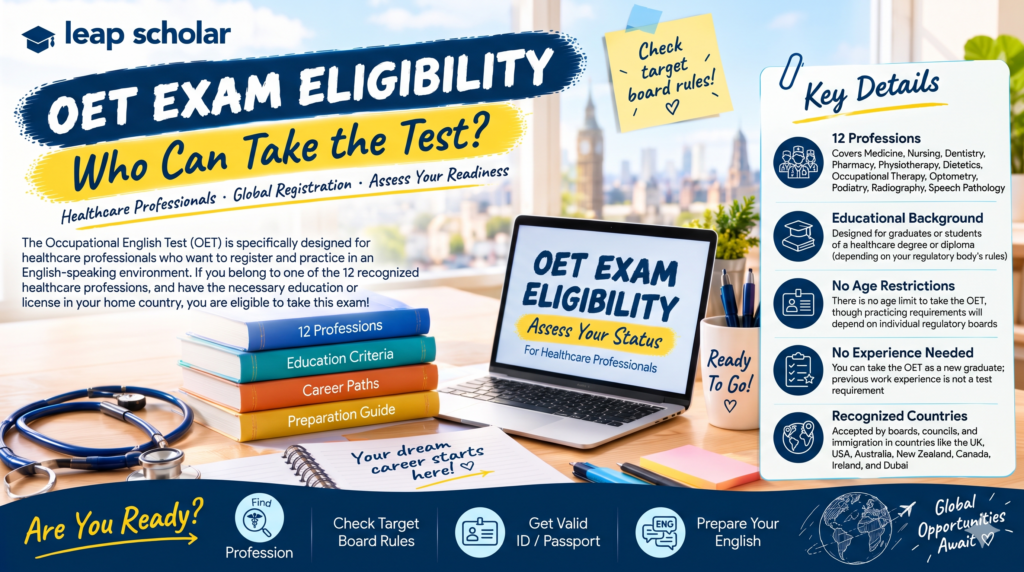
OET covers 12 professions, but you only need the Medicine version
Under the OET eligibility criteria, 12 healthcare professions can book OET, and you book the version for your field. OET has four sub-tests, which are its four parts: Listening, Reading, Writing, and Speaking. A profession version means the Writing and Speaking tasks are set for your field, while Listening and Reading are the same for everyone.
As a doctor, you book the Medicine version: only your Writing and Speaking tasks are built around clinical scenarios like referral letters and patient consultations.
If you're weighing the UK specifically, see the doctor route to the UK for the full registration path beyond just the English test.
Sources: OET test overview
OET eligibility criteria on booking day: ID, one booking, and four sub-tests
On booking day, the OET eligibility criteria are three things: valid ID, one booking per test window, and all four sub-tests at your first sitting.
A valid passport shows your name, date of birth, photo, and expiry date. The ID rules:
- Passport for every mode: it works for paper, computer, and at-home tests.
- National ID: one from the national government where you sit works; computer and at-home tests need English lettering or a certified translated copy with the original.
- Never a driver's license: it isn't accepted for any mode.
- Same ID twice: the ID you book with must be the ID you carry on test day.
- No ID, no test: without valid ID you can't sit, and you may not get a refund.
A test administration is one OET test period, a set of test dates, and you may hold only one booking in each. Your first sitting must also include all four sub-tests, with Listening, Reading, and Writing taken together.
My insight: If you're torn between booking now and booking later, decide your regulator and mode first. OET won't stop you from paying INR 39,300 (AUD 587), so the real risk is a result your regulator doesn't accept.
Sources: OET test day ID rules
OET eligibility by test mode: paper, computer, or OET@Home?
There are three OET modes. Each one changes the booking cutoff and the ID you can use, while the fee stays the same.
- OET on Paper: The first mode is the pen-and-paper test, taken at a test venue.
- OET on Computer: Listening, Reading, and Writing at a venue; Speaking at home or at a venue in select countries.
- OET@Home: this test is the remote version you take from your own home.
OET@Home adds its own OET eligibility criteria. Your computer must meet the system requirements, and you must either live where no paper or computer venue exists or get approval for exceptional circumstances, such as a medical condition. It has limits, and not every regulator accepts it.
Use this table to match each mode to its booking cutoff, fee, and ID:
| Mode | Bookings close | Fee | ID that works |
| OET on Paper | 24 days before the test | INR 39,300 (AUD 587) | Passport or national ID |
| OET on Computer | 7 days before the test | INR 39,300 (AUD 587) | Passport or national ID |
| OET@Home | 7 days before the test | INR 39,300 (AUD 587) | Passport or national ID |
The fee is converted at 1 AUD = INR 66.93 as of October 2026 and will shift with the exchange rate, so check the latest rate before you pay.
For doctors specifically: the GMC's own guidance accepts OET results from all three modes paper, computer, and OET@Home for registration and for PLAB. Ahpra and MCNZ are stricter; see the regulator table below before you pick a mode.
What this means for you: in India, plan on paper or computer at a venue. Before you pick a mode, look up who recognizes OET in that mode for your regulator.
Sources: OET booking page, who recognizes OET, , gmc-uk.org (Using your OET certificate)
Which regulators set the OET score for doctors?
Your regulator, not OET, decides whether you need an English test, which OET scores count, and which modes it accepts. A recognized organization is OET's name for any regulator, employer, or authority that accepts OET results.
Each sub-test (one of the four parts) gets a score and a letter grade. Grade B starts at 350, and Grade C+ covers scores of 300 to 340. These are the four regulators most Indian doctors ask about, with the OET Medicine-version scores currently in force:
| Regulator | OET scores | Modes and limits |
| GMC (UK) | Grade B (350) in Listening, Reading, Writing, and Speaking, all in the same sitting, from your most recent attempt | Paper, computer, or OET@Home; valid 2 years; no combining across sittings |
| Ahpra / Medical Board of Australia | Numeric score (not letter grade) for tests taken on or after 23 April 2026: 350 in Listening and Writing, 360 in Reading and Speaking. Tests sat on or before 22 April 2026 are still assessed on the older Grade B/C+ scale. | Test centre only, paper or computer, not OET@Home; valid 2 years |
| Medical Council of New Zealand (MCNZ) | 350 in Listening, Reading, Speaking; 300 in Writing | One sitting, or two sittings within 12 months if no score falls below the minimum; valid 2 years |
| Ireland (HSE Circular 063-2020, for doctors joining the public health service) | Overall and per-skill minimum of Grade B in Listening, Reading, Writing, and Speaking | Check with the HSE/Medical Council for the latest circular before booking |
Ahpra combining (tests from 23 April 2026): up to two sittings within 12 months, provided no score falls below the floor of 320 in Listening, 340 in Reading, 350 in Writing, and 350 in Speaking.
What this means for you: a GMC-ready 350 across the board is actually below Ahpra's current bar Ahpra now wants 360 in Reading and Speaking, not 350. Ahpra and MCNZ both allow combining two sittings within 12 months (each with its own floor scores); the GMC does not.
If you're weighing Australia, note that the Medical Board of Australia also accepts the PLAB test or NZREX as an alternative route to the English-test requirement, per Ahpra's own accepted-tests page.
My insight: Read your regulator's page for the exact scores before you book. A result that meets one regulator's requirements may not meet another's, and NMBI accepts only a single sitting.
This is general information, not legal or registration advice; check the GMC, Ahpra, Medical Council of New Zealand, or HSE page before you decide.
Sources: gmc-uk.org (Using your OET certificate), ahpra.gov.au (Accepted English language tests), mcnz.org.nz (English language policy), HSE Circular 063-2020
Do you need OET at all? Non-test routes for doctors
The GMC lets you skip OET or IELTS entirely in two cases:
- Primary medical qualification (PMQ) in English: accepted only if your degree is less than two years old at the time of registration and was taught and examined solely in English.
- Structured English Language Reference (SELR): a formal UK job offer where the employer confirms your English proficiency directly, used mostly for niche specialties and not the usual route for most Indian IMGs.
For Ireland, doctors who completed their entire medical degree in English in Australia, Canada, New Zealand, the USA, or the UK, or who hold an Irish Leaving Certificate/UK A-Levels plus a medical degree in English, are generally exempt from the HSE's IELTS/OET requirement. Check the current HSE circular for your exact category.
Your regulator decides whether your evidence fits, so ask before you skip the test. If none of these routes fits you, the OET eligibility criteria above are your next step.
Sources: gmc-uk.org (Evidence of your knowledge of English), HSE Circular 063-2020
OET eligibility criteria checklist for Indian Doctors
This seven-step checklist turns the OET eligibility criteria into an order of work, so you never pay before you know the test will count.
- Confirm your field: you are a health professional or are working towards registration as a doctor.
- Name your regulator: pick the country and open its English language page.
- Note its rules: write down the scores, accepted modes, result validity, and sitting rules.
- Book the Medicine version of OET.
- Check your passport: it must be valid, and your booking name must match it.
- Choose mode and date: paper bookings close earlier than computer ones.
- Plan the fee: keep about INR 39,300 ready for each sitting.
Keep these other exams separate from OET in your plan:
- Doctors aiming for the UK: the PLAB exam is the UK licensing test for doctors, a separate step from the English test.
- Medicine studied abroad: if you plan to practice in India first, the FMGE exam, India's licensing test for foreign medical graduates, has its own eligibility rules.
- UK hospital jobs: the NHS is the UK's National Health Service, and anyone aiming for NHS roles still needs to register with their UK regulator first.
- Postgraduate route to the UK: the Medical Training Initiative (MTI) scheme is another route into NHS experience for Indian doctors, separate from PLAB, and it still needs the same GMC English-language evidence above.
My insight: If you're torn between booking OET now or later, book when your application can follow soon after. GMC, Ahpra, and MCNZ results all count for two years from the relevant application date.
OET or IELTS: which fits your eligibility criteria?
The GMC accepts both OET and IELTS Academic, so for UK medical registration you can choose the format that works best for you. OET uses healthcare tasks set for your profession. IELTS Academic doesn't.
You can't combine an IELTS result with an OET result at most regulators, so commit to one test per attempt.
See our full OET vs IELTS comparison if your regulator accepts both and you're still deciding.
The OET eligibility criteria won't decide your path for you. If you write clinical notes and talk to patients every day, OET's tasks may feel more familiar.
Our OET Writing sample letters for doctors show what the referral-letter task actually looks like.
What if you do not meet the OET eligibility criteria or score?
Missing a score is the most common setback. Of the four regulators above, Ahpra and MCNZ let you combine results from two sittings within 12 months, each against its own floor scores. The GMC requires a single, most-recent sitting for all four skills. Here's what to do in each case:
- You miss one score: the GMC needs every skill from one sitting, so a single weak score usually means a full retake. Ahpra and MCNZ will each combine two sittings within 12 months if no score falls below their respective floors.
- You miss the booking cutoff: paper closes earlier than computer, so a computer date may still be open.
- Your ID isn't valid on the day: you can't sit, and you may not get a refund.
- Your regulator rejects your mode: Ahpra doesn't accept OET@Home for doctors, so book a centre based test instead if you're targeting Australia.
- Your OET certificate has aged past two years: the GMC may extend its validity if you passed PLAB 2 within the last three months, and your certificate is still under three years old; otherwise, you'll likely need to resit.
Who should you contact? Ask OET support about bookings and ID, your regulator about scores and modes, and your counselor about your next sitting. Falling short of the OET eligibility criteria once isn't a judgment on your ability; it's a rule you can plan around.
My insight: If one sub-test is the gap, check whether your regulator allows combining before paying for another full sitting. The GMC does not, so for the UK you need all four scores from one sitting.
Sources: gmc-uk.org (Using your OET certificate)
3 Takeaways on OET Eligibility Criteria
- The OET eligibility criteria ask for no degree, but your regulator sets the bar: a GMC-ready 350 across all four skills is actually below Ahpra's current Reading/Speaking minimum of 360, so check the exact table above before you book.
- Carry a passport that matches your booking: a driver's license is never accepted.
- Check scores and mode before you pay INR 39,300 (AUD 587): the GMC allows OET@Home, but Ahpra does not.
Talk to a Leap Scholar counselor to check which regulator and OET mode fit your profile.
Frequently Asked Questions About OET Eligibility Criteria
-
What are the OET eligibility criteria for Indian doctors?
The OET eligibility criteria for Indian doctors are simple at the test level: book the Medicine version, accept OET's terms, and carry valid ID. Your regulator sets the scores; the GMC, for example, asks for Grade B (350) across all four skills in one sitting.
-
Can a final-year MBBS student take OET?
The OET eligibility criteria don't include a finished degree, and OET describes the test as built for health professionals working towards registration. Your regulator decides when you can apply and how long a result stays valid, so check its page before booking, because an early result may expire first.
-
Do I need work experience to meet the OET eligibility criteria?
OET's Test Regulations set no work-experience requirement, so a fresher can book. Experience matters elsewhere: the GMC's SELR route can use an employer's reference after two years of continuous practice in an accepted English-speaking country. Ask your regulator what counts for you.
-
Which ID do I need to book OET in India?
Under the OET eligibility criteria, a valid passport works for every mode. A national ID from the national government where you sit also works for the computer and OET@Home needs English lettering or a certified translated copy. A driver's license is never accepted.
-
Can I take OET at home from India?
OET@Home is open only where no paper or computer venue exists or with approval for exceptional circumstances such as a medical condition. Check your regulator too: the GMC accepts OET@Home, while Ahpra requires a test centre. Confirm MCNZ's current accepted modes directly with the Council before booking.
-
Which professions fit the OET eligibility criteria?
Twelve professions fit: medicine, nursing, dentistry, dietetics, pharmacy, physiotherapy, podiatry, radiology, occupational therapy, veterinary science, optometry, and speech pathology. Listening and Reading are the same for everyone, while Writing and Speaking are set for your profession, so book the version that matches your registration.
-
Who decides what OET score I need?
Your regulator or employer decides, not OET. OET asks you to confirm minimum results, accepted modes, and whether one sitting is required before you book. That is why the OET eligibility criteria for one country can differ from another's, even for the same profession.
-
Are OET eligibility criteria the same as the OET Writing and Speaking criteria?
They are different things. Eligibility is about who can sit the test, while assessment criteria are the marking guides used for Writing and Speaking. If you searched for those marking guides, the OET exam guide linked above covers the test pattern and grading.









Have Questions? Get Guidance to reach your Dream University
Connect with India's finest counsellors and biggest study abroad community.
Get Guidance