
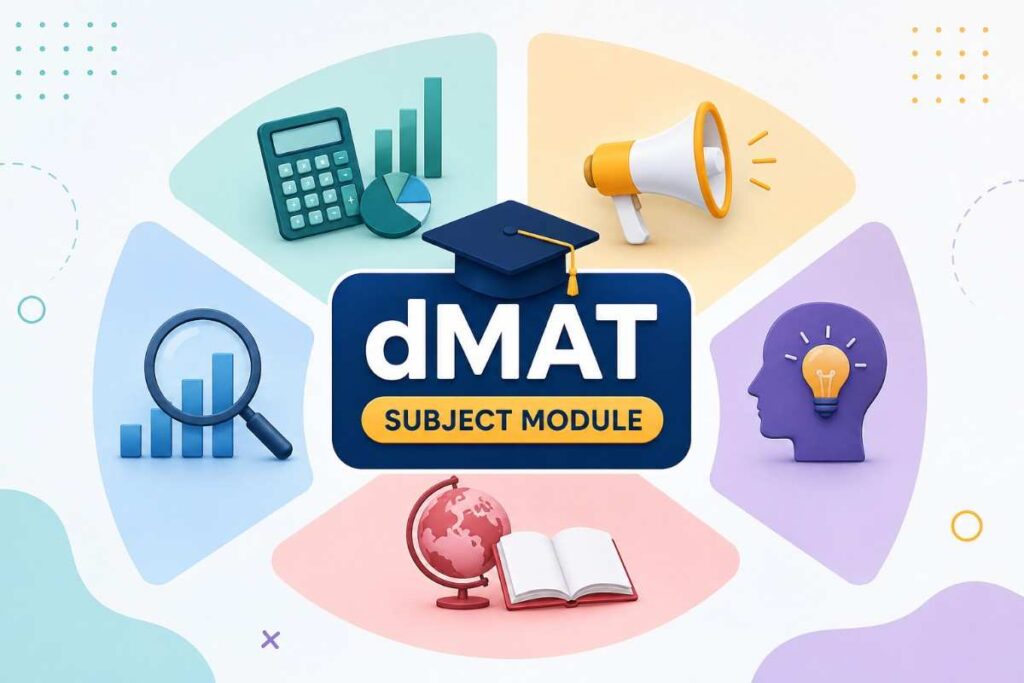
Quick Read
- The dMAT Exam Subject Module tests applied knowledge, not memorised facts.
- Most APS India applicants sit only the General Academic Module.
- Field-specific modules currently apply to just two German universities.
- Subject Module runs 90 minutes after a 30-minute break.
- Fee is Rs.16,506 (€150), separate from your APS certificate fee.
- First India Subject Module exam is scheduled for 26 September 2026.
The dMAT Exam Subject Module is the second half of the Digital Master Assessment Test, and it is where most of the confusion about this new APS India requirement actually sits. Understanding the dMAT Subject Module correctly before you register saves you from preparing for the wrong content entirely. The Core Module is identical for every applicant. The Subject Module is not, and which version you sit depends on your bachelor’s field and, in a small number of cases, the specific German program you are targeting. If you get this part wrong, you may either prepare for content that won’t appear on your screen or miss that a field-specific module applies to you.
dMAT Battery Science Module: Full Syllabus
The subject module covers five engineering areas. Start with the overview, then work through the section that matches your degree. Every page has free practice questions with solution paths.
Battery Science and Technology in Engineering
Module overview · format, timing and the full topic list · 15 practice questions
Mechanical Engineering
Synthetic materials · Mathematics II · Rankine cycle
What Is the dMAT Exam Subject Module?
The Subject Module is a 90-minute section that follows the Core Module after a 30-minute break, developed by g.a.s.t., the German organization that also runs TestDaF and TestAS. Instead of the abstract reasoning tasks in the Core Module, the Subject Module gives you a short academic scenario, sometimes with a table, figure, or passage attached, and asks single-choice questions based on it.
The official framing matters here: the Subject Module tests your ability to apply knowledge from your bachelor’s degree to a new problem, not how much of your syllabus you can recall. A commerce graduate is not tested on definitions from an accounting textbook. They are cased and asked to reason through it the way they would in a real academic setting.
Counselor insight: Students consistently over-prepare for the Core Module’s logic puzzles because they feel more approachable to revise for and under-prepare for the Subject Module because there is no obvious textbook to open. That imbalance is backwards. The Subject Module carries equal weight in your combined score.
Do You Sit the General Academic Module or a Field-Specific One?
This is the single most misunderstood part of the dMAT Subject Module, and several guides online blur it further by using “Subject Module” and “Engineering Subject Module” interchangeably. As of the 2026 rollout, there are two completely unique tracks:
Track 1: General Academic Module. This is what almost every APS India applicant sits, regardless of whether their degree is in Engineering, Commerce, Finance, Economics, Business, or Management. It is not tied to your specific stream. It draws on quantitative reasoning, business and economic scenarios, and social science material applied to a general academic problem.
Track 2: Field-Specific Subject Modules. These currently exist for exactly six named tracks, tied to two specific German programs, not to the APS India process in general.
Here is how to position yourself based on your current situation:
- If you are a final-year BTech Computer Science student graduating in 2027, applying broadly to MS programs in Germany, and you are not specifically targeting RWTH Aachen’s Battery Science and Technology program: you sit the General Academic Module. Your Computer Science background does not automatically place you in a Computer Science Subject Module.
- If you are a Mechanical, Electrical, Chemistry, Physics, or Computer Science background applicant specifically applying to RWTH Aachen’s MSc Battery Science and Technology in Engineering: you sit the field-specific Subject Module that matches your background, as required by that program.
- If you are applying to Georg-August University Göttingen’s MSc Data Science: You sit in the Data Science Subject Module, which the program uses as one of its selection inputs.
Counselor insight: The mistake we see most often at LeapScholar is a student assuming their undergraduate major decides their Subject Module. It does not. The program you are applying to decides it, and outside RWTH Aachen’s Battery Science track and Göttingen’s Data Science track, every APS India applicant defaults to the General Academic Module.
What the General Academic Module Actually Tests
Since the General Academic Module is the module that applies to the overwhelming majority of Indian applicants, it is worth understanding in its own right. You are given a typical academic problem, occasionally with a short passage, a data table, or a simple figure, followed by single-choice questions that test whether you can extract and apply information correctly. The subject matter draws from quantitative reasoning, business and economic case scenarios, and general social science content, not from any single degree’s syllabus.
There is no published chapter list to revise from, and every official source, including g.a.s.t. itself, is explicit that the omission is intentional. Preparation here looks like practicing with sample academic passages and case-style questions, not re-reading old semester notes.
Counselor insight: Don’t hunt for a “General Academic Module syllabus” the way you would for a competitive exam. Revise how you use concepts under time pressure. An accounting graduate benefits more from applying a ratio to a case study than from re-reading its definition.
The Five RWTH Aachen Subject Modules (Battery Science and Technology)
RWTH Aachen University uses dMAT as a selection input specifically for its MSc Battery Science and Technology in Engineering program. Applicants to this program, depending on their undergraduate background, sit in one of five discipline-specific Subject Modules rather than the General Academic Module.
| Subject Module | Tests | Who it applies to |
|---|---|---|
| Chemistry | Applied chemistry concepts relevant to battery materials and processes | Chemistry background applicants to this RWTH program |
| Physics | Applied physics reasoning relevant to energy systems | Physics background applicants to this RWTH program |
| Computer Science | Applied CS concepts and problem-solving | CS background applicants to this RWTH program |
| Electrical Engineering | Applied electrical engineering reasoning | EE background applicants to this RWTH program |
| Mechanical Engineering | Applied mechanical engineering problem-solving | Mechanical background applicants to this RWTH program |
Each of these tests the ability to apply concepts acquired during your Bachelor’s degree, using the same input-plus-questions format as the General Academic Module, just built around discipline-specific scenarios instead of general ones. If you are aiming for top engineering universities in Germany and RWTH Aachen’s Battery Science program specifically is on your shortlist, confirm with the program directly which of these five applies to your background before you register.
The Göttingen Data Science Subject Module
Georg-August University Göttingen encourages applicants to its MSc Data Science program to take the dMAT with the Data Science Subject Module. This tests applied statistical reasoning, data interpretation, and problem-solving relevant to a Data Science curriculum, using the same scenario-and-question format as the other modules.
If MS in Data Science in Germany at Göttingen is your target, this is the module to prepare for rather than the General Academic Module.
Outside these two universities and six named modules, no other German institution currently treats a dMAT Subject Module score as a formal input into its own admission decision. Every other applicant defaults to the General Academic Module purely for APS documentation purposes.
dMAT Exam Subject Module Timing, Format and Fee
The Core Module runs 90 minutes across three subtests (Figure Sequences: 25 min, Mathematical Equations: 25 min, and Latin Squares: 20 min). The Subject Module runs 90 minutes on top of that. Per the official g.a.s.t. preparatory materials, the exam itself runs to about three hours across both modules, with a 30-minute break between them, which is where the commonly quoted “3.5 hours” total, including the break, comes from.
Every question in the Subject Module is single-choice, delivered on a computer, in English. No calculators, rough sheets, or notes are permitted at any point.
Your result is reported on two scales: a dMAT score standardised between 0 and 200 with a mean of 100 and a percentile rank showing how you performed against other test-takers. Core Module and Subject Module results are calculated separately, then combined into a total.
The dMAT fee is €150, which comes to Rs.16,506 at an exchange rate of Rs.110.04 per Euro. This is paid directly through the g.a.s.t. registration portal, separate from your APS certificate fee, which you should confirm at its current amount directly on APS India.
Exchange rate used: Rs.110.04 per Euro. Verify the current rate before finalizing your budget.
How to Prepare When There’s No Fixed Subject Module Syllabus
Because neither the General Academic Module nor most field-specific dMAT Subject Module tracks come with a chapter-wise syllabus, preparation has to be built around task familiarity and applied reasoning rather than content revision.
If you are taking the General Academic Module: practise reading short academic or business passages, tables, and simple figures, then answer application-style questions about them. Revise how you apply core concepts from your degree in unfamiliar scenarios, rather than simply re-reading definitions.
If you are sitting in one of the RWTH Aachen field-specific modules: g.a.s.t. has published official preparatory materials for these tracks, including worked examples, for Chemistry, Physics, Computer Science, Electrical Engineering, and Mechanical Engineering. Work through these materials directly, rather than assuming that your regular coursework covers the same content.
If you are sitting in the Göttingen Data Science module, published preparatory materials are available for this track as well and are the most reliable indicator of question style and difficulty.
Documents and registration checklist:
| Requirement | Detail for Indian applicants |
|---|---|
| Valid email and identity documents | Your name must match your passport exactly when registering on the dMAT website |
| APS eligibility confirmation | Confirm your Bachelor’s field is on the affected list (Engineering, Commerce, Finance, Economics, Business, Management) before registering |
| Test centre selection | Choose from 10 centres: Ahmedabad, Bengaluru, Bhopal, Chandigarh, Chennai, Kolkata, Mananthavady, Mumbai, New Delhi, Pune |
| Program-specific confirmation | If targeting RWTH Aachen Battery Science or Göttingen Data Science, confirm the exact Subject Module with the program before registering |
| Fee payment | Rs.16,506 (€150), paid on the g.a.s.t. portal, separate from your APS fee |
Month-by-month calendar for the 2026 cycle:
| Period | What to do |
|---|---|
| Now through August 2026 | Confirm your eligibility and target Subject Module; begin practicing with any published sample materials |
| By 15 September 2026 | Complete dMAT registration; this is a hard deadline with no confirmed makeup sitting |
| 26 September 2026 | Sit the Core Module and your Subject Module |
| 12 October 2026 | Certificates become available; submit alongside your APS documentation |
| After 12 October 2026 | Proceed with your APS application for the Summer 2027 intake |
What Happens If You Pick the Wrong Module or Miss the Deadline
If you registered for the wrong dMAT Subject Module, correct this through the g.a.s.t. portal before your registration closes; there is no confirmed process to switch modules after the exam date. If you are unsure which module applies to you, especially for borderline degrees like BSc Statistics, integrated MBAs, or dual-major programs, get written confirmation from APS India before registering rather than guessing based on subject overlap.
Missing the 15 September 2026 registration deadline means missing the 26 September 2026 sitting entirely, with no confirmed makeup date currently announced for this cycle. Since dMAT certification feeds into your APS documentation for the Summer 2027 intake, a missed cycle can delay your entire application timeline by a full intake.
A low Subject Module score does not automatically block your APS certificate. APS India has confirmed the dMAT does not replace document verification, and your score is reported to universities as one input among several, not a pass or fail gate.
Counselor insight: Treat a weak practice score as a signal to adjust your prep focus, not as a reason to panic or delay registration. The registration deadline is fixed regardless of how ready you feel.
Key Takeaways on dMAT Subject Module
Three things to act on before you go any further with your dMAT preparation:
- Confirm which Subject Module actually applies to you: the General Academic Module for almost everyone, or one of the six field-specific modules only if you are targeting RWTH Aachen’s Battery Science program or Göttingen’s Data Science program.
- Register before 15 September 2026 regardless of how prepared you feel, since there is no confirmed makeup sitting for a missed cycle.
- Budget Rs.16,506 (€150) for the dMAT separately from your APS certificate fee, and build your preparation around applying concepts under time pressure, not memorizing a syllabus that does not exist.
Verified by: LeapScholar’s Germany counseling team, with hands-on experience guiding Indian students through APS certification and German Master’s admissions.
Have questions about your dMAT Subject Module eligibility? Book a free session with a LeapScholar counselor.
Frequently Asked Questions About dMAT Exam Subject Module
-
What is the difference between the dMAT Core Module and Subject Module?
The Core Module is identical for every applicant and tests general reasoning through three subtests. The Subject Module varies by your field or target program and tests applied academic knowledge using a scenario-plus-questions format, not memorized facts.
-
Do all dMAT applicants take the same Subject Module?
No. Most APS India applicants sit for the General Academic Module regardless of their Bachelor’s field. Field-specific Subject Modules currently apply only to RWTH Aachen’s Battery Science and Technology program and Göttingen’s Data Science program.
-
Is there a fixed syllabus for the dMAT Subject Module?
No traditional chapter-wise syllabus exists for any Subject Module. Preparation focuses on applying concepts from your Bachelor’s degree to new academic scenarios rather than memorizing a defined content list.
-
How much does the dMAT Subject Module cost?
The full dMAT, covering both the Core and Subject Modules, costs €150, which is Rs.16,506 at Rs.110.04 per Euro. This is paid separately from your APS certificate fee.
-
What happens if I select the wrong Subject Module?
Correct your selection through the g.a.s.t. portal before registration closes. There is no confirmed way to change modules after the exam date, so confirm your correct module with APS India or your target program in advance.
-
Does the dMAT replace IELTS or TOEFL for Germany?
No. The dMAT is an academic aptitude test that feeds into your APS documentation. Your English language requirement for Germany through IELTS, TOEFL, or another accepted test remains a separate requirement.
-
Is the dMAT Subject Module the same as TestAS?
No. TestAS is a separate, longer-standing aptitude test used for different admission purposes. The dMAT is a newly introduced test that sits specifically inside the APS India documentation process and does not replace TestAS where a program independently requires it.
-
What if I miss the dMAT registration deadline?
You will not be able to sit that cycle’s exam, and no confirmed makeup sitting exists for missed registrations in 2026. This can delay your APS documentation and push your intended Summer 2027 intake to a later cycle.
-
Does a low Subject Module score affect my APS certificate?
Not directly. APS India has confirmed the dMAT does not replace document verification and a low score does not cause automatic APS refusal. Universities that consider the score treat it as one input among several.











Have Questions? Get Guidance to reach your Dream University
Connect with India's finest counsellors and biggest study abroad community.
Get Guidance