
Quick Read
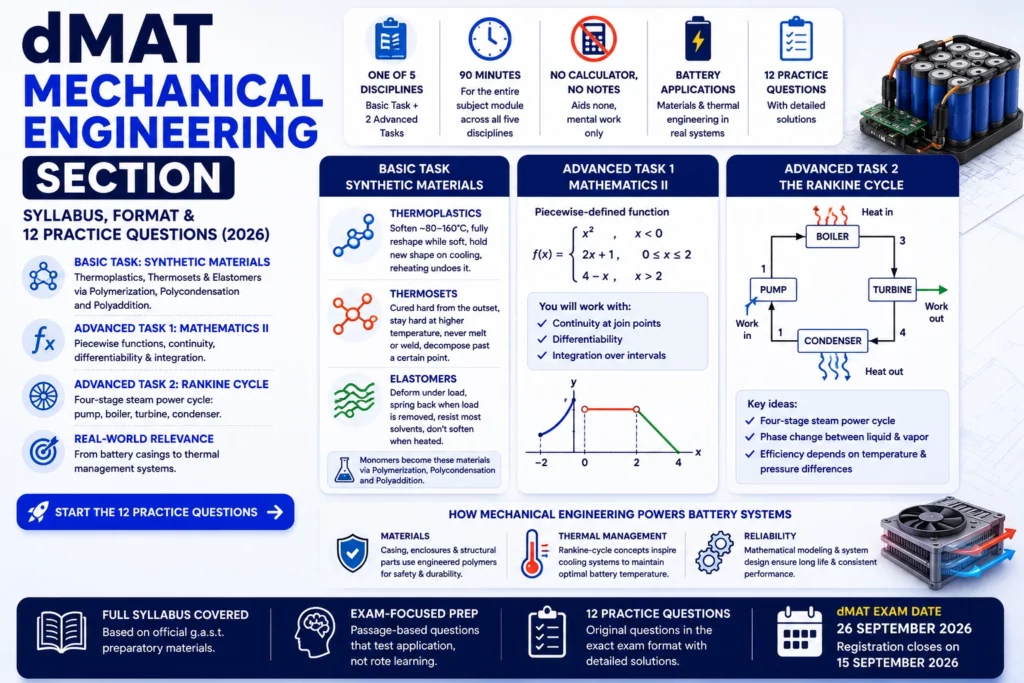
- One of five disciplines in the dMAT Battery Science module, not a standalone test, tested in the Basic Task plus two Advanced Tasks
- Basic Task: synthetic materials (thermoplastics, thermosets, and elastomers). Advanced Tasks: Mathematics II, then the Rankine cycle
- Both advanced topics map to real battery engineering: materials to housings/casings, the Rankine cycle to thermal management
- 90 minutes covers the whole subject module across all five disciplines together, not 90 minutes for Mechanical alone
- Method: sort materials into one of three behaviours (softens/stays hard/springs back), work piecewise functions piece by piece, keep Rankine stages in strict order
- Attempt 12 free practice questions below using this method
This guide sets out exactly what this module asks, who needs to prepare for which part of it, and gives you 12 original practice questions with full solution paths so you can see the format before test day.
What Is the dMAT Mechanical Engineering Section?
The Battery Science and Technology in Engineering subject module tests undergraduate engineering knowledge across five areas: chemistry, physics, computer science, electrical engineering, and mechanical engineering. Every candidate sitting this module answers a Basic Task in all five areas, then moves on to Advanced Tasks that go deeper.
Basic Task: Synthetic Materials.
| Material | Behaviour |
|---|---|
| Thermoplastics | Soften ~80-160°C, fully reshape while soft, hold new shape on cooling, reheating undoes it |
| Thermosets | Cured hard from the outset, stay hard at higher temperature, never melt or weld, decompose past a certain point; only machining changes a finished part |
| Elastomers | Deform briefly under load, spring back once load is removed, resist most solvents, don’t soften when heated |
Advanced Task 1: Mathematics II
Advanced Task 1, Mathematics II, works with piecewise-defined functions over a stated domain, checking continuity where pieces meet, testing differentiability, then integrating. Advanced Task 2, the Rankine Cycle, is the four-stage steam power cycle behind steam-driven generation, worked through as the fluid changes phase between liquid and vapor, and looks at what drives efficiency.
Advanced Task 2: The Rankine Cycle
It is the four-stage steam power cycle behind steam-driven power generation. It’s worked through as the fluid changes phase between liquid and vapor, with a look at what drives its efficiency.
How to Solve dMAT Mechanical Engineering Questions
Read the materials passage for definitions, not memorization. The distinction between a thermoplastic, a thermoset, and an elastomer usually depends on one property: does it soften and reshape, stay hard and decompose, or spring back after deformation? Sort a scenario into one of those three behaviors, and most material questions answer themselves.
Work Mathematics II piece by piece. A piecewise function is several separate functions stitched together at boundary points. Identify which piece applies to the value the question asks about first, and check continuity and differentiability only at the join points.
Keep the Rankine cycle stages in strict order. Pump, boiler, turbine, condenser. Know which stage changes pressure, which changes phase, and which does both, and locate where in that sequence the question is asking.
Use the passage’s numbers rather than recalling your own. Substituting a half-remembered textbook constant instead of the passage’s stated value is a common way to lose easy marks.
Pace yourself across all five disciplines. With 90 minutes for the whole subject test, mechanical engineering is one fifth of your time budget, not the whole exam. If a question is taking too long, mark your best guess and move on.
dMAT Mechanical Engineering Practice Questions with Answers (Free)
The 12 questions below are original, written to test the same concepts the syllabus above describes, across four short reading passages: materials compared, choosing a material for a stated requirement, the three production routes, and the Rankine cycle. Work through them without notes and without a calculator, the same conditions you will have in the exam.
📄 Input 1 · Synthetic Materials: Thermoplastics, Thermosets and Elastomers Compared
Synthetic materials used in engineering divide into three families based on how they behave when heated. Thermoplastics turn soft somewhere in the range of about 80 to 160 degrees Celsius, at which point they can be reshaped completely; once cooled they hold the new shape, but heating them again undoes it. Thermosets are set hard from the start and stay hard even at raised temperature: they will not melt, burn or fuse to another piece, and past a certain temperature they simply decompose rather than soften. The only way to change a finished thermoset part is by machining it, in the same way a woodworker shapes timber. Elastomers behave differently again: squeeze or stretch one and it deforms briefly, then springs back to its original form the moment the load is removed. They resist most solvents and do not go soft on heating. Questions 1 to 3 refer to this input.
| Family | Response to heat | How it is reshaped |
|---|---|---|
| Thermoplastics | Softens near 80 to 160 degrees Celsius | Remoulded, repeatedly |
| Thermosets | Stays hard, then decomposes | Machined only |
| Elastomers | Does not soften | Recovers its own shape |
Question 1 Easy
A moulded plastic bracket needs to be melted down and recast into a different shape after use. Which family does it belong to?
- a) Thermoplastic
- b) Thermoset
- c) Elastomer
- d) None of the three, since no synthetic material can be recast
✦View Solution PathHide Solution Path▼
Answer: a. A thermoplastic is defined by its ability to soften on heating, most often somewhere between about 80 and 160 degrees Celsius, be reshaped, and hold the new form once cooled. That same softening is what lets offcuts be melted down and recast, which a thermoset that decomposes rather than melts, and an elastomer that does not soften at all, cannot do.
Question 2 Medium
Which statement correctly distinguishes a thermoset from a thermoplastic?
- a) A thermoset softens between 80 and 160 degrees Celsius while a thermoplastic does not soften at all
- b) A thermoset cannot be melted or welded once cured, while a thermoplastic can be repeatedly softened and reshaped
- c) A thermoset returns to its original shape after a load is removed, while a thermoplastic does not
- d) Both families behave identically until temperatures exceed 200 degrees Celsius
✦View Solution PathHide Solution Path▼
Answer: b. Thermosets are cured into a fixed molecular structure that stays hard as temperature rises; they cannot be melted or welded back together once set. Thermoplastics, by contrast, soften every time they are heated into their working range and can be reshaped as many times as needed. The softening temperature figure belongs to thermoplastics, not thermosets, which rules out option a, and elastic recovery describes elastomers, which rules out option c.
Question 3 Hard
Which of the following best explains why a thermoset cannot be recycled by remelting, unlike a thermoplastic?
- a) Thermosets are more expensive to produce than thermoplastics
- b) Thermosets contain metal reinforcement that blocks melting
- c) The heating that cures a thermoset creates a structure that will decompose rather than soften when reheated
- d) Thermosets are always naturally occurring rather than synthetic
✦View Solution PathHide Solution Path▼
Answer: c. Curing a thermoset locks its structure permanently; heating it again does not reverse that structure, it simply pushes it past the point where it decomposes. A thermoplastic's structure is not locked in the same way, so it softens and can be reshaped instead of decomposing. Cost, reinforcement and origin, options a, b and d, have no bearing on whether a material can be remelted.
📄 Input 2 · Synthetic Materials: Choosing a Material for a Stated Requirement
Selecting a synthetic material for a component starts from the working conditions it must survive and the way it may need to be reworked later. A few questions usually narrow the choice: does the part see a load that must spring back afterwards, or a load that should hold a new shape permanently? Will it meet heat that reaches a thermoplastic's softening range? Does the application call for the part to be remoulded or recycled by heating, or machined to its final size instead? As a rough guide, elastomers suit seals and cushioning, thermoplastics suit housings and parts that may need reshaping or recycling, and thermosets suit structural parts that must keep their strength at higher service temperatures. Questions 4 to 6 refer to this input.
Question 4 Easy
A manufacturer wants to injection mould thousands of identical clips and later regrind the sprue waste to mould more clips. Which family fits best?
- a) Thermoset
- b) Elastomer
- c) Any of the three equally
- d) Thermoplastic
✦View Solution PathHide Solution Path▼
Answer: d. Regrinding sprue waste and remoulding it depends on the material softening cleanly on reheating, which is the defining property of a thermoplastic. A thermoset would decompose rather than soften, and an elastomer is not injection moulded into rigid clips in the first place.
Question 5 Medium
An engine mount must flex under vibration and return to its original shape thousands of times over its service life, without softening from the heat of the engine bay. Which family is correct?
- a) Elastomer
- b) Thermoplastic
- c) Thermoset
- d) A composite of glass and metal
✦View Solution PathHide Solution Path▼
Answer: a. The mount needs to flex repeatedly and spring back, which is the defining behaviour of an elastomer, and it must do this without softening from engine heat, which elastomers also satisfy since they do not soften on heating. A thermoplastic would eventually deform permanently under repeated engine heat, and a thermoset would not flex at all.
Question 6 Medium
A control panel housing must survive brief contact with a soldering iron at around 300 degrees Celsius without softening or losing its shape, though it does not need to be reshaped afterwards. Which family suits this requirement best, and why?
- a) Thermoplastic, because it can be reshaped if the heat distorts it
- b) Thermoset, because it stays hard at raised temperature and will not soften under brief local heating
- c) Elastomer, because it returns to shape after any deformation
- d) Any family will do, since heat resistance does not vary between them
✦View Solution PathHide Solution Path▼
Answer: b. The housing needs to stay hard under brief high heat without needing to be reshaped afterwards. A thermoset is defined by staying hard at raised temperature rather than softening, which fits a brief soldering contact. A thermoplastic softening near its own working range risks distorting under 300 degrees, and an elastomer's ability to spring back after deformation is not relevant to heat resistance.
📄 Input 3 · Synthetic Materials: Polymerisation, Polycondensation and Polyaddition
Synthetic materials are built up from small repeating units called monomers, and three routes turn monomers into the long chains of a polymer. In polymerisation, monomers carrying a double bond are opened up under heat and pressure, usually with a catalyst, and join directly into a chain with no other substance given off. In polycondensation, monomers with reactive end groups link together step by step, and a small molecule, most often water, is released at each link as the chain grows. In polyaddition, monomers with reactive groups also join step by step, but without releasing a by-product molecule; atoms simply rearrange, often as a hydrogen atom migrates from one monomer to the next, as the chain forms. Questions 7 to 9 refer to this input.
| Route | By-product released | Example |
|---|---|---|
| Polymerisation | None | Polyethylene from ethylene |
| Polycondensation | Small molecule, often water | Polyester from an acid and an alcohol |
| Polyaddition | None, but atoms rearrange | Polyurethane from a diisocyanate and a polyol |
Question 7 Easy
Which production route releases water as a by-product at every step of chain growth?
- a) Polymerisation
- b) Polyaddition
- c) Polycondensation
- d) None of the three
✦View Solution PathHide Solution Path▼
Answer: c. Polycondensation joins monomers with reactive end groups step by step, and at every new link a small molecule, typically water, is released as a by-product. Polymerisation and polyaddition both build chains without releasing a by-product, so neither fits a route that gives off water at each step.
Question 8 Medium
In polymerisation, what happens to the double bonds of the monomer as the chain forms?
- a) They remain double bonds throughout the chain
- b) They convert into triple bonds under pressure
- c) They break apart into two separate monomers
- d) Heat and pressure convert them into single bonds, freeing a bonding site to link to the next monomer
✦View Solution PathHide Solution Path▼
Answer: d. In polymerisation, heat and pressure act on the double bonds that unsaturated monomers carry, converting each double bond into a single bond. That conversion frees a bonding position on the monomer, which is what allows it to link to the next monomer and extend the chain, without any separate molecule being given off.
Question 9 Hard
A chain grows without releasing any by-product molecule, but analysis shows a hydrogen atom has moved from one monomer to its neighbour at each new link. Which route produced this chain?
- a) Polyaddition
- b) Polycondensation
- c) Polymerisation
- d) None of the three, since a moving hydrogen atom always signals a by-product
✦View Solution PathHide Solution Path▼
Answer: a. No by-product molecule appearing rules out polycondensation, which always releases one at each link. What is left is a choice between polymerisation and polyaddition; the rearrangement described, an atom migrating between adjoining monomers such as a hydrogen atom shifting across the new bond, is the hallmark of polyaddition rather than the double-bond conversion of polymerisation.
📄 Input 4 · The Rankine Cycle: Stages and Thermal Management
The Rankine cycle is the power cycle behind steam-driven generation, and it runs in four stages while the working fluid changes phase between liquid and vapour. First, a pump raises the pressure of the liquid working fluid with very little temperature rise. Second, the pressurised liquid absorbs heat at constant pressure in a boiler, turning into vapour. Third, the vapour expands through a turbine, giving up energy as it drives the shaft and dropping in pressure and temperature. Fourth, the low-pressure vapour is cooled at constant pressure in a condenser, returning to liquid so the cycle can repeat. Cycle efficiency depends on how much heat is added at high temperature against how much is rejected at low temperature during condensation. The same principle of moving heat through a working fluid, and rejecting it efficiently at the low-temperature end, is what makes thermal management such a central concern in battery pack design. Questions 10 to 12 refer to this input.
| Stage | What happens | Fluid state change |
|---|---|---|
| 1: Pump | Pressure raised | Liquid, at higher pressure |
| 2: Boiler | Heat added at constant pressure | Liquid to vapour |
| 3: Turbine | Vapour expands, work extracted | Pressure and temperature fall |
| 4: Condenser | Heat rejected at constant pressure | Vapour to liquid |
Question 10 Easy
In which stage of the Rankine cycle does the working fluid change from liquid to vapour?
- a) The pump
- b) The boiler
- c) The turbine
- d) The condenser
✦View Solution PathHide Solution Path▼
Answer: b. The passage places the phase change from liquid to vapour in the boiler, where the pressurised liquid absorbs heat at constant pressure until it becomes vapour. The pump only raises the pressure of the liquid, the turbine expands vapour that is already vapour, and the condenser reverses the phase change rather than causing it.
Question 11 Medium
Which stage extracts usable work from the cycle by letting the working fluid expand?
- a) The pump
- b) The boiler
- c) The turbine
- d) The condenser
✦View Solution PathHide Solution Path▼
Answer: c. Work is extracted as the vapour expands through the turbine, driving the shaft as its pressure and temperature fall. The pump consumes a small amount of work rather than producing it, and the boiler and condenser transfer heat rather than doing mechanical work.
Question 12 Hard
An engineer wants to raise the efficiency of a Rankine cycle plant without changing how much heat is added in the boiler. Based on the passage, which change should improve efficiency?
- a) Increase the pressure rise across the pump only
- b) Slow down the turbine so the vapour expands more gradually
- c) Add a second boiler in series with the first
- d) Reject heat at a lower temperature during condensation, widening the gap between heat added and heat rejected
✦View Solution PathHide Solution Path▼
Answer: d. Cycle efficiency turns on the gap between the temperature at which heat is added and the temperature at which it is rejected. Since the question fixes the heat added in the boiler, the lever left is the condenser: rejecting heat at a lower temperature widens that gap and improves efficiency. Changing only the pump's pressure rise, slowing the turbine, or adding a second boiler do not address the temperature at which heat is rejected.
Who Must Take the dMAT Mechanical Engineering Section?
Anyone assigned the module answers the Basic Task in all five disciplines, including Synthetic Materials, regardless of Bachelor’s background, deliberately, so no one is penalized for weaker chemistry or materials science outside their field.
Your background matters in the Advanced Tasks. Mechanical or production engineering graduates should find Mathematics II and the Rankine cycle closer to familiar territory than the other disciplines’ advanced content; treat the Basic Task as light shared revision and your own Advanced Tasks as where real preparation pays off.
dMAT Mechanical Engineering Syllabus: Basic and Advanced Tasks
Here is the mechanical engineering portion of the published syllabus, drawn from the official g.a.s.t. preparatory materials.
| Task | Topic | What it involves |
|---|---|---|
| Basic Task | Synthetic Materials | Thermoplastics, thermosets and elastomers are classified by physical behavior and production via polymerisation, polycondensation and polyaddition |
| Advanced Task 1 | Mathematics II | Piecewise-defined functions over a stated domain, and the continuity, differentiability and integration analysis that follows |
| Advanced Task 2 | The Rankine Cycle | The four-stage steam power cycle, the working fluid’s phase change, cycle efficiency, and its link to battery thermal management |
Every one of these arrives as a reading passage first, then a set of four-option, single-answer questions on it. The passage typically carries most of the numbers, definitions, and any formula you need. What you bring is the ability to apply undergraduate reasoning to it under time pressure.
dMAT Mechanical Engineering Study Plan Before 26 September 2026
Registration closes on 15 September 2026, and the exam runs on 26 September 2026, which gives a four-week runway from mid-August if you start now.
| Week | Focus |
|---|---|
| 1: Diagnose | Attempt the 12 practice questions plus official Core Module exercises at all three difficulty levels. Note whether Mathematics II, the Rankine cycle, or the Basic Task costs the most time |
| 2: Rebuild foundations | Revisit the three materials and production routes, then refresh piecewise functions and the four Rankine stages; a few evenings should suffice |
| 3: Go deep | Mathematics II and the Rankine cycle, continuity/differentiability at domain boundaries, identifying Rankine stages from a description rather than a diagram |
| 4: Rehearse conditions | Timed, no notes, no calculator, on-screen. Watch the d-mat.de videos |
Frequently Asked Questions About the dMAT Mechanical Engineering Section
Is the Mechanical Engineering section only about batteries?
No. It tests standard fundamentals, synthetic materials, calculus, and thermodynamics that happen to matter for battery housings and thermal management. You do not need prior battery-specific coursework.
Do I need to prepare all ten Advanced Task sets across every discipline?
The published breakdown lists two per discipline, ten in total. Focus your deepest preparation on the two that match your background, Mathematics II and the Rankine cycle, and treat the Basic Tasks across all five disciplines as lighter, shared revision.
Can I use a calculator during the Mathematics II questions?
No. No calculator or notes are allowed anywhere in the dMAT.
Is the dMAT a pass or fail?
No. It produces a score that appears on your APS certificate, which the university assesses alongside the rest of your application.
Where can I find the official preparatory materials?
g.a.s.t. publishes them free of charge, with exercises and worked solutions at three difficulty levels, low, medium, and high, for every topic in the syllabus table above.









Have Questions? Get Guidance to reach your Dream University
Connect with India's finest counsellors and biggest study abroad community.
Get Guidance