
Quick Read
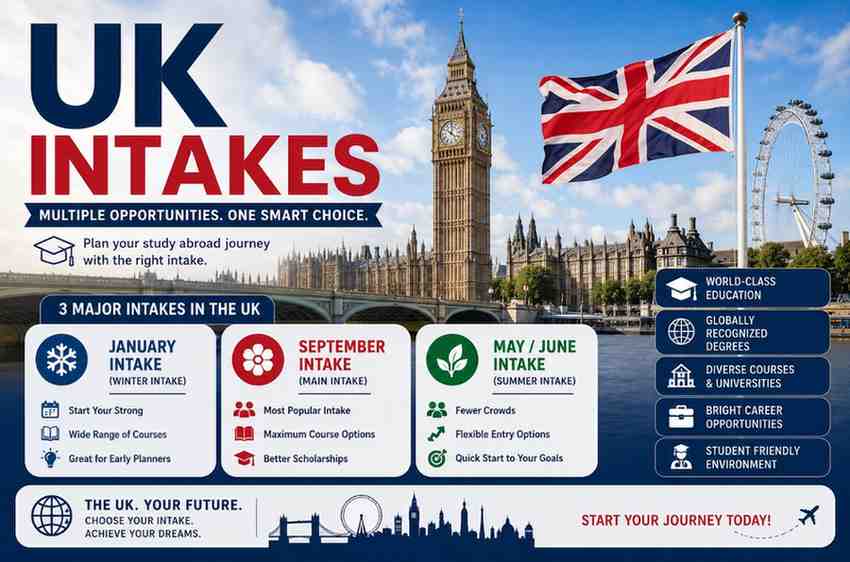
- The UK has three intakes: September, January and May.
- September 2027 is the primary intake with the widest course choice.
- The Graduate Route drops to 18 months from 1 January 2027.
- A UK student visa costs Rs.72,691 plus Rs.1,01,090 annual IHS.
- January 2028 intake suits students who missed September deadlines.
How Many Intakes Are There in the UK for 2027-28
There are three intakes in UK: September, January and May. This holds for the 2027-28 academic year as it has for previous cycles. September is the primary intake, January is the secondary intake, and May is the smallest and most limited.
| Intake | Type | Course/Scholarship Access | Who It Suits |
|---|---|---|---|
| September 2027 | Primary | Widest range, most scholarships | Final-year graduates, most UG and PG applicants |
| January 2028 | Secondary | Fewer courses, mostly PG | Students who missed September, need extra prep time |
| May 2028 | Tertiary | Very limited, select universities only | Students missing both earlier intakes, foundation/pre-Masters |

Choose your dream country
 UK
UK
 USA
USA
 Germany
 Australia
 Ireland
 Canada
 UAE
UAE
 France
 Sweden
 Italy
Italy
 Other
Other
When do you want to study abroad?
What's your highest level of education?
Have you completed Class 12th?
What was your Class 12 CGPA/percentage?
Are you a student or a parent/guardian?
What do you want to study?
Select your current city
How Leap will help you

Personalised University Shortlist

Express Applications with Quicker Admits

End-to-End Application Support
The question "how many intakes are there in the UK" has a simple answer, but the more useful question is which of these UK intakes actually fits your graduation timeline, your English test readiness, and your post-study work plans. That last part has changed materially for the 2027-28 cycle.
September 2027 UK Intake: Dates, Universities and the Graduate Route Change
September 2027 remains the intake with the broadest course list, the strongest scholarship access, and the widest choice of universities across all UK intakes.
Key dates for undergraduate applicants:
| Milestone | Date |
|---|---|
| UCAS 2027 entry registration opens | 12 May 2026 |
| UCAS submissions open | 1 September 2026 |
| Oxford, Cambridge, medicine, dentistry, veterinary science deadline | 15 October 2026 |
| All other undergraduate courses deadline | 13 January 2027 |
| Clearing opens for unfilled places | 2 July 2027 (typical pattern) |
UCAS confirms that students can register and start their 2027 entry application immediately, though submission to UCAS is not possible until 1 September 2026. The Oxford and Cambridge deadline, along with most medicine, veterinary and dentistry courses, falls on 15 October, while other undergraduate courses have a January deadline.
For postgraduate applicants: deadlines are rolling and course-specific rather than fixed. Most top universities want applications in by October-December 2026 for scholarship consideration, even though final deadlines can stretch into spring 2027.
Counselor insight: India saw a 7.1% increase in student visa issuances in the most recent full-year data, recovering after a prior decline, and became the top country for newly issued UK student visas once again. Students often assume the UK is shrinking as a destination for Indians. The visa-issuance data says otherwise. What has genuinely changed is what happens after graduation, not whether India is still welcome.
The reason this matters for September specifically: the Graduate Route reduces from two years to 18 months for applications made on or after 1 January 2027, while PhD graduates keep three years. A one-year Master's starting September 2027 finishes around September 2028, well past the cutoff. Every September 2027 postgraduate starter should plan around 18 months of post-study work, not two years.
January 2028 UK Intake: Is It a Real Second Chance or a Compromise
January, sometimes called the winter intake, exists mainly for students who missed September or need more preparation time. It is genuinely useful for the right student and a poor fit for the wrong one.
- Roughly 30 to 40 UK universities confirm a January intake, concentrated in postgraduate business, data science, and engineering programs.
- Application portals typically open mid-2026, with most deadlines falling between September and November 2026.
- Course choice is meaningfully smaller than in September. Not every program that runs in September also runs in January.
- Competition is lower, and acceptance rates are typically higher than the September cycle for comparable courses.
Counselor insight: Most students who contact counselors describing themselves as "January applicants" are actually September applicants who simply haven't started their preparation yet. January intake should be a deliberate choice, made because a specific course genuinely runs then and genuinely suits the student's timeline, not a fallback chosen out of procrastination.
The Graduate Route math for January 2028 starters is stricter than for September. A January 2028 Master's starter typically completes the course around December 2028, applies for the Graduate Route in early 2029, and receives 18 months under the post-January 2027 rules regardless of intake month.
May 2028 UK Intake: Who Actually Has This Option
May is the smallest of all UK intakes by a wide margin. Historically, universities including Coventry University, University of Kent, Northumbria University, and Brunel University have offered May starts for a limited set of courses, mostly foundation programs, pre-Masters bridges, and select postgraduate cohorts.
Treat May as a genuine backup, not a first plan. Course choice is minimal, scholarship access is close to zero, and class sizes are small, which some students prefer and others find socially isolating in their first term.
UK Intakes Compared: September vs January vs May for Indian Students
| Factor | September 2027 | January 2028 | May 2028 |
|---|---|---|---|
| Course availability | Widest (UG + PG, all subjects) | Moderate (mostly PG: Business, Data Science, Engineering) | Very limited (foundation, pre-Masters, select PG) |
| Scholarship access | Highest | Lower | Minimal |
| Competition level | Highest | Moderate | Lowest |
| Universities offering it | All UK universities | ~30-40 confirmed | Handful (Coventry, Kent, Northumbria, Brunel, and select others) |
| Application window opens | October-December 2026 (PG); May 2026 (UG, UCAS) | Mid-2026 | Late 2026/early 2027 |
| Graduate Route outcome | 18 months (applies post-Jan 2027 cutoff) | 18 months | 18 months |
| Best suited for | Final-year graduates, strongest profiles | Missed-September students, extra prep time needed | Late deciders, foundation-year students |
Note the Graduate Route row: this change applies from applications made on or after 1 January 2027, so it affects every 2027-28 intake student almost without exception, regardless of which of the three UK intakes they choose.
What Each UK Intake Costs in INR: Visa, IHS and Living Funds
Every UK intake carries the same visa cost structure. The intake month does not change what you pay; your course length and city do.
| Cost Item | GBP | INR | Source |
|---|---|---|---|
| Student visa application fee | £558 | Rs.72,691 | UK Home Office fee schedule |
| Immigration Health Surcharge (per year) | £776 | Rs.1,01,090 | gov.uk healthcare surcharge |
| Maintenance funds, London (9 months) | £13,761 | Rs.17,92,645 | gov.uk student visa money guidance |
| Maintenance funds, outside London (9 months) | £10,539 | Rs.13,72,916 | gov.uk student visa money guidance |
| Typical Master's tuition (one year) | £15,000-£45,000 | Rs.19,54,050-Rs.58,62,150 | University fee pages |
| Graduate Route IHS (per year, post-study) | £1,035 | Rs.1,34,830 | Home Office IHS schedule |
Exchange rate note: All INR figures in this article use a fixed rate of Rs.130.27 per £1. Verify the live rate before finalising your budget, since bank conversion rates and government fees both change.
The official government guidance sets maintenance funds at £1,529 per month for up to 9 months for courses in London, and £1,171 per month for up to 9 months for courses outside London. This money must sit in your account for 28 consecutive days before you apply, with the closing date falling within 31 days of your application.
Which UK Intake Should You Choose? A Decision Framework for Indian Students
If you are a final-year student graduating May or June 2027 with a strong profile: Target September 2027. Your results arrive in time for conditional-offer conversion, and September gives you access to every scholarship and every course option across all UK intakes. Apply as soon as your provisional results are out; most universities accept provisional marksheets for conditional offers.
If you are a working professional with 2+ years of experience targeting an MBA or MSc in management: Both September 2027 and January 2028 are realistic. If a fully-funded scholarship like Chevening matters to you, plan around a September start, since Chevening requires two full years of post-qualification work experience and runs on a single annual cycle. If scholarship funding is not the deciding factor, January 2028 is worth serious consideration for the lower competition and typically faster off-peak visa processing.
If you missed the September 2027 deadline or your English test score came in below requirement: January 2028 is your real second chance, not a lesser path, provided your target course actually runs in January. Call the admissions office directly; many postgraduate programs have rolling admissions and unfilled seats even after the stated deadline closes. If January is also closed for your course, May 2028 remains an option for a narrower set of universities and programs.
Documents and English Test Requirements for Your UK Intake
| Document/Requirement | Standard Requirement | India-Specific Detail |
|---|---|---|
| Academic transcripts | Attested final or provisional marksheets | CBSE/state board attestation can take 4-6 weeks; request the moment final exams end |
| English proficiency | IELTS for UKVI, PTE Academic UKVI, or MOI/Class 12 waiver at eligible universities | CBSE/ICSE students with 80%+ in English may qualify for an MOI-based waiver at some universities; Punjab, Haryana and J&K state board students should check waiver eligibility case by case |
| CAS (Confirmation of Acceptance for Studies) | Issued by university after offer acceptance and deposit | Read your CAS carefully; the English-assessment field must be filled correctly or your visa can be delayed |
| Financial evidence | 28 consecutive days of maintenance funds in an approved account | Indian family funds, education loans, and sponsor letters are all accepted if formatted per UKVI rules |
| Visa application | Student visa via UKVI online portal | Processing typically takes about 3 weeks from outside the UK |
For English test specifics by score band, see LeapScholar's guides on IELTS score requirements for the UK, studying in the UK without IELTS, PTE score requirements for the UK, and Duolingo accepted universities in the UK.
Month-by-Month Planning Calendar for UK Intakes 2027-28
Mapped to the Indian academic year, board exam schedule, and result timelines.
| Month (India) | Action |
|---|---|
| December-January (Class 12 board prep season) | Shortlist universities and courses across all three UK intakes; check English test requirements |
| February-March | Book and sit IELTS/PTE; begin SOP and LOR drafts |
| April-May (board results season) | Apply to September 2027 intake with provisional results; request transcript attestation the week final exams end |
| June-July | Convert conditional offers to unconditional as final marksheets arrive; open education loan process |
| August-September | Pay deposit, receive CAS, apply for student visa; arrive in the UK for September 2027 intake |
| October-November | January 2028 intake applications typically close in this window if you are pursuing that route instead |
| December-January (following year) | January 2028 intake starters apply for visa and prepare to travel |
What to Do If You Miss a Deadline or Your Scores Are Delayed
Missed the September deadline entirely: Contact the admissions office directly before assuming the door is closed. Many postgraduate programs run rolling admissions and hold seats past the published deadline. If truly closed, pivot to January 2028 for the same or a comparable course.
Your final results are delayed past the conditional-offer window: Ask your university in writing for an extension on the transcript submission date. Most UK universities will hold a place for four to six weeks beyond the standard deadline if you communicate proactively, rather than staying silent and risking automatic withdrawal.
Your English test score fell short: A one-skill retake (available for IELTS) lets you redo a single section rather than the full test, useful for a narrow half-band gap. For a wider gap, most universities offer a six-to-ten-week pre-sessional English program that satisfies the language requirement on successful completion, though this adds cost and time to your timeline.
Your UK student visa was refused: There is no mandatory waiting period before reapplying. Identify and correct the specific refusal reason first; reapplying with the same gap in your application produces the same refusal.
3 Takeaways on UK Intakes for Indian Students
- Confirm your UK intake choice based on your current academic stage and course availability, not calendar preference alone. September 2027 suits most final-year graduates; January 2028 is a genuine option only if your specific course runs then.
- Budget separately for the roughly Rs.1.7 lakh in visa and IHS costs beyond tuition and living expenses, and start education loan or funding conversations at least four to five months before your target intake.
- Start document preparation, including transcript attestation and your English test, at least six months before your target intake's application deadline, since attestation delays are the most common reason Indian students miss otherwise-achievable deadlines.
Verified by: LeapScholar's UK counseling team, with hands-on experience guiding Indian students through UK intake selection, visa applications, and post-study planning.
Have questions about which UK intake fits your profile? Book a free session with a LeapScholar counselor.
Frequently Asked Questions About UK Intakes
-
Is the UK still worth it for Indian students given the Graduate Route changes?
India recorded a 7.1% increase in student visa issuances in the most recent data, becoming the top country for newly issued UK student visas again, which suggests strong continued demand despite policy changes. The Graduate Route shrinking to 18 months is a real reduction in post-study work time, but it does not eliminate the route. Career planning simply needs to start earlier, from the first term rather than the final year.
-
Do January intake students get fewer scholarships than September intake students?
Yes, scholarship access is generally lower for January intake compared to September, since most university-wide and government scholarships are aligned with the September cycle. Some university-specific scholarships remain available for January starters, so check each university's scholarship page directly rather than assuming none exist.
-
What happens if I miss the September 2027 UK intake deadline?
Contact the university's admissions office directly, since many postgraduate programs run rolling admissions with seats available past the published deadline. If your specific course is closed for September, January 2028 is typically the next available option for the same or a similar program.
-
Which universities offer the May intake in UK?
Universities including Coventry University, University of Kent, Northumbria University, and Brunel University have historically offered May intake for a limited number of courses, mostly foundation and pre-Masters programs. Always confirm current-year availability directly with the university, since May intake offerings change year to year.
-
How much does a UK student visa cost in INR for the 2027-28 intakes?
A UK student visa application costs Rs.72,691 (£558), plus Rs.1,01,090 (£776) per year for the Immigration Health Surcharge. Add maintenance funds of roughly Rs.17,92,645 for London or Rs.13,72,916 outside London, calculated at Rs.130.27 per pound.
-
Does the Graduate Route change affect which UK intake I should choose?
The Graduate Route reduces from two years to 18 months for applications submitted on or after 1 January 2027, and this applies to nearly every 2027-28 intake starter regardless of whether you choose September, January, or May. PhD graduates are unaffected and retain three years.
-
What are the January 2028 UK intake dates for Indian students?
January 2028 intake applications for most postgraduate courses typically open around mid-2026 and close between September and November 2026, with the term itself starting in January 2028. Confirm exact dates directly with your target university, since deadlines vary by course.
-
Which is the primary intake among all UK intakes?
September is the primary UK intake and carries the largest number of applications and the widest range of undergraduate and postgraduate courses. Most Indian students target this intake because it aligns with results timing from Indian board exams and degree programs.
-
How many intakes are there in the UK?
There are three intakes in the UK: September, January and May. September is the primary intake with the widest course and scholarship access. January is the secondary intake, mostly for postgraduate courses. May is the smallest, offered by a limited number of universities for select programs.









Have Questions? Get Guidance to reach your Dream University
Connect with India's finest counsellors and biggest study abroad community.
Get Guidance