
Quick Read
- Over 50 UK universities accept MBA applications without a GMAT score in 2026.
- MBA fees in UK range from Rs.22 lakh to Rs.1.3 crore per year for Indian students.
- Work experience of 2-3 years often replaces GMAT requirement at most UK universities.
- IELTS score of 6.5 or above is mandatory for Indian applicants without GMAT.
Which UK Universities Let You Study MBA in UK Without GMAT in 2026
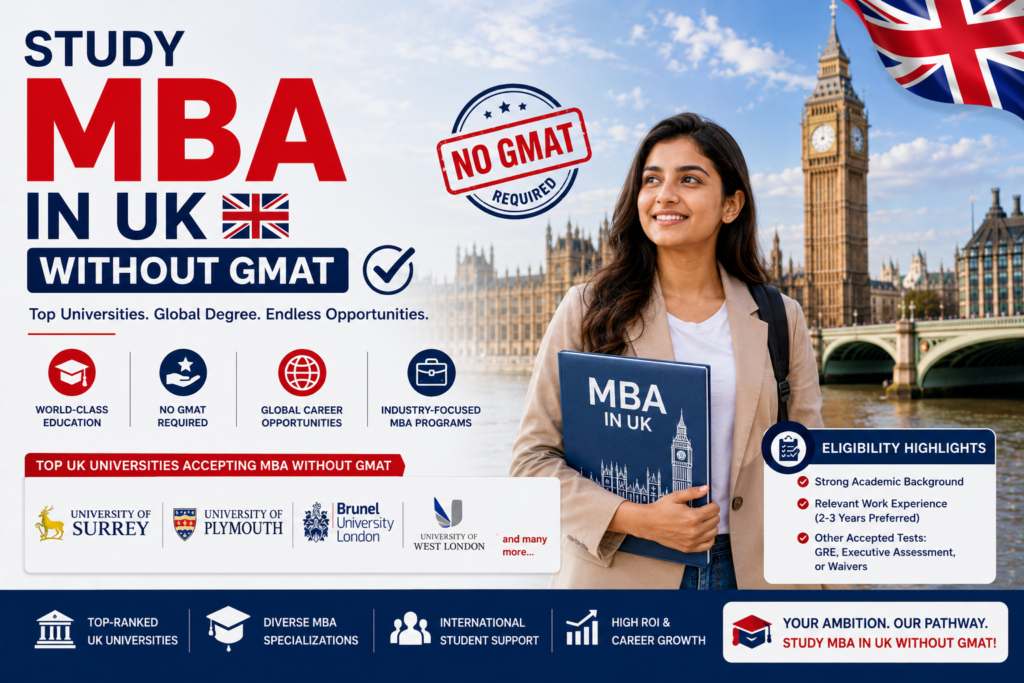
Yes, you can do an MBA in UK without GMAT. Many UK business schools have waived or made the GMAT optional for applicants with strong academics and relevant work experience.
| University | MBA Program | Annual Fees (INR) | GMAT Required? | Minimum Work Experience |
| University of Strathclyde | Strathclyde MBA | Rs.38,10,000 (£30,000) | No | 2 years |
| University of Hull | Global MBA | Rs.25,40,000 (£20,000) | No | 2 years |
| University of Salford | MBA | Rs.27,94,000 (£22,000) | No | 2 years |
| Coventry University | MBA | Rs.26,67,000 (£21,000) | No | None mandatory |
| University of Sunderland | MBA | Rs.22,86,000 (£18,000) | No | None mandatory |
| Robert Gordon University | MBA | Rs.25,40,000 (£20,000) | No | 2 years preferred |
| Anglia Ruskin University | MBA | Rs.25,40,000 (£20,000) | No | None mandatory |
| University of East London | Global MBA | Rs.24,13,000 (£19,000) | No | None mandatory |
| De Montfort University | MBA | Rs.24,13,000 (£19,000) | No | None mandatory |
| University of Gloucestershire | MBA | Rs.25,40,000 (£20,000) | No | None mandatory |

Choose your dream country
 UK
UK
 USA
USA
 Germany
 Australia
 Ireland
 Canada
 UAE
UAE
 France
 Sweden
 Italy
Italy
 Other
Other
When do you want to study abroad?
What's your highest level of education?
Have you completed Class 12th?
What was your Class 12 CGPA/percentage?
Are you a student or a parent/guardian?
What do you want to study?
Select your current city
How Leap will help you

Personalised University Shortlist

Express Applications with Quicker Admits

End-to-End Application Support
Most of these universities still prefer applicants who bring something beyond marks: a specific professional project, a business case you managed, or a clear career pivot story. That context is what replaces the GMAT signal for admission committees.
Counselor insight: Indian students often assume that removing the GMAT requirement makes these programs easier to get into. That is not accurate. A university waiving the GMAT just means they are using other signals: your undergraduate GPA, work history, references, and SOP. These are assessed much more carefully when there is no GMAT score to anchor the evaluation. A weak SOP at a GMAT-waiver university hurts you more, not less.
Is the GMAT Mandatory to Study MBA in UK? University-Wise Breakdown
GMAT is required at elite programs. LBS, Oxford Said, and Warwick typically expect 680+. For a large portion of accredited UK MBA programs, GMAT is either optional or not required at all.
Here is the breakdown for 2026:
| University Tier | GMAT Policy | Average GMAT (if required) |
| Elite (LBS, Oxford Said, Warwick) | Required | 680-720+ |
| Mid-tier Russell Group | Optional | 600-660 |
| Post-92 Universities | Not required | N/A |
| Online/Flexible MBA | Usually not required | N/A |
Target mid-tier and post-92 universities. These schools are AACSB or AMBA-accredited, and their graduates work in the UK, Europe, and India. At Rs.25–38 lakh vs. Rs.1.1–1.3 crore, the ROI math and payback period are fundamentally different, and more favourable for most Indian profiles targeting mid-management roles.
Counselor insight: A common mistake Indian students make is applying to 8 GMAT-free universities without checking accreditation. AMBA, AACSB, and EQUIS are the three international accreditations that matter. Check for at least one of these before applying. An unaccredited MBA from a UK university will create problems when you try to work in India or apply for a UK Graduate Route visa.
What Replaces GMAT When You Apply for MBA in UK Without GMAT
UK business schools that do not require the GMAT assess your application through a combination of these factors:
Academic Qualifications
Most UK universities expect a minimum of 55% or a 2:2 degree. Some with higher standards ask for 60% or a first-class equivalent or higher. Indian students from engineering, commerce, or science backgrounds are well-positioned. UK admissions committees are familiar with Indian grading patterns: a 60% from a tier 2 college is not penalized against a 55% from a tier 1 college.
Professional Work Experience
For most GMAT-free MBA programs in the UK, work experience is the most important part of your application. Two to three years of full-time professional work is the ideal amount. Internships typically do not count.
What matters more than years: the quality and relevance of your experience. Managing a team of two people with clear business outcomes is worth more than five years of individual contributor work.
Statement of Purpose (SOP)
Your SOP for MBA in UK is where you explain why you are doing an MBA, why this specific university, and why now. Universities that waive GMAT lean much harder on the SOP because it is the clearest signal of thinking ability and career clarity that they have access to.
Letters of Recommendation
Two letters of recommendation are standard. The typical combination includes one letter from a direct manager and another from a senior professional who knows your work. Academic references are accepted but are considered less important than professional ones for an MBA.
English Language Proficiency
Indian students need to demonstrate English proficiency regardless of the GMAT waiver. The standard requirements are:
- IELTS: 6.5 overall, no band below 6.0
- TOEFL iBT: 90-100
- PTE Academic: 62-65
Some universities accept prior English-medium education (10+2 and a degree from an English-medium institution) as a waiver for the language test. Check each university's individual policy.
MBA Fees in UK for Indian Students Without GMAT: Full Cost Breakdown
Tuition is only part of the cost. Here is the full annual picture for a GMAT-free MBA in UK:
| Cost Category | Annual Amount (INR) | Annual Amount (GBP) |
| Tuition fees (mid-range GMAT-free) | Rs.25,40,000-Rs.38,10,000 | £20,000-£30,000 |
| Accommodation (shared) | Rs.15,24,000-Rs.20,32,000 | £12,000-£16,000 |
| Food and groceries | Rs.5,08,000-Rs.7,62,000 | £4,000-£6,000 |
| Health insurance (IHS) | Rs.98,552 | £776 |
| Books, materials, travel | Rs.1,27,000-Rs.2,54,000 | £1,000-£2,000 |
| Total annual estimate | Rs.47,97,552-Rs.68,58,000 | £37,776-£54,776 |
Accommodation and food estimates sourced from the UKCISA Cost of Living guide. IHS rate is confirmed on UK Visas and Immigration.
For context, at some of the best schools like LBS or Said Business School, the fees for UK MBA are Rs.1.0-1.3 crore for the tuition alone. GMAT-free programs are in a different budget category altogether.
Counselor insight: Student budgets commonly overlook the Immigration Health Surcharge (IHS). From 2026, the IHS for a student visa will be £776 a year (Rs.98,552 at current rates). For a one-year MBA, the visa is typically issued for around 16 months (course plus a 4-month buffer), which means you pay IHS for two full years upfront: approximately Rs.1,97,104. This is a non-negotiable, non-refundable payment made before you leave India. Factor it in before you finalize your budget.
Scholarships Available to Study an MBA in UK Without GMAT
Key options for Indian students:
- GREAT Scholarships: British Council-funded, Rs.12,70,000 (£10,000) for postgraduate study including MBA. Available at numerous affiliated universities.
- Chevening Scholarships: Covers full tuition, living expenses, and flight costs. Competitive: 2 to 3 years of work experience and leadership ability. No GMAT needed.
- University-specific scholarships: Most of the mid-level universities in the UK have scholarships from Rs.1.27 to 5.08 lakh (£1,000 to £4,000) for merit-based international students.
- Saltire Scholarships (Scotland): Rs.2,54,000 (£2,000) for Indian students in universities in Scotland. Universities such as Strathclyde and Robert Gordon University are qualified.
Check the MBA scholarships in UK guide for a full list.
Post-study work: The Graduate Route Visa gives 2 years for applications submitted by 31 December 2026. September 2026 starters graduate in 2027 and will receive 18 months. Plan your UK job search timeline accordingly.
How to Apply to Study MBA in UK Without GMAT: Step-by-Step Process
The steps below are mapped to real dates for the September 2026 intake. If you are targeting January 2027, shift each step forward by three months.
| Month | What to Do |
| Now (May 2026) | Shortlist 5-6 universities. Match your profile honestly: 3+ years experience and 65%+ degree open mid-tier universities; fresh graduates should limit the shortlist to universities that explicitly accept freshers such as Coventry and East London. Confirm AMBA, AACSB, or EQUIS accreditation on each university's official website, not on third-party sites. Begin your first SOP draft. |
| June 2026 | Submit applications to universities with rolling admissions: Hull, Salford, and Sunderland typically accept until June for September entry. Apply directly on each university's admissions portal. UCAS is for undergraduates only. Allow 4-6 weeks for Indian documents: attested transcripts, letters of recommendation on official letterhead, and police clearance certificates from your local Passport Seva Kendra. |
| July 2026 | Receive conditional or unconditional offers. Accept your preferred offer and request your CAS (Confirmation of Acceptance for Studies) number. Begin your 28-day bank balance period; your bank account must show sufficient You must have funds for tuition and living costs for 28 consecutive days before your visa application. |
| August 2026 | Apply for your UK Student Visa as soon as the CAS arrives. The application fee from India is £558 (approximately Rs.70,866). Pay the IHS upfront at this stage: £776 per year, charged for the full visa duration before you travel. This payment is non-refundable. |
| September 2026 | Arrive in the UK. MBA begins. |
| January 2027 | Alternative intake: Salford and Hull typically offer this. If you miss the September cycle, apply by October 2026 for January 2027 entry. |
Which UK MBA Specialisation to Choose Without GMAT: Matched to Indian Career Goals
Picking the wrong specialization costs more than a bad GMAT score, because UK and Indian employers hire for specific functions. Your pre-MBA background, chosen specialization, and post-MBA goal must form a clear line. If they do not, your SOP will not hold up. The table below matches in-demand specializations to Indian career targets and the strongest GMAT-free universities for each.
| MBA Specialisation | Best For (Indian Career Goal) | Top GMAT-Free UK Universities | Avg. UK Starting Salary |
| MBA in Finance | Investment banking, corporate finance, treasury roles in India or UK | University of Strathclyde, University of Birmingham | Rs.88-1.14 crore (£70,000-£90,000) |
| MBA in Business Analytics | Data strategy, product management, BI roles at MNCs | University of Salford, Coventry University | Rs.82-1.02 crore (£65,000-£80,000) |
| MBA in Marketing | Brand management, digital marketing, growth strategy | University of Hull, Anglia Ruskin University | Rs.63-82 lakh (£50,000-£65,000) |
| MBA in Human Resources | HR Business Partner, talent acquisition, people analytics | De Montfort University, University of Sunderland | Rs.57-76 lakh (£45,000-£60,000) |
| MBA in International Business | Global operations, export management, consulting | Robert Gordon University, University of East London | Rs.70-89 lakh (£55,000-£70,000) |
| MBA in Project Management | Infrastructure projects, IT delivery, operations | University of Gloucestershire, Coventry University | Rs.70-89 lakh (£55,000-£70,000) |
Salary figures sourced from the GMAC 2024 Corporate Recruiters Survey and Glassdoor UK MBA data, February 2026.
How to Pick the Right Specialisation for Your Background
MBA in Finance: Best if you have 3-5 years in banking, fintech, NBFC, CA practice, or corporate finance. Strathclyde's Finance MBA is AACSB-accredited, with direct hiring relationships in Edinburgh's and London's financial services sectors. Do not pick this if your only connection to finance is general interest; admissions committees see through it.
MBA in Business Analytics: Best if you are a software engineer, data analyst, or BI professional moving into product management or data strategy. The technical background carries you through quantitative modules; the MBA credential gets you into cross-functional leadership roles. University of Salford and Coventry University both offer this without GMAT.
MBA in Marketing: Best if you have worked in FMCG, retail, e-commerce, advertising, or digital marketing and want to move into brand or growth roles. University of Hull's Marketing MBA has industry partnerships you can reference in interviews.
Note: Starting salaries in marketing run Rs. 63-82 lakh (£41,700). Skilled Worker visa threshold: consider this option if staying in the UK post-MBA is the goal.
MBA in Human Resources: Best if you are already in HR, talent acquisition, L&D, or people operations and want to step into an HR Business Partner or People Analytics role. The course deepens an existing career; it does not change it. De Montfort University and the University of Sunderland offer this program without the GMAT. Indian students from IT services with HR backgrounds are particularly well-placed given how heavily UK tech firms recruit in this function.
MBA in International Business: Best if you work in export, supply chain, trade finance, or cross-border consulting and want to move into global operations or strategy. If your expertise is in infrastructure, oil and gas, or logistics, Aberdeen has strong links with the energy and natural resources sectors, and Robert Gordon University is well-connected to those industries. The University of East London is the more affordable alternative.
MBA in Project Management: Ideal for those in IT delivery, infrastructure, or construction looking for roles like program leader or operations director. The UK offers recognized MBA in Project Management from Coventry and Gloucestershire. Project and program managers are common on the UK shortage employment list, so your Skilled Worker immigration route after graduation is much easier.
Counselor insight: The specialization that gets the best salary is the one your background already supports. A finance MBA will not get you into investment banking if you have spent five years in IT. Pick what needs the least explanation in your SOP, not what sounds most impressive.
What to Do When Things Go Wrong
Your application was rejected without explanation
Request feedback directly from the admissions office by email. If there is no response, apply to a different university in the next intake. Do not apply to the same university twice in the same academic year.
Your IELTS score is below the requirement
An overall score of 6.0, which is below the required 6.5, does not automatically result in rejection. Contact the admissions office and ask about pre-sessional English programs. Many UK universities offer 6- to 12-week courses that lead to conditional admission.
Your visa application was refused
Refusals usually cite one of three reasons: insufficient proof of funds, document inconsistencies, or concerns about your intention to leave the UK. Your refusal letter will state the specific reason. Address it directly before reapplying. Reapplying without addressing the stated reason is the most common and avoidable mistake.
You miss the September intake deadline
Apply for the January intake if the university offers one; Salford and Hull typically do. If neither works, use the gap to get more work experience, retake IELTS, or rewrite your SOP before the next September cycle.
3 Specific Takeaways for Indian Students Planning to Study MBA in UK Without GMAT
- Accreditation matters more than a GMAT waiver. Before applying to any GMAT-free MBA program in the UK, confirm that the university holds at least one of the three recognized accreditations: AMBA, AACSB, or EQUIS. A non-accredited MBA will create real problems in your career, regardless of where you obtained it.
- Your SOP carries the weight that the GMAT would have. UK universities that do not require GMAT are not making your admission easier: they are replacing one signal with another. Invest the same time and energy in your SOP and references as you would have invested in preparing for the GMAT.
- Budget for the full cost, not just tuition. Indian families consistently underestimate the total cost of an MBA in the UK. Tuition at GMAT-free programs is Rs.25-38 lakh, but your total annual budget, including accommodation, food, health surcharge, and travel, is closer to Rs.48-68 lakh. Start your financial planning at least 12 months before your application deadline.
Have questions about studying MBA in UK without GMAT? Book a free session with a LeapScholar counselor.
Frequently Asked Questions About How to Study MBA in UK Without GMAT
-
Can I do an MBA in the UK without the GMAT?
Yes. Over 50 UK universities accept MBA applications without a GMAT score in 2026, including Strathclyde, Salford, Hull, and Coventry. These universities assess you on your undergraduate grades, work experience, SOP, and IELTS score instead.
-
Is an MBA in UK cheap for Indian students?
Not cheap, but significantly more affordable than the US or Australia. GMAT-free programs cost Rs.22-38 lakh in tuition per year, and the one-year format means you spend roughly half what a two-year US MBA costs in total. Scholarships like GREAT (Rs.12.7 lakh) and Chevening (fully funded) can reduce the burden further.
-
Is GMAT harder than IELTS?
Yes, by a significant margin. The GMAT examines quantitative reasoning, data interpretation, and critical verbal skills at a graduate business level. IELTS examines your ability to use daily English. For an Indian student with a conventional engineering or business background, IELTS is manageable in 4-6 weeks of careful study. It takes 3-6 months of structured study to score competitively on the GMAT.
-
Which MBA is in demand in the UK?
According to GMAC Corporate Recruiters Survey 2024, as of 2026, MBA programs in Finance, Business Analytics and International Business are most in demand by employers in the UK job market. Specifically for Indian students, Finance and Business Analytics fit best with both UK hiring trends and high-paying return opportunities in India.
-
Can I get a 100% scholarship in the UK?
Yes, but only through Chevening or Commonwealth scholarships, both of which are highly competitive and require 2-3 years of work experience with a strong leadership profile. Most other scholarships, GREAT, Saltire, and university-specific awards cover a portion of tuition, not the full cost. The budget is for partial funding, which serves as your base case, rather than for full funding.
-
Is UK MBA valid in India?
Yes. Indian employers, especially at MNCs, consulting firms, and BFSI corporations, acknowledge UK MBAs from an AMBA, AACSB, or EQUIS-approved university. McKinsey India, Deloitte India, and Goldman Sachs India actively hire UK MBA graduates. In traditional Indian PSU environments, people sometimes question the one-year format, but the private sector fully accepts it.
-
Which UK MBA is best for Indian students without a GMAT?
The University of Strathclyde Business School is the best all-rounder, triple-accredited (AMBA, AACSB, and EQUIS), with no GMAT necessary and highly respected by businesses in consulting and finance. The University of Salford and Coventry University are excellent mid-range options with outstanding foreign student support and affordable tuition prices.







Have Questions? Get Guidance to reach your Dream University
Connect with India's finest counsellors and biggest study abroad community.
Get Guidance