
Quick Read
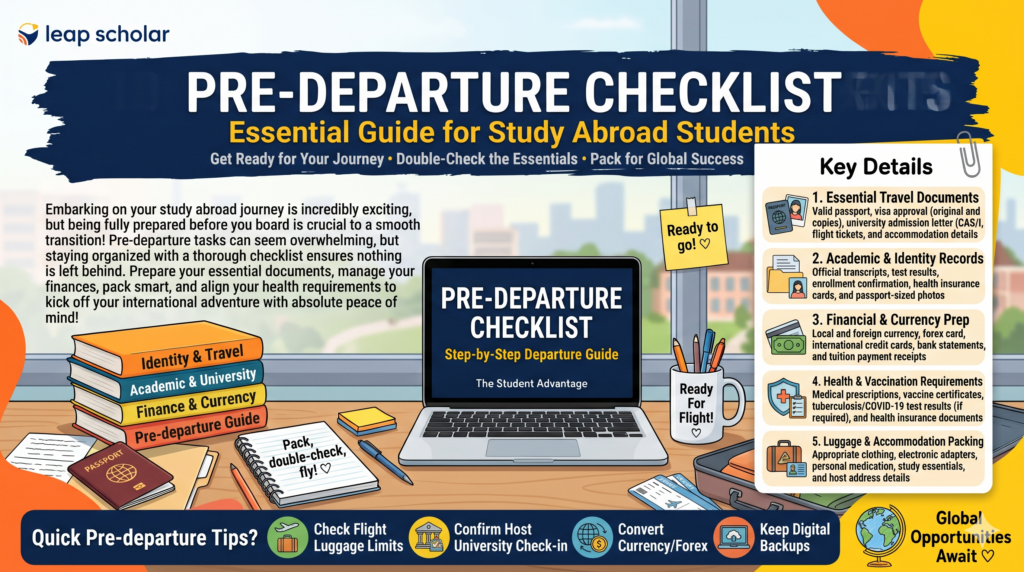
- Start your pre departure checklist for students abroad right after your offer.
- Residents can send up to INR 2.35 crore yearly for studies.
- US entry opens 30 days before your I-20 program start date.
- Keep your passport, visa, offer letter, and Indian transcripts in cabin luggage.
Where to Start Your Pre Departure Checklist for Students Abroad
Your pre departure checklist for students abroad runs on two official dates: the UK lets you apply for a Student visa up to 6 months before your course starts. In the US, you can land up to 30 days before the program start date on your Form I-20, which is the school document that supports your F-1 student visa.
Start your pre departure checklist for students abroad the day you accept your offer, in this order: documents, then money, then housing.

Choose your dream country
 UK
 USA
 Germany
 Australia
 Ireland
 Canada
 UAE
 France
 Sweden
 Italy
 Other
When do you want to study abroad?
What's your highest level of education?
Have you completed Class 12th?
What was your Class 12 CGPA/percentage?
Are you a student or a parent/guardian?
What do you want to study?
Select your current city
How Leap will help you

Personalised University Shortlist

Express Applications with Quicker Admits

End-to-End Application Support
Read the table below as a planning guide, not a rule: each row is a stage you move through, not a fixed date.
| When | What to finish | Why it matters |
| Right after your offer | Accept the offer, start the visa file, plan funds, start the housing search | Visas and housing take the longest |
| While the visa is pending | Forex plan, insurance, health records, scans of every document | None of these needs the visa result |
| Visa decision made | UK decision is usually within 3 weeks; US entry opens 30 days before the I-20 date | Book travel once your dates are clear |
| Final week | Cabin bag, airport plan, first-night plan | Small gaps cause the most stress |
What this means for you: the slow items go first, and nothing in the final week should be new.
Sources: GOV.UK: Student visa, Study in the States: first-time arrival
Documents for Your Pre Departure Checklist for Students Abroad
Your folder is the heart of any pre departure checklist for students abroad, so sort it before you sort your clothes.
Three terms first. Your offer letter is the university's written offer of a place on your course. Proof of funds means the bank or loan papers that show you can pay your fees and living costs. A transcript is the official record of your marks, issued by your college or school.
- Passport: Check that it's valid for your stay and that every detail matches your visa exactly.
- Visa or grant notice: Print the visa page, approval letter, or grant email, because phones die at the worst moments.
- Offer letter: Carry the latest version the university issued, not an old draft from your inbox.
- Proof of funds: Pack bank letters, your education loan sanction letter, and every fee receipt.
- Academic records: Ask your college for sealed academic transcripts well before the final week, and add your degree and Class 12 certificates.
- Study plans: Keep a clean copy of the statement of purpose you submitted, so your answers about your course match what you wrote.
- Photos and ID: Add a few passport-size photos and copies of your Indian ID cards.
- Backups: Make two sets of photocopies for different bags, plus scans in cloud storage you can open from any phone.
Every original goes in your cabin bag. For US arrivals, Study in the States notes that checked bags aren't accessible until after the port of entry, which is the airport where you're checked on arrival, so clothes go in the hold and papers stay with you.
Visa and Entry Rules Before You Travel Abroad
A student visa is the permission to enter a country to study, and each country issues its own. You need the one named in your offer papers, such as a Canadian study permit, which is Canada's permission to study.
The myth is that the visa is the finish line. The officer at the port of entry still makes the final decision. This part of your pre departure checklist for students abroad is about what that officer wants to see.
Three more terms: the SEVIS fee is a US government fee you pay before the visa is issued; a letter of introduction is the Canadian immigration letter you show on arrival; and a TB test is a tuberculosis screening some UK visa applicants need.
Read only your country's row, and treat it as the minimum you confirm before you fly.
| Country | What to confirm before flying |
| USA F1 visa | Land no more than 30 days before your I-20 start date; carry passport, visa, signed I-20, I-901 SEVIS fee proof, and proof of funds in the cabin |
| UK student visa | Apply no earlier than 6 months before your course; the decision is usually within 3 weeks; confirm whether a TB test certificate applies (valid 6 months from the x-ray) |
| Canada | Passport, letter of introduction, and acceptance letter at the port of entry, plus medical exam results if you needed one |
The UK TB test applies only if you're coming for 6 months or more and have lived in a listed country for 6 months or more, so check the listed-countries page.
For Germany or Ireland, read the Germany study visa and Ireland student visa guides.
Sources: GOV.UK: TB test for UK visa, IRCC: prepare for arrival
Money and Forex on Your Pre Departure Checklist for Students Abroad
Sending money abroad for your studies is, through your bank, under the Liberalized Remittance Scheme (LRS), the RBI scheme that lets a resident individual send foreign currency abroad up to a yearly limit. The limit is INR 2.35 crore (USD 250,000) per financial year (April to March), and one of the permitted purposes is studying abroad.
Money is where a pre departure checklist for students abroad from India differs most from anyone else's. Here's what to sort:
- Pay fees by bank transfer: Send tuition straight to the university's account, never in cash.
- Get a forex card: A forex card is a prepaid card loaded with foreign currency, so you aren't carrying a pile of notes; compare forex card options before you load money.
- Tell your bank: Let your Indian bank know you're leaving so it doesn't block your card abroad.
- Check loan timing: If a loan pays your fees, confirm the disbursement date with the bank and compare education loan options early.
- Know your cash-carrying limit: Apart from the LRS limit for bank transfers, RBI lets you carry only USD 3,000 in foreign currency notes and Rs 25,000 in Indian currency per trip. If you come back with foreign currency notes above USD 5,000 or total forex (cash plus cards plus cheques) above USD 10,000, you'll need to file a Currency Declaration Form at Indian customs.
- Keep first-days money: Carry a small amount of local currency and one working card for the first few days.
- Run the numbers: Add up tuition and living costs for your city using the country guides below before you decide how much to carry.
- US students: These US banking tips explain what to set up once you land.
Whether 20 lakhs is enough depends on your country and city, which is why the next section points you to cost pages. This content is general information, not financial or legal advice; check the official page before you decide.
1 USD = INR 93.93 (ECB-based, as of November 2026); the INR value shifts with the exchange rate your bank uses on the day you send money.
My insight: The common slip is tossing the remittance receipt once the fee clears. Pay tuition by bank transfer and keep that receipt with your visa papers, because you may need to show where the money went.
Sources: RBI: Liberalized Remittance Scheme, RBI: rules for carrying foreign currency Frankfurter: ECB reference rates
Pre Departure Checklist for Students Abroad by Country
Once you know your country, read its cost page before you book anything:
- USA living costs: read this before you pick a city.
- UK living costs: compare London with other cities before you choose.
- Canada living costs: check rent and transport for your province.
- Australia living costs: use it to plan your first months of rent.
- Germany living costs: read it alongside your fund plan.
- Ireland living costs: check housing early in your planning.
Accommodation on Your Pre Departure Checklist for Students Abroad
Don't land with a plan to "find something near campus": that's a housing search with a suitcase in each hand. Treat housing as a hard item on your pre departure checklist for students abroad, not a soft one.
- Book the first weeks before you fly: Use temporary housing if your permanent place isn't ready yet.
- Get it in writing: A booking email or signed agreement beats a chat message.
- Match your papers: Check that the address on your visa forms matches where you'll stay, or that you can explain any change.
- Check key pickup times: Compare them with your landing time, since a 6 a.m. arrival and a 2 p.m. check-in don't mix.
- Save contacts offline: Write down the landlord's and the university housing office's numbers on paper too.
Housing routes differ by country: Germany has dorms and shared flats, and Ireland has its own mix of on-campus and private rentals. Canada's options are student accommodation in Canada. If you start in autumn, September intake housing gets busy, so begin your search as soon as you have an offer.
Health Checklist Before You Fly Abroad
Health prep is the part students rush, and it's the hardest part to fix from abroad. Do it while your family doctor is a short drive away.
- Medicines: Carry prescriptions and a doctor's note for any regular medicine in your cabin bag.
- Vaccination records: Keep the originals and scans, since your university may ask for them.
- Health insurance: Check whether your university or destination country requires cover, and buy it before you fly if it does.
- UK TB test: If the UK rule in the visa section applies to you, remember the certificate lasts 6 months from the x-ray date, so time it with your visa application.
- Check-up: Get a general and dental check-up in India before you leave.
Packing and Phone Setup Before You Fly
Overpacking is the classic mistake: nobody abroad needs a fifth steel tiffin. The phone part of your pre departure checklist for students abroad matters more than the suitcase.
- Cabin bag: Pack your document folder, medicines, phone charger, and a card or some cash for the first night.
- Baggage limits: Weigh your bags at home against your airline's own limit, not at the counter.
- Labels: Put your name, phone number, and destination address on every bag.
- Power adapter: Buy one that fits your destination's plug type.
- Indian SIM: Keep your Indian number active so bank OTPs still reach you.
- Local SIM or eSIM: Plan one for week one, so you can call your landlord from the airport.
- Apps: Download your university, banking, maps, and ride apps before you leave.
- Family: Share your flight number and arrival address with home.
First Week Checklist After You Land Abroad
Your first week abroad has 6 jobs, even if jet lag argues otherwise. The last item on any pre departure checklist for students abroad is knowing where help is, so work through these in order:
- Clear arrival checks with your document folder in hand.
- Reach your accommodation and message home.
- Register with your university and attend orientation.
- Set up a local bank account and SIM.
- Learn the local transport routes and emergency numbers.
- Find your university's international student office and the Indian embassy or consulate for your area.
If safety worries you or your parents, read up on the safest countries for Indians before you go. Knowing who helps and where makes the first week far less lonely.
What Can You Do If Your Pre Departure Checklist for Students Abroad Goes Wrong?
Something will slip, and that's normal. Here's who to call for each problem:
- Visa delayed: Tell your university's international office, and book only a ticket you can change if the fare rules allow it.
- Visa refused: Read the refusal letter for the reason, then ask your university whether you can defer and talk it through with your counselor.
- Document lost or damaged: Use your scans, ask the issuing office for a duplicate, and tell the university. In the US, that's your DSO (Designated School Official), the person at your school who looks after international students.
- Money falls short: Look at the education loan options linked above and ask the university about payment dates.
- Flight missed or cancelled: Go to the airline desk first, then tell your university and your accommodation.
- Passport lost abroad: Contact the Indian embassy or consulate for your area.
My insight: Students get this wrong by booking the cheapest fixed fare before the visa arrives. Book only once the visa is in hand, unless the fare is changeable; a cheap fare isn't cheap if you lose it.
3 Takeaways on Pre Departure Checklist for Students Abroad
- Start your pre departure checklist for students abroad early: begin the day you accept your offer, with documents first, then money and housing.
- Send money through your bank under LRS: pay fees by bank transfer and keep every remittance receipt with your visa papers.
- Read your destination's official entry page: carry your passport, visa, and key papers in your cabin bag.
Talk to a Leap Scholar counselor to build a country-specific pre-departure plan for your intake.
Frequently Asked Questions About Pre Departure Checklist for Students Abroad
-
When should I start my pre departure checklist for students abroad?
Start your pre departure checklist for students abroad the day you accept your offer; get documents first. The UK lets you apply for a Student visa up to 6 months before your course, and US students can enter 30 days before their I-20 start date.
-
What documents should be in my hand luggage?
Keep your passport, visa, offer letter, proof of funds, and academic records in your cabin bag. US students add the signed I-20 and SEVIS fee receipt; Canada-bound students add the letter of introduction. A pre departure checklist for students abroad keeps originals in the cabin, never in checked bags.
-
How much money do I need before studying abroad?
It depends on your country and city. Add tuition to living costs for that city, using the country guides above, and compare it with your loan sanction. Whether 20 lakhs is enough is a question about your city and course, not a general rule.
-
How much money can I send abroad for studies from India?
Under the RBI's Liberalized Remittance Scheme, a resident individual can send up to INR 2.35 crore (USD 250,000) per financial year, and studying abroad is a permitted purpose. Your bank handles the transfer. Keep every remittance receipt with your visa papers, since it shows where your money went.
-
How early can I fly to the US before my classes start?
You can enter the US up to 30 days before the program start date on your signed Form I-20. That window comes from Study in the States, the US government's student site, so plan your flight and housing check-in around that date rather than the cheapest fare.
-
Is 20 lakhs enough to study abroad?
It depends entirely on your country and course. For a lower-cost destination like Germany or parts of Europe, Rs 20 lakh can cover a full year, including tuition and living expenses, at many public universities. In the US, UK, Canada, or Australia, Rs 20 lakh often covers only one semester or a single year's tuition, once you add living expenses. Check your specific university's fee page and the country-wise living cost guides above, and compare the total against your loan sanction and savings before assuming Rs 20 lakh will be enough.
-
Who can help me with my pre departure checklist for students abroad?
Your university's international student office is the first stop for arrival, housing, and registration questions. For a lost passport abroad, contact the Indian embassy or consulate. For planning the whole pre departure checklist for students abroad, a study abroad counselor can walk through each step with you.
-
What should I do first after landing abroad?
Keep your document folder with you through arrival checks, then head to your accommodation and message your family. Over the coming days, register with your university, attend orientation, and set up a local SIM and bank account so daily life can start properly.












Have Questions? Get Guidance to reach your Dream University
Connect with India's finest counsellors and biggest study abroad community.
Get Guidance