
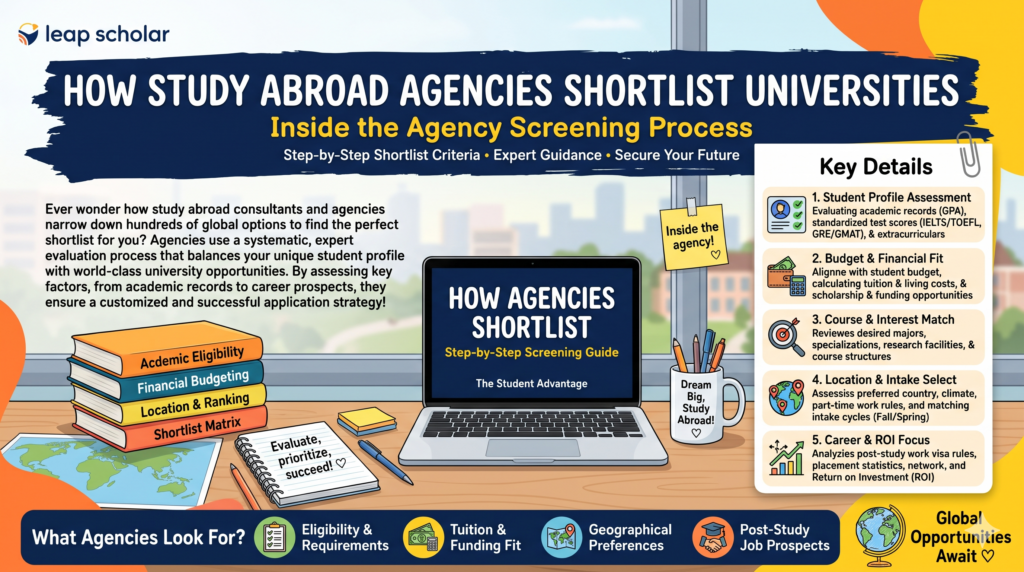
Quick Read
- How study abroad agencies shortlist universities starts with a budget in lakhs.
- Counselors compare your Indian CGPA with each program’s published minimum.
- Sort the list into ambitious, moderate, and safe tiers; safe first.
- Check every pick on its country’s official register before applying.
How Study Abroad Agencies Shortlist Universities, and Can You Do It Yourself?
How study abroad agencies shortlist universities starts with a repeatable method: score your profile against each program’s entry bar, then sort picks into ambitious, moderate, and safe tiers. A shortlist is the final set of universities you actually apply to, and a study abroad agency is a company that advises students and can handle applications for them.
Any list is only as effective as its inputs: your marks, test scores, budget, and target intake.

Choose your dream country
 UK
 USA
 Germany
 Australia
 Ireland
 Canada
 UAE
 France
 Sweden
 Italy
 Other
When do you want to study abroad?
What's your highest level of education?
Have you completed Class 12th?
What was your Class 12 CGPA/percentage?
Are you a student or a parent/guardian?
What do you want to study?
Select your current city
How Leap will help you

Personalised University Shortlist

Express Applications with Quicker Admits

End-to-End Application Support
Shortlisting is one stage inside the wider step-by-step study abroad process, so this page covers only that stage. If you decide to use an agency anyway, the same checks help you choose a study abroad consultant who can explain every pick.

What an Agency Counselor Does During a University Shortlist
A thorough counselor works through 5 tasks before a list reaches you, and you can ask to see each one. Here is what sits behind how study abroad agencies shortlist universities:
- Profile audit: your marks, tests, experience, and projects against each program's entry rules.
- Budget and country fit: which countries and cities match the yearly amount your family can fund.
- Tiering: placing each university in an ambitious, moderate, or safe group.
- Program matching: checking that course content and entry rules suit your degree and goal.
- Application support: documents, essays, and deadlines once the list is final.
Agents are a recognized part of the system in some countries. Australia's Department of Education calls education agents an important part of its international education industry. Its education agents page also refers to the ethical standards in the National Code, which is Australia's code of practice for providers that teach overseas students.
A partner university is one that has a formal agreement with an agency. That isn't a problem by itself, but it's a fair question: ask whether any university on your list is a partner and why it was chosen over a non-partner option for your profile. Services and prices differ too, so read what consultants charge before you sign anything.
How Agencies Read Your Profile Before Shortlisting Universities
Five inputs determine where a university ranks on your list, and reviewing them is the first step in how study abroad agencies shortlist universities. Your CGPA (cumulative grade point average, the overall score on your Indian degree) comes first.
Read the table row by row: the middle column shows what a counselor checks, and the last shows where you check it yourself.
| Input | What a counselor checks | Where you check it |
| Marks (CGPA or percentage) | your score against the program minimum | admission page |
| Test scores | whether a test is asked, and the minimum | entry requirements |
| Work, projects, research | fit with the course | program description |
| Budget | tuition plus living costs against your funds | fee page |
| Intake | which start date fits your timeline | dates page |
When one input is weak, a counselor moves the university to a different tier rather than dropping your goal. That is the core of how study abroad agencies shortlist universities: the tier moves, the target stays.
- Convert your marks: use a CGPA to GPA calculator when a university asks for a 4-point scale.
- Know the master's bar: for US programs, compare yourself with the minimum CGPA for MS.
- Check the test rule: the GRE is a graduate admissions test, so see whether the program asks for a GRE score or lists it as optional.
- Map every test: the exams you may need sit in one place.
How Study Abroad Agencies Shortlist Universities Into Three Tiers
The whole list rests on 3 tiers: ambitious, moderate, and safe. This is how study abroad agencies shortlist universities so that one rejection never empties your options. Read each row as a definition first, then a count to aim for.
| Tier | What it means | Rule of thumb |
| Ambitious | your profile sits at or a little below the usual bar, or competition is high | two or three picks |
| Moderate | your profile matches the published entry bar | the largest group |
| Safe | you clearly clear the published bar, and the fee fits your budget | at least two you would happily attend |
The counts in the last column are a planning guideline, not a statistic, and no university can guarantee a specific outcome.
To place a university, compare your CGPA and test scores with the minimum and any typical profile on the program page. If the page publishes no profile, treat the minimum as the floor, not the target.
My insight: The number to watch is how many safe picks you have, not how many ambitious ones. One safe university you'd happily attend gives you a floor; a list with none leaves you nowhere to go after one bad result.
Checking Fit by Course, Cost, Intake, and Visa Before You Shortlist
There are 5 official lists that show whether a university can enroll you on a student visa, one per common destination. That answers the biggest worry here: what if you shortlist a school that can't host you? Each country has its own terminology:
- An SEVP-certified school is a US school that the Student and Exchange Visitor Program has cleared to enroll F-1 and M-1 students, which are the two US student visa types.
- A licensed sponsor is a UK institution on the government register that can sponsor students on the Student route, the UK's immigration route for students.
- A designated learning institution (DLI) is a Canadian school that a provincial or territorial government has approved to host international students.
- In Canada, you need a letter of acceptance, which is the admission letter that a DLI issues, to apply for a study permit.
- CRICOS is Australia's Commonwealth Register of Institutions and Courses for Overseas Students.
- The DAAD program database is a searchable list of internationally oriented programs offered by universities in Germany.
The table matches each destination to its list.
| Country | Official list to search | What it tells you |
| universities in the USA | Study in the States school search | whether the school can enroll F-1 students |
| universities in the UK | register of licensed sponsors | whether it can sponsor Student route applicants |
| colleges in Canada | designated learning institutions list | whether it can issue a letter of acceptance |
| universities in Australia | CRICOS | whether it can enroll students on a student visa |
| universities in Germany | DAAD program database | which programs match your filters |
- Course fit: read the module list, and in Canada check the program itself, because not every program at a DLI is eligible for the Post-Graduation Work Permit (PGWP), which is Canada's work permit for some graduates after study.
- Cost fit: set an annual ceiling in lakhs before you rank anything.
- Intake fit: pick one intake per program and read its deadline on the program page.
- Visa fit: proof of funds is the money you must show a visa officer, and the rules differ by country.
This visa step is where study abroad agencies differ most from ranking sites in how they shortlist universities, because a ranking never tells you whether a school can host you.
My insight: The number to watch is cost and visa eligibility, and it matters more than entry difficulty. A university you can't afford, or one that can't enroll you on a student visa, isn't a safe pick however easy its entry looks.
The Free Way: How Study Abroad Agencies Shortlist Universities, Step by Step
These 7 steps rebuild how study abroad agencies shortlist universities using only free pages. An intake is the start date of a program, such as fall or spring, and it anchors every step below.
- Pick the country and course: if the country is still open, compare the best country for a master's first.
- List 15 to 20 candidates: a working range, not a rule; use the official lists above, not aggregator sites.
- Read each entry page: note minimum marks, tests, work or portfolio rules, and the intake.
- Price each one: add tuition and living costs in the tuition and living cost calculator and drop any that break your ceiling; the guide to study abroad for free covers low-cost routes.
- Tier it: place each university as ambitious, moderate, or safe using the tier table.
- Break ties: compare outcomes and scholarships on the university's own pages, and use rank last.
- Cut to a final list: keep a one-line reason per university. This habit is what makes a shortlist defensible, whether you built it yourself or are auditing an agency's.
Those reasons also feed your statement of purpose, which is the essay that explains why you chose each program. Match each program to one intake, using the intake dates in the USA as a starting point if you're applying there. Ask referees early, since letters of recommendation take time and limit how many applications you can finish.
University Shortlisting Help by Course: MS, MBA, Design and More
The right course depends on your degree and interest, so how study abroad agencies shortlist universities changes across 6 program groups. Find your group, then check those items on each program page.
| Course group | What to check on the program page |
| Tech and data (Computer Science, Data Science, AI, Analytics, Cybersecurity) | module list, prerequisite subjects, test rule |
| Engineering (Electrical, Mechanical, Civil) | specializations, prerequisites, project component |
| Management and finance (MBA, Finance, Marketing, Economics, Supply Chain) | work experience asked, test rule, fee |
| Design and architecture | portfolio rules and submission date |
| Health, social, and education (Public Health, Social Work, Psychology, Biotechnology) | registration notes, accepted backgrounds |
| Bachelor's after Class 12 | Class 12 subjects and marks, any foundation year |
No row names a university on purpose: start with these checks, not a brand name.
Questions to Ask Before You Trust an Agency's Shortlist
There are 9 city pages for counseling across India, but the method an advisor shows matters more than the pin code. Counselors work with students in person and online through study abroad consultant offices across India.
Pick the page for your city below.
| City | Counseling page |
| Mumbai | Mumbai office |
| Bengaluru | Bengaluru office |
| Chennai | Chennai office |
| Pune | Pune office |
| Kolkata | Kolkata office |
| Jaipur | Jaipur office |
| Ludhiana | Ludhiana office |
| Indore | Indore office |
| Delhi | Delhi office |
Wherever you meet an advisor, these questions show how study abroad agencies shortlist universities in practice. Keep the answers in writing:
- Why this university for my profile? The answer should cite your CGPA, budget, and intake.
- Which tier is each pick? Every university should sit in one tier.
- Is any pick a partner university, and why did it make the list? A clear reason matters more than the label.
- Where is the official page for the entry rule? You should be able to open it yourself.
Bring the questions to ask a consultant to your first meeting. If an advisor can't explain how study abroad agencies shortlist universities for your profile, keep asking before you pay.
My insight: The number to watch is reasons per pick, and it matters more than the length of the list. An advisor who can explain each university using your CGPA, budget, and intake has built a shortlist; one who can't has handed you a catalog.
What If Your University Shortlist Does Not Work Out?
Worried that every pick could say no? A tiered list exists for that risk, and each fix below uses the same logic as how study abroad agencies shortlist universities: change the inputs, keep the goal.
- All tiers rejected: reread the entry pages and add moderate and safe options for the next intake.
- Safe tier too thin: add two universities that clear the entry bar and fit your budget.
- Budget short: compare education loan options and look for scholarships on each university's own page.
- Test score too low: plan a retake or move to programs whose published minimum you meet.
- Deadline missed: move to the next intake and fix the common application mistakes before the next round.
- Backlogs: a backlog is a subject you failed and cleared later, and policies differ by university, so read each admissions page.
For entry questions, contact the university's international admissions office. If you have a counselor, ask them to help you re-tier your list.
3 Takeaways on How Study Abroad Agencies Shortlist Universities
- Fill the safe tier first: how study abroad agencies shortlist universities starts with a floor, so add at least two safe picks you'd happily attend.
- Confirm every pick on the official list: search Study in the States, the UK sponsor register, the DLI list, CRICOS, or DAAD before you apply.
- Ask for a reason per university: a list without reasons tied to your CGPA, budget, and intake is a catalog, not a shortlist.
Talk to a Leap Scholar counselor to review your tiered shortlist against your CGPA, budget, and intake.
Frequently Asked Questions About How Study Abroad Agencies Shortlist Universities
-
Can you explain how study abroad agencies shortlist universities for an MS?
Counselors start with your CGPA, test scores, work experience, and budget, then read each program's entry page to see where you stand. Each university goes into an ambitious, moderate, or safe tier, and the final list keeps a reason for every pick tied to your profile.
-
How much do study abroad agencies charge for shortlisting universities?
Shortlisting is usually bundled into a counseling or application-support package rather than billed as a separate line item, and fees vary by agency, destination, and how many applications you file. Ask for a written fee breakdown before you sign anything, and confirm whether it covers only the shortlist or also the full application and visa support.
-
Can I shortlist universities myself for free?
Official school lists and university entry pages are public and free to search. Use the seven-step method: pick a country and course, list candidates from official registers, read entry pages, price each one, tier it, break ties on outcomes, then cut to a final list with reasons.
-
Do agencies only suggest partner universities?
How study abroad agencies shortlist universities can include both partner and non-partner picks, so ask the advisor which ones are partners and why each made the list. A sound list explains every choice. In Australia, the Department of Education's agent page points to the ethical standards in the National Code.
-
How should I shortlist for a bachelor's after Class 12 versus a master's?
Bachelor's lists lean on your Class 12 subjects, marks, and any test the program asks for. Master's lists lean on your CGPA, test scores, and work or project experience. In both cases, read each program page for its entry rules, intake, and any foundation year.
-
How do I confirm a university can host me on a student visa?
Before you apply, check the official list for that country. Use the Study in the States school search for the USA, the sponsor register for the UK, the DLI list for Canada, and CRICOS for Australia. If a school is missing from its list, ask the university directly.
-
How do I find low-cost or free programs for my shortlist?
Set a yearly ceiling in lakhs first, then read each program's fee page and drop anything above it. Price tuition and living costs together, since a low fee in an expensive city can still break your budget. Scholarships on the university's own page can close small gaps.
-
Do I need a study abroad agency to shortlist universities, or can I do it myself?
You can shortlist universities yourself using only free official pages: list candidates from a country's student visa register, read each program's entry page, and price tuition and living expenses, then sort picks into ambitious, moderate, and safe tiers. An agency can save you time and catch details you might miss, but the method itself needs no paid help.











Have Questions? Get Guidance to reach your Dream University
Connect with India's finest counsellors and biggest study abroad community.
Get Guidance