
Quick Read
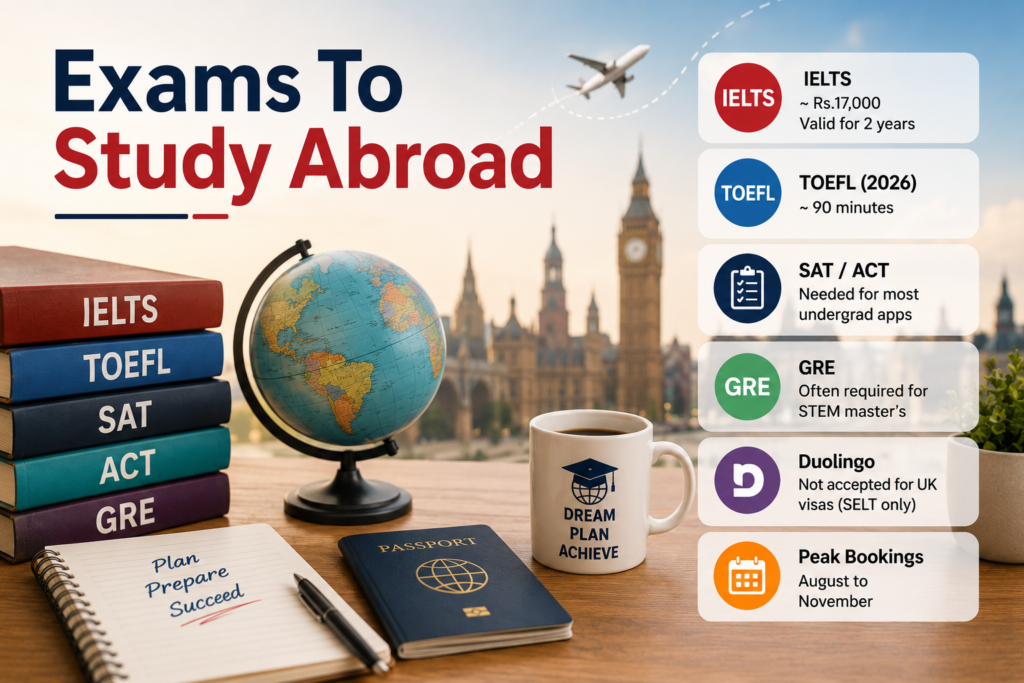
- IELTS runs about Rs.17,000 and stays valid for two years.
- After its 2026 redesign, TOEFL now takes roughly 90 minutes.
- Most undergrad applicants abroad need an SAT or ACT score.
- STEM master’s programs abroad often still require the GRE.
- Duolingo doesn’t count for UK visas; only SELT-listed tests do.
- India’s exam bookings cluster heavily between August and November.
What Exams Do You Need to Study Abroad? The Two Categories
Every exam you’ll come across for studying abroad falls into one of two categories, and most Indian applicants end up clearing at least one exam from each:
- English Language Proficiency Tests (ELPTs): IELTS, TOEFL, PTE, Duolingo. Prove you can study in English if it isn’t your first language.
- Standardized Entrance Exams: SAT/ACT for undergrad, GRE/GMAT for postgrad. Prove your academic readiness for the specific course you’re applying to.

Choose your dream country
 UK
UK
 USA
USA
 Germany
 Australia
 Ireland
 Canada
 UAE
UAE
 France
 Sweden
 Italy
Italy
 Other
Other
When do you want to study abroad?
What's your highest level of education?
Have you completed Class 12th?
What was your Class 12 CGPA/percentage?
Are you a student or a parent/guardian?
What do you want to study?
Select your current city
How Leap will help you

Personalised University Shortlist

Express Applications with Quicker Admits

End-to-End Application Support
One thing to watch for once you've picked your exams: the same test doesn't always satisfy both admission and visa requirements.
- UK example: IELTS UKVI, and PTE Academic UKVI satisfy immigration rules. A plain Duolingo score doesn't, even when the university itself accepts it for admission.
- The fix: confirm both requirements separately before booking anything. This mix-up causes a significant number of last-minute deferrals among students preparing their exams to study abroad in the UK.
Source: UK Home Office, approved English language tests for visa purposes
English Proficiency Exams to Study Abroad: IELTS, TOEFL, PTE, and Duolingo
English proficiency is usually the first exam Indian students book, and which one fits depends on where you're headed. Here's how the four major options compare:
| Exam | Cost (approx.) | Duration | Validity | Best fit |
|---|---|---|---|---|
| IELTS | Rs.17,000 ($180) | 2 hrs 45 min | 2 years | UK, Canada, Australia, NZ |
| TOEFL | Rs.16,900 ($179) | 90 min (since Jan 2026) | 2 years | USA-focused |
| PTE Academic | Rs.16,000-19,000 ($169-201) | 2 hrs | 2 years | Australia, growing in Canada |
| Duolingo | Rs.4,852-6,000 ($51-64) | 1 hr | 2 years | USA, Canada (not UK visas) |
TOEFL had its biggest overhaul in years on January 21, 2026: ETS shortened it to roughly 90 minutes, moved to a 1-6 band scale, and made Reading and Listening adaptive. IELTS added something useful too: clear three sections but underperform in one, and you can now retake just that skill within 60 days instead of resitting the whole exam.
My insight: Students often pick an ELPT based on the nearest coaching center, not what their target university prefers. American universities lean TOEFL, Australian ones lean PTE. Picking wrong wastes 6-8 weeks of prep close to a deadline.
Still deciding between the four? Our IELTS vs TOEFL vs PTE vs Duolingo comparison breaks down scoring and acceptance side by side.
Exams to Study Abroad After 12th: SAT, ACT, and What Changed
If you're applying straight after Class 12, the exams to study abroad after 12th that come up most are the SAT and ACT, both aimed at undergraduate admission in the US and, to a lesser extent, Canada. Both have changed recently, so here's the current situation:
| Exam | Duration | Cost (approx.) | Score range | Recent change |
|---|---|---|---|---|
| SAT | 2 hrs 14 min | Rs.8,000-9,300 ($85-98) | 400-1600 | Fully digital and adaptive since 2024 |
| ACT | 2 hrs (core) | Rs.16,700 ($177) | 1-36 | Science and Writing now optional, since April 2025 (online) / September 2025 (paper) |
Test-optional policies are real but deceptively simple to misread. Some US universities reinstated mandatory testing after 2024, others stayed optional, and optional doesn't mean it doesn't matter. A strong score still works as a tie-breaker when Indian boards grade so differently from one another.
My insight: Strong in math with more time per question in mind? SAT usually suits you. Think fast under pressure and want to show off graph reading? ACT tends to work better, and science is now optional if that's not your strength.
For pacing and scoring weightage side by side, see our ACT vs SAT guide.
Exams to Study Abroad After Engineering: GRE, GMAT, and PG Routes
For students applying after a B.Tech, the exams for foreign studies are usually split by what you want to study next.
If you're targeting an MS in engineering, computer science, or data science:
- GRE is your default exam, required or strongly weighed by most STEM programs, especially at research-heavy US universities.
- Shorter since September 2023: ETS cut it to 1 hour 58 minutes, removed one essay task, and sped up score delivery to 8-10 days.
- Costs Rs.22,550-24,600 ($239-260), valid for 5 years.
- Non-STEM and several professional master's have made GRE optional, leaning more on GPA and your SOP.
If you're targeting an MBA:
- GMAT reset too: since February 2024, the Focus Edition scores 205 to 805 across Quant, Verbal, and a newer Data Insights section, replacing the older essay and sentence-correction components.
- Runs 2 hours 15 minutes, costs around Rs.24,600-27,000 ($260-286).
- Stronger in quant than in grammar-heavy verbal? GRE's math section is generally more approachable, with an on-screen calculator throughout, if a program accepts either.
Sources: ETS, on the shorter GRE; mba.com (GMAC), GMAT Focus scoring
Not sure whether you need one, both, or neither alongside your English test? See our GRE vs IELTS comparison.
Exams to Study Abroad by Country: Which Country Expects What
The exam pair you need doesn't just depend on undergraduate versus postgraduate; it shifts by destination too, since these exams for foreign studies aren't standardized across countries the way a single global list might suggest. Here's the quick reference, followed by the exceptions worth knowing for each country.
| Country | Level | English test | Standardized exam |
|---|---|---|---|
| USA | UG | TOEFL, Duolingo | SAT/ACT |
| USA | MS/MBA | TOEFL, Duolingo | GRE/GMAT |
| UK | UG/PG | IELTS UKVI, PTE UKVI | Rarely required |
| Canada | UG/PG | IELTS, TOEFL, PTE, Duolingo | Often optional |
| Australia | All | IELTS, PTE | GMAT for MBA |
| Germany | UG/PG | IELTS/TOEFL (English-taught) or TestDaF/DSH (German-taught) | Rarely SAT/ACT/GRE; dMAT now mandatory for some PG applicants |
Country-Specific Notes and Exceptions
The table above is the quick reference, but three destinations have exceptions worth knowing before you assume a pattern applies everywhere.
- USA: The one destination most likely to ask for both an English test and a standardized exam at every level, which is why it appears twice in the table above.
- UK and Canada: Both generally skip the standardized exam and lean on your English test plus academic record instead. Canada has made GRE and GMAT optional across most programs.
- Germany: Skips SAT, ACT, and GRE for most public universities, since admission leans on your CGPA and the program's HZB (higher education entrance qualification) criteria instead. What it does insist on is language proof: IELTS or TOEFL for English-taught programs, TestDaF or DSH for German-taught ones.
New for Germany: the dMAT Requirement
From the Summer Semester 2027 intake onward, Indian applicants going through APS with a bachelor's in engineering, commerce, finance, economics, business, or management must include a dMAT (Digital Master Test) certificate in their APS documentation:
- It's a separate 3.5-hour test run by g.a.s.t., not by APS India or your target university.
- It isn't pass/fail; a low score doesn't automatically block your APS certificate, since universities weigh it independently.
- It costs Rs.16,300 (€150), and the first India sitting was held on September 26, 2026.
- If you're applying for Winter Semester 2026/27 or already hold an APS certificate, the rule doesn't apply to you yet.
Want to practice questions and details on the exam pattern, check our blog on DMAT Exam Sample Questions 2026
Source: The PIE News, on the German Embassy New Delhi's dMAT announcement
Which Exam Should You Actually Take? A Decision Framework
If you're a Class 12 student aiming for a US Fall intake: Book SAT or ACT first, ideally August to November of Class 12, since early decision and early action deadlines fall in October and November. Book your English test right after.
If you're a final-year B.Tech student targeting an MS in the US the following Fall: Close your GRE window. 12-14 months before your intake to submit applications with 8-10 months of runway. Don't let GRE prep collide with final-semester projects and placements; students who try consistently underperform on both.
If you're a working professional applying for an MBA: GMAT prep alongside a full-time job typically needs 4-5 months, not the 6-8 weeks a full-time student might get away with. Start earlier than you think you need to.
Documents You Need Alongside Your Exam Scores
Your exam score is one part of the application. These documents usually go alongside it:
| Document | India-specific detail |
|---|---|
| Passport | Valid for at least 6 months beyond your intended travel date |
| Class 10 and 12 marksheets | Provisional certificate accepted if the final marksheet is delayed |
| Bachelor's degree and transcripts (PG applications) | Provisional degree certificate from your university usually acceptable initially |
| Statement of Purpose (SOP) | Format varies by university and country |
| Letters of Recommendation | Usually 2-3, from professors or employers |
Popular Intakes to Study Abroad
Before booking any exam, know which intake you're planning around, since that decides how far back your timeline needs to start:
- Fall/Autumn intake (starts Aug-Oct): Nearly every US, UK, Canadian, and Australian program runs a Fall intake, and it's when the widest range of courses and scholarships is open. Most Indian applicants target the Fall intake.
- Spring intake (starts Jan-Feb): A smaller, secondary window. Fewer programs offer it, mainly in Canada and some US MS programs, and scholarship funding tends to be thinner here.
- Germany's Winter/Summer semesters (Oct and Apr): Run on their own academic calendar, so if Germany is your target, plan your English or German-language test around these dates instead of the Fall/Spring split above.
When to Take Your Exams: A Planning Calendar
Once you know your intake, the exam window works backward from it. The dates below are relative to your intake month, not tied to a specific year, so the information stays accurate whichever year you're planning for:
| Time before intake | What to do | Why it matters |
|---|---|---|
| 14-16 months before | Research target exams, shortlist universities | Right after board or semester results land |
| 10-13 months before | Book and take your English test and standardized exam | This is the August-November peak season in India for a typical Fall intake, sits right before most application deadlines open |
| 7-9 months before | Submit applications, finish any retakes | Most Fall-intake deadlines fall in this window |
| 4-6 months before | Track decisions, respond to offers | Overlaps with board exams for Class 12 students, plan around this |
| 1-3 months before | Complete visa documentation | Applies once you have a confirmed admit |
For a Fall intake specifically (the most common one), that 10-13 month mark usually lands in the August-November window, which is why exam bookings across India cluster there every year.
My insight: Students who book their English test right when applications are also due, instead of 10+ months out, consistently end up under-prepared for both. Working backward from your intake month, not from the calendar year, is what actually prevents this.
What to Do If Your Score, Slot, or Deadline Goes Wrong
Even careful planning around your exams to study abroad can go sideways. Here's what actually helps.
Missed your slot: Most centers allow rescheduling for a fee if done a few days in advance. Check the university's late-score policy before assuming you've missed your chance.
Score came in lower than expected: Use the IELTS one-skill retake if only one section let you down. For GRE and GMAT, most universities accept your highest attempt, so a retake within a few weeks is usually worth it if your deadline allows.
Results delayed, deadline close: Many universities accept a "score pending" note with proof of a booked or completed test. Email the admissions office directly rather than assuming the door is shut.
Visa test doesn't match what your university listed: Common with Duolingo and UK applications. If caught late, book an IELTS UKVI or PTE Academic UKVI slot immediately, since visa timelines don't bend for exam scheduling.
Exams to Study Abroad With a Scholarship
Clearing your exams to study abroad doesn't just get you admitted, in specific cases it directly unlocks funding:
- The British Council runs the IELTS Award for Indian students, judged partly on your IELTS score alongside academic merit and a personal statement.
- The Commonwealth Scholarship and Fellowship Plan lists IELTS as a standard eligibility requirement for Indian applicants heading to the UK.
- On the business side, INSEAD's MBA scholarships and ISB's fees and scholarships page both weigh GMAT or GRE performance alongside merit, and awards can cover a significant share of tuition.
Our own breakdown of GMAT scholarships walks through eligibility for a wider set of business schools.
Score thresholds change yearly, so treat any number here as a starting point and confirm current eligibility on the provider's own page before budgeting.
Exchange rate used: Rs.94.47 per USD (as of Sep 4, 2026). Verify the current rate before finalising your budget.
Three Key Takeaways on Exams To Study Abroad
First, confirm which exam pair, one English test and one standardized exam if your course needs it, your university and program require before registering for anything.
Second, book your English proficiency exam 6 to 9 months ahead of your deadline, ideally in the August-November window that fits the Indian academic calendar.
Third, treat visa and admission requirements as separate checklists: a test your university accepts isn't automatically what the visa office accepts.
Verified by: LeapScholar's test-prep and admissions counseling team, with hands-on experience guiding Indian students through IELTS, TOEFL, GRE, and GMAT preparation timelines.
Have questions about which exams to study abroad apply to you? Book a free session with a LeapScholar counselor for a personalized exam and application timeline.
Frequently Asked Questions About Exams to Study Abroad
-
Which exam is best for study abroad?
There isn't one universal answer. The "best" exam among the exams to study abroad depends on where you're headed: IELTS for the UK, Canada, and Australia; TOEFL for most US applications; PTE for Australia specifically. Check your shortlisted university's admissions page rather than going by what's popular.
-
Which exams are required to study abroad after 12th?
Most US and Canadian universities want SAT or ACT alongside an English test like IELTS, TOEFL, or Duolingo. UK universities usually skip the standardized exam and focus on your board percentage plus an English test, so this genuinely shifts by destination.
-
Can I study abroad without IELTS?
Yes. TOEFL, PTE, and Duolingo all work for plenty of US and Canadian universities. The UK is trickier since student visas there only accept SELT-listed tests like IELTS UKVI or PTE Academic UKVI, regardless of what the university's admissions page says.
-
How can I get a scholarship to study abroad after 12th?
Combine a strong board percentage with an SAT or ACT score above a program's merit threshold. Government-backed options like the Commonwealth Scholarship are worth researching early since their deadlines often land months before the university's own deadline.
-
Is GRE compulsory for a master's degree abroad?
Not universally, and this trips up a lot of engineering graduates. STEM programs still expect it or weigh it heavily, but plenty of non-STEM and professional masters have quietly made it optional, leaning more on GPA and your SOP instead.
-
What happens if my English test score expires before I apply?
IELTS and TOEFL are valid for exactly 2 years from the test date, no extensions. If your intake falls outside that window, you're retaking the test, since neither universities nor visa offices accept an expired score.
-
Do UK universities accept Duolingo scores?
Some do, for admission only. The catch is the visa: UK student visas require a SELT-listed test, and Duolingo isn't on it. If the UK is genuinely your plan, take IELTS UKVI or PTE Academic UKVI from the start.
-
How much do exams to study abroad cost in total, realistically?
Plan for roughly Rs.17,000-25,000 ($180-265) per exam. Most students take one English test plus one standardized exam, putting total costs between Rs.35,000 and Rs.50,000 ($370-529) before retakes.











Have Questions? Get Guidance to reach your Dream University
Connect with India's finest counsellors and biggest study abroad community.
Get Guidance