
Quick Read
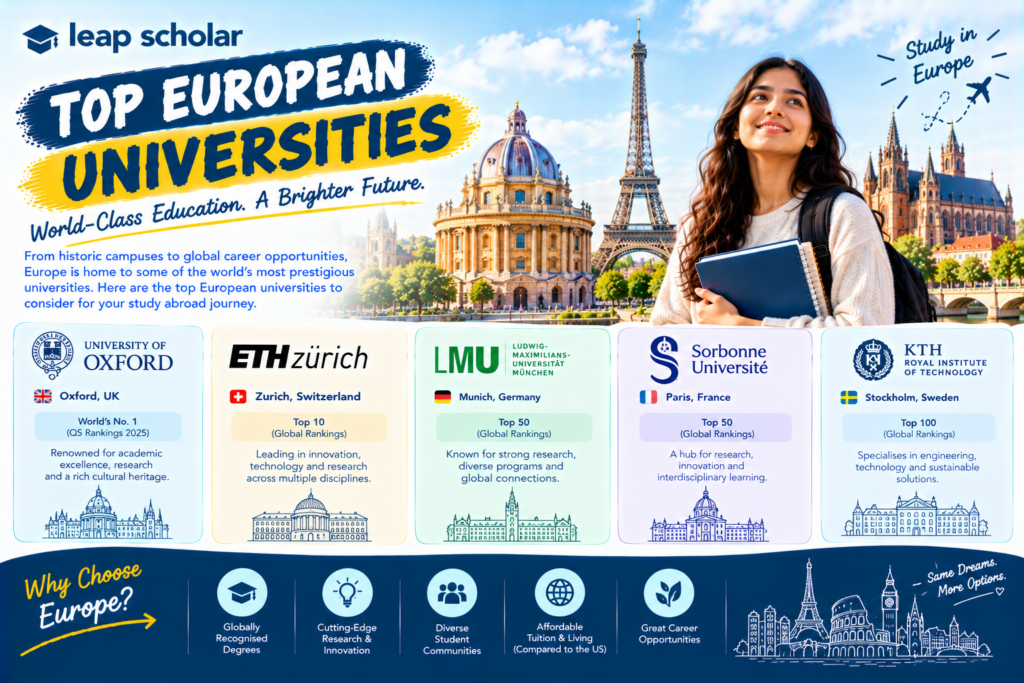
- QS 2027 ranks Imperial, ETH Zurich, and TUM among Europe’s best picks.
- Germany’s public universities charge zero tuition, only a small semester fee.
- Most European master’s programs accept Duolingo or TOEFL instead of IELTS.
- Fall 2027 applications are now open across Germany, France, and Ireland.
Why Indian Students Are Choosing European Universities
Indian students are moving toward European universities for three reasons: lower tuition than the US or UK, one to two year post-study work visas, and English-taught programs that no longer require a European language. Germany, France, the Netherlands, and Ireland together host the largest share of Indian students on the continent, and that number keeps growing as GRE requirements drop and Duolingo acceptance widens.
Three factors matter more than overall ranking when an Indian student shortlists a European university:

Choose your dream country
 UK
UK
 USA
USA
 Germany
 Australia
 Ireland
 Canada
 UAE
UAE
 France
 Sweden
 Italy
Italy
 Other
Other
When do you want to study abroad?
What's your highest level of education?
Have you completed Class 12th?
What was your Class 12 CGPA/percentage?
Are you a student or a parent/guardian?
What do you want to study?
Select your current city
How Leap will help you

Personalised University Shortlist

Express Applications with Quicker Admits

End-to-End Application Support
- Public vs. private tuition. Public universities in Germany, France, and much of Italy charge low or zero tuition regardless of ranking. Private institutions and most UK universities charge full international fees, often EUR 15,000 to EUR 35,000 a year.
- Teaching language. Bachelor's programs in continental Europe are still mostly taught in the local language. Master's programs, by contrast, are overwhelmingly available in English, especially in the Netherlands, Germany, and the Nordic countries.
- Post-study work rights. France and Ireland offer two-year post-study work permits, longer than Germany's 18 months and the Netherlands' one-year orientation period. For students planning to work in Europe after graduation, this difference affects the real return on a degree more than a 20-30 spot gap in the rankings.
Study in Europe: Ultimate Guide for International Students covers the full country-by-country picture if you are still deciding between destinations. This guide focuses on the specific universities worth shortlisting and where they stand in the newest rankings.
Top European Universities 2026-27: QS World Rankings 2027
The table below uses the QS World University Rankings 2027, released in June 2026, the most recent edition available.
| University | Country | QS 2027 Rank | Known For |
| Imperial College London | UK | 2 | Engineering, medicine, business |
| University of Oxford | UK | 4 | Humanities, law, research depth |
| University of Cambridge | UK | 6 | STEM, natural sciences |
| ETH Zurich | Switzerland | 8 | Engineering, computer science |
| UCL | UK | 8 | Architecture, social sciences |
| Technical University of Munich (TUM) | Germany | 25 | Engineering, highest-ranked in the EU |
| Université PSL | France | 34 | Sciences, research, arts |
| University of Edinburgh | UK | 35 | Law, medicine, international relations |
| King's College London | UK | 37 | AI, computer science, law, medicine |
| University of Manchester | UK | 40 | Business, engineering, life sciences |
| Institut Polytechnique de Paris | France | 43 | Engineering, applied sciences |
| TU Delft | Netherlands | 48 | Engineering, architecture |
| University of Bristol | UK | 57 | Research-intensive sciences and engineering |
| University of Amsterdam | Netherlands | 60 | Social sciences, business |
| London School of Economics (LSE) | UK | 62 | Economics, political science, law |
| Sorbonne University | France | 73 | Medicine, humanities |
| Trinity College Dublin | Ireland | 75 | Business, computer science |
| Université Paris-Saclay | France | 76 | Physics, engineering, data science |
| Politecnico di Milano | Italy | 87 | Design, architecture, engineering |
| University College Dublin | Ireland | 100 | Business, agriculture, engineering |
Switzerland and the UK sit outside the EU but are included here because "European universities" is how Indian students search and shortlist; both remain top destinations for Indian applicants.
A Closer Look at the Top 5
Imperial College London (QS 2027: 2). Imperial is a STEM-only university, with no humanities faculty, so every applicant competes within engineering, medicine, natural sciences, or business. It has one of the largest Indian student populations among UK universities and strong placements in finance and tech roles in London. Programs are intensive and assessment-heavy compared to the more essay-based style at other UK universities.
University of Oxford (QS 2027: 4). Oxford runs on a collegiate system: you apply to the university but live and are tutored in one of its colleges, each with its own application quirks and interview process. It is strongest for humanities, law, and PPE (Politics, Philosophy and Economics), and interviews are a mandatory part of admission for most courses, unlike most other European universities on this list.
University of Cambridge (QS 2027: 6). Cambridge mirrors Oxford's collegiate structure but leans further toward natural sciences and mathematics. Many STEM applicants choose between Cambridge and Imperial based on whether they want a broader, college-based university experience (Cambridge) or a specialist, STEM-only environment (Imperial).
ETH Zurich (QS 2027: 8, tied). ETH is a public Swiss university, which makes its low cost relative to its ranking unusual among top-10 institutions. It raised its fee for non-EU students to CHF 2,190 per semester (about CHF 4,380 a year) from autumn 2025, still far below UK or private-university costs. Teaching for most bachelor's programs is in German, but master's programs are predominantly in English.
UCL (QS 2027: 8, tied). UCL is the largest university on this list by student enrollment and is known for its architecture school (the Bartlett), medicine, and a very broad subject range. Because it is spread across many departments of different sizes, selectivity varies more by course than it does at Oxford, Cambridge, or Imperial.
Country by Country Snapshot
Germany: Public universities charge zero tuition for international students in most states, so TUM and other top-ranked institutions cost close to nothing beyond a semester contribution. Baden-Württemberg is the one state that charges non-EU students a flat fee. TUM is strongest for engineering and computer science, while LMU Munich and Heidelberg lead on life sciences and humanities.
See Cost of Studying in Germany and Study in Germany Without IELTS for the details.
France: Public universities keep tuition low for all students, and France pairs this benefit with a two-year post-study work permit (APS), among the longest in Europe. Université PSL and Sorbonne University lead on research and medicine, while Institut Polytechnique de Paris and Université Paris-Saclay are the stronger picks for engineering and data science.
Study in France Without IELTS and Cost of Studying in France break down admission routes.
Netherlands: TU Delft and the University of Amsterdam both sit inside the global top 60, and nearly every master's program is taught entirely in English, with no local-language requirement even for admission. Tuition for non-EU students is higher than in Germany, but scholarships and assistantships are relatively easy to find at the research-intensive universities.
See Best Universities in the Netherlands for Masters.
Ireland: Trinity College Dublin and UCD have both climbed into the QS global top 100 in 2027, and Ireland's two-year post-study work visa makes it popular for Indian master's students, particularly in business, data science, and pharmaceuticals, where Ireland has a dense base of multinational employers.
Study in Ireland Without IELTS and Cost of Studying in Ireland cover the application process.
Italy: Politecnico di Milano leads Italian institutions and is particularly strong for design, architecture, and engineering, with tuition adjusted by household income (ISEE) for many public programs. Most Indian students without an Italian ISEE certificate are assessed at the standard non-EU rate, so check each university's fee bracket before applying.
Tuition and Living Costs in INR
At Rs. 106 per EUR:
- Germany (public universities): tuition is Rs. 0, and the semester contribution ranges from roughly Rs. 15,900 to Rs. 37,100. Baden-Württemberg's non-EU fee of EUR 1,500 per semester works out to about Rs. 1,59,000 per semester.
Counselor insight: The most common mistake Indian students make here is assuming "Germany is tuition-free" applies everywhere in the country. It is a state-level policy, not a national one. TUM sits in Bavaria, which is tuition-free, so it is unaffected by Baden-Württemberg's fee. Always check which state a shortlisted university is in before assuming the zero-tuition rule applies, rather than going by the country name alone.
- France (public universities): the state keeps tuition low; the budget primarily covers living costs rather than fees.
- Netherlands, Ireland: Tuition varies by program and runs higher than Germany or France, typically EUR 8,000 to EUR 20,000 a year depending on the university and course.
Living costs across most of these countries run between Rs. 85,000 and Rs. 1,30,000 a month, depending on the city. Cost of Living in Europe has the full city-wise breakdown.
GRE and IELTS Requirements for European Universities
Most European master's programs, including those at TUM, TU Delft, and Trinity College Dublin, do not require the GRE. For English proficiency, the Duolingo English Test and TOEFL are accepted as IELTS alternatives at a growing number of universities. Duolingo Accepted Universities in Europe lists which ones.
Scholarships for Indian Students at European Universities
The Erasmus Mundus Joint Master's Scholarship is the largest scholarship open to Indian students across European universities, covering tuition and a monthly stipend for selected joint-degree programs. Several countries also run their own scholarships (Germany's DAAD, France's Eiffel and Charpak programs) alongside university-specific merit awards.
See the Erasmus Mundus Scholarship guide for eligibility and deadlines.
Post-Study Work Visas by Country
- Germany: 18 months to search for a job after graduation.
- France: Up to 2 years under the APS (Autorisation Provisoire de Séjour).
- Ireland: 2 years for master's graduates under the Third Level Graduate Scheme.
- Netherlands: 1 year under the "zoekjaar" (orientation year).
Jobs in Europe for Indians covers which pathway fits which profile.
How to Apply: Fall 2027 Intake Timeline
Fall 2026 intakes have already started, so Indian students applying now should target the Fall 2027 intake. Application windows typically open in October 2026 and close between January and June 2027 depending on the country and university; Germany's winter semester applications generally close earlier (several already closed for 2026/27) and run on a similar cycle for 2027/28, while France and Ireland keep rolling windows into mid-2027. Confirm each university's exact deadline directly on its admissions page, since these shift by program.
A typical application for a European master's needs:
- Academic transcripts and degree certificates, which often require attestation (uni-assist for Germany, Campus France for French public universities).
- Statement of purpose, usually 500-1,000 words tied to the specific program rather than a generic one for every application.
- Two to three letters of recommendation, ideally from academic referees for research-heavy programs.
- English proficiency score, IELTS, TOEFL, or Duolingo, depending on what the university accepts.
- CV or resume, especially for programs with a work-experience component like most MBA and some MS programs.
- Proof of funds, required for the visa stage rather than the university application itself and varies by country (Germany's blocked account, France's Campus France financial proof, and Ireland's bank statement requirement).
Build in at least 6 to 8 months between shortlisting and the application deadline to get transcripts attested, LORs collected, and English test scores back in time.
3 Takeaways on Top European Universities for Indian Students
- Shortlist universities using the QS 2027 rankings above, not outdated 2026 figures still circulating on other sites.
- Germany's public universities remain the lowest-cost route into a top-100 European university for Indian students.
- Apply for the Fall 2027 intake now, since Fall 2026 application windows have already closed at most universities.
Ready to shortlist European universities that fit your budget and profile? Talk to a LeapScholar counselor for a personalized shortlist, scholarship matches, and application timeline built around the 2026 intake.
Frequently Asked Questions About Top European Universities for Indian Students
-
Which are the best European universities for Indian students?
Imperial College London, ETH Zurich, TUM, TU Delft, and Trinity College Dublin are consistently the strongest picks for Indian students, combining high QS 2027 ranks with manageable costs and clear post-study work visas.
-
Why is Europe a good study destination for Indian students?
Europe combines lower tuition than the US or UK, English-taught programs without a GRE requirement at most universities, and post-study work visas of one to two years, making the total cost and career payoff more predictable for Indian families.
-
What is the cheapest university in Europe?
Germany's public universities, including TUM and other top-ranked institutions, charge zero tuition for most programs, and most states have only a semester contribution of roughly Rs. 15,900 to Rs. 37,100. Baden-Württemberg is the exception, charging non-EU students EUR 1,500 per semester.
-
What is the hardest university to get into in Europe?
Oxford, Cambridge, Imperial College London, and ETH Zurich are widely considered the hardest to get into, with highly selective admission for their most competitive programs and strong academic and employer reputation scores in the QS rankings.
-
Can Indian students study in Europe without IELTS?
A growing number of European universities, including several in Germany, France, and Ireland, accept the Duolingo English Test or TOEFL instead of IELTS, and some waive the requirement entirely for applicants with an English-medium undergraduate degree.
-
Which are the top European universities for engineering?
In the QS World University Rankings by Subject 2026 for Engineering & Technology, ETH Zurich ranks 3rd globally, Imperial College London 7th, Technical University of Munich 16th, and KTH Royal Institute of Technology 33rd, making them the strongest engineering picks in Europe.
-
How can Indian students find an affordable master's in Europe taught in English?
Germany's public universities offer the largest number of zero-tuition, English-taught master's programs. The Netherlands and several Nordic countries also offer English-taught master's degrees, though tuition for non-EU students runs higher than in Germany.
-
Which scholarships are available for Indian students studying in Europe?
The Erasmus Mundus Joint Master's Scholarship is the most widely accessible, covering tuition and a stipend for selected programs. Country-specific options include Germany's DAAD scholarships and France's Eiffel and Charpak scholarships.







Have Questions? Get Guidance to reach your Dream University
Connect with India's finest counsellors and biggest study abroad community.
Get Guidance