


 Blogs
Blogs  Leap Digest
  Events
  About Us
 There are two kinds of money in this guide, and confusing them is the single most common financial planning mistake Indian families make about Germany. The first kind is money you spend and never see again: tuition, fees, insurance, rent. The second kind is money that's yours, simply held and released to you on a schedule: the blocked account. Add both kinds together, and Germany looks far pricier than it is. Keep them separate, and the picture gets a lot clearer. That distinction runs through this entire guide.


Cost of Studying in Germany for Indian Students
Last Updated - Sep 28, 2026
Introduction

Tuition Fees In Germany
| Situation | Tuition |
|---|---|
| Public university, 14 of 16 states | €0 |
| Public universities in Baden-Württemberg (Heidelberg, Stuttgart, KIT, Freiburg, Tübingen, Mannheim, Konstanz) | €1,500 per semester for non-EU students, since Winter Semester 2017/18 |
| TUM (Bavaria), newly enrolled non-EU students since WS 2024/25 | €2,000–€3,000/semester Bachelor's; €4,000–€6,000/semester Master's, programme-dependent |
| Private university | €10,000–€40,000+ total |
Two things people consistently get wrong
- The Baden-Württemberg €1,500 figure is per semester, not per year. A two-year Master's is four payments, roughly €6,000 in total, not €1,500.
- LMU Munich sits in the same state as TUM and has kept tuition at effectively zero. "Bavaria charges tuition" is not a safe generalisation. Always check the specific university and programme, not just the state.
Public universities in Germany do not charge tuition fees, requiring only a nominal semester transport and administrative fee of around €200. In contrast, US universities required significant financial investments, ₹20 to 30 lakhs at the time, without a guaranteed scholarship.
— Mriganka Das, Mechanical Engineering graduate, working in Germany since 2019
The Semester Contribution In Germany
Every student at every public university pays a Semesterbeitrag each semester, typically €120 to €430. It covers the Studierendenwerk (canteens, dormitories, and counselling), the student body, administration, and, in most cases, your transport ticket, which is usually the largest single component.
What the data says: The transport component changed in 2026, so double-check this if you're reading older material. The nationwide Deutschlandticket rose to €63 a month from 1 January 2026. The student version, the Deutschland-Semesterticket, is fixed by law at 60 percent of that: €34.80 a month (€208.80 a semester) through Summer Semester 2026, rising to €37.80 a month (€226.80 a semester) from Winter Semester 2026/27. It's unlimited local and regional transport across the whole country, not just your city, and it's bundled into the semester contribution rather than separately cancellable.
This is genuinely one of the best deals available to any student anywhere. Roughly €38 a month for national regional rail is a large part of why living slightly outside an expensive city remains a workable choice rather than a hardship.
Public vs. Private University Costs In Germany
This decision is really a cost decision dressed up as an academic one. Here's the honest version of what you're actually choosing between.
- Public universities are funded by the state and, in fourteen of sixteen states, charge no tuition to international students at all. They're accredited to the same national standard regardless of size or reputation.
- Private universities set their own tuition, usually €10,000 to €40,000 or more for a full degree, and often market themselves aggressively to international applicants with smaller cohorts and English-taught catalogues.
- Privacy doesn't automatically buy a better outcome. Employers weigh subject relevance, practical experience, and language ability well above whether a degree is public or private.
- Tuition is only one line in a two-year budget. A public university with zero tuition in Munich or Frankfurt can cost more overall than a private university with real tuition in a cheaper city, once rent and daily living are added in. Run the full two-year number, tuition plus roughly twenty-four months of living costs at your target city's rate, before ruling either option out.
The tuition fee at my private university was approximately €19,000, along with a €1,000 registration fee.
— Pooja Kale, Master's graduate, Management, SRH Heidelberg
Accommodation and Rent In Germany
Housing is usually your largest monthly expense, and it varies widely based on where and how you live.
- Studierendenwerk dormitories: the cheapest option, typically €250 to €450 a month, but with waiting lists that routinely run one to three semesters in high-demand cities. Apply the day you get your admission letter, not the day your visa is granted.
- A WG (Wohngemeinschaft, shared flat): the most common student arrangement, typically €350 to €600 a month depending on the city, found through WG-Gesucht and similar platforms.
- A private studio or one-bedroom flat: the most expensive and most independent option, typically €500 to €900 or more depending on the city.
- The rent deposit (Kaution) is legally capped at three months' base rent (Kaltmiete) under §551 BGB, usually €1,000 to €3,000. It's returnable, but it can take three to six months after you move out to get it back.
What the data says: Never transfer a deposit or sign a lease without a video call to verify the landlord and the property first. Rental scams targeting international students, especially around high-demand intake months, are common enough to be one of the most frequently reported issues in student community discussion.
I budgeted approximately ₹40,000 (€450) per month for rent while living in Essen prior to moving to Berlin.
— Titixa Kamani, Master's student, Usability Engineering, Hochschule Rhein-Waal
Day-to-Day Living Expenses
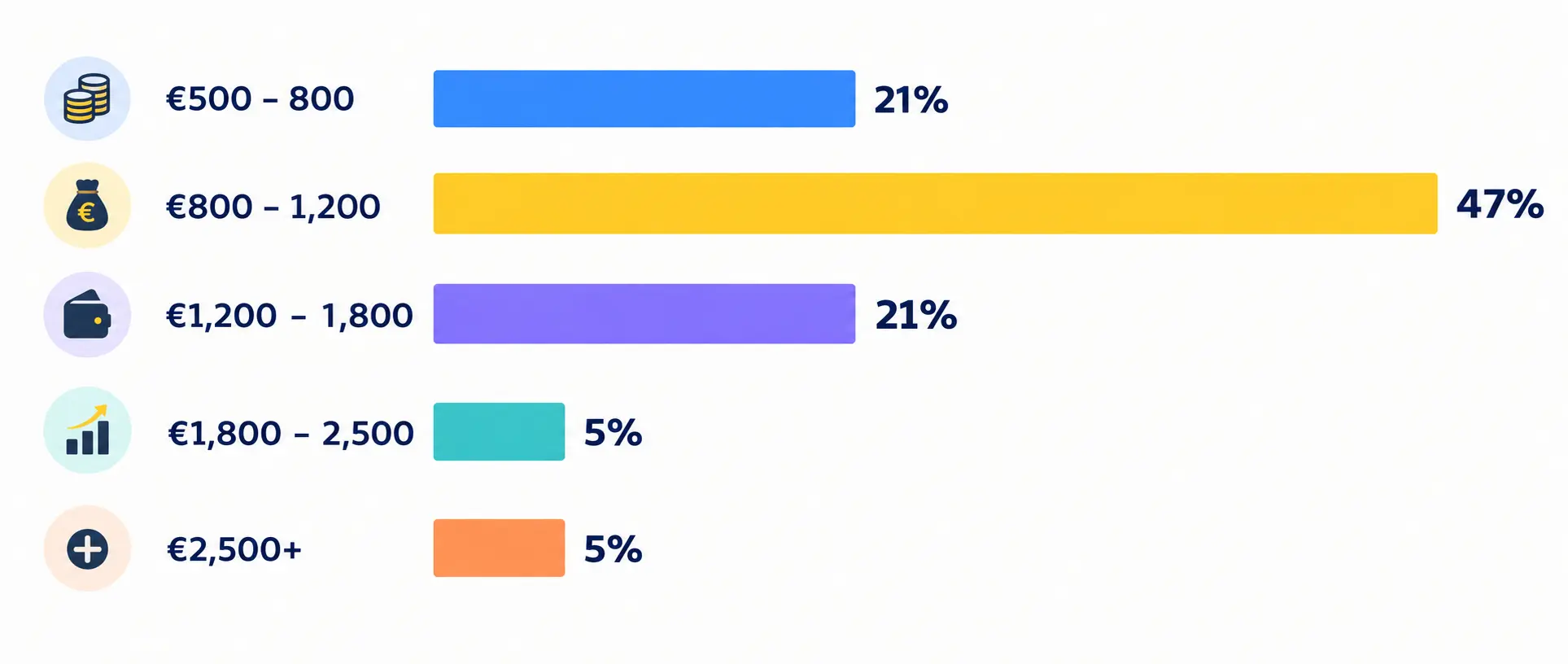
Here's what a typical month actually breaks down into for a student in a moderate-cost city, once rent is accounted for separately above.
| Category | Typical monthly cost |
|---|---|
| Food and groceries | €200–€250 |
| Health insurance | €140–€152 |
| Semester contribution (amortised monthly) | ≈ €40 |
| Phone and internet | €20–€35 |
| Rundfunkbeitrag (mandatory broadcasting fee) | €18.36 |
| Miscellaneous (toiletries, clothing, social) | €80–€120 |
Add rent from section 4 on top of this table, and you have a realistic full monthly picture. This is also the number to compare directly against the €992 a month your blocked account releases, which is exactly what section 11 of this guide walks through.
Health Insurance Costs for Students in Germany
Health insurance is mandatory in Germany, not optional, and it's checked before you can even enrol. Almost every student under 30 uses statutory health insurance (gesetzliche Krankenversicherung), through funds like TK, AOK, or Barmer, at a standard student rate.
- The statutory student rate typically runs €140 to €152 a month, and the specific fund you choose barely matters for coverage since core benefits are legally standardised. Choosing the cheapest compliant option (often around €139–€140 versus €152) saves roughly €150–€300 over a two-year degree for identical mandatory coverage.
- Insurance costs rise at age 23, when a higher long-term-care contribution kicks in for childless students, and change again at 30 or after 14 semesters, after which statutory student rates no longer apply and you move to a voluntary rate of roughly €240 to €260 a month. If you'll be close to 29 when you start, model these figures into your multi-year budget.
- You'll also need travel and bridging health insurance, typically €30 to €60, to cover the gap between landing in Germany and your semester officially starting, with a minimum coverage requirement of €30,000.
As a student, mandatory health insurance costs around €120 per month. Once you transition to full-time employment, the cost increases significantly because it scales with your salary.
— Pooja Kale, Master's graduate, Management, SRH Heidelberg
The Blocked Account and Financial Proof
This fee is the single most misunderstood cost in the entire process, so it's worth being precise about what it actually is.
The blocked account (Sperrkonto) is not a fee. It's your own money, deposited to prove you can support yourself, then released back to you at a fixed monthly rate. As of the 2026 requirement, you deposit €11,904, and it's released at €992 a month across your first year. Families routinely add this figure to "the cost of studying in Germany" and conclude the country costs far more than it does. It doesn't. This money comes back to you each month.
The provider fee is a real, separate cost. Opening a blocked account through a provider like Expatrio or Fintiba costs €148 to €278 for the first year, plus an ongoing monthly fee of roughly €4.90 to €5. This is money you don't get back, and it's easy to forget when you're focused on the much larger deposit figure.
What the data says: The blocked account proves your first year of living costs. It does not prove your tuition is covered if you're at a fee-charging program, and it does not cover the before-arrival or first-month costs detailed in sections 10 and 11. Plan for all three separately, not as one number.
A blocked account is a mandatory account where incoming international students deposit one year's worth of living expenses prior to arriving in Germany. It serves as financial proof for visa approval, releasing a fixed monthly amount to cover living costs.
— Pooja Kale, Master's graduate, Management, SRH Heidelberg
Sources and Further Reading
Tuition rules, the blocked account requirement, insurance thresholds, and scholarship terms come from official German sources wherever a primary source exists. City-tier living-cost bands are compiled from Studierendenwerk cost-of-living guidance and DAAD material and should be checked against your specific target city's own Studierendenwerk page for an authoritative figure.
Tuition, fees and the semester contribution
Heidelberg University, fees and charges (Baden-Württemberg tuition): https://www.uni-heidelberg.de/en/study/all-subjects-from-a-to-z/fees-and-charges
TUM, tuition fees: https://www.tum.de/en/studies/fees-and-financial-aid/tuition-fees
Studis Online, semester contribution overview: https://www.studis-online.de/studienkosten/semesterbeitrag.php
VRR, Deutschlandticket and student semester ticket: https://www.vrr.de/tickets-tarife/deutschlandticket/semesterticket/
Blocked account and financial proof
German Missions in India, financial proof requirements: https://india.diplo.de/in-en/service/visa-einreise/studium
Table of content
