
Quick Read
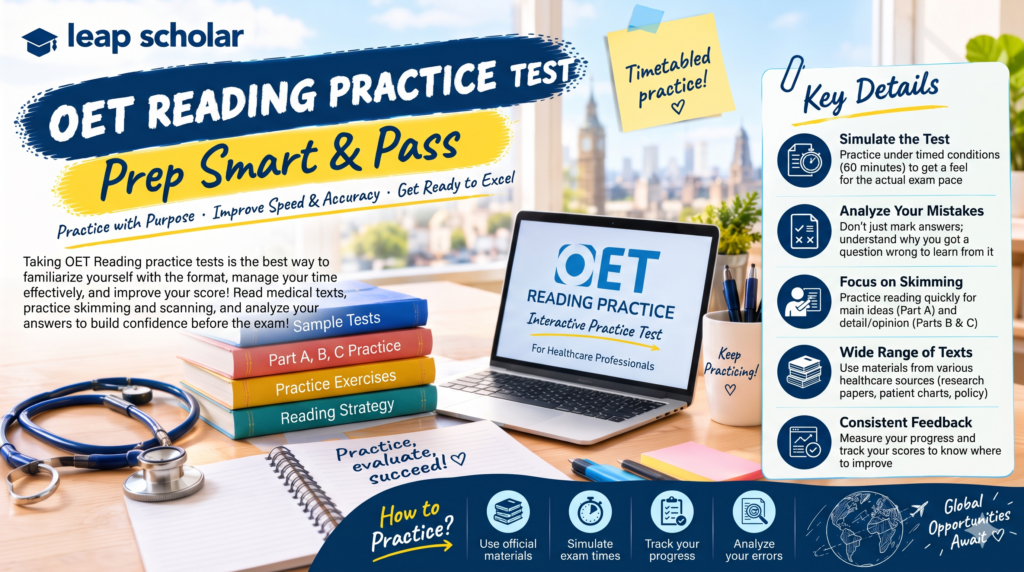
- A free OET reading practice test comes from oet.com sample tests.
- Part A gets 15 minutes; Parts B and C share 45.
- A second OET sitting means another INR 39,200 (AUD 587) fee.
- Indian paper test candidates can get results in as little as 5 days.
Where can you find a free OET reading practice test?
Your best free OET reading practice test comes from oet.com, where OET posts official sample tests for Reading and every other sub-test.
OET is an English test built for health professionals. A subtest is one of its four parts: Listening, Reading, Writing, and Speaking. A sample test is an official practice paper from OET. Worried you have to buy PDFs? You don’t.

Choose your dream country
 UK
 USA
 Germany
 Australia
 Ireland
 Canada
 UAE
 France
 Sweden
 Italy
 Other
When do you want to study abroad?
What's your highest level of education?
Have you completed Class 12th?
What was your Class 12 CGPA/percentage?
Are you a student or a parent/guardian?
What do you want to study?
Select your current city
How Leap will help you

Personalised University Shortlist

Express Applications with Quicker Admits

End-to-End Application Support
What oet.com lists as free:
- Sample tests: for paper and for computer or OET@Home (OET taken online on your computer with remote supervision).
- Intro to OET online course: a starter course for the test.
- OET Study Guide: a download on OET's preparation page.
- On-demand lesson libraries: listed among OET's free resources.
- Interactive progress guide: for tracking your progress.
OET Pulse is a separate 30-minute test that shows your current English level. OET's store sells courses and books, not covered here.
One caution: OET says practice tasks on social media might misrepresent the test, so this page links to no third-party OET reading practice test PDF.
Which OET reading practice test fits your test mode and profession?
OET publishes sample tests for paper and for computer or OET@Home, and its paper collection covers all 12 OET professions.
The computer nursing page lists four packs, each with question files, an answer key, and a Speaking role card. Pick the OET reading practice test pack for your profession and mode.
Reading is common to all professions: an aspiring nurse applying through the UK's NMC and a doctor applying through Australia's AHPRA sit the exact same Reading paper.
Practice the answer handling too:
- Paper: Part A, the first part, is answered in pen or pencil; Parts B and C are shaded with a 2B pencil.
- Computer: left click to choose an answer, right click to cross out an option.
How do you run a timed OET reading practice test at home?
Reading lasts 60 minutes: 15 for Part A and 45 for Parts B and C, and Part A is collected at the 15-minute mark.
In Part A you find and copy specific information from four texts, and once it's collected, there's no time to check it later. A mock is a full sample test taken at home with the clock running. Set yours up in this order:
| Step | What to do | Reason |
| 1. First sitting | Take one sample test untimed and note your strategies | OET advises ignoring the clock at first |
| 2. Timed sitting | Wall clock, phone off, no dictionary or highlighter | Copies test conditions |
| 3. Paper format | Print the sample and write on it, or use a notebook | Same page layout as test day |
| 4. Desk items | Pens, pencils, erasers, sharpeners, and water for paper; only water for computers | Matches what each mode allows |
| 5. Part A stop | Put Part A away in 15 minutes | The real test collects it then |
| 6. Parts B and C | One 45-minute block for both | OET gives them 45 minutes together |
What this means for you: the real test enforces the clock, and a relaxed home mock doesn't, so treat every timed OET reading practice test as test day.
My insight: Take your first sample test untimed to learn the task types, then count only the second, timed sitting as a score.
How do you review an OET reading practice test and keep an error log?
OET's advice is to analyze your wrong answers and build the skills behind them, rather than taking test after test.
An error log is your own table of every wrong answer, its cause, and the fix you'll practice. Fill it in right after each OET reading practice test:
| Column | What you write | Why it helps |
| Test and date | Sample test name and day | Shows your spacing |
| Part and question | Where you lost the mark | Shows which part leaks marks |
| Your answer and the key | Both side by side | Makes the gap visible |
| Cause tag | One tag from the list below | Turns misses into patterns |
| Fix | One sentence on what you'll practice | Gives the next session a job |
Cause tags, based on OET's stated rules:
- Part A slips: misspelling, a different word form, extra words, or an abbreviation not in the texts.
- Wrong text letter: a Part A matching question sent to the wrong text.
- Stem misread: in Parts B or C, you answered a different question.
- Verb or stance mismatch: the option claimed more or less than the text.
- Time ran out: the clock, not the language, cost the mark.
Fictional example row written for practice, not an official OET sample or clinical guidance.
| Part | What happened | Cause tag | Fix |
| Part A | Wrote four words where the text gives two | Part A slip | Copy only what the gap needs |
| Part A | Picked a letter from the heading alone | Wrong text letter | Read the lines under each heading first |
| Part C | Chose an option with an absolute verb the text didn't support | Verb or stance mismatch | Match the option's verb to the text's verb |
What this score means for you: tag every miss as language or test skill; only language misses need study outside practice papers.
My insight: Count your tags every two tests; if language tags outnumber test-skill tags, pause the papers and study vocabulary and sentences instead.
How do you track OET reading practice test scores without a conversion chart?
Each correct Reading answer earns 1 mark out of 42, and OET converts that total to its 500-point scale in steps of ten.
Your scale score is that converted result, which ranges from 0 to 500. Grade B is the letter grade for 350, which typically takes at least 30 marks, but OET shifts the boundaries slightly for each test.
Raw marks are the number of questions you got right; track those and don't convert them yourself. Record after each OET reading practice test:
| Column | What to write | How to use it |
| Part A | Marks out of 20 | Is exact copying held for 15 minutes? |
| Part B | Marks out of 6 | Are short texts read accurately? |
| Part C | Marks out of 16 | Is your stamina lasting? |
| Total | Marks out of 42 | Compare your last three totals |
| Top cause tag | Most frequent tag in your log | Names the next skill to study |
| Minutes left | Time left in the 45-minute block | Pace problem or accuracy problem? |
Treat 30 as a rough marker, never a pass line. Your real target comes from your regulator, which is the official body that registers health workers in a country:
- UK nurses: for nursing in the UK, the NMC (Nursing and Midwifery Council) asks for at least grade B (350) in Reading.
- Australian nurses: for nursing in Australia, the score comes from your regulator's own site, so read it there.
- UK doctors: on the doctor route to the UK, check the score page of the GMC (General Medical Council).
My insight: Set your mock target one or two marks above 30, because the grade B boundary moves with each test.
What practice schedule works in the weeks before your OET Reading test?
OET recommends one practice test every 2 to 3 weeks, with work in between on the skills that caused your errors.
How much you need depends on your English level and weekly study hours. This six-week table is my suggested plan, not an OET rule:
| Week | Focus | Output |
| Week 1 | OET Pulse or an untimed first sample test | A starting level and an empty log |
| Week 2 | Part A: skim and scan drills, vocabulary, 10 minutes a day of longer texts | Fewer Part A slips |
| Week 3 | First timed mock at the end of the week | A first total out of 42 |
| Week 4 | Skill work on your top cause tag | One tag closed |
| Week 5 | Second timed mock on an unseen paper | A second total to compare |
| Week 6 | Review the log; no new full mock | A short list of final fixes |
What this means for you: with under six weeks left, drop skill weeks rather than squeeze mocks together. Each OET reading practice test is scarce: the nursing computer packs list four, which at one every 2 to 3 weeks covers 8 to 12 weeks.
My insight: Use an unseen paper for your last timed mock, so you're not scoring yourself on a test you've already read.
How should you practice Reading Part A and Parts B and C differently?
OET says Part A tests expeditious reading, which means finding and recording specific information quickly across four texts.
The table pairs each part with one drill:
| Part | What OET says it holds | A drill to practice |
| Part A | Four texts on one topic; answers usually 1 to 3 words copied exactly | Skim headings, then scan for one word like a find command; add the clock later |
| Part B | Six short workplace texts, each with a three-option question | Put each option's verb in your own words first |
| Part C | Two longer texts, eight four-option questions each | Read longer texts for 10 minutes a day, on paper or screen, to match your test |
What this result means for you: run drills between full papers so each OET reading practice test stays a fair check of progress. OET's multiple-choice guide adds one rule for Parts B and C: you won't lose marks for a wrong answer, so choose something and move on.
My insight: Practice Part A untimed until your misses are no longer spelling and word form, then bring in the 15-minute clock.
What changes for Indian candidates practicing OET Reading at home?
Reading is common to all professions, so there is no separate OET reading practice test for Indian students; the only change is logistics.
- Internet speed: OET@Home needs at least 5.0 Mbps download and 1.0 Mbps upload; run a speed test at your usual study hour before booking.
- Shared connection: ask others at home to stay off it during your test session.
- Shared space: OET@Home needs a private, walled, quiet indoor room with a clear desk and nobody else around, plus a wired headset for Listening.
- Results timing: paper results for candidates tested in India can arrive in as little as 5 days.
Which mistakes make OET reading practice misleading?
Six habits make a practice score look better or worse than it is:
- Test after test: papers with no language study in between.
- Unofficial papers: they might misrepresent the test.
- A friendly clock: pausing it or returning to Part A after 15 minutes.
- Banned desk items: a phone, dictionary, or highlighter within reach.
- Checking the key mid-test: the score stops meaning anything.
- Loose counting: record each part's marks, not a vague total.
If you also sit IELTS, IELTS Academic Reading is a separate paper with its own task types, so practice it on other days. Still choosing between the two exams? Read the OET vs IELTS differences first.
What if your OET reading practice test scores stall or time runs out?
OET warns that taking test after test improves test-taking, not your English, so a stalled score is a signal to study language.
Four situations, four fixes:
- Scores stall: pause full papers and work on vocabulary, reading comprehension, and grammar. OET lists teachers and preparation partners on its study-with-a-teacher page.
- Time runs out: practice Part A with a hard 15-minute stop, and guess and move on in Parts B and C.
- Practice is high, the result is low: OET writes new Reading tests and adjusts boundaries each time. A remark is a request for OET to mark a sub-test again, made within 72 hours of receiving results.
- Still below your regulator's bar: the NMC wants grade B (350) in Reading. Sitting again means paying again: INR 39,200 (AUD 587), so reach that bar in practice before you retake.
The fee is converted at 1 AUD = INR 66.7 as of October 2026 and will shift with the exchange rate, so check the latest rate before you pay.
This page is general information, not registration or medical advice, so confirm every requirement on your regulator's page and oet.com before deciding.
3 Takeaways on OET Reading Practice Test
- Start official: use OET's free sample tests and give Part A exactly 15 minutes in every timed mock.
- Log every miss: tag each wrong answer as language or test skill, and fix language tags first.
- Space your papers: take one full test every 2 to 3 weeks and study the gaps in between.
Talk to a Leap Scholar counselor to plan your OET Reading practice around your regulator's score.
Frequently Asked Questions About OET Reading Practice Test
-
Where can I get a free OET reading practice test?
OET's own website, oet.com, offers free official sample tests for paper and for computer or OET@Home, and the paper collection covers all 12 professions. Download the OET reading practice test for your profession and mode, then take your first one untimed to learn the tasks.
-
Is there an OET reading practice test with answers?
OET's computer sample packs list an answer key download beside the question file, and the nursing page shows four such packs. Open the pack for your profession to see what it holds, and check every OET reading practice test against its key only after you finish.
-
Can I download an OET reading practice test PDF?
Paper sample tests can be downloaded from oet.com, and OET suggests printing them so you can write on the page. Avoid third-party uploads of copied papers, because OET warns they might misrepresent the test. An official OET reading practice test is the safer download.
-
How many questions are there in the OET Reading sub-test?
There are 42 questions in total across the three parts: 20 in Part A, 6 in Part B, and 16 in Part C. Part A is marked out of 20, Part B out of 6, and Part C out of 16, and all three parts add up to your raw Reading score out of 42.
-
What score is 350 in OET Reading?
A scale score of 350 is grade B on OET's 500-point scale. OET says grade B results typically come with at least 30 correct answers out of 42, but boundaries shift slightly with each test, so the exact marks needed change from one test to the next.
-
How often should I take an OET reading practice test?
OET recommends one practice test every 2 to 3 weeks. Between tests, work on the skills that caused your errors, using your error log. Taking an OET reading practice test every few days improves test-taking, not your English, and uses up the limited official papers.
-
How can I study OET Reading at home?
Start with OET's free resources: sample tests, the Intro to OET online course, and the OET Study Guide. Run timed mocks with a wall clock and no phone, keep an error log, and follow a schedule with one full test every 2 to 3 weeks.
-
Should my OET reading practice test be on paper or computer?
Take your OET reading practice test in the mode you've booked. OET states that paper and computer tests match in structure, content, length, and marking. On paper, shade Parts B and C with a 2B pencil; on computer, click to choose answers and eliminate options.









Have Questions? Get Guidance to reach your Dream University
Connect with India's finest counsellors and biggest study abroad community.
Get Guidance