
Quick Read
- DS-160 form fee is $185 (Rs. 17,575) for F-1 student visa applicants.
- A new $250 Visa Integrity Fee applies at visa issuance, not submission.
- Once submitted electronically, the DS-160 form cannot be edited at all.
- Social media usernames from the past five years must be disclosed.
What Is the DS-160 Form?
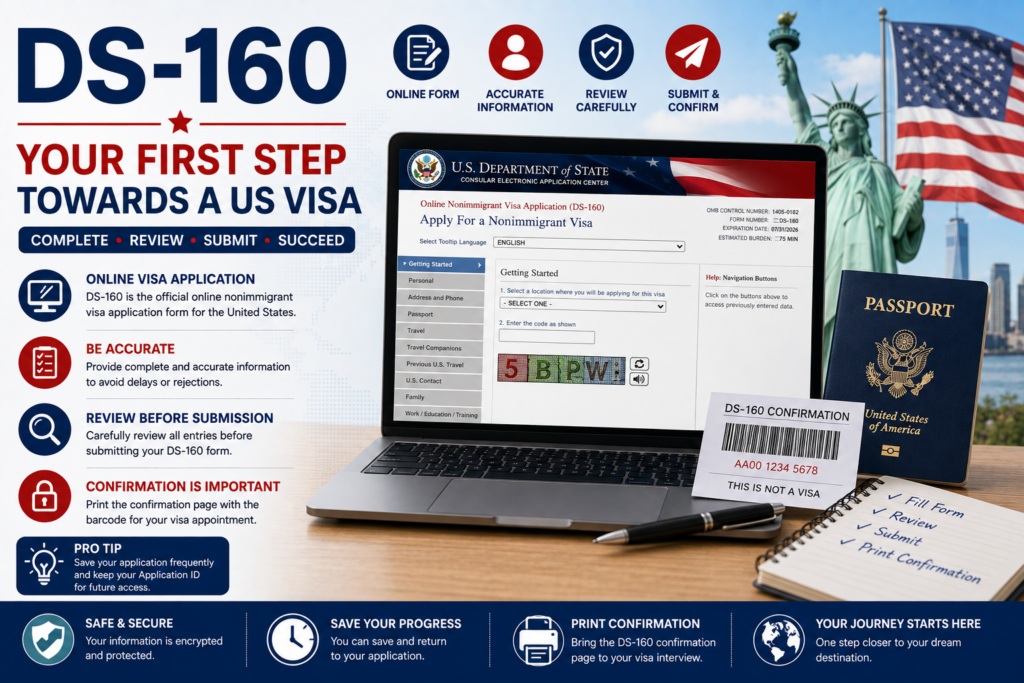
The DS-160 form is the Online Nonimmigrant Visa Application required by the US Department of State for every nonimmigrant visa category, including the F-1 student visa. It is not an admission document. Your university’s I-20 confirms your admission; this form is what the consulate uses to evaluate your visa eligibility and prepare questions for your interview.
The form collects:

Choose your dream country
 UK
UK
 USA
USA
 Germany
 Australia
 Ireland
 Canada
 UAE
UAE
 France
 Sweden
 Italy
Italy
 Other
Other
When do you want to study abroad?
What's your highest level of education?
Have you completed Class 12th?
What was your Class 12 CGPA/percentage?
Are you a student or a parent/guardian?
What do you want to study?
Select your current city
How Leap will help you

Personalised University Shortlist

Express Applications with Quicker Admits

End-to-End Application Support
- Personal and passport details
- Travel plans and US point of contact (your university's address, for F-1 applicants)
- Family information
- Education and work history
- Security and background declarations
- Social media usernames used in the past five years
Filling it out typically takes 45 minutes to an hour for a first-time F-1 applicant, longer if you have prior US travel history or need to look up SEVIS and school details. The system will time out after 20 minutes of inactivity, so please have your I-20 and passport ready before you begin.
DS-160 Form Fee and Total US Visa Costs in 2026
The form itself has no separate filing fee. For F-1 student visa applicants, you pay three separate fees across the process, and Indian students often budget for only one of them.
| Fee | Amount (USD) | Amount (INR at Rs.95/USD) | When it's paid |
|---|---|---|---|
| MRV application fee (DS-160) | $185 | Rs.17,575 | Before your interview, non-refundable |
| SEVIS I-901 fee | $350 | Rs.33,250 | Before scheduling your interview |
| Visa Integrity Fee | $250 | Rs.23,750 | Only if your visa is approved, at issuance |
| Total (if approved) | $785 | Rs.74,575 | Across the process |
The Visa Integrity Fee was created under the One Big Beautiful Bill Act, signed into law in July 2025. Its rollout across consulates was uneven through late 2025 and early 2026, but by mid-2026, most posts processing F-1 visa applications, including the consulates in India, are collecting it as a standard part of visa issuance. Budget for it rather than treating it as optional. It is not owed if your visa is refused, and DHS has indicated a refund may eventually be available to applicants who fully comply with their visa terms, though the refund process has not been published yet.
The MRV fee is non-refundable regardless of whether your visa is approved, and the receipt is valid for 12 months from the date of payment.
Counselor insight: It is advisable to pay the MRV fee only after your DS-160 is submitted and you have the confirmation number. Some students pay the MRV fee before submitting their application, then make an error that requires a fresh submission, meaning they pay again. Submit, confirm, then pay.
Documents You Need Before You Start the DS-160 Form
Keep these ready before you open the form, so you are not searching for details mid-session:
- Valid passport (with at least six months' validity beyond your intended US arrival)
- I-20 issued by your US university, with your SEVIS ID
- Travel itinerary, if already booked
- Details of any previous US visits or visa refusals
- Academic transcripts and standardised test scores (GRE, IELTS, TOEFL, or Duolingo)
- Work experience details, if applicable
- A digital photo meeting the DS-160 photo specifications
- Names, dates of birth, and addresses of immediate family members
- A list of social media platforms and usernames used in the past five years
You will also need to pay the SEVIS fee before your visa interview, separate from this form and the MRV fee.
DS-160 Form Sections: A Step-by-Step Walkthrough
It is broken into sections. Here is what each one covers and where Indian F-1 applicants most often go wrong.
| Section | What it covers | Common Indian applicant error |
| Personal Information | Name, DOB, nationality, national ID | Name not matching the passport exactly |
| Travel Information | Purpose of visit, arrival date, US contact | Selecting "Tourism" instead of "Student/Exchange Visitor" |
| Travel Companions | Anyone travelling with you | Leaving blank when a parent is accompanying for drop-off |
| Previous US Travel | Past visits, prior visa refusals | Answering "No" to a refusal that occurred years ago |
| Address and Phone | Current and permanent address | Mismatch with the address on the I-20 |
| Passport Information | Passport number, issue/expiry | Typo in passport number |
| US Point of Contact | University's address and SEVIS ID | Using the wrong campus address for multi-campus universities |
| Family Information | Parents' names and DOB | Leaving spouse section incomplete if married |
| Work/Education/Training | Employment and academic history | Omitting a gap year or short-term job |
| Security and Background | Criminal history, prior overstays, social media | Rushing through without reading each question |
Once you reach the security question step, you will choose your own security question from a list of options provided on the form. Along with your Application ID (a code starting with AA), surname, and birth year, the security question is what allows you to retrieve a saved application if you close the browser partway through. A saved, incomplete application is deleted after 30 days of inactivity.
Counselor insight: Write down your Application ID, security question, and answer the moment they're generated. Losing this combination is the single most common reason Indian students have to restart their application from scratch.
Since June 2025, the US Department of State requires all F-1 student visa applicants to do two separate things, not just one:
- Disclose every social media platform and username you have used in the past five years on the DS-160 form itself, including accounts that are no longer active.
- Set every one of those accounts to public visibility before your visa interview so a consular officer can review your online presence as part of screening.
Disclosure alone is not enough. An applicant who lists their Instagram handle but keeps the account private has not met the current requirement. Consular officers have broad discretion in reviewing what they observe and there is no published standard for what content leads to a delay or denial.
Counselor insight: Do these tasks at least a week before your interview, not the night before. Some platforms take time to fully update privacy settings across cached versions of your profile, and officers have flagged applicants whose accounts still showed as private during review.
DS-160 Form vs DS-260: What’s the Difference
Students preparing for a US visa often confuse this form with the DS-260. They serve different visa categories entirely.
| DS-160 Form | DS-260 | |
| Used for | Nonimmigrant visas (F-1, B-1/B-2, H-1B, J-1) | Immigrant visas (green card categories) |
| Relevant to Indian students | Yes, for F-1 student visa | No, unless applying through a family or employment-based green card |
| Editable after submission | No | No |
| Fee tied to it | MRV fee ($185 for F-1) | Immigrant visa application fee (separate schedule) |
If you are applying to study in the US on an F-1 visa, you need the DS-160. The DS-260 is not relevant unless a family member is separately sponsoring your green card.
After You Submit: Confirmation, Payment, and Booking Your Interview
Once you submit the DS-160, here's what happens next:
- Print the confirmation page. It has your Application ID and a barcode. You need this at your interview.
- Pay the MRV fee. The fee can typically be paid online or at a designated bank, depending on your consulate.
- Schedule your interview through the US visa appointment portal for your consulate.
- Retrieve your application if needed using your Application ID, surname, birth year, and security question. You cannot edit a submitted form, but you can view it.
- Bring the confirmation page and your I-20 to your interview, along with your passport and financial documents.
Indian applicants typically apply at consulates in New Delhi, Mumbai, Chennai, Kolkata, or Hyderabad. Appointment availability varies by consulate and by intake season, so book as soon as your I-20 is confirmed rather than waiting until closer to your intake. Check F-1 visa slot availability as soon as your DS-160 confirmation is ready.
A note on the interview itself: Since September 2, 2025, the State Department ended the "dropbox" interview waiver for F-1 applicants, both new and renewal. Every F-1 applicant, regardless of age or prior US visa history, is now expected to attend an in-person interview unless a consular officer's discretion says otherwise. If you're renewing a student visa and remember that Dropbox was available in earlier years, plan for an in-person appointment this time.
For a full breakdown of what to expect at the interview stage, see our guide on F1 visa interview questions and answers.
What Changes After Your Visa Is Issued: The New Fixed Admission Period
This isn't part of the DS-160 form, but it directly affects every Indian student applying for an F-1 visa right now, so it's worth knowing before your interview.
Since the F-1 visa was created, most students were admitted to the US for "Duration of Status" (D/S), meaning they could stay as long as they remained a full-time student in good standing, with no fixed expiry date on their I-94 record. The Department of Homeland Security published a final rule on 17 July 2026 ending this. Effective 15 September 2026, F-1 students will instead be admitted for a fixed period tied to their program length on the I-20, capped at four years, after which an extension of stay must be filed with USCIS if the program isn't finished. The post-completion grace period also drops from 60 days to 30 days for students admitted under the new rule.
If you're applying for a visa now for an intake starting on or after mid-September 2026, this will apply to you from your first entry. If you already hold an F-1 visa and don't travel internationally after the effective date, transition provisions may let you keep your original D/S terms for longer. This is a fast-moving regulatory change; confirm your specific situation with your university's international student office closer to your travel date.
Common DS-160 Form Mistakes Indian Students Make
Most delays and 214(b) refusals linked to this form trace back to a small set of avoidable mistakes:
- Name mismatch: Entering your name differently from how it appears on your passport, including missing hyphens or middle names.
- Wrong visa purpose: Selecting a generic visa category instead of "Student/Exchange Visitor" for F-1 applicants.
- Inconsistent travel history: Leaving out a previous US visit or visa refusal that the consular officer already has on record.
- SEVIS ID errors: Entering the SEVIS ID incorrectly, or listing the wrong campus address for the US point of contact.
- Incomplete social media disclosure: Leaving out platforms used in the past five years, which can raise questions during screening.
- Rushing security questions: Selecting "No" without reading the full question, particularly around prior denials or overstays.
A submitted DS-160 form cannot be edited. If you discover an error after submission, you will need to explain the discrepancy to the consular officer at your interview and bring supporting documents, or in some cases, submit a fresh one and pay the MRV fee again.
Counselor insight: Fill it in one sitting where possible. Students who fill it across multiple sessions over several days are more likely to introduce inconsistencies between what they entered earlier and what they enter later, especially in the travel history and family information sections.
Check what commonly causes US visa rejections before your interview so you know what officers are actually screening for.
3 Key Takeaways on DS-160 Form
- Budget for all three fees, not just the MRV fee. The SEVIS fee ($350) and the Visa Integrity Fee ($250) bring your real visa cost closer to $785 (Rs.74,575), not $185.
- Set your social media to public, not just disclosed. This is a separate, enforced step since June 2025, and skipping it can hold up your interview.
- A submitted DS-160 form cannot be edited, so accuracy on the first attempt, especially around travel history, SEVIS details, and social media, matters more than speed.
Ready to move from your I-20 to a confidently filled DS-160 form? Talk to a LeapScholar counselor before you submit it to ensure your F-1 visa application is consistent, complete, and interview-ready.
Frequently Asked Questions About DS-160 Form
-
What is the DS-160 form used for?
The DS-160 form is the online application the US Department of State uses to collect personal, travel, and background information from every nonimmigrant visa applicant, including F-1 students. It is required before you can schedule a visa interview.
-
How much is the DS-160 form fee in 2026?
For F-1 student visa applicants, the MRV fee tied to the DS-160 form is $185, approximately Rs. 17,575 at Rs. 95/USD. This fee is non-refundable and valid for 12 months from payment.
-
Can I edit the DS-160 form after submission?
No. Once submitted electronically, it cannot be changed. If you find an error, you either explain it at your interview with supporting documents or submit a new form and pay the MRV fee again.
-
How long is the DS-160 form valid?
The form itself doesn't expire in the way a visa does, but your MRV fee receipt is valid for 12 months. If you don't schedule and complete your interview within that window, you will likely need to submit a fresh one and pay again.
-
Can I fill multiple DS-160 forms?
You should only have one active application per visa application. Submitting multiple forms with conflicting information can cause problems. If you made a genuine error, submit a corrected new form rather than leaving both active.
-
What is the DS-160 form security question?
It's a question you choose yourself from a list of options while filling out the form, not a fixed question. Along with your Application ID, surname, and birth year, it lets you retrieve a saved but incomplete application.
-
How do I retrieve my DS-160 form?
Use the "Retrieve an Application" option on the DS-160 portal with your Application ID, surname, date of birth, and the security question and answer you set. A saved, incomplete form is deleted after 30 days of inactivity.
-
What is the difference between the DS-160 form and the DS-260?
It is for nonimmigrant visas like F-1, B-1/B-2, and J-1. The DS-260 is a separate form for immigrant visa (green card) categories and isn't relevant to most Indian students applying for a US student visa.
-
Do I need to disclose social media accounts on the DS-160 form?
Yes. Applicants must disclose usernames or handles for social media platforms used in the past five years. This has been a mandatory field since 2019, with screening scrutiny increasing through 2025-26.
-
Do I still need an in-person interview if I've held an F-1 visa before?
Yes, in almost all cases. Since September 2, 2025, the Dropbox interview waiver no longer applies to F-1 renewals. Plan for an in-person interview regardless of your prior visa history.








Social Media Requirements on the DS-160: What Changed