
Quick Read
- US tuition runs ₹25L to ₹1Cr a year; Australian tuition is usually ₹15L to ₹30L.
- An F-1 visa now costs about $535 (₹50,800); Australia’s subclass 500 costs AUD 2,500 (₹1.68L).
- Australia no longer lets most students bring dependants on a subclass 500 visa from October 2026.
- The USA pays higher average salaries; Australia generally offers a faster route to PR.
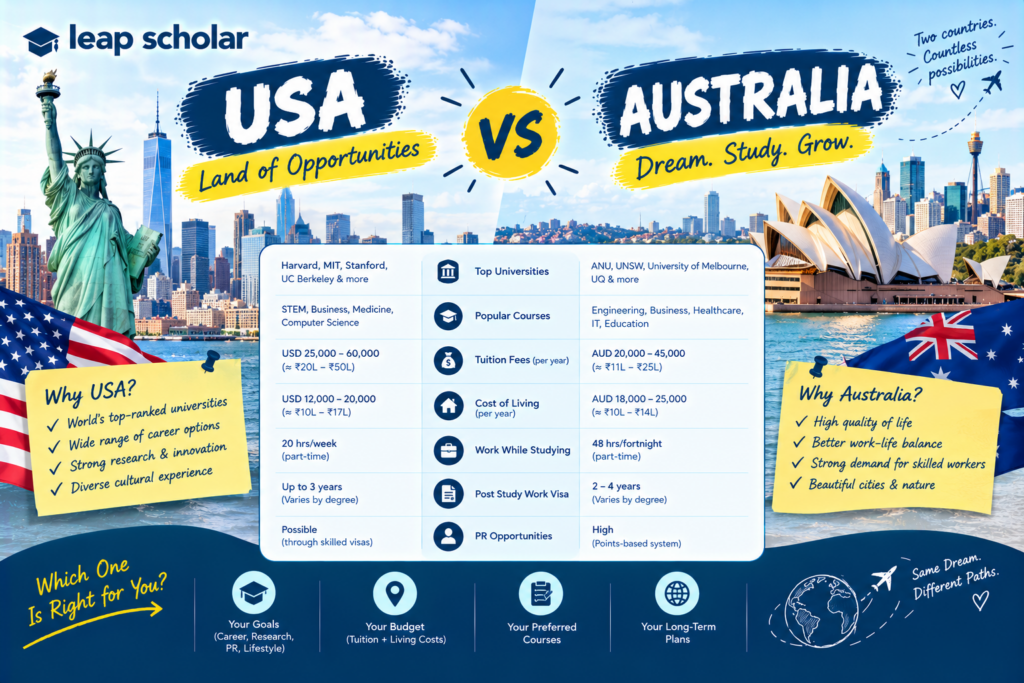
USA vs Australia for International Students: At a Glance
Before you pick a side in the USA vs Australia debate, look at how the two countries actually stack up. The United States remains the single largest destination for Indian students abroad, with 3,63,019 Indian students enrolled in 2024-25 (Open Doors report), making India the top sending country to the US for the first time. Australia is the second-largest, with close to 1.78 lakh Indian students currently studying there.
| Factor | USA | Australia |
| Student visa | F-1 | Subclass 500 |
| Visa cost | $535 (₹50,800) | AUD 2,500 (₹1.68L) |
| Avg. UG tuition/year | ₹25L to ₹60L | ₹15L to ₹25L |
| Avg. PG tuition/year | ₹20L to ₹1Cr | ₹18L to ₹30L |
| Avg. cost of living/month | ₹98,000 ($1,031) | ₹93,000 (AUD 1,388) |
| Minimum PR points | Not point-based (employer/family route) | 65 points |
| Dependants allowed on study visa | Yes, on F-2 | Restricted from Oct 2026 for most applicants |
| Top-ranked universities (QS 2027) | MIT (1st), Stanford (tied 2nd), Harvard (5th) | UNSW (19th), Melbourne (22nd) |
This USA vs Australia for international students snapshot already tells you the basic trade-off: the USA costs more to study in but tends to pay more after graduation, while Australia costs less upfront and currently offers a more predictable PR pipeline.
Counselor insight: Students often ask us to pick a “winner” in this USA vs Australia comparison. There isn’t one. A STEM research student chasing a PhD pipeline is usually better off in the USA. A student who wants to settle abroad within five to six years, with a tighter education budget, tends to prefer Australia.

Top Universities and Courses: USA vs Australia for Masters and UG
In the QS World University Rankings 2027, the USA holds 4 of the global top 10 spots (MIT at 1st, Stanford tied for 2nd, Harvard at 5th, and Caltech at 7th). Australia had a shake-up at the top this year: UNSW overtook the University of Melbourne to become the country’s highest-ranked university for the first time, coming in at 19th globally, with Melbourne close behind at 22nd.
| Top Universities in the USA (QS 2027) | Avg. PG Fee/Year |
| Massachusetts Institute of Technology (1st) | ₹25L |
| Stanford University (tied 2nd) | ₹42L to ₹45L |
| Harvard University (5th) | ₹16L to ₹62L |
| University of California, Berkeley | ₹30.6L |
| Top Universities in Australia (QS 2027) | Avg. PG Fee/Year |
| UNSW Sydney (19th) | ₹28L |
| University of Melbourne (22nd) | ₹25L |
| University of Sydney (28th) | ₹20L |
| Monash University (31st) | ₹21L |
For a masters degree, the USA vs Australia for masters decision usually comes down to course length and research depth. US masters programs run 1.5 to 2 years and lean heavily on electives and research assistantships. Australian masters programs are typically 1 to 2 years and are more tightly structured around a set curriculum, which suits students who want a faster, more predictable finish.
Popular courses:
- USA: Computer Science, Data Science and Analytics, Business Administration, Public Policy, Healthcare Management
- Australia: Computer Science Engineering, Cybersecurity, Nursing, Accounting, Agriculture Science
Fee figures are approximate and vary by course, campus, and intake; confirm the latest figures on the official university page before applying.
Eligibility, English Tests, and Documents
Both countries expect 12 years of schooling before undergraduate admission and proof of English proficiency, but the testing options differ slightly in this USA vs Australia comparison for international students.
| Requirement | USA | Australia |
| Minimum English score | IELTS 6.5 (TOEFL, Duolingo also accepted at most schools) | IELTS 6.5 (PTE and Duolingo widely accepted) |
| Standardized tests | SAT/ACT for UG; GRE/GMAT for some PG programs | Rarely required for UG; GRE/GMAT for select PG programs |
| Key documents | I-20, SOP, LOR, academic transcripts, financial proof | Confirmation of Enrollment (CoE), GTE statement, SOP, financial proof |
If you’d rather skip a language test altogether, check the list of Duolingo-accepted universities in the USA and the Duolingo-accepted universities in Australia before shortlisting.
For the application essay itself, a well-structured SOP for your masters application carries real weight in both countries’ admission processes.
See what our counselors say about IELTS requirements for Master’s programs in USA and Australia
Cost of Tuition and Living: USA vs Australia Cost of Living Compared
Cost is usually the single biggest factor in a USA vs Australia cost of living comparison, and the gap is real. At ₹95/USD and ₹67/AUD, here’s how a typical month compares for a student living in a major city:
| Monthly Expense | USA | Australia |
| Rent (shared, city) | ₹1.2L to ₹1.5L ($1,250 to $1,575) | ₹85,000 to ₹1.1L (AUD 1,270 to AUD 1,640) |
| Groceries and food | ₹18,000 to ₹25,000 ($190 to $260) | ₹20,000 to ₹28,000 (AUD 300 to AUD 420) |
| Transport pass | ₹5,500 to ₹6,500 ($58 to $68) | ₹8,500 to ₹9,500 (AUD 125 to AUD 140) |
| Utilities and mobile | ₹7,000 to ₹9,000 ($74 to $95) | ₹6,000 to ₹8,000 (AUD 90 to AUD 120) |
| Total (approx.) | ₹98,000 ($1,031) | ₹93,000 (AUD 1,388) |
On raw tuition plus living expenses, Australia usually works out 25 to 35 percent cheaper than the USA for an equivalent masters program, largely because US tuition at research universities runs much higher than Australian tuition at a comparable ranking tier.
For a full month-by-month breakdown, see our detailed guides on the cost of living in the USA and cost of living in Australia.
Scholarships in the USA vs Australia
| Scholarships in the USA | Scholarships in Australia |
| Fulbright Scholarship | Australia Awards |
| Inlaks Shivdasani Foundation Scholarship | Sydney Scholars India Scholarship |
| Tata Scholarships (Cornell) | Monash International Merit Scholarship |
| University-specific merit aid | International Postgraduate Research Scholarship |
The USA generally has a larger pool of scholarship money overall, but most of it is tied to specific universities and is highly competitive. Australia’s scholarships are fewer in number but easier to track centrally.
Browse the full list of scholarships in Australia for Indian students and scholarships to study in the USA before you finalize a budget.
Student Visa: Process and Fees
This area is the section where most USA vs Australia comparisons online are already out of date, so here are the current numbers.
USA (F-1 visa): An Indian student pays the SEVIS I-901 fee of $350 plus the MRV (DS-160) application fee of $185, for a total of $535 (about ₹50,800). A separate $250 Visa Integrity Fee exists in US law, but as of October 2026, it is not being collected at Indian consulates. Processing typically takes a few weeks to a few months, depending on the consulate and season.
Read our step-by-step guide on how to apply for an F-1 visa and prepare using our F-1 visa interview questions and answers.
Australia (Subclass 500): The standard visa application charge is AUD 2,500 (about ₹1.68L) for applications lodged on or after 1 July 2026, up 25 percent from AUD 2,000 the year before. Processing time ranges from a few weeks to several months depending on your passport and course.
| Visa Parameter | USA (F-1) | Australia (Subclass 500) |
| Total govt. fee | $535 (₹50,800) | AUD 2,500 (₹1.68L) |
| Dependants allowed | Yes (F-2 visa) | Restricted for most applicants from Oct 2026 |
| Onshore visa changes | Not applicable | Onshore “visa hopping” between providers has been tightened since Oct 2026 |
What changed in October 2026: Australia removed the ability for most student visa holders to bring a spouse or children on a dependant visa, and tightened rules around switching institutions after arriving onshore. If your study plan depends on bringing family along, this is a genuine deciding factor in the USA vs Australia for immigration conversation, and it currently favours the USA.
Average Salaries and Job Market
| Role | Avg. Salary in the USA | Avg. Salary in Australia |
| Software Engineer | ₹1.2Cr ($1,43,736) | ₹64.3L (AUD 1,20,000) |
| Data Analyst | ₹75L ($89,903) | ₹50L (AUD 92,500) |
| Civil Engineer | ₹92L ($1,10,361) | ₹61L (AUD 1,13,949) |
| Accountant | ₹73.3L ($87,851) | ₹48L (AUD 90,000) |
On paper, the USA pays noticeably more across most roles, which is one reason the US MS ROI calculation still tends to favor American universities despite the higher upfront cost. But the US job market has also tightened for international graduates. Indian student enrollment in US graduate programs fell close to 9 to 10 percent in 2024-25, partly on the back of stricter visa scrutiny and slower OPT-to-H-1B conversion. Australia, by contrast, raised its international student cap to roughly 2,95,000 for 2026 and continues to add seats, which keeps the door open for new applicants even as costs rise.
For role-by-role detail, see average salary in the USA and average salary in Australia.
PR and Post-Study Pathways: USA vs Australia for Immigration
The USA vs Australia immigration question has two very different answers.
USA: There is no direct student-to-PR route. Most Indian students move from F-1 to Optional Practical Training (OPT), then try for an H-1B work visa through an annual lottery, and only then start the employment-based Green Card process. Backlogs currently extend for several years for Indian applicants in the employment-based (EB-2/EB-3) Green Card categories.
Read our guide on how to get a Green Card for the US for the full process.
Australia: PR runs on a points-based system (Skilled Independent visa, subclass 189, and Skilled Nominated, subclass 190). You need a minimum of 65 points, though a score of 85 or higher meaningfully improves your chances. Points come from age, English proficiency, skilled work experience, and an Australian qualification. Because the points system is transparent and predictable, many students can map out a realistic PR timeline before they even enroll.
Counselor insight: If PR speed is your main goal in this USA vs Australia comparison, Australia’s points system gives you a clearer, more controllable path. The USA can still work for PR, but it depends heavily on employer sponsorship and lottery luck, which are outside your control.
Which Country Should You Choose: USA vs Australia for Different Student Profiles
- Budget-conscious students: Australia is cheaper on tuition and living costs, and the gap can run 25 to 35 percent in Australia’s favor for an equivalent masters.
- Career-outcome-first students: The USA pays higher average salaries and has deeper industry networks in tech, finance, and consulting, which matters if maximizing starting salary is the priority.
- PR-first students: Australia’s points-based system gives a clearer and generally faster pathway to permanent residency than the USA’s employer-sponsored route.
- Research and top-ranking-first students: The USA holds 4 of the world’s top 10 universities in the QS 2027 rankings, which matters most for PhD-track and research-heavy programs.
- Students travelling with family: The USA currently allows dependants on an F-2 visa; Australia has restricted this option for most subclass 500 applicants since October 2026.
If you’re wondering which is better for students, the USA or Australia, this guide is for you. That usually depends more on lifestyle than cost: the USA has bigger cities and a faster pace, while Australia’s campuses are more relaxed and have a stronger outdoor and work-life balance culture.
3 Takeaways on USA vs Australia
- If your budget is tight, Australia’s lower tuition and living expenses, plus its predictable points-based PR system, make it the safer financial bet.
- If maximizing salary and research opportunities matters more than cost, the USA’s higher pay scales and research-heavy universities are worth the extra spend.
- Factor in the new October 2026 Australian rules on dependants and visa switching before you commit, especially if you plan to travel with family.
Not sure which is the better fit for you, the USA or Australia? Talk to a LeapScholar counselor and get a shortlist matched to your budget and career goals.
Frequently Asked Questions About USA vs Australia
-
Is the USA or Australia cheaper for Indian students?
Australia is generally cheaper. Tuition and living costs together usually run 25 to 35 percent lower than an equivalent US program, mainly because Australian tuition at a similar ranking tier is lower than at top US research universities.
-
Which country is better for a masters degree, USA or Australia?
It depends on your goal. The USA has more research-intensive programs and a wider range of electives, while Australia offers shorter, more structured masters programs that are often cheaper and easier to plan around a fixed timeline.
-
How much does an F-1 visa cost for the 2027-28 intake?
An F-1 visa costs $535 in government fees: a $350 SEVIS I-901 fee and a $185 MRV application fee. That works out to roughly ₹50,800 at current exchange rates, not counting the separate SEVP school fee or any agent charges.
-
How much does an Australian student visa cost for the 2027-28 intake?
The subclass 500 student visa costs AUD 2,500 (about ₹1.68L) for applications lodged from 1 July 2026 onward. This is a 25 percent increase from the previous AUD 2,000 fee and does not include Overseas Student Health Cover (OSHC).
-
Can I bring my spouse or children on an Australian student visa?
Most student visa holders can no longer bring dependants on a subclass 500 visa, following rule changes that took effect in October 2026. Exceptions apply in limited circumstances, so check your eligibility with the Department of Home Affairs before assuming you can bring family.
-
Which country offers a faster path to PR, USA or Australia?
Australia’s points-based system (minimum 65 points, competitive scores from 85) gives a clearer and usually faster path to PR than the USA, where most students rely on employer-sponsored visas and face long Green Card backlogs.
-
Do Indian students need IELTS for the USA or Australia?
Both countries accept IELTS, but neither requires it exclusively. The USA also accepts TOEFL and Duolingo at most universities, while Australia widely accepts PTE and Duolingo alongside IELTS, so check your shortlisted university’s specific policy.
-
Which country has better job opportunities after graduation?
The USA generally pays higher average salaries and has a larger job market in tech, finance, and consulting. Australia has a smaller but steadily growing job market, with an increased international student cap for 2026 that keeps opportunities open for new graduates.
-
Is Australia or the USA safer for Indian students?
Both countries are considered safe for international students overall, and safety varies more by city and campus than by country. Research student safety resources and campus support services for your specific shortlisted university before making a final decision.










Have Questions? Get Guidance to reach your Dream University
Connect with India's finest counsellors and biggest study abroad community.
Get Guidance