
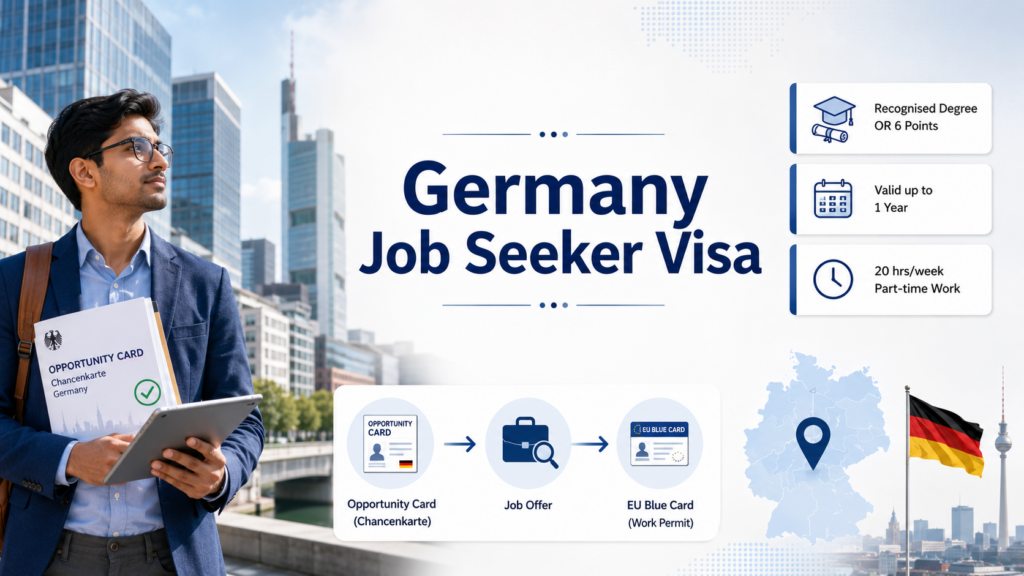
Quick Read
- Germany replaced the old 6-month Job Seeker Visa with the Opportunity Card (Chancenkarte) in June 2024.
- Indian applicants qualify via a recognized degree or a minimum 6-point score.
- Blocked account: €13,092/year (approx. Rs.14.37 lakh) for the Opportunity Card.
- Processing takes 2–6 months from India, including the consulate wait.
What Is the Germany Job Seeker Visa in 2027?
The term “Germany Job Seeker Visa” is now used loosely by applicants, but the actual legal instrument for someone applying from India without a job offer is the Opportunity Card (Chancenkarte), introduced under Section 20a of the Residence Act (Aufenthaltsgesetz) on 1 June 2024. It replaced the older six-month Job Seeker Visa for anyone applying from outside Germany.
There is a separate, narrower route under Section 20 of the Residence Act, but it applies only if you completed your degree or vocational training inside Germany. That route is not relevant if you are applying directly from India with an Indian degree; the Opportunity Card is your path.

Choose your dream country
 UK
UK
 USA
USA
 Germany
 Australia
 Ireland
 Canada
 UAE
UAE
 France
 Sweden
 Italy
Italy
 Other
Other
When do you want to study abroad?
What's your highest level of education?
Have you completed Class 12th?
What was your Class 12 CGPA/percentage?
Are you a student or a parent/guardian?
What do you want to study?
Select your current city
How Leap will help you

Personalised University Shortlist

Express Applications with Quicker Admits

End-to-End Application Support
Official source: Make it in Germany, the Federal Government's portal for skilled workers
Which Route Applies to You? A Decision Framework
The Opportunity Card has two qualifying options. Which one applies to you depends on your degree and experience.
- Option 1: Skilled worker route, no points needed: If you hold a foreign degree that is fully recognized in Germany (check anabin for H+ status), you qualify directly. You do not need to prove German language skills for this option, though it helps your job search.
- Option 2: Points system, minimum 6 points: If your degree isn't fully recognized, you can still qualify by scoring at least 6 points from a mix of partial qualification recognition, professional experience, language ability, age, and prior time spent in Germany.
- If you already completed a degree or vocational training in Germany itself: You don't need the Opportunity Card at all. You can apply directly for the Section 20 job-seeker residence permit, valid for 18 months instead of one year, with unrestricted part-time work.
- If you already have a job offer: You don't need a job-seeker route at all. Depending on your salary and qualification, apply directly for the EU Blue Card or a standard work visa for qualified professionals.
Worth knowing before you treat either route as a destination: a job-seeker permit is a safety net, not a plan. Time spent on it does not count toward your settlement-permit residence clock, which only starts once you are on a qualifying skilled-worker or Blue Card permit. Converting straight to a Blue Card, without lingering on a job-seeker route, is the single decision that most shortens your path to permanent residence.
Counselor insight: The biggest mistake Indian applicants make is assuming a fully recognized degree isn't "good enough" without work experience. Under Option 1, a recognized degree alone gets you into the Opportunity Card; experience only affects the points system in Option 2.
The Opportunity Card Points System, Explained
You need a minimum of 6 points if you're applying under Option 2. Points are awarded as follows:
| Criterion | Points |
| Partial recognition of foreign qualification | 4 |
| Qualification in a shortage occupation | 1 |
| 2+ years' professional experience (within last 5 years) | 2 |
| 5+ years' professional experience (within last 7 years) | 3 |
| German language: A2 / B1 / B2 or above | 1 / 2 / 3 |
| English at C1 or above, or native speaker | +1 |
| Age 35 or under | 2 |
| Age 35–40 | 1 |
| Previous stay in Germany: 6+ months in last 5 years | 1 |
| Spouse or partner also meets Opportunity Card requirements | 1 |
There is no published maximum score; you simply need to reach 6. Language and professional experience are usually the fastest points for Indian applicants to build up, since IT, engineering, and MINT qualifications are frequently on Germany's shortage occupation list.
Example: Can an Indian IT graduate qualify under Option 2?
Bachelor's in Computer Science, partial recognition via ZAB (4 pts) + 3 years' experience in the last 5 years (2 pts) = 6 points. Qualifies. Add B1 German, and the score rises to 8, comfortably above the threshold.
The applicants who find language points easy are usually the ones who started years earlier. Explaining his own sequence, a Process Engineer in North Germany and TU Bergakademie Freiberg graduate who contributed to LeapScholar's Germany guide, Hemanth Kiran, says: "Recognised early on that the primary obstacle to studying in Germany is the language barrier. Started learning German (A1, A2) during undergraduate studies in India and continued through B1 and B2 levels after arriving in Germany."
Germany Job Seeker Visa Requirements: Documents for Indian Applicants
Whether you're building toward a Germany work visa for Indians through qualified employment later or applying for the Opportunity Card right now, the required documents overlap significantly. Here is the full list of Germany job seeker visa required documents for both Option 1 and Option 2 applicants:
| Document | What to Submit | India-Specific Note |
| Visa application form | Completed via the Consular Services Portal | Filed online before your VFS appointment |
| Valid passport | Original + photocopy | Minimum 12 months' validity, 2 blank pages |
| Degree certificate | Original + notarised copy | Regional-language degrees need a certified translation |
| Proof of qualification | anabin printout, or Statement of Comparability (Zeugnisbewertung) | Required for Option 1; also strengthens Option 2 |
| Professional experience certificates | Original letterheads | Needed for points under Option 2 |
| Language certificate | German A1–B2, or English B2+ | Optional for Option 1, mandatory for Option 2 |
| Financial proof | Blocked account confirmation, or Declaration of Commitment | €13,092 (Rs.14,37,633) per year for the Opportunity Card |
| Health insurance | Policy document | Minimum coverage as required by your consulate |
On how the account behaves once funded: a Master's graduate in Management from SRH Heidelberg and contributor to LeapScholar's Germany guide, Pooja Kale, explains, "A blocked account is a mandatory account where incoming international students deposit one year's worth of living expenses prior to arriving in Germany. It serves as financial proof for visa approval, releasing a fixed monthly amount to cover living costs."
Counselor insight: Applicants under Option 2 often submit language certificates but forget to also apply for partial recognition through ZAB, which is worth 4 points on its own and is frequently the difference between qualifying and falling short.
Germany Job Seeker Visa Cost for Indian Applicants
| Cost Item | Amount |
| National (D) visa fee | €75 (Rs.8,236) |
| Opportunity Card blocked account, monthly | €1,091 (Rs.1,19,801) |
| Opportunity Card blocked account, annual | €13,092 (Rs.14,37,633) |
| Document translation (if needed) | €15–€40 per document (Rs.1,647–Rs.4,392) |
| One-way flight: India to Germany | €375–€700 (Rs.41,179–Rs.76,867) |
Exchange rate used: €1 = Rs.109.81. Confirm the live rate with your bank or blocked-account provider before transferring funds.
Source: Federal Foreign Office, national visa information, blocked account amount: Make it in Germany: Opportunity Card requirements
For a sense of what that pre-departure and early-arrival period actually costs: LeapScholar's survey found 47% of respondents in Germany spend between €800 and €1,200 a month, with most of the rest between €500 and €1,800.
Counselor insight: Budget separately for 2 to 6 months of pre-departure accommodation and living costs. Your blocked account only starts releasing funds after you register in Germany, not while your application is being processed in India.
Where to Apply for the Germany Job Seeker Visa and How Long It Takes
Indian applicants apply through the German mission covering their home state: Mumbai, Chennai, or New Delhi. Applications are filed online via the Consular Services Portal before your biometric appointment at VFS Global.
| Stage | Typical Duration |
| Consulate appointment wait | 4–12 weeks (longest in Mumbai) |
| Decision after appointment | 4–12 weeks |
| Total, India to visa in hand | 2–6 months |
October to December is peak season across all German missions in India; apply outside this window if your timeline allows.
Counselor insight: Mumbai applicants consistently face the longest appointment waits. This is a jurisdiction issue, not a processing-speed issue, so plan your Sperrkonto and documents around your consulate's typical wait time rather than assuming you can switch cities.
Source: Consular Services Portal, Federal Foreign Office
How to Apply for the Germany Job Seeker Visa from India: Step-by-Step
Here's exactly how to apply for the Germany job seeker visa from India, end to end, from your first ANABIN check to registering in Germany:
- Check your degree on anabin. Search your university at anabin.kmk.org. H+ status qualifies you directly under Option 1.
- Calculate your points if your degree isn't H+, using the table above.
- Fund your blocked account with €13,092 (Rs.14,37,633), or arrange a Declaration of Commitment.
- Apply online through the Consular Services Portal, then book your VFS biometric appointment.
- Prepare your documents using the checklist above, translated and notarized where needed.
- Attend your appointment and pay the €75 (Rs.8,236) visa fee.
- Wait for the decision, typically 4 to 12 weeks.
- Travel and register at your local Bürgeramt within 14 days of arrival.
Germany Job Seeker Visa 2027 Planning Calendar
| Timeframe | Action |
| January–February 2027 | Check anabin status; calculate your points if not H+ |
| March–April 2027 | Fund your blocked account; start language testing if needed |
| May–June 2027 | Apply via the Consular Services Portal and book your VFS appointment |
| July–August 2027 | Attend your appointment, ahead of peak season |
| September–November 2027 | Decision period, typically 4 to 12 weeks |
| December 2027–January 2028 | Travel, register locally, and begin your job search in Germany |
Two things to plan that search around. LeapScholar's survey found 84% of respondents used LinkedIn while job hunting, far more than StepStone (32%) or XING (16%) but describing what actually works on the ground, a Simulation Engineer in the medical technology sector and contributor to LeapScholar's Germany guide, Raj Sinha, notes: "While active on LinkedIn for global professional networking, regional job portals such as Xing and Indeed are heavily utilized alongside LinkedIn for job hunting in Germany and broader Europe." On timing, 53% of respondents found a job within 3 months, but 18% took six months or longer plan your one-year card around the slower end too.
Counselor insight: Starting your anabin check in January gives you the full runway to avoid the October–December consulate slowdown entirely.
From Job Search to Career: What Comes After the Opportunity Card
Once you find qualified work in Germany, you convert to a standard work permit or the EU Blue Card, depending on your salary and qualification. If your job doesn't yet qualify you for another residence permit, your Opportunity Card itself can be extended for up to two years.
EU Blue Card 2026 salary thresholds: €50,700 (Rs.55,67,367) a year for standard occupations, reduced to €45,934.20 (Rs.50,44,035) for shortage occupations, recent graduates within 3 years, and IT specialists without a formal degree who have 3+ years of relevant experience. These figures are revised every January; the 2027 threshold hadn't been published at the time of writing, so confirm the current figure before negotiating a salary.
Software engineering is one of the strongest sectors for this pathway: Germany's IT shortage occupation list keeps most engineering salaries above the reduced Blue Card threshold from the first job offer.
Source: Make it in Germany, EU Blue Card
That threshold should drive the negotiation more than the headline number does. Advising candidates on their first German offer, a Group Product Manager at SAP and contributor to LeapScholar's Germany guide, Harit Bhasin, says: "Don't focus only on getting the highest salary. First, make sure your salary is enough to qualify for a Blue Card. That's your starting point, because it allows you to continue working in Germany and later leads to permanent residency and citizenship."
Germany Job Seeker Visa (Opportunity Card) vs EU Blue Card vs Post-Study Permit
Comparing the Germany Job Seeker Visa against the two routes it's most often confused with:
| Feature | Opportunity Card | EU Blue Card | Section 20 Post-Study Permit |
| Job offer required | No | Yes | No |
| Who it's for | Applying from abroad, any degree status | Confirmed job offer, qualifying salary | Graduated from a German institution |
| Duration | Up to 1 year, extendable | Contract length + 3 months, max 4 years | 18 months |
| Work rights during permit | Up to 20 hrs/week + trial work | Full-time | Unrestricted part-time |
| Visa fee | €75 (Rs.8,236) | €75 (Rs.8,236) | €75 (Rs.8,236) |
Source: Make it in Germany, types of visa
Common Germany Job Seeker Visa Rejections and How to Fix Them
- Application rejected: Request the rejection letter; it states the specific reason. The most common causes for Indian applicants are insufficient points, an underfunded blocked account, and missing proof of qualification.
- Degree not on ANABIN or showing partial recognition: You're not disqualified. Apply under Option 2 using the points system; partial recognition alone is worth 4 of the 6 points you need.
- Points fall short of 6: Improve your German or English language score, or wait until you cross an age or experience threshold before reapplying. There's no mandatory waiting period to reapply.
- One year passes without qualified employment: Extension isn't automatic. If you have a concrete job offer that doesn't yet qualify for another permit, an Opportunity Card extension of up to two years may be issued instead.
Fixing and refiling is now the only route. The remonstration procedure, a free administrative appeal previously available after a refusal, was abolished worldwide from 1 July 2025. Your only remaining recourse is a fresh application with the deficiency corrected — paying the fee again and queuing for a new appointment — or an action before the Verwaltungsgericht Berlin, which requires German legal representation and is slow and expensive.
Path to Permanent Residency After the Opportunity Card
Most Indian applicants use the Opportunity Card as a bridge to the EU Blue Card and then to a Settlement Permit (Niederlassungserlaubnis), Germany's permanent residency title. Blue Card holders can apply for a Settlement Permit after 27 months in Germany at level A1 or after just 21 months at level B1.
This is where German language investment pays off directly: reaching B1 shortens your path to permanent residency by half a year compared to staying at A1.
If PR planning is central to your move, especially if you're targeting a software or engineering role where the Blue Card threshold is easiest to clear, our Software Engineering in Germany guide walks you through the PR timeline in more detail, along with realistic salary expectations by city and specialization.
One precision that a lot of Indian content gets wrong is worth stating alongside it: the graduate fast route is not "two years after graduation." It is two years on a qualifying skilled-worker residence title, with 24 months of pension contributions on the record.
3 Takeaways on Germany Job Seeker Visa
- Check your ANABIN status today. This status decides whether you qualify directly under Option 1 or need to build points under Option 2.
- Fund your blocked account as soon as you decide to proceed: €13,092 (Rs.14,37,633) for the Opportunity Card.
- Apply through the Consular Services Portal outside the October–December peak season, using the 2027 planning calendar above to work backwards from your target arrival month.
Verified by: LeapScholar's Germany counseling team, with hands-on experience guiding Indian applicants through ANABIN recognition, the Opportunity Card points system, and EU Blue Card applications.
Have questions about the Germany Job Seeker Visa for Indian applicants? Book a free session with a LeapScholar counselor.
Frequently Asked Questions About the Germany Job Seeker Visa
-
Who is eligible for the Germany Job Seeker Visa in 2027?
Anyone applying from India without a job offer now applies through the Opportunity Card, not a separate job seeker visa. You qualify directly with a fully recognized degree or through a minimum 6-point score based on partial recognition, experience, language, and age.
-
What are the Germany job seeker visa eligibility requirements for Indian professionals with a state university degree?
If your degree isn't rated H+ on anabin, you're not eligible under Option 1. You can still qualify under Option 2, since partial recognition alone is worth 4 of the 6 points required, and language skills or age can close the rest.
-
How much does the Germany job seeker visa cost for Indian applicants?
The national visa fee is €75 (Rs.8,236). The larger cost is the blocked account, €13,092 (Rs.14,37,633) per year, held for the duration of your Opportunity Card.
-
How long is the Opportunity Card valid for?
It is valid for up to one year initially. If you find qualified employment or a qualification measure but can't yet get another residence permit, an extension of up to two years may be issued.
-
What is the processing time for the Germany job seeker visa from India?
Typically 2 to 6 months total, combining a 4-to-12-week wait for a consulate appointment and a 4-to-12-week decision period.
-
Can I bring my family on the Opportunity Card?
Not directly. Family reunification generally requires a settled residence permit, such as a work visa or EU Blue Card, which you can apply for after securing qualified employment.
-
Do I need a job offer before applying?
No. The Opportunity Card is specifically designed for job searching without a prior offer, provided you meet Option 1 or Option 2 requirements.
-
What is the Germany job seeker visa success rate for Indian applicants?
Germany doesn't publish country-specific approval rates. Applications with full qualification recognition or a clear 6+ point score, a fully funded blocked account, and complete documentation have meaningfully better outcomes.
-
Can vocational diploma holders apply for the Opportunity Card?
Yes, provided the vocational training took at least two years and is recognized in the country where it was obtained. This qualifies under Option 2's points system.
-
What is the software engineer salary in Germany, and does it qualify for the EU Blue Card?
Most software engineering roles clear the reduced EU Blue Card threshold of €45,934.20 (Rs.50,44,035) from the first job offer, since IT remains on Germany's shortage occupation list.
-
How do I get permanent residency in Germany after the Opportunity Card?
Convert to qualified employment or the EU Blue Card first. From the Blue Card, a Settlement Permit is available after 27 months with A1 German or 21 months with B1 German.












Have Questions? Get Guidance to reach your Dream University
Connect with India's finest counsellors and biggest study abroad community.
Get Guidance