
Quick Read
- Chancenkarte grants a 12-month Germany job search residence permit.
- Section 20a of the Residence Act has governed it since June 2024.
- India received 3,721 of 11,497 visas issued through mid-2025.
- Applicants need 6 of 14 points, or a fully recognized degree.
- Financial proof required is Rs.14,39,354 (€13,092) for 2026.
- Part-time work up to 20 hours weekly is allowed while job hunting.
What Is the Germany Opportunity Card (Chancenkarte) for Indian Applicants?
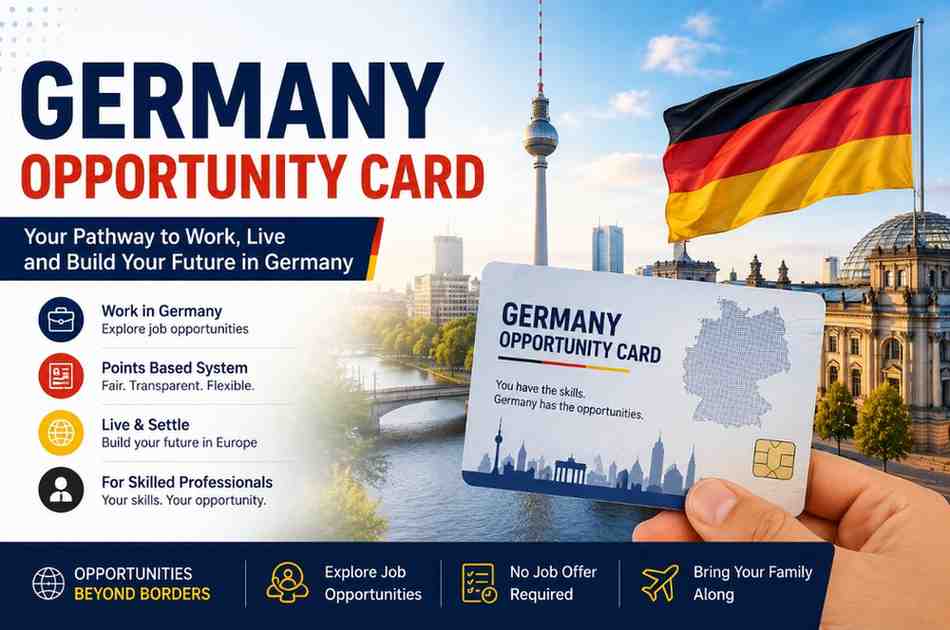
The Germany Opportunity Card, called the Chancenkarte in German, is a residence permit under Section 20a of the Residence Act (Aufenthaltsgesetz), in force since June 1, 2024. It lets non-EU nationals, including Indians, live in Germany for up to 12 months to search for qualified employment without a job offer in hand.
| What you get | Detail |
|---|---|
| Validity | 12 months, extendable |
| Job offer needed upfront | No |
| Part-time work allowed | Up to 20 hours/week |
| Trial jobs | Unlimited, up to 2 weeks per employer |
| Legal basis | Section 20a, Aufenthaltsgesetz |
| Launch date | June 1, 2024 |

Choose your dream country
 UK
UK
 USA
USA
 Germany
 Australia
 Ireland
 Canada
 UAE
UAE
 France
 Sweden
 Italy
Italy
 Other
Other
When do you want to study abroad?
What's your highest level of education?
Have you completed Class 12th?
What was your Class 12 CGPA/percentage?
Are you a student or a parent/guardian?
What do you want to study?
Select your current city
How Leap will help you

Personalised University Shortlist

Express Applications with Quicker Admits

End-to-End Application Support
According to make-it-in-germany.com's official one-year review, Germany issued 11,497 Opportunity Card visas between June 1, 2024 and June 15, 2025. India topped the list with 3,721 visas, ahead of China (807) and Turkey (654). If you are from India and considering this route, you are already in the largest applicant pool in the world for this visa.
Counselor insight: Almost a third of Opportunity Card holders globally are Indian. Indian STEM graduates typically clear the 6-point threshold through work experience and English proficiency alone, without needing German language points.
See what our counselors say on whether you can take up part-time work on an Opportunity Card while still studying in Germany, a mix-up that comes up often.
Prerequisites for the Opportunity Card
- A recognized university degree, or at least 2 years of completed vocational training
- Basic language skills: German A1 or English B2, at minimum
- Either full qualification recognition (via ANABIN) or 6 of 14 points on the points system
- Proof of financial means: Rs.14,39,354/year (€13,092) via blocked account, job contract, or sponsor declaration
- Valid passport with at least 3 months' validity beyond your planned entry, and 2 blank pages
- Minimum €30,000 Schengen-wide health insurance coverage from day one
- No age cap, though applicants over 40 earn zero age points and must qualify through other categories
Do You Need the Opportunity Card, or the Job Seeker Visa?
This is the single most common mix-up. The Chancenkarte and Germany's other job-seeker permits are not interchangeable, and picking the wrong one wastes months.
| Situation | Correct Permit | Duration | Points Needed |
|---|---|---|---|
| You have an Indian degree, never studied in Germany | Opportunity Card (Chancenkarte) | 12 months | 6 of 14 |
| You already graduated from a German university | 18-month Job Seeker permit, Section 20 | 18 months | None |
| You have a confirmed job offer above the salary threshold | EU Blue Card | Up to 4 years | None (offer-based) |
If you studied in Germany, do not apply for the Chancenkarte. The Section 20 permit gives you 6 extra months, skips the blocked-account points calculation, and is specifically designed for Germany's own graduates. Apply for the Chancenkarte only if you are applying from India with an Indian (or other non-German) qualification.
See what our counselors say on the exact difference between a student visa and an Opportunity Card for Germany if you're still unsure which one applies to you.
Germany Opportunity Card Points System: How to Score Your 14 Points
You qualify one of two ways:
- Direct route: Your foreign degree or vocational qualification is fully recognized in Germany (checked via ANABIN). No points needed.
- Points route: Score at least 6 of a possible 14 points.
| Category | Points Available | How You Earn Them |
|---|---|---|
| Qualification recognition | Up to 4 | Partial recognition of foreign degree/training |
| Professional experience | Up to 3 | 2+ years in last 5 years (2 pts); 5+ years in last 7 years (3 pts), related to your qualification |
| Language proficiency | Up to 3 | German A2 (1), B1 (2), B2+ (3); English C1/native (+1) |
| Age | Up to 2 | Under 35 (2 pts); 35-40 (1 pt) |
| Prior stay in Germany | 1 | 6+ continuous months in the last 5 years |
| Spouse also qualifies | 1 | Joint application, spouse independently meets criteria |
| Total possible | 14 | Minimum 6 required |
Worked example: A 27-year-old Indian mechanical engineering graduate with 3 years' relevant work experience and IELTS 7.0 (English B2+) scores 2 (age) + 2 (experience) + 0 (English alone doesn't add unless C1) = 4 points from those categories, and typically clears 6+ once qualification partial-recognition points are added. If you're preparing your English score for this or any Germany-taught program, our IELTS exam guide and GRE vs IELTS comparison cover which test German universities and employers accept.
Counselor insight: Within each points category, only your highest applicable score counts; points are not cumulative across sub-levels. A B2 German speaker gets 3 points, not 1+2+3. Students often miscalculate this and assume they've cleared 6 points when they haven't.
Germany Opportunity Card Cost in INR (2026)
| Cost Item | EUR | INR |
|---|---|---|
| Financial proof (blocked account or equivalent) | €13,092/year (€1,091/month) | Rs.14,39,354/year (Rs.1,19,942/month) |
| Visa application fee | €75 | Rs.8,246 |
| Health insurance (minimum required coverage) | €30,000 coverage | Not a premium; check Fintiba or Coracle for actual monthly cost |
| Document apostille/translation | Varies | Rs.3,000-Rs.15,000 depending on document count |
Exchange rate used: 1 EUR = Rs.109.94. Rates fluctuate; verify the live rate before transferring funds.
You can prove financial means through a blocked account (Sperrkonto), a signed part-time employment contract, or a Declaration of Commitment (Verpflichtungserklärung) from a sponsor in Germany. For a full breakdown of how blocked accounts work, see our blocked account Germany guide.
Counselor insight: The Chancenkarte financial threshold (Rs.14,39,354/year) is higher than the German study visa's blocked account requirement (roughly €11,904 x 109.94 = Rs.13,08,725/year for students ). Don't reuse an old student blocked-account quote when budgeting for the Opportunity Card; the job-seeker rate is different.
See what our counselors say on the exact blocked account amount required for Germany visa applications if you've seen conflicting figures elsewhere.
Germany Opportunity Card Application Timeline: A Month-by-Month Plan
Mapped to the typical Indian academic and results calendar:
| Month | What to Do |
|---|---|
| Results month (April-June or Nov-Dec) | Get final marksheets and provisional degree apostilled immediately |
| +1 month | Run your ANABIN check; calculate your points honestly |
| +1-2 months | Open blocked account (Fintiba/Coracle) or arrange sponsor declaration |
| +2 months | Book VFS/German Mission appointment; gather documents |
| +2-3 months | Attend visa interview/biometrics |
| +3-4.5 months | Await decision (processing commonly reported at 4-8 weeks, sometimes longer for India |
| On approval | Book flights, register residence (Anmeldung) within 2 weeks of arrival |
What Happens If Your Germany Opportunity Card Application Goes Wrong
- Application rejected: German missions must state a reason. Fix the specific issue (commonly: unrecognized documents, insufficient points, or unclear financial proof) and reapply; there is no mandatory waiting period for a fresh, corrected application.
- You don't find a job within 12 months: You must leave Germany. There's no automatic extension for unsuccessful job seekers, and you can generally reapply for a fresh Chancenkarte only after a break.
- You found a job but the work permit isn't through yet: You can apply for a Folge-Chancenkarte (extension) of up to 2 additional years at your local Foreigners' Authority (Ausländerbehörde) while the conversion processes.
- Your documents were rejected for translation issues: Use only certified translators recognized by German missions; informal translations are a common, avoidable rejection cause.
Counselor insight: Roughly 83% of processed Chancenkarte applications were approved between June 2024 and May 2025, based on figures reported in the DeZIM Institute's one-year policy brief. Most rejections trace back to unrecognized qualifications or miscalculated points, not surprise factors, so a clean self-audit before applying meaningfully improves your odds.
See what our counselors say on the process and eligibility for permanent residency after studying and working in Germany once your Chancenkarte converts into an employment permit.
Germany Opportunity Card vs EU Blue Card vs Job Seeker Visa
| Feature | Chancenkarte | EU Blue Card | Section 20 Job Seeker |
|---|---|---|---|
| Job offer required | No | Yes | No |
| Who it's for | Indian applicants, no German degree | Anyone with a qualifying job offer | Germany's own graduates |
| Duration | 12 months | Up to 4 years | 18 months |
| Points system | Yes (6 of 14) | No | No |
| Path to PR | Via employment, then standard routes | 21-33 months with employment | Via employment, then standard routes |
If you already have a job offer above Germany's Blue Card salary threshold, skip the Chancenkarte entirely and apply directly for the EU Blue Card; it skips the job-search phase and moves you toward permanent residency faster. Blue Card thresholds shift year to year, so confirm the current figure with your consulate before assuming a number.
3 Key Takeaways on Germany Opportunity Card
- Confirm which permit is actually yours first: Chancenkarte if you're applying from India with a non-German degree, Section 20 if you already graduated in Germany.
- Self-score your 14 points honestly, remembering only your highest score per category counts, before you open a blocked account.
- Start your ANABIN check and apostille process the moment your results are out; document preparation, not the visa interview, is usually what determines your timeline.
Verified by: LeapScholar's Germany counseling team, with hands-on experience guiding Indian students through the Opportunity Card, Job Seeker Visa, and EU Blue Card processes.
Have questions about the Germany Opportunity Card? Book a free session with a LeapScholar counselor.
Frequently Asked Questions About Germany Opportunity Card
-
What is the Germany Opportunity Card?
The Germany Opportunity Card (Chancenkarte) is a 12-month residence permit under Section 20a of the Aufenthaltsgesetz, letting non-EU nationals, including Indians, enter Germany to search for qualified work without a prior job offer. It allows part-time work up to 20 hours weekly and unlimited two-week trial jobs while you search.
-
Should I apply for the opportunity card if I already studied in Germany?
No. Graduates of German universities should use the 18-month job seeker permit under Section 20 instead, since it offers 6 extra months, skips the points calculation entirely, and is built specifically for that group.
-
What types of jobs can I get with the Germany Opportunity Card?
Germany's shortage list, tracked by the Federal Employment Agency, prioritizes IT, engineering, healthcare, and skilled trades. Roles in these sectors also tend to qualify for the lower EU Blue Card salary threshold once you convert from job search to employment.
-
Can I bring my spouse on the Germany Opportunity Card?
Yes. Your spouse can apply jointly, and if they independently meet the Opportunity Card criteria, you earn an additional point toward your own 6-point threshold. They'll need to submit their own qualification and language documents alongside yours.
-
What if I don't find a job within 12 months?
You must leave Germany, since there's no automatic extension for unsuccessful job seekers. If you found a job but your work permit hasn't cleared yet, you can apply for a Folge-Chancenkarte extension of up to 2 years instead of leaving.
-
Is there an age limit for the Germany Opportunity Card?
There's no strict cutoff, but the points system rewards younger applicants: under 35 earns 2 points, and 35-40 earns 1 point. Applicants over 40 get zero age points and must compensate through qualification, experience, or language points instead.
-
What is the cost of the Germany Opportunity Card?
Budget Rs.14,39,354 (€13,092) for the mandatory financial proof, Rs.8,246 (€75) for the visa fee, plus health insurance and document apostille/translation costs. Use 1 EUR = Rs.109.94 as a starting reference, and confirm the live rate before transferring funds.
-
How do I apply for the Germany Opportunity Card from India?
Apostille your educational certificates through India's Ministry of External Affairs, run an ANABIN check on your degree, open a blocked account or arrange a sponsor declaration, then book your appointment through VFS Germany or your nearest German mission. Processing commonly runs 4-8 weeks after biometrics, though this varies by mission workload.
-
What are the 2026 requirements for the Germany Opportunity Card?
You need a recognized university degree or at least 2 years of vocational training, basic language skills (German A1 or English B2), and either full qualification recognition or 6 of 14 points across experience, language, age, and prior German stay. You must also show financial proof of Rs.14,39,354 (€13,092) for the year.











Have Questions? Get Guidance to reach your Dream University
Connect with India's finest counsellors and biggest study abroad community.
Get Guidance