
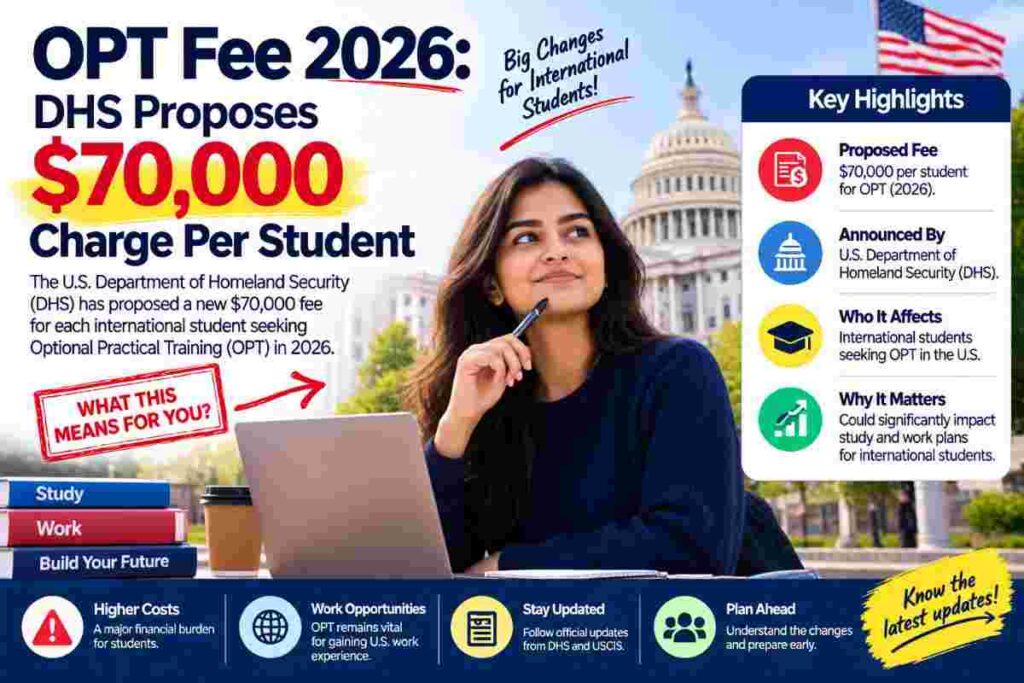
The US Department of Homeland Security (DHS) has proposed a rule that would make schools pay $70,000 (₹66.71 lakh) as the OPT fee the first time they recommend an F-1 student for Optional Practical Training (OPT) and $30,000 (₹28.59 lakh) for each later authorization, including STEM OPT extensions. The proposal was announced on October 7, 2026, and is open for public comment. It is a proposed rule, not a final one, so no student or school pays anything under it today.
Exchange Rate: all rupee figures use $1 = ₹95.30. Reconfirm against a live rate before publishing.
What DHS Is Proposing
- Initial fee: $70,000 (₹66.71 lakh) the first time a school recommends a student for any type of OPT, whether pre-completion or post-completion.
- Later fee: $30,000 (₹28.59 lakh) for each later OPT recommendation for a student who has already participated, including STEM OPT extensions. A student who goes through post-completion OPT and then a STEM extension would trigger both fees, a combined $100,000 (₹95.30 lakh).
- Who pays: SEVP-certified schools would have to pay the fee before their designated school official can recommend a student for OPT in SEVIS. DHS acknowledges that schools may pass the cost on to students or employers.
- Where the money goes: collected fees would be deposited in the US Treasury.
- Open question: DHS also asks for comment on charging the $70,000 fee again at each higher education level, for example, once after a bachelor’s degree and again after a master’s.
- Effective date: 60 days after a final rule is published, if one is issued.
How OPT Works Today

Choose your dream country
 UK
UK
 USA
USA
 Germany
 Australia
 Ireland
 Canada
 UAE
UAE
 France
 Sweden
 Italy
Italy
 Other
Other
When do you want to study abroad?
What's your highest level of education?
Have you completed Class 12th?
What was your Class 12 CGPA/percentage?
Are you a student or a parent/guardian?
What do you want to study?
Select your current city
How Leap will help you

Personalised University Shortlist

Express Applications with Quicker Admits

End-to-End Application Support
OPT lets F-1 students work in jobs related to their field of study during or after their degree. Under current rules, students pay about $500 (₹47,650) to apply and can generally work for up to 12 months at each education level. Students in science, technology, engineering, and mathematics (STEM) fields can get an additional 24-month extension.
DHS estimates roughly 194,000 OPT participants and 95,000 STEM OPT participants were active in 2024. The Institute of International Education counted about 294,000 international students in OPT in 2024-25, more than double the figure a decade earlier.
Why DHS Says It Is Doing This
DHS argues OPT has become a "magnet for fraud" and a pipeline for cheap labor. It says investigators found more than 10,000 students linked to suspect employers and, in some cases, empty buildings at addresses where hundreds of students were supposedly employed. It also points to growth in work authorizations, from 160,627 in 2023 to 194,554 in 2024. DHS says the fee would push schools to be more selective and that without it the department cannot run OPT as it wants to and may shut the program down entirely. It also says the fee is meant to stop OPT being used to get around the H-1B visa.
Comment Period and Legal Pushback
- Comment deadline: the general comment period is 30 days from publication on October 8. TIME and American Bazaar report it closing November 9; one law firm summary puts it at November 7. A separate 60-day comment period applies to the paperwork-related part of the proposal. Some wire reports describe "60 days" for comments, which appears to refer to that second period. Confirm the exact date on the official Federal Register page.
- Expected challenges: critics say DHS lacks authority to impose the fee. Courts have already blocked the $100,000 H-1B fee, and a federal judge blocked the duration-of- status rule in September. On October 5, education groups sued over separate changes to Curricular Practical Training.
- Student sentiment: a survey by the Institute for Progress found a steep drop in international students' stated intent to stay in the US if the fees were introduced.
Why It Matters for Indian Students
OPT is the main bridge between a US degree and a US job for most Indian master's students, and it is the step that usually comes before an H-1B petition. Nothing changes for you today, because this is a proposal, and a final rule would take effect only 60 days after publication. But the proposal shifts risk onto the school, and schools can respond in three ways: pass the cost to students or employers, recommend fewer students for OPT, or drop OPT support for some programs. Which of these happens would vary by university.
If you are applying for the Fall 2027 or Spring 2027 intake, treat OPT as less certain than it was a month ago, but not as gone. Ask each university on your shortlist two direct questions before you pay a deposit: whether it would pass any OPT fee on to students and whether it would keep recommending all eligible students if the rule is finalized. If you are already in the US, speak to your designated school official about how any final rule would apply to your OPT timeline.
This follows the DHS duration of status rule, which a federal judge blocked in September.
Read our coverage of the rule being blocked and the original four-year cap.
For the basics of how the program works, see our OPT and STEM OPT guide.
Have questions about how the rule could affect your US study plans? Book a free session with a LeapScholar counselor.








Have Questions? Get Guidance to reach your Dream University
Connect with India's finest counsellors and biggest study abroad community.
Get Guidance