
Quick Read
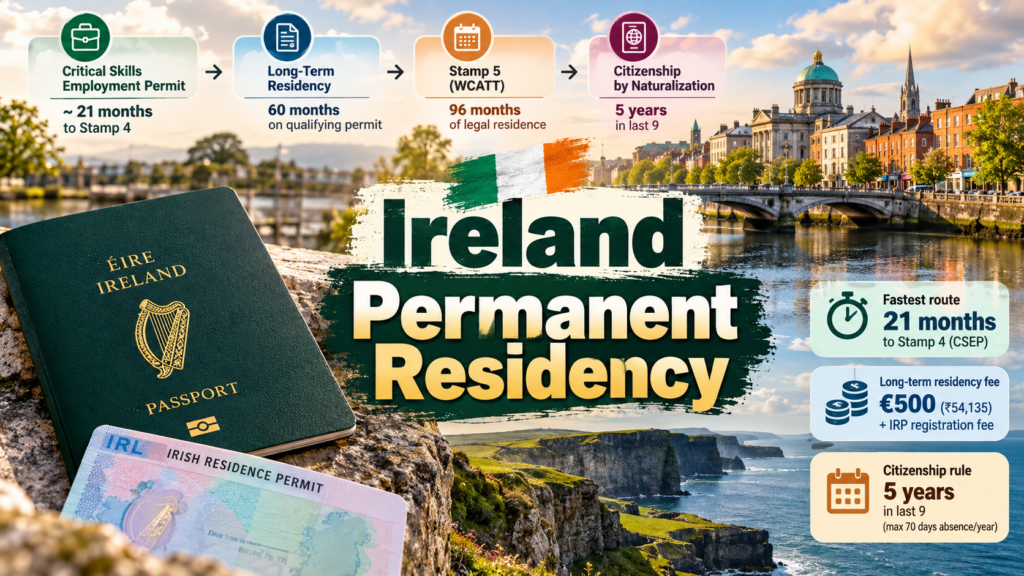
- Ireland has no single “PR visa”; the term covers four separate statuses: Stamp 4, Long Term Residency, Stamp 5, and citizenship
- Critical Skills Employment Permit holders can reach Stamp 4 in 21 months, the fastest route
- Long-term residency needs 60 months on a qualifying employment permit; the fee is €500 (₹54,135) plus a separate IRP registration fee
- Citizenship by naturalization needs 5 years’ reckonable residence in the last 9, with a strict 70-day annual absence limit
Ireland Permanent Residency Requirements at a Glance
Checking Ireland PR requirements and Ireland PR eligibility starts with figuring out which of these four statuses you’re actually asking about. Ireland doesn’t issue a single “PR card”; four distinct statuses get searched under the same phrase, each with its own residency requirement, fee, and legal effect.
| Status | Residency required | Fee | What it actually grants |
| Stamp 4 | Varies by route (see below) | Varies by route | Work without an employment permit; the gateway status |
| Long-Term Residency | 60 months on a qualifying employment permit | €500 (₹54,135) + IRP registration fee | Stamp 4 for a further 5 years; no employment permit needed |
| Stamp 5 (WCATT) | 96 months (8 years) of legal residency | IRP registration fee only | Indefinite residence, no periodic renewal |
| Citizenship by naturalization | 5 years of reckonable residence in the last 9 | €175 application + €950 certification | Irish passport, EU freedom of movement, voting rights |

Choose your dream country
 UK
UK
 USA
USA
 Germany
 Australia
 Ireland
 Canada
 UAE
UAE
 France
 Sweden
 Italy
Italy
 Other
Other
When do you want to study abroad?
What's your highest level of education?
Have you completed Class 12th?
What was your Class 12 CGPA/percentage?
Are you a student or a parent/guardian?
What do you want to study?
Select your current city
How Leap will help you

Personalised University Shortlist

Express Applications with Quicker Admits

End-to-End Application Support
Source: Immigration Service Delivery, Long-Term Residency and Naturalization Guidance
What Is Ireland’s Permanent Residency? Understanding the Rules
When people search "Ireland permanent residency," they're usually looking for one of two things: a status that lets them stay and work indefinitely, or the fastest legal route to get there. Republic of Ireland permanent residency isn't a single application; it's a ladder, and most Indian applicants climb it through an employment permit rather than a dedicated PR visa.
The Four Statuses
- Stamp 4: Lets you work without an employment permit. Stamp 4 is granted through several separate routes (a qualifying employment permit, marriage to an Irish/EU citizen, or refugee status), and not through time served on its own.
- Long-Term Residency: One specific route into Stamp 4, requiring 60 months on qualifying employment permit stamps (Stamp 1 or Stamp 4).
- Stamp 5 (WCATT): Requires 96 months of legal residence on qualifying stamps, granting indefinite residence with no renewal.
- Citizenship by naturalization: Requires 5 years of reckonable residence within the last 9 years, plus 1 continuous year immediately before applying.
If you haven't committed to Ireland yet, our Study in Ireland guide covers universities and costs; this article picks up once you're focused on the residency outcome.
Stamp 4 Ireland: The Gateway to Permanent Residency
The Ireland PR process for Indian applicants almost always starts with an employment permit, not a standalone PR application. Stamp 4 lets you live and work in Ireland without needing an employment permit, run a business, and access most state services. It is often what people mean when they search "Ireland PR," even though it isn't the final status in the system.
You can reach Stamp 4 through several routes, not just Long Term Residency:
- Completing a qualifying period on a Critical Skills Employment Permit or General Employment Permit
- Being the spouse or civil partner of an Irish or EU citizen
- Being granted refugee status or subsidiary protection
Wondering what the post-study pathway actually looks like end to end? See what our counselors say about whether Ireland offers a clear PR pathway for international students.
Source: Immigration Service Delivery, Long-Term Residency conditions
Many Indian graduates obtain their first qualifying employment permit through the Stamp 1G Third Level Graduate Program, which allows them to work full-time for up to 24 months immediately after graduation.
See our guide on part-time and post-study work rules in Ireland for how Stamp 1G's work-hour rules and PPS number requirement actually work before you move onto a CSEP or GEP.
Routes to Stamp 4: Ireland PR in 2 Years vs the Standard Timeline
This is where "ireland pr in 2 years" actually comes from, and it's real, but only for one permit type.
| Route | Timeline to Stamp 4 |
| Critical Skills Employment Permit (CSEP) | Around 21 months |
| General Employment Permit (GEP) | 57 months |
| Long-Term Residency (combination of permits) | 60 months total, any qualifying combination |
Counselor insight: If you hold a Critical Skills Employment Permit and a Stamp 1, you don't need to renew the CSEP. After 21 months of employment on it, you can apply directly to the Department of Justice (Immigration Service Delivery) for Stamp 4. DETE no longer issues a support letter. The 21 months count from when you registered your Stamp 1.
Source: Immigration Service Delivery, Critical Skills Employment Permit Stamp 4 provisions
Critical Skills Employment Permit Ireland: 2026 Salary Thresholds
Since the CSEP route is the fastest way to Ireland PR, qualifying for one depends on your salary meeting DETE's threshold. These increased from 1 March 2026 under Ireland's phased Roadmap for Minimum Annual Remuneration, with further increases planned through 2030.
| CSEP Category | Threshold before 1 March 2026 | Threshold from 1 March 2026 |
| With a relevant degree | €38,000 (₹41.14L) | €40,904 (₹44.29L) |
| Without a relevant degree, with experience | €64,000 (₹69.29L) | €68,911 (₹74.61L) |
| Recent graduate (new category) | Not applicable | €36,848 (₹39.90L) |
Counselor insight: Ireland's old "Green Card" permit was replaced by the Critical Skills Employment Permit; if you're searching "Irish green card" or "green card in Ireland," this is the permit you're looking for.
Exchange rate note: All EUR figures in this article use 1 EUR = ₹108.27, fixed for this piece as of October 2026. Verify current rates before budgeting.
Source: Department of Enterprise, Trade and Employment, Roadmap for Minimum Annual Remuneration thresholds
Long-Term Residency: Ireland PR Process, Eligibility, and Fees
Long-term residency is Ireland's formal 60-month pathway to a further 5 years of Stamp 4, and it is the specific process that most searches for "how to get permanent residency in Ireland" are really asking about.
Eligibility requirements:
- 60 months of legal residence on qualifying employment permit stamps (Stamp 1 or Stamp 4, issued for work)
- Good character (no adverse Garda Síochána record)
- No breach of previous permission conditions
- Currently employed at the time of application (self-employed applicants are not accepted)
- Not an undue burden on the State (no non-PRSI social welfare dependency)
Stamps that do NOT count, despite looking similar: student permissions (Stamp 2/2A), Start-Up Entrepreneur Programme, Intra-Company Transfer, spouse/dependent permissions on Stamp 3, and several others. This situation confuses many applicants who assume all residence time counts equally.
If your spouse or dependent was legally resident alongside you for the same 60 months, they can apply too, receiving Stamp 1G or Stamp 3 depending on your permit type.
Source: Immigration Service Delivery, Long-Term Residency eligibility criteria
Stamp 5 (Without Condition As To Time): Ireland’s Closest Equivalent to Indefinite PR
Stamp 5, formally "Without Condition As To Time" (WCATT), is the status that functions most like permanent residency in the way the term is understood elsewhere. It requires 8 years (96 months) of legal residency, calculated from stamps in your passport or expired IRP cards, and once granted, it doesn't need periodic renewal; it's valid until your passport expires.
Most applicants qualify for citizenship (5 years) well before Stamp 5 (8 years), so Stamp 5 mainly suits those who want to keep another country's citizenship without the complications naturalization might create, or who don't yet meet citizenship's character or documentation requirements. For applicants chasing Ireland permanent residency with no renewal requirement at all, Stamp 5 is the status that actually delivers that, not Stamp 4.
Source: Immigration Service Delivery, Without Condition As To Time (Stamp 5) eligibility
Irish Citizenship vs Ireland Permanent Residency
Naturalization is a separate legal track from PR, not a step that requires Stamp 5 first. It's commonly confused with "Ireland PR" in search results, but the rules are distinct.
Core requirements for adult applicants:
- 5 years of reckonable residence within the last 9 years
- 1 full continuous year of residence immediately before applying (the "5 in 9" rule)
- No more than 70 days' absence from Ireland in the 12 months before applying (a 30-day discretionary extension exists for rare, severe circumstances; there is no discretion at all beyond 100 days)
- Good character, verified through a Garda Síochána report
- Intention to continue residing in Ireland
Time on Stamp 2/2A (student permissions) does not count as reckonable residence for citizenship, even though it may count differently for other purposes. This is one of the most common reasons Indian student applicants miscalculate their eligibility date.
Note: In September 2026 the Government approved drafting of a bill that would raise the residence requirement from 5 to 8 years, add language and civics tests and a self-sufficiency test, and lengthen the spouse route. It is not law yet. The current rule is 5 years out of the last 9. Check Immigration Service Delivery before relying on any date.
Source: Immigration Service Delivery, How to Become an Irish Citizen Guide
Ireland Permanent Residency Cost: Full Breakdown in EUR and INR
This is where most online guides conflict, usually because they're each citing one piece of a two-part fee structure.
| Fee | Amount | INR equivalent |
| Long-term residency permission fee | €500 | ₹54,135 |
| IRP registration fee (separate, paid on registering the permission) | €300 | ₹32,481 |
| Stamp 5 (WCATT) application | No separate permission fee; IRP registration fee applies | ₹32,481 |
| Citizenship application fee (Online Form Portal) | €175 | ₹18,947 |
| Citizenship certification fee (standard adult, on approval) | €950 | ₹102,857 |
| Citizenship certification fee (minor) | €200 | ₹21,654 |
| Citizenship certification fee (widow/widower/surviving civil partner) | €200 | ₹21,654 |
| CSEP application fee (employer or employee) | €1,000 | ₹108,270 |
Counselor insight: So a long-term residency application in full typically costs €800 (₹86,616) once both the permission fee and IRP registration are counted, not the €300 or €500 figure quoted in isolation elsewhere.
Source: Immigration Service Delivery, Long-Term Residency and citizenship fee schedules
Ireland’s Permanent Residency Benefits and Limitations
Once you hold Stamp 4, Long Term Residency, or Stamp 5, you gain:
- The right to work in any job without needing an employer-specific permit
- The ability to start or run your own business
- Access to public health and most state services
- Eligibility to buy property in Ireland
- Family reunification: your spouse and dependents can apply for matching residency (typically Stamp 1G or Stamp 3)
- A clear route toward Irish citizenship once the separate naturalization requirements are met
What it does NOT give you, which is where most confusion with citizenship comes from:
- No Irish passport or EU freedom of movement rights
- No right to vote in Irish general elections or referendums (local election voting rights differ and are handled separately)
- Status is tied to maintaining continuous residence; extended absences can affect renewal or revoke the permission entirely
Which Ireland PR Pathway Suits You? A Decision Framework
Ireland's permanent residency requirements for Indians differ mainly by which employment permit you hold or whether you're applying through marriage to an Irish or EU citizen.
Scenario 1: Recent Irish master's graduate, Critical Skills-listed occupation, no job offer yet.
Your priority is securing a CSEP-eligible job offer that meets the 2026 salary threshold. From there, the roughly 21–24 month route to Stamp 4 is the fastest realistic path to Ireland permanent residency available to you.
Scenario 2: Working on a General Employment Permit, five years still ahead.
You're on the standard 60-month long-term residency timeline. Track every stamp carefully; gaps in registration, even short ones, don't count and can push your eligibility date back further than expected.
Scenario 3: Married to an Irish or EU citizen.
You may be eligible for Stamp 4 directly through the marriage route, separate from the employment-permit timeline, and for citizenship after 3 years (not 5) if married for at least 3 years and resident on the island for the same period.
Scenario 4: Want to keep your current citizenship and are unsure about naturalization.
Stamp 5 at 8 years gives you indefinite residence without requiring you to navigate Ireland's rules on dual citizenship or your home country's citizenship-loss provisions.
Ireland Permanent Residency Documents Checklist
- Valid passport and all previous passports showing immigration stamps
- Current and expired Irish Residence Permit (IRP) cards
- Employment contract or employer letter confirming dates and terms
- Full color copies of all employment permits issued by DETE
- Proof of continuous residence (tenancy agreements, bank statements, utility bills)
- Police clearance/good character documentation
- For citizenship specifically: certified birth certificate, identity documents totaling 150 points, and year-by-year residency evidence totaling 150 points per year
Planning Timeline: From Employment Permit to Ireland PR
Unlike a single-stage visa, Ireland's path to permanent residency is really a sequence of milestones tied to your permit type, not a fixed intake calendar. Here's how the timeline typically unfolds for a CSEP holder arriving in early 2027.
| Stage | Typical timing | Why it matters |
| Secure CSEP-eligible job offer | Before arrival | Must meet the 2026 salary threshold for your category; job offer must be for at least 2 years |
| CSEP application and grant | 1–3 months before the start date | The processing fee is €1,000; this is the clock start for your Stamp 4 eligibility |
| Register Stamp 1/IRP | On arrival | Keep every IRP card; gaps in registration are not reckonable later |
| Continuous CSEP employment | Months 1–21 to 24 | Maintain tax compliance and continuous residence throughout |
| Apply directly to ISD for Stamp 4 | From month 21 | No DETE support letter has been needed since 30 November 2023 |
| Receive and register Stamp 4 | After ISD approval | Typically granted for 2 years initially, renewable |
| Reckonable residence toward citizenship continues | From day one of legal residence | The 5-in-9 citizenship clock runs independently of your Stamp 4 timeline |
| Eligible for citizenship application | Once 5 years' reckonable residence is met | Requires the preceding 1 year to be fully continuous, with no more than 70 days' absence |
Working backward from this, a CSEP holder who arrives in early 2027 is typically looking at a realistic Stamp 4 grant by late 2028 to early 2029 and citizenship eligibility by 2032, assuming no gaps in registration or employment.
Source: Immigration Service Delivery, Stamp 4, and reckonable residence guidance
Counselor insight: The single biggest mistake we see is students assuming every year in Ireland counts the same way toward every status. Time on a student visa doesn't count toward citizenship. Time on certain Stamp 4 variants doesn't count toward long-term residency. Track your exact stamp history from day one, not just your total years in the country.
3 Takeaways on Ireland Permanent Residency
- "Ireland permanent residency" isn't one application; it's four separate statuses (Stamp 4, Long Term Residency, Stamp 5, citizenship), each with its own timeline and rules.
- The Critical Skills Employment Permit is the fastest verified route to Stamp 4, at roughly 21 months, well ahead of the 5-year General Employment Permit path.
- Budget for the full cost, not just one fee. Long-term residency is €800 total once the IRP registration fee is included alongside the €500 permission fee.
Verified by: LeapScholar's Ireland counseling team, drawing on direct experience guiding students and professionals through Stamp 1G and Critical Skills Employment Permit transitions, long-term residency applications, and naturalization documentation with Immigration Service Delivery (ISD).
Have a specific question about Ireland permanent residency? Book a free session with a LeapScholar counselor.
Frequently Asked Questions About Ireland Permanent Residency
-
What are the main Ireland permanent residency requirements?
There's no single requirement because there's no single status. Stamp 4 (via CSEP) can take around 21 months, Long Term Residency needs 60 months on a qualifying employment permit, Stamp 5 needs 96 months, and citizenship needs 5 years' reckonable residence in the last 9.
-
How do international students get permanent residency in Ireland?
Most Indian students move through: Stamp 1G (graduate stay-back) → a qualifying employment permit (CSEP or GEP) → Stamp 4 → optionally Stamp 5 or citizenship. Studying in Ireland alone doesn't count toward any of these; only post-study work time on a qualifying permit starts the clock.
-
Is there really an Ireland PR in 2 years?
Close to it. Critical Skills Employment Permit holders can typically reach Stamp 4, Ireland's gateway residency status, in around 21 months, provided they maintain continuous employment and meet the salary threshold throughout.
-
What is the total cost of Ireland permanent residency?
For long-term residency specifically, the budget is €800 total (₹86,616): the €500 permission fee plus a separate €300 IRP registration fee. Citizenship adds a further €175 application fee and €950 certification fee on approval.
-
What's the difference between Irish permanent residency and citizenship?
Permanent residency (Stamp 4, Long Term Residency, or Stamp 5) lets you live and work indefinitely but doesn't grant an Irish passport, EU freedom of movement, or voting rights in general elections. Citizenship by naturalization grants all of these but requires its own separate 5-in-9-year residency test.
-
Does Ireland still have a "green card"?
Not by that name. The old Green Card Permit was replaced by the Critical Skills Employment Permit, which remains the fastest route toward Stamp 4 and, eventually, permanent residency.
-
What are the main benefits of Ireland permanent residency?
Unrestricted work rights, the ability to start a business, access to public health and state services, property ownership eligibility, and family reunification for your spouse and dependents.
-
How long does it actually take to get PR in Ireland?
It depends entirely on your route: roughly 2 years via CSEP to Stamp 4, 5 years via General Employment Permit or Long Term Residency, or 8 years for Stamp 5. There's no single timeline that applies to everyone.







Have Questions? Get Guidance to reach your Dream University
Connect with India's finest counsellors and biggest study abroad community.
Get Guidance