
Quick Read
- Indians cannot use the E-9/EPS route; India isn’t an EPS country.
- E-7 is the main work visa route Indian professionals qualify for.
- Top-Tier Visa now covers STEM researchers, with PR possible in 3 years.
- Visa fees run Rs 3,200-8,100; processing usually takes 2-6 weeks.
Why “South Korea work visa” means something specific for Indians
Search “south korea work visa,” and most pages lump every visa category together, including the E-9 visa under the Employment Permit System (EPS). That is misleading for Indian applicants.
EPS lets 18 countries send workers to South Korea for non-professional jobs in manufacturing, construction, agriculture, and fishing, according to HRD Korea, the government agency that runs the scheme. As of 2026, those 18 countries are the Philippines, Mongolia, Sri Lanka, Vietnam, Thailand, Indonesia, Uzbekistan, Pakistan, Cambodia, Nepal, Myanmar, Kyrgyzstan, Bangladesh, East Timor, Laos, China, Tajikistan (the 17th country, added in 2025), and Kazakhstan, confirmed by South Korea’s Ministry of Employment and Labor after Kazakhstan’s addition in August 2026. India is not on this list, and there is no public indication it will be added soon.

Choose your dream country
 UK
 USA
 Germany
 Australia
 Ireland
 Canada
 UAE
 France
 Sweden
 Italy
 Other
When do you want to study abroad?
What's your highest level of education?
Have you completed Class 12th?
What was your Class 12 CGPA/percentage?
Are you a student or a parent/guardian?
What do you want to study?
Select your current city
How Leap will help you

Personalised University Shortlist

Express Applications with Quicker Admits

End-to-End Application Support
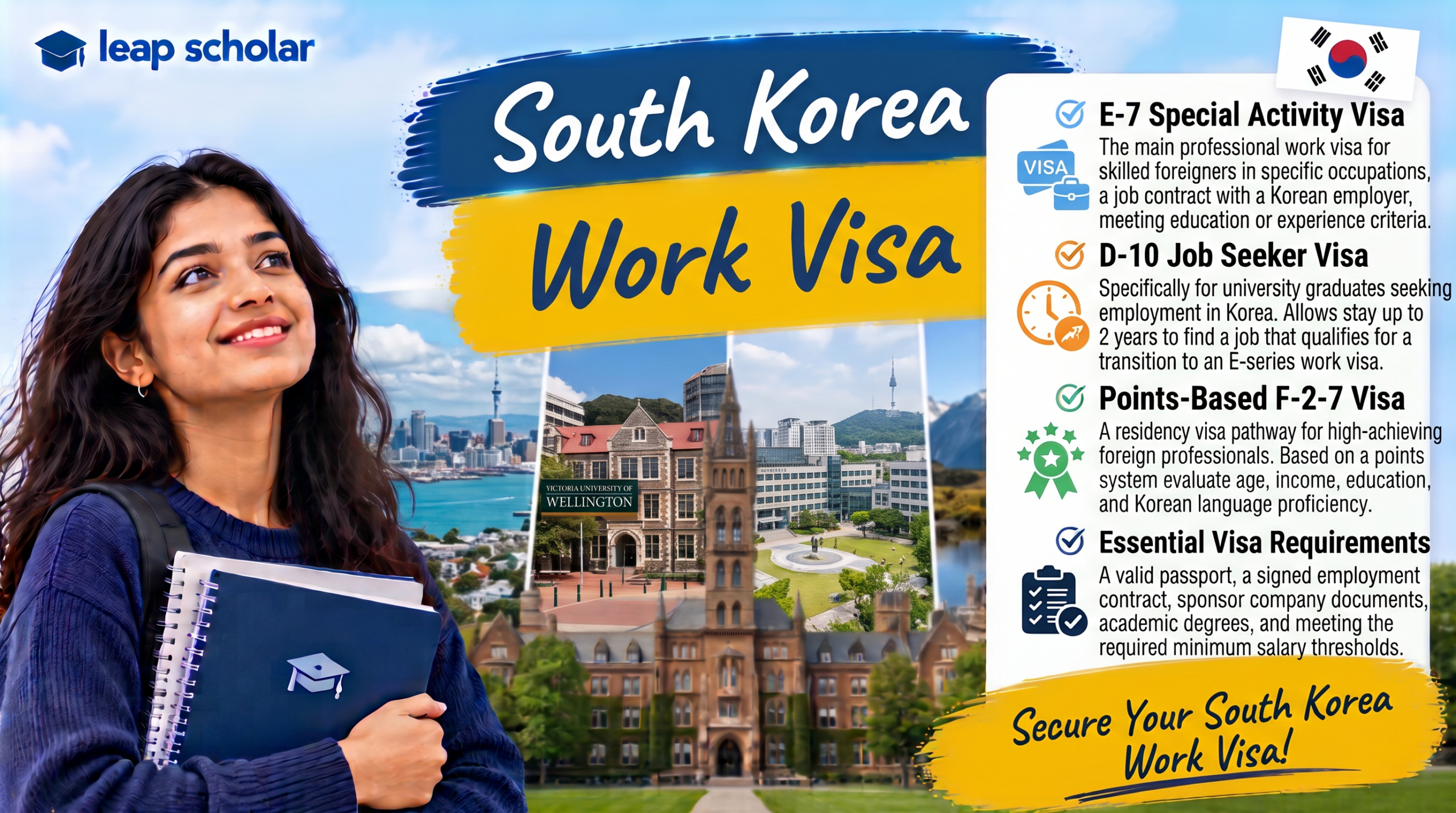
So if you are an Indian applicant, the South Korea E9 work visa, also called the South Korea EPS work visa, is not available to you, no matter what a site's keyword-stuffed guide says. The work permit visa for Indian citizens that actually exists is the E-7 series, the E-1 to E-3 academic visas, the newly expanded Top-Tier Visa, and, for a narrower group, the F-1-D digital nomad visa.
Types of South Korea work visa for Indian citizens
| Visa | Who it's for | Sponsor required | Typical stay |
| E-7 (Specially Designated Activities) | Skilled professionals: IT, engineering, management, design, corporate roles | Yes, Korean employer | 1 to 3 years, renewable |
| E-1 / E-2 / E-3 | Professor, foreign language teacher, researcher | Yes, institution | 1 to 2 years, renewable |
| Top-Tier Visa (expanded June 2026) | Senior industry professionals in AI, semiconductors, biotech; now also professors and researchers in science and technology | No job offer needed for some academic applicants | Long-term F-2 status; PR eligible after 3 years |
| D-10 | Job-seeker visa for recent graduates and professionals searching for Korean employment | No | Up to 3 years |
| F-1-D (Workation/Digital Nomad) | Remote employees of a non-Korean company or owners of an overseas business | No Korean sponsor; income-based eligibility | Up to 3 years |
| E-9 (EPS) | Non-professional labor from 18 MOU countries | N/A for Indians | Not applicable to Indian citizens |
Counselor insight: Most Indian applicants we see assume the South Korea work visa E7 category is only for IT roles. It also covers management, marketing, design, and several skilled trades, as long as a Korean employer is willing to sponsor the specific subcategory and meets the salary threshold the Ministry of Justice sets for that role.
Which South Korea work visa fits your profile
| Your situation | Likely visa route |
| You have a job offer from a Korean company in IT, engineering, or management | E-7 |
| You're a professor, teacher, or researcher with an institutional offer | E-1 / E-2 / E-3 |
| You have 8+ years' experience, a master's/PhD, and a high-paying industry offer | Top-Tier Visa |
| You're a published researcher without a confirmed job yet | Top-Tier Visa (academic track) |
| You're a recent graduate still job-hunting in Korea | D-10 job-seeker visa |
| You work remotely for a company outside Korea and earn above the income threshold | F-1-D Digital Nomad |
| You want factory, construction, or agricultural work without a prior Korean employer | Not available to Indians (EPS route, India not covered) |
South Korea work visa documents and requirements for Indian citizens
South Korea work visa requirements vary slightly by category, but a South Korea work visa for Indian citizens generally needs these documents:
- Valid passport with at least 6 months' validity
- Signed employment contract from the Korean employer
- Employer's business registration certificate
- Educational certificates relevant to the role (original or notarized copies)
- Police Clearance Certificate from India
- Health/medical clearance, including a tuberculosis test certificate for long-term stays
- Passport-size photographs and a completed visa application form
- Proof of relevant work experience where the E-7 sub-category requires it
For the Top-Tier Visa, industry applicants additionally need proof of a master's or PhD from a top-100 global university, at least 8 years of professional experience, 3+ years at a Fortune Global 500-level company, and a salary at or above roughly 3 times South Korea's percapita GNI (pushing past $100,000 a year for many applicants). Academic applicants are judged instead on research publications, international recognition, and a track record of commercializing research.
South Korea work visa fees for Indian applicants
Visa fees for Indians are paid in INR at the Korea Visa Application Centre (VFS Global) in India.
| Entry type | Standard fee (INR) | Service charge |
| Single entry, up to 90 days | Rs 3,200 to Rs 3,600 | Rs 1,100 |
| Single entry, over 90 days (includes most E-7 cases) | Rs 4,800 to Rs 5,400 | Rs 1,100 |
| Double or multiple entry | Rs 5,600 to Rs 8,100 | Rs 1,100 |
At the locked rate of ₩1 = ₹0.069 for this article, a Korean employer's typical E-7 contract offer (say ₩40,000,000 a year for a fresher IT role) works out to roughly Rs 27.6 lakh a year before tax. Always check the day's exchange rate before you budget, since it moves daily.
How to apply for a South Korea work visa from India
Applying for a South Korea work visa online is a common search, but the honest answer is "partially." Whether you call it a South Korea job visa for Indians or a work permit visa for Indian citizens, the real process looks like this.
- Secure a job offer. No work visa category covered here is issued without an employer (or, for some Top-Tier and academic cases, a qualifying institution or research track) behind it.
- Employer applies for a Certificate of Visa Issuance (CVI) with Korean immigration if the role requires one. This step happens in Korea, not India.
- Fill out the visa application through Korea's official visa portal or the paper form, depending on your Visa Application Centre's current process.
- Book an appointment at the Korea Visa Application Centre (VFS Global or BLS International) in Delhi, Mumbai, Chennai, Kolkata, or Bengaluru.
- Submit documents and biometrics in person. There is no fully paperless, completely online route for E-7, E-1 to E-3, or Top-Tier work visas, even though parts of the form can be filled online in advance.
- Pay the visa fee and service charge.
- Track your application via the VAC's online tracking portal.
- Collect your passport once the visa is issued, then register for an Alien Registration Card (ARC) within 90 days of arriving in Korea.
LeapScholar's dedicated jobs in South Korea guide covers this same D-2 to D-10 to E-7 route in more depth, including which sectors are hiring and how to build a Korean-style resume.
South Korea work visa processing time for Indians
Processing time depends on the visa category:
- E-7 and E-1 to E-3 visas: typically 2 to 4 weeks once the complete file reaches the Visa Application Centre
- Top-Tier Visa: can run longer, often 4 to 8 weeks, since it involves a more detailed credential and research-record review
- D-10 job-seeker visa: usually 2 to 3 weeks
Incomplete documentation is the most common cause of delay. Double-check your employer's business registration certificate and your own educational certificates before you submit, since these are the two documents Indian applicants most often resubmit.
If your application gets delayed or rejected
- Missing or mismatched documents: re-verify your educational certificates and employment contract against the exact list your Visa Application Centre gave you, not a generic checklist from a blog.
- Salary below the E-7 threshold for your subcategory: ask your employer to confirm the role's salary against the Ministry of Justice's current threshold before you apply, not after a rejection.
- CVI not yet issued: your employer's Certificate of Visa Issuance request in Korea can take longer than your own paperwork in India, so confirm this is done before you book your VAC appointment.
- Unclear role classification: if your job title doesn't map cleanly to an E-7 subcategory, ask your employer's HR or immigration consultant to confirm the correct subcategory before submission, since the wrong one is a common cause of rejection.
Salary expectations once you're working in South Korea
LeapScholar's guide to the cost of studying in South Korea already covers tuition and living costs for Indian students heading into South Korea's university system, which is useful context if you're weighing a D-2 to D-10 to E-7 path rather than a direct employer-sponsored route.
On salary, entry-level E-7 roles in IT and engineering commonly start around ₩40,000,000 to ₩55,000,000 a year, with experienced professionals earning ₩90,000,000 or more. At ₩1 = ₹0.069, that is roughly Rs 27.6 lakh to Rs 38 lakh for freshers, going well above Rs 60 lakh for senior roles. Top-Tier Visa salary expectations are considerably higher given the $100,000-plus threshold for industry applicants.
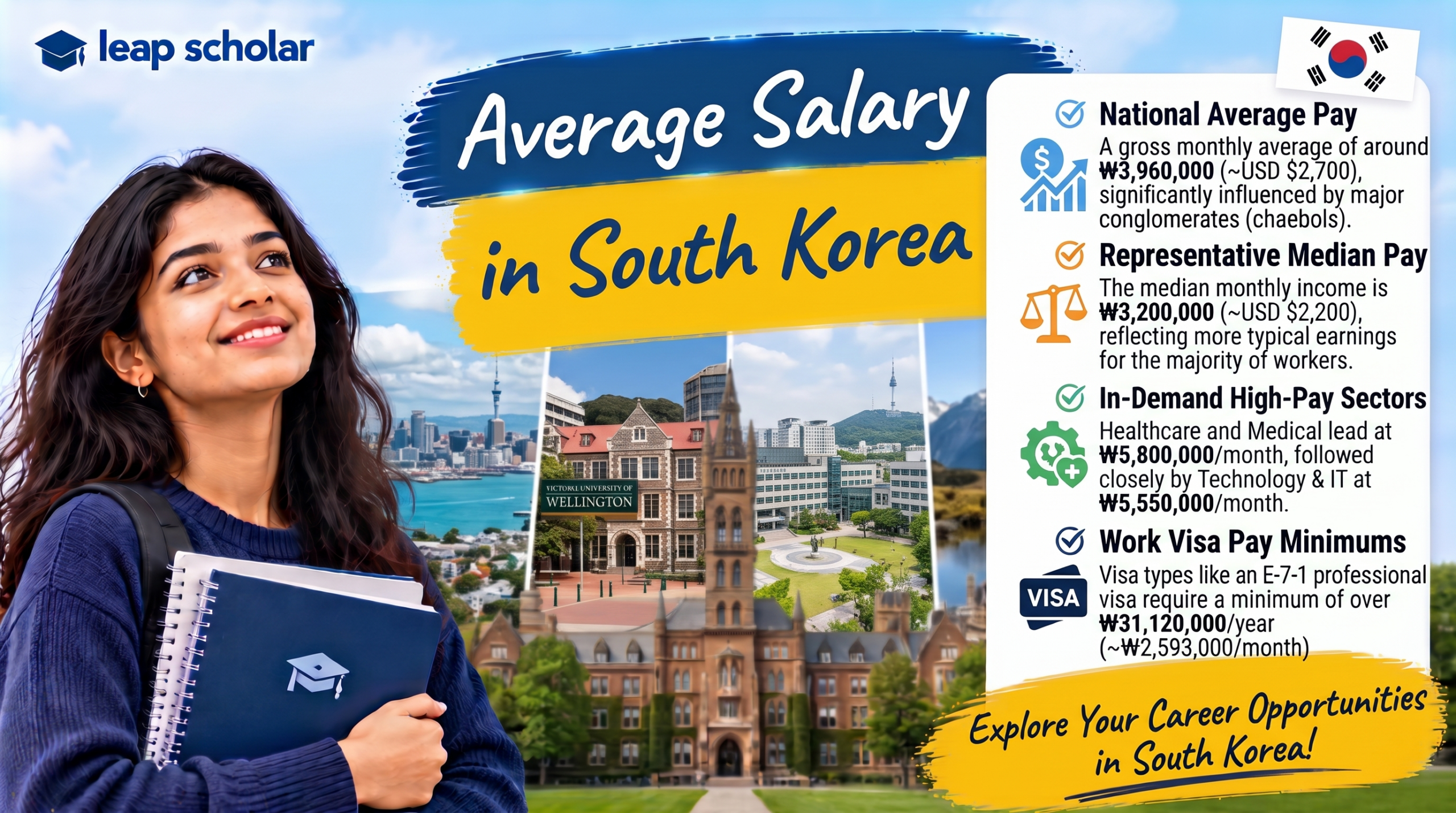
For a fuller sector-by-sector and city-wise breakdown, see LeapScholar's average salary in South Korea guide.
From student to worker: the D-2 to D-10 to E-7 path
A large share of Indian students who eventually get a South Korea work visa start on a South Korea D-2 student visa, finish their degree, then move to the D-10 job-seeker visa (now valid up to 3 years) while they look for Korean employment before converting to E-7 once they have a signed offer. If you're still at the planning stage, it's worth checking your cost of living in South Korea budget alongside your work visa plan, since the two overlap heavily in the first year.
South Korea working holiday visa for Indian citizens
South Korea's working holiday visa (H-1) agreements currently cover a defined list of partner countries, mostly in Europe, North America, and parts of Asia-Pacific. India is not currently part of this working holiday scheme, so Indian citizens looking to work in Korea need to go through the employer-sponsored or talent-track routes covered above, not the working holiday visa.
Indians who want to work remotely from South Korea without a local employer have a narrower option: the F-1-D Workation (digital nomad) visa, which Business Standard reports now allows qualifying remote workers to stay in Korea for up to 3 years, subject to an income threshold.
3 Takeaways on South Korea Work Visa
- India is not an EPS country, so rule out E-9 and focus your search on E-7, academic, or Top-Tier Visa routes instead.
- Budget Rs 3,200 to Rs 8,100 in consular fees, and confirm the day's KRW-INR rate before you finalize your salary math.
- If you're starting from a student visa, plan your D-2 to D-10 to E-7 timeline early, since the job-seeker window now runs up to 3 years.
Not sure whether EPS, E-9, or E-7 fits your profile? Talk to a LeapScholar counselor to figure out the right South Korea work visa pathway for you.
Frequently Asked Questions About South Korea Work Visa
-
How do I get a work visa for South Korea?
You need a signed job offer from a Korean employer (or a qualifying research or academic track for the Top-Tier Visa), after which your employer or institution helps you apply for the right E-series visa through the Korea Visa Application Centre in India.
-
How much does a South Korea work visa cost?
Consular fees for Indian applicants run roughly Rs 3,200 for a short single-entry visa and up to Rs 8,100 for a multiple-entry visa, plus a service charge of about Rs 1,100. Always confirm the current fee with VFS Global before you apply.
-
Can I apply for a South Korea work visa online?
Partly. You can fill parts of the application through Korea's official visa portal, but document submission and biometrics for E-7, academic, and Top-Tier visas still happen in person at a Visa Application Centre in India.
-
What is the processing time for a South Korea work visa?
Most E-series and D-10 applications take 2 to 4 weeks once your complete file is submitted. Top-Tier Visa applications can take 4 to 8 weeks because of the more detailed credential review.
-
Can Indians apply for South Korea's E-9 or EPS work visa?
The Employment Permit System covers workers from 18 specific countries under government-to-government agreements, and India is not one of them. The E-9 route simply isn't open to Indian citizens right now.
-
Is it easy to get a South Korea work visa for Indians?
It is realistic but employer dependent. Without a Korean employer willing to sponsor an E-7 role or a strong enough research profile for the Top-Tier Visa, there is no direct work-visa pathway for Indians to use.
-
Is there a South Korea working holiday visa for Indian citizens?
India isn't currently part of South Korea's working holiday visa agreements, so Indian applicants need to use the employer-sponsored or Top-Tier Visa routes instead.
-
Can a South Korea student visa be converted into a work visa?
Indirectly, yes. Students typically move from the D-2 student visa to the D-10 job-seeker visa after graduating, then convert to E-7 once they have a signed job offer from a Korean employer.










Have Questions? Get Guidance to reach your Dream University
Connect with India's finest counsellors and biggest study abroad community.
Get Guidance