
Quick Read
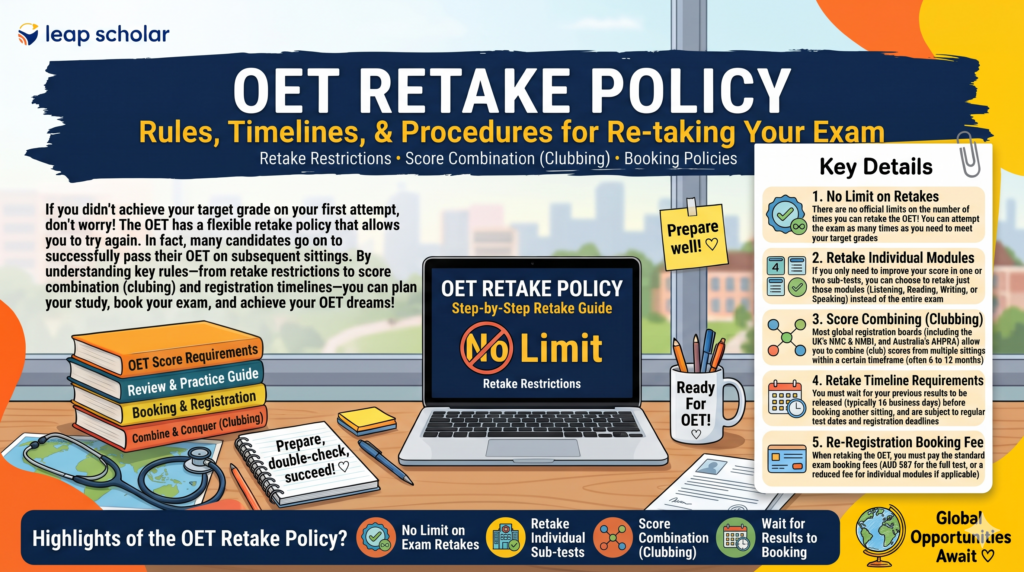
- Single sub-test resits are available only for OET on Paper.
- A full sitting costs about INR 38,100 (AUD 587) each time.
- A remark costs INR 7,800 (AUD 120) per sub-test.
- Regulators, not OET, set sitting limits and combining rules.
What Is the OET Retake Policy, and Can You Sit the Test Again?
OET is an English test for healthcare professionals who want to register, work, or study in an English-speaking place. Worried one missed grade sends you back to zero? It doesn’t: a retake is simply sitting the test again, and you can book one.
The catch is that the OET retake policy has two layers, and most candidates only read the first. OET calls whoever accepts your result a recognized organization (the regulator, board, or employer you’re applying to). If you are still deciding on the test itself, our OET exam guide covers fees, pattern, and eligibility first.

Choose your dream country
 UK
 USA
 Germany
 Australia
 Ireland
 Canada
 UAE
 France
 Sweden
 Italy
 Other
When do you want to study abroad?
What's your highest level of education?
Have you completed Class 12th?
What was your Class 12 CGPA/percentage?
Are you a student or a parent/guardian?
What do you want to study?
Select your current city
How Leap will help you

Personalised University Shortlist

Express Applications with Quicker Admits

End-to-End Application Support
A sub-test is one of OET's four parts, and the OET exam pattern names them Listening, Reading, Writing, and Speaking.
- OET sets the booking rules: you sit all four sub-tests the first time, and you can hold only one booking per test date.
- Your regulator sets the limits: how many sittings count, whether two results combine, and whether one sub-test is enough.
So the real OET retake policy question isn't "can I sit again?" It's "what will my regulator accept?"
Sources: OET test regulations
What Is the Difference Between an OET Retake, a Resit, and a Re-Mark?
Most candidates use "retake" for three different things, and that mix-up is how money goes on the wrong one. Here, a retake means taking all four sub-tests again. A resit means booking one or more sub-tests after your first full sitting. A remark means paying OET to mark a sub-test a second time.
OET on Paper and OET on Computer are taken at a test center, and OET@Home is the remote version you take from home. Read the table row by row: it shows what each route under the OET retake policy books and where it works.
| Route | What you book | Where it works | Cost |
| Retake | All four subtests, in any mode | Any regulator that accepts a new full sitting | Full test fee |
| Resit | One or more sub-tests | OET on Paper only, if your regulator accepts single sub-test scores | See the cost table below |
| Remark | A second marking of a sub-test | Requested within 72 hours of results release | INR 7,800 (AUD 120) per sub-test |
In short, your regulator decides whether a resit counts.
My insight: Most candidates pay for a full retake when only one sub-test is short. Ask your regulator which route it accepts before you book, because a result it won't accept is wasted money.
How Soon and How Often Does the OET Retake Policy Let You Sit?
Most candidates ask OET how many attempts they are allowed but the limits that matter come from the regulator. The OET retake policy itself works around the test administration, which is one scheduled OET session with its booking close and results date.
- One booking per test date: you can't hold two bookings in the same test administration, even across Paper, Computer, and OET@Home.
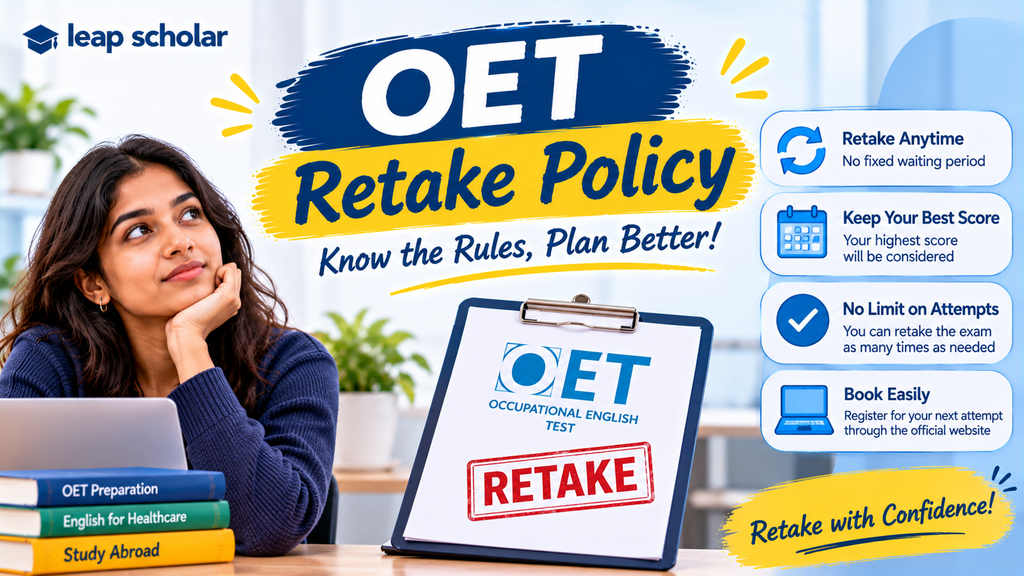
- Regulators cap sittings: Ahpra (Australia's health practitioner regulator) allows one sitting, or at most two within 12 months.
- Nurses can combine two: the NMC (the Nursing and Midwifery Council, the UK nurse regulator) combines two sittings within 12 months of each other.
- Your next sitting: check the current OET test dates and your regulator's window before you book.
Which OET Sub-Tests Can You Resit on Their Own?
You must take all four sub-tests the first time, and the common myth is that you can always resit just the one you missed later. You can, but only on Paper and only where your regulator agrees, which makes this the most misread part of the OET retake policy.
- Later, one or more: after your first test, you may book one or more extra sub-tests without having to book all four.
- Paper only: OET's rule for resitting fewer than four sub-tests applies only to OET on Paper.
- Regulator first: check that your regulator accepts single sub-test scores before you pay.
Test mode matters too. Ahpra does not accept at-home or remote versions, so OET@Home doesn't count there. The NMC and the GMC (General Medical Council, the UK doctor regulator) accept OET@Home, and OET says at-home results may not be accepted everywhere.
Sources: OET@Home
What Is the OET Retake Policy for Nurses Under the NMC?
The NMC needs at least B in Reading, Listening, and Speaking and C+ in Writing, and the mistake nurses make is booking a single sub-test resit. Under the NMC's OET retake policy, you must be tested in all four areas at the same time.
OET scores each sub-test from 0 to 500. Grade B is a score of 350 or above, and C+ is 300 or above. On the Nursing version, the NMC also asks for:
- Combining: OET's term is clubbing (using results from two test dates); between two sittings, you need one B each in Reading, Listening, and Speaking, and one C+ in Writing.
- Floors: every score in both sittings must be at least C+, or C for Writing.
- Timing: test dates must be within 12 months of each other, and both must be under two years old when the NMC assesses your application.
- Same test type: two OET tests only, never OET with IELTS; OET@Home can be combined with Paper or Computer.
- Paperwork: send both certificates and give the NMC permission to verify both tests.
Read each row of the NMC's own example as a second sitting added to a first sitting of Listening C+, Reading B, Writing B, and Speaking B.
| Second sitting | NMC decision | Why |
| Listening B, Reading B, Writing C, Speaking B | Accepted | B in every area across the two, no score below the floor |
| Listening C, Reading B, Writing C+, Speaking B | Not accepted | Listening is C in one sitting, below the C+ floor |
So one strong sitting only carries you if the other stays above the floors.
My insight: Most nurses rush a single sub-test resit after a near miss. If one score sits below B, plan a full second sitting within 12 months of the first instead, because the NMC won't count a single sub-test.
Sources: NMC: OET, NMC: accepted English language tests
What Is the OET Retake Policy for Doctors and Dentists: GMC and Ahpra?
The GMC counts only your most recent sitting, yet many doctors assume two sittings can be patched together the way nurses do for the NMC. They can't, though Ahpra allows two.
Read across each row to see which sittings count and whether results combine.
| Regulator | Sittings that count | Single sub-test | Combining | Scores needed |
| NMC (nurses, UK) | Two within 12 months | Not accepted | Yes, with floors | B (350) in Listening, Reading, Speaking; C+ (300) in Writing |
| GMC (doctors, UK) | Most recent sitting | All grades from the same test | No | B in all four, Medicine version |
| Ahpra (Australia, tests on or after 23 April 2026) | One, or two within 12 months | Not accepted for OET | Yes, floors: Listening 320, Reading 340, Writing 350, Speaking 350 | Listening 350, Reading 360, Writing 350, Speaking 360 |
Pick your regulator before you book, because under the OET retake policy, one score sheet can pass one regulator and fail another. Your GMC certificate must show your candidate number, which is the number a regulator uses to verify your result.
If you're a doctor, your certificate must be valid on the day you sit PLAB part 1 (the first UK exam for international doctors), a step on the doctor route to the UK.
Under Ahpra, each of two sittings must test all four components, and these are the rules behind Ahpra registration. Dentists take the Dentistry version.
My insight: Doctors aiming for the GMC need all four grades in one sitting, so a strong first sitting is worth more than two patched ones. Book only when your mock scores clear B in every sub-test.
Sources: GMC: using your OET certificate, Ahpra: accepted English language tests
When Does Your OET Retake Policy Depend on Score Validity?
The NMC, the GMC, and the AHPRA each use a two-year validity window, and most candidates forget that a second sitting must land inside it too. OET doesn't set that window; the authorities that recognize the test do.
- OET leaves it to regulators: each authority decides how long results count, so check its website.
- The earlier sitting runs out first: with two sittings combined, the older result sets your deadline.
- Plan both together: your OET retake policy plan and your validity plan are really the same plan.
How long a result lasts for each regulator is set out in the OET score validity rules.
Sources: OET results and scoring
What Does an OET Retake Cost in INR?
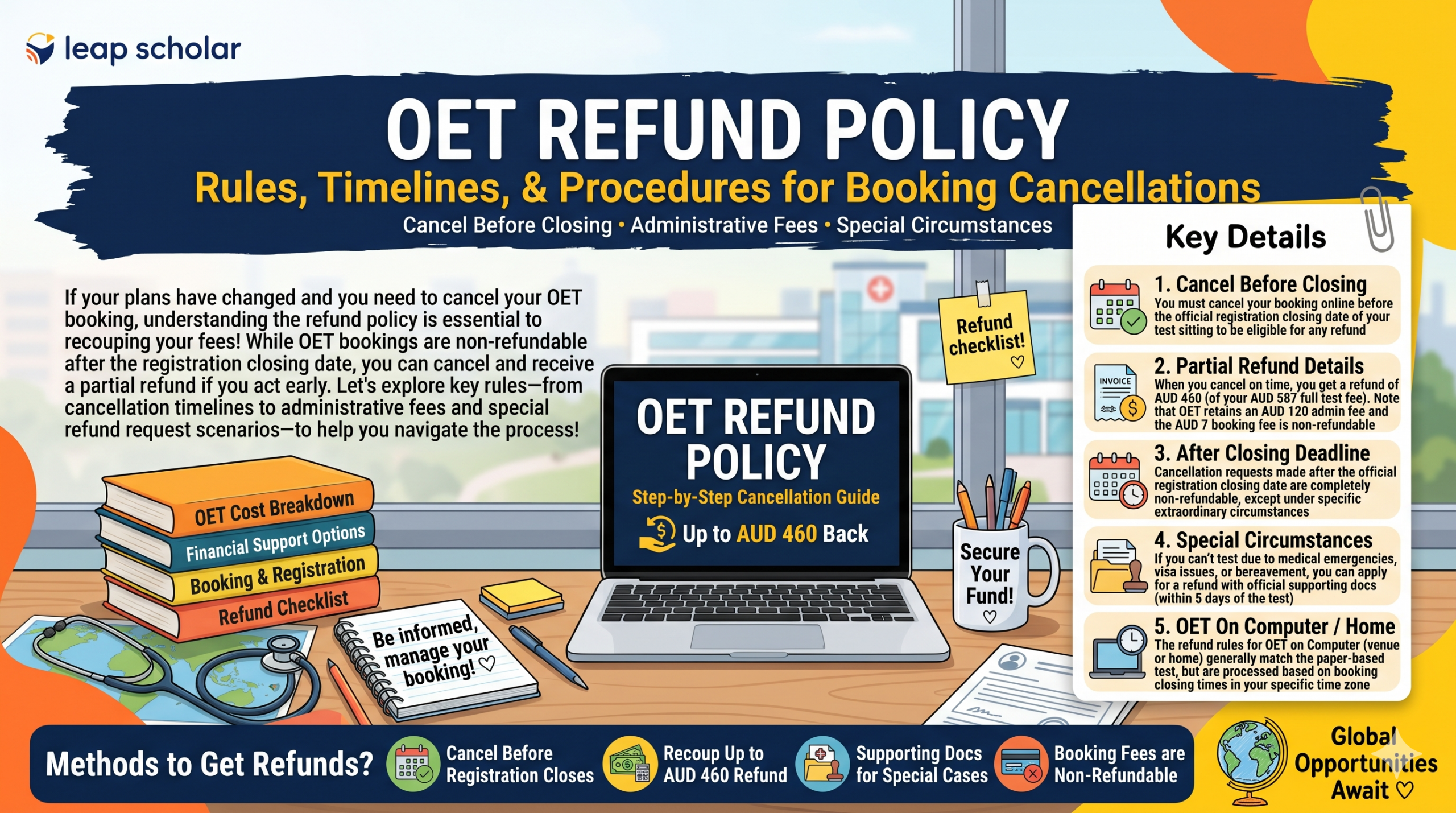
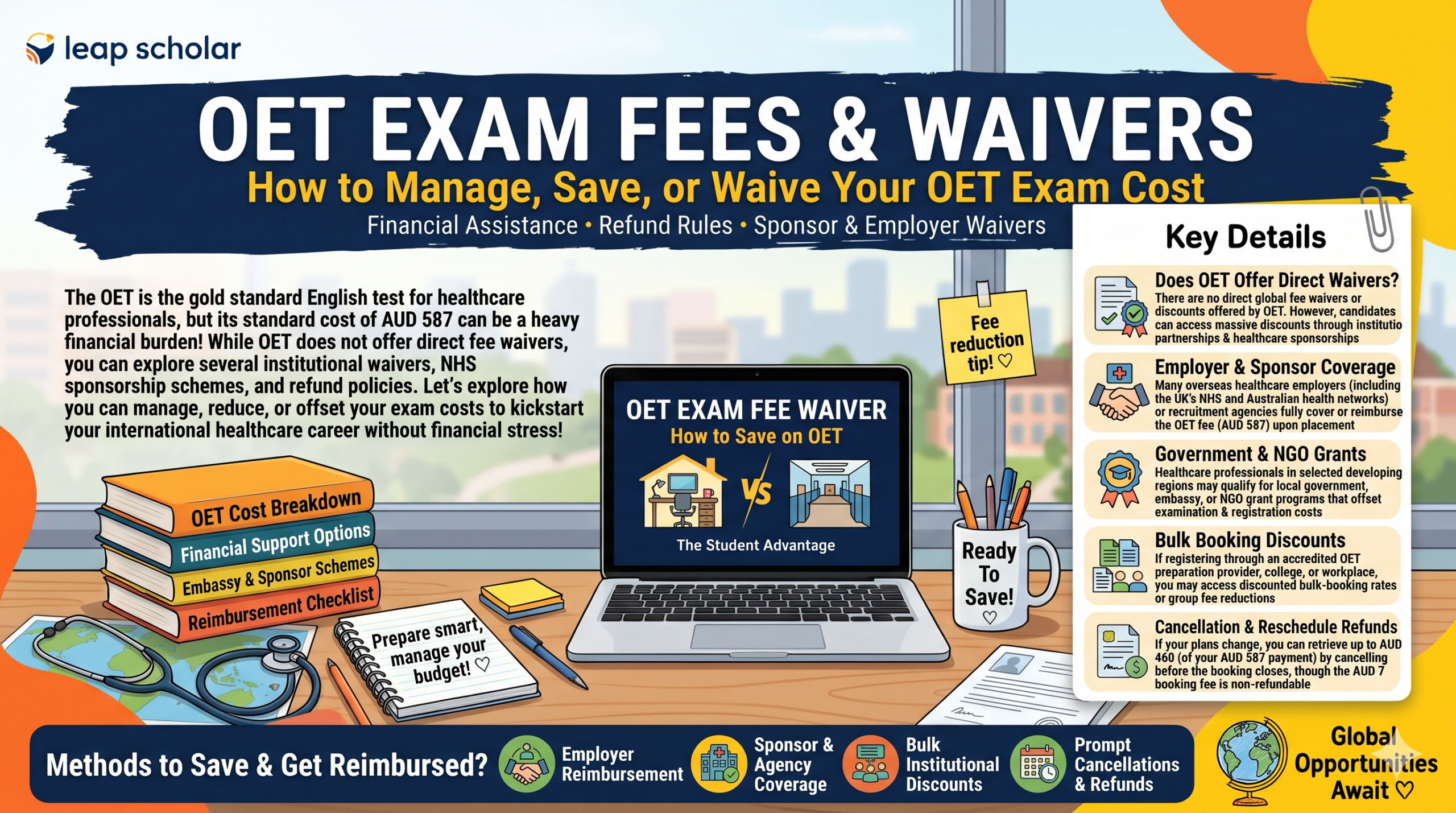
A retake costs the full test fee of INR 38,100 (AUD 587) again, and a remark costs INR 7,800 (AUD 120) per sub-test. That's the money side of the OET retake policy, and it adds up fast.
The table shows the bill for each route, with INR rounded to the nearest 100.
| Route | Fee in INR (AUD) | Note |
| One full retake | INR 38,100 (AUD 587) | Same fee on Paper, Computer and OET@Home |
| Two full sittings | INR 76,100 (AUD 1,174) | Two full test fees |
| Resit, 1 sub-test | INR 20,400 (AUD 315) | OET on Paper only, after a full first sitting |
| Resit, 2 sub-tests | INR 26,900 (AUD 415) | OET on Paper only, after a full first sitting |
| Resit, 3 sub-tests | INR 33,400 (AUD 515) | OET on Paper only, after a full first sitting |
| Re-mark, one sub-test | INR 7,800 (AUD 120) | Refunded only if your grade changes |
| Re-mark, two sub-tests | INR 15,600 (AUD 240) | Two remark fees |
Resitting a single sub-test costs about half of a full retake, so it's worth confirming with your regulator which sub-test it needs before paying for all four again.
Fees are converted at 1 AUD = INR 64.842 as of November 2026 and will shift with the exchange rate, so check the latest rate before paying.
For date-change and other booking costs, see the OET exam fees page.
My insight: Budget for two full sittings, not one, and treat a remark as a gamble. It costs less than a sitting, but it can also lower a score.
Sources: OET Test on Paper
Should You Ask for a Re-Mark or Retake OET?
A remark must be requested within 72 hours of your results, so decide fast if you think the marker was harsh. A remark is a bet, not a refund promise.
- Outcome: your score can go up, go down, or stay the same, and a remarked result can't be switched back.
- Timing: a re-mark outcome takes three to six weeks.
- Second test meanwhile: if you sit another test during the remark, OET won't refund it, even if your grade rises.
The OET retake policy gives you a fresh sitting; a remark gives the old one a second look.
My insight: A re-mark pays only when you were a few points short and your own mock scores say you should have cleared it. Otherwise, spend the money on a better second sitting.
Sources: OET Re-marking Policy
How Should You Plan Around the OET Retake Policy After a Missed Grade?
Your Statement of Results shows a 0-500 score for each sub-test, and the usual mistake is booking the next date before reading it. Four calm steps are better than one rushed booking for any OET retake policy decision.
- Read your Statement of Results: find the short sub-test; grades run from A (highest) to E (lowest).
- Read your regulator's rule: check sittings, combining, and single sub-tests in the regulator sections above.
- Choose the route: retake, resit, or re-mark, using the table near the top.
- Book the next open date: only after the first three steps tell you which route works.
Then practice where the gap is:
- Listening: the OET Listening test page shows the format you'll drill.
- Reading: the OET Reading test page lays out what each part asks.
- Speaking: the OET Speaking test page explains the format.
- Writing: sample letters for nurses and sample letters for doctors show what a strong letter looks like.
Knowing how hard OET is for Indian candidates, sub-test by sub-test, helps you decide where to resit.
What If You Miss the Grade Again or Your Regulator Won't Combine?
The NMC also accepts IELTS Academic, so a second miss under the OET retake policy doesn't mean you can't still pass. The mistake is switching tests out of frustration before reading the new test's rules.
- Sit again within your regulator's limits: book another full sitting on a later date, keeping Ahpra's two-sitting rule and the NMC's 12-month combining window in mind.
- Look at the other test: IELTS Academic is the other English test the NMC lists (7 in Listening, Reading, and Speaking, 6.5 in Writing), and OET vs IELTS compares the two.
- Know the single-skill option: IELTS has its own one-skill retake if you switch tests.
- Ask the right people: your regulator for its rule and OET support for booking questions.
This is general information, not registration or legal advice; check your regulator's page before you decide.
3 Takeaways on OET Retake Policy
- Ask your regulator first: under the OET retake policy, it decides how many sittings count, whether results combine and whether one sub-test is enough.
- Resit on Paper only: a single sub-test resit is an OET on Paper rule, and it still needs your regulator's yes.
- Count the INR: a full retake is INR 38,100 (AUD 587), and a remark is INR 7,800 (AUD 120) per sub-test.
Talk to a Leap Scholar counselor to choose between a retake, a resit, and a re-mark for your regulator.
Frequently Asked Questions About OET Retake Policy
-
How does the OET retake policy work?
The OET retake policy lets you book the test again, with one booking per test date and all four sub-tests in your first sitting. Your regulator decides how many sittings count, whether results combine and whether a single sub-test resit is accepted.
-
How many times does the OET retake policy let you sit the test?
OET's own rules set one booking per test date, and your regulator sets the sitting limits. Ahpra counts one sitting or at most two within 12 months. The NMC combines two sittings within 12 months, and the GMC counts only your most recent sitting.
-
How soon can you retake OET after a missed grade?
Under the OET retake policy, you can hold only one booking per test date, so check the open OET test dates before you book. Then check your regulator's window: the NMC and Ahpra both want two combined sittings within 12 months of each other.
-
Can you retake just one OET sub-test?
A single sub-test resit works only on OET on Paper, and only after you have sat all four sub-tests once. Your regulator must also accept it. The NMC and Ahpra do not allow this option, and the GMC requires all four grades from the same test, so check first.
-
What is the OET retake policy for nurses going to the UK?
Under the OET retake policy for nurses, the NMC lets you combine two OET sittings within 12 months. Between them, you need B in Reading, Listening, and Speaking and C+ in Writing, with no score below C+ (Writing C). You must sit all four sub-tests each time you take the OET.
-
What is the OET retake policy for doctors?
The GMC needs at least a B in all four sub-tests, achieved in the same test and in your most recent sitting, so results can't be combined. Ahpra accepts one sitting or two within 12 months, with minimum scores in every component across both.
-
How much does an OET retake cost in India?
A full OET retake costs INR 38,100 (AUD 587) per sitting at 1 AUD = INR 64.842, the same on Paper, Computer and OET@Home. A remark costs INR 7,800 (AUD 120) per sub-test, refunded only if your grade changes. Budget for two sittings.
-
Is a remark better than an OET retake?
A re-mark suits you only when a score sits just under the number. You must ask within 72 hours; it costs INR 7,800 (AUD 120) per sub-test, it takes three to six weeks, and it can lower your score as well as raise it.












Have Questions? Get Guidance to reach your Dream University
Connect with India's finest counsellors and biggest study abroad community.
Get Guidance