
Quick Read
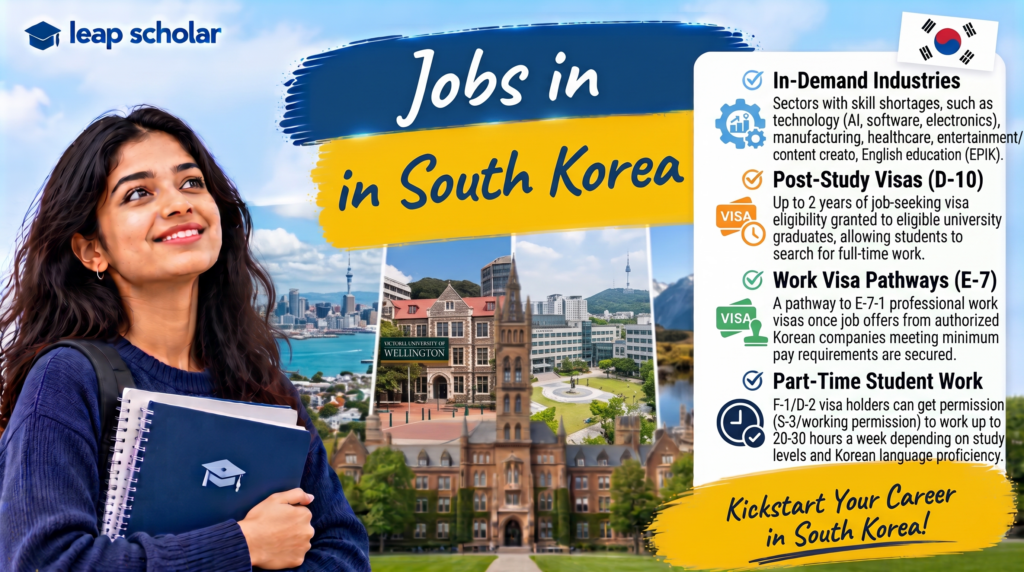
- South Korea’s 2027 minimum wage is ₩10,700/hour (about ₹749 at ₹0.070/KRW).
- The D-10 job-seeker visa now runs for up to 3 years.
- IT and semiconductor roles fall under the easier E-7-1 professional visa.
- Science and engineering freshers can skip E-7’s one-year experience rule.
Can Indians Get Jobs in South Korea? The Visa Reality
Jobs in South Korea for Indians almost always run through a sponsor. You cannot walk into the country on a tourist or student visa and simply start working. An employer has to offer you a role first, and that employer applies for your visa issuance certificate on your behalf.
For Indian students already studying in South Korea, the process usually plays out in three stages: the D-2 student visa while you study, the D-10 job-seeker visa while you search for jobs in South Korea after graduation, and an E-series work visa once you have an offer in hand. Understanding this sequence matters more than any single job listing, because the visa route decides what kind of job in South Korea for Indian freshers is even possible.

Choose your dream country
 UK
 USA
 Germany
 Australia
 Ireland
 Canada
 UAE
 France
 Sweden
 Italy
 Other
When do you want to study abroad?
What's your highest level of education?
Have you completed Class 12th?
What was your Class 12 CGPA/percentage?
Are you a student or a parent/guardian?
What do you want to study?
Select your current city
How Leap will help you

Personalised University Shortlist

Express Applications with Quicker Admits

End-to-End Application Support
If you are still finalizing where to study, our guide to the South Korea student visa covers the D-2 application in detail. and our South Korea scholarships guide is worth reading first if funding the degree itself is still the main concern.
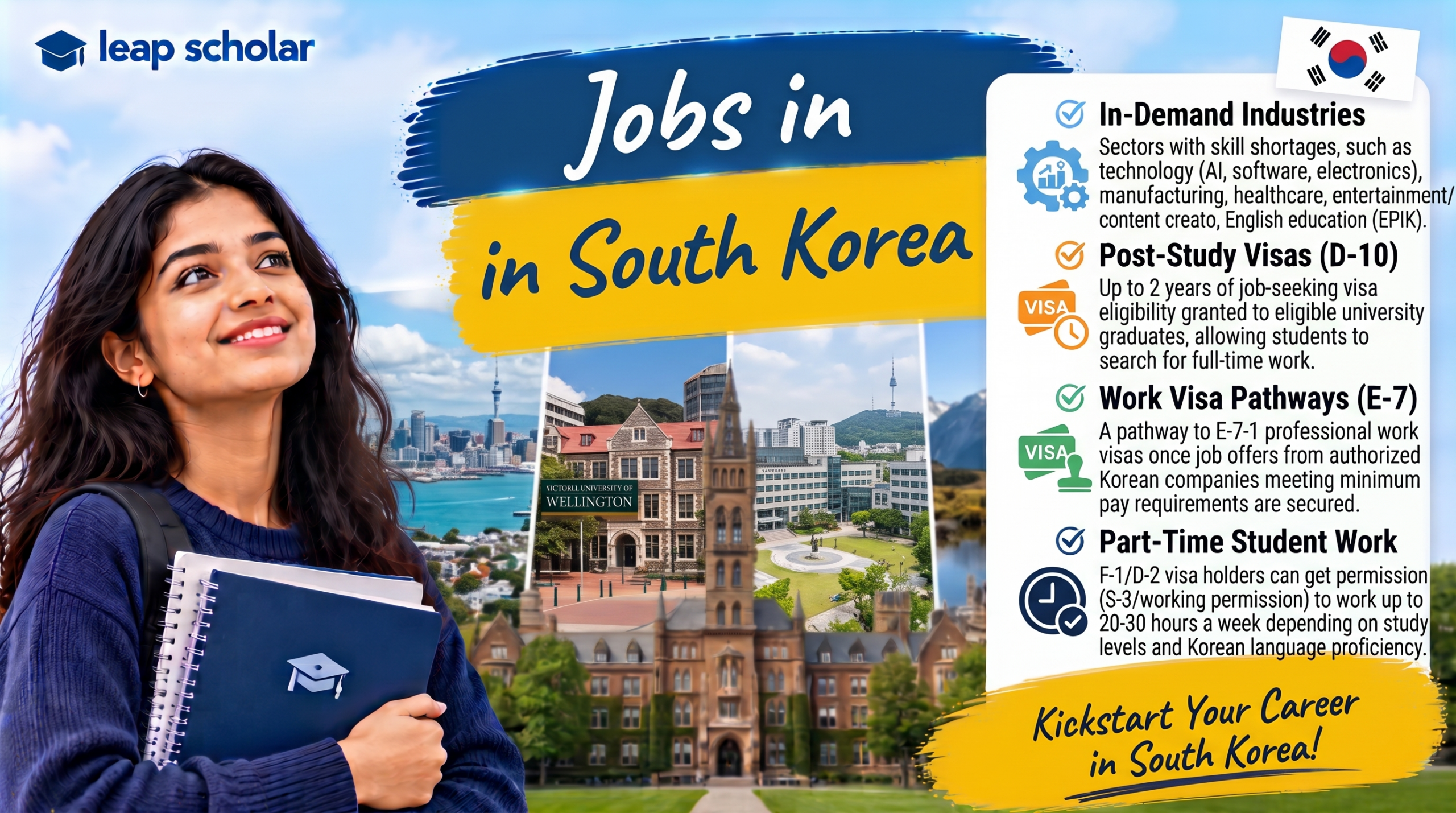
The Visa Pathway: From Student to Employee
| Visa | Who it's for | Duration |
| D-2 | Enrolled students in South Korea | Length of the course |
| D-10 (job seeker) | Graduates searching for jobs in South Korea | Up to 3 years (extended from 2 years in October 2025) |
| E-2 | Native-level English teachers; open to Indian citizens | 1 year, renewable |
| E-7-1 | Degree holders in professional roles (IT, engineering, research) | Tied to employment contract |
| E-7-2 | Semi-professional roles: hotel reception, customer service, tour guides, chefs | Tied to employment contract |
| E-7-4 | Point-based route for graduates hired by SMEs | Tied to employment contract |
The D-10 extension is the single biggest change for Indian students chasing work visas for jobs in South Korea right now. Three years of job-hunting runway, instead of two, gives graduates real room to clear the E-7 salary and qualification bar without rushing into the first offer.
Jobs in South Korea for Foreigners: Which Sectors Are Hiring
Jobs in South Korea and salary expectations vary sharply by sector. Four areas stand out for Indian graduates specifically:
IT and software. South Korea's tech firms, from Samsung to a growing set of startups, hire foreign developers under the E-7-1 category. This is where most jobs in south korea for indian students in computer science and engineering end up, often after a postgrad at one of the top universities in South Korea.
Semiconductors and electronics. With South Korea pushing to retain foreign technical talent amid a shrinking domestic workforce, semiconductor and electronics roles are among the easiest E-7-1 approvals for engineering graduates.
Biotechnology and research. Universities and research institutes recruit foreign postgraduates into lab and research roles, particularly for those coming out of an MS in South Korea in life sciences.
English teaching. The E-2 visa remains the most accessible route for freshers without a technical degree. India is one of a small set of nationalities eligible for E-2, alongside citizens of a handful of English-speaking countries.
Best jobs in South Korea for Indians tend to sit in the first two categories: they pay above the minimum wage, don't require Korean fluency to the same degree as customer facing E-7-2 roles, and align with what Indian universities already produce in volume.
Salary and Minimum Wage in South Korea (2027)
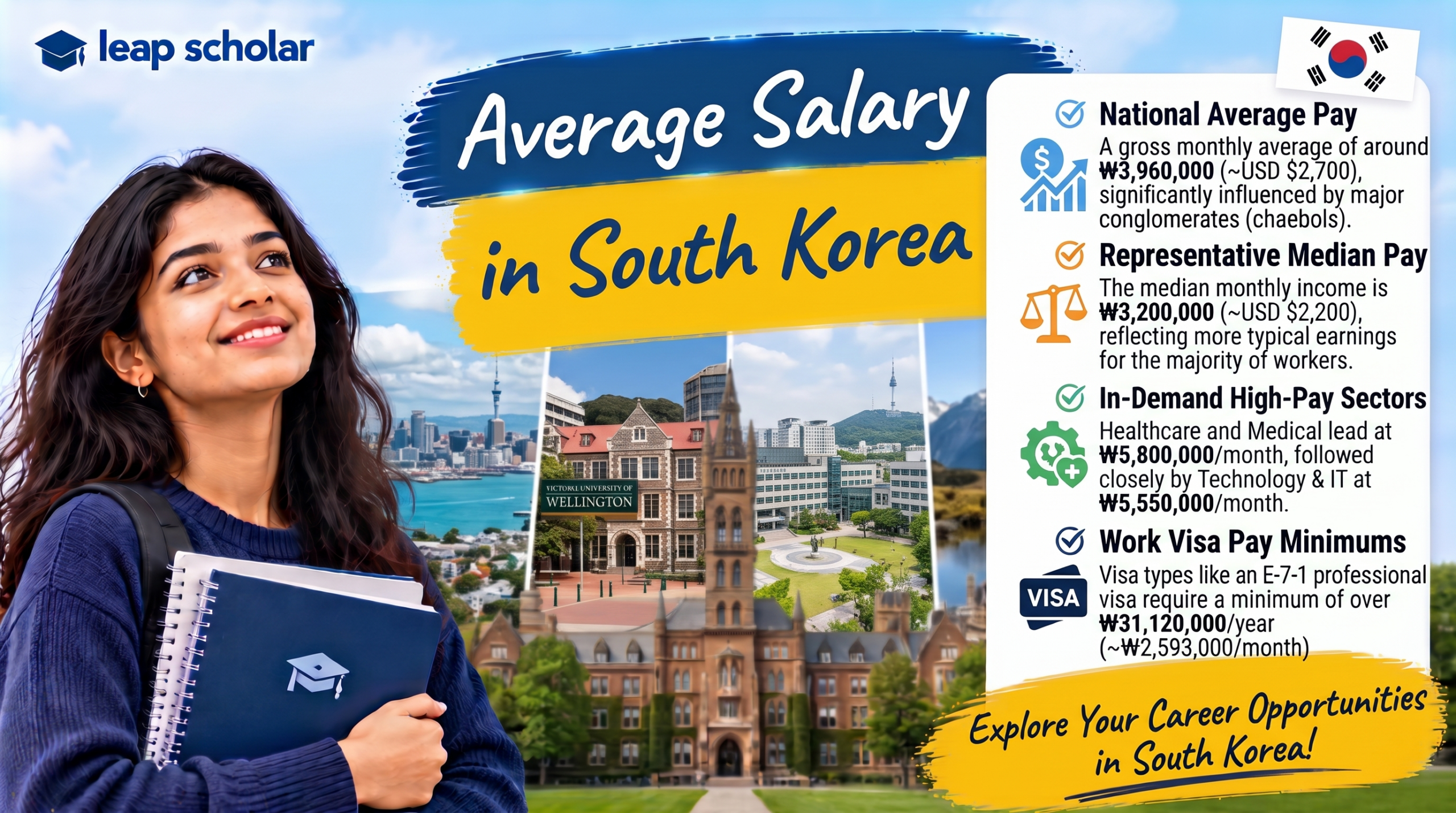
South Korea's Minimum Wage Commission confirmed the 2027 hourly minimum wage at ₩10,700, a 3.7% rise from 2026's ₩10,320. On a standard 209-hour month, that works out to ₩22,36,300 a month.
| KRW | INR (at ₹0.070/KRW) | |
| Minimum wage (hourly) | ₩10,700 | ₹749 |
| Minimum wage (monthly, 209 hrs) | ₩22,36,300 | ₹1,56,541 |
Note: we've used ₹0.070 per KRW for this article. The live mid-market rate in late 2026 runs closer to ₹0.061 to ₹0.064 per KRW, so recheck the current rate before quoting these figures to a student.
This minimum wage is a floor, not a representative salary for skilled E-7 roles. E-7-1 visa holders must clear a separate, higher salary threshold tied to Korea's gross national income per capita, a figure the Ministry of Justice revises each year. For context, LeapScholar's own research into MS graduates placed average salaries for postgraduate roles in South Korea around INR 8 lakh annually, though the figure varies widely by specialization and employer.
For a detailed cost comparison before you commit to studying there, see our breakdown of the cost of studying in South Korea.
Jobs in South Korea for Indian Freshers and Without Experience
Direct hiring jobs in South Korea without experience are rare under the standard E-7-1 rule, which usually asks for either a year of related work experience or a recognized skills program. But two routes work for freshers right now:
- English teaching (E-2). No prior work experience is required beyond a bachelor's degree and, for most placements, a TEFL-style certification.
- The Korea Chamber of Commerce and Industry pathway. Science and engineering graduates applying for E-7-1 roles can now skip the one-year experience requirement entirely by completing a recognized KCCI training program first. This option is new as of 2026 and is the clearest opening for Indian freshers in technical fields to get jobs in South Korea.
Outside these two routes, most jobs in South Korea for foreigners without a degree remain limited. The main employment visa for non-graduate factory, farm, and construction roles (E-9) is not currently open to Indian applicants, so freshers without a degree have very few formal routes in.
Part-Time Work Rules for Students
If you're on a D-2 visa and want to work while studying, South Korea caps your weekly hours, and the cap depends on your TOPIK score and major. The one major exception: in 2026, South Korea relaxed this rule for 16 technical majors, allowing students in those programs up to 35 hours of part-time work a week, well above the usual limit for other disciplines.
Our roundup of recent policy changes for international students covers this and related updates in more depth.
How to Apply for Jobs in South Korea
- Build a Korean-style resume. Most employers expect a one-page format with a photo, unlike the longer CVs common in India.
- Use the right portals. Saramin and JobKorea list the bulk of domestic openings; LinkedIn and university career centres carry more of the foreign-friendly roles.
- Apply through your university's career office if you're still enrolled. Many E-7-1 and E-7-4 placements for graduates start as campus recruitment drives.
- Confirm your employer will sponsor the visa issuance certificate before accepting an offer. Not every company is registered to sponsor foreign hires.
- Keep your D-10 timeline in mind. With three years to search, there's no need to accept the first offer that doesn't fit your qualifications.
Counselor insight: Students often assume a job offer guarantees a visa. It doesn't. We've seen offers fall through at the visa stage because the employer wasn't registered to sponsor E-7 hires, or the salary fell just short of the threshold. Always ask the employer directly whether they've sponsored foreign hires before.
3 Takeaways on Jobs in South Korea
- Line up your visa path before your job search: D-2 to D-10 to E-7 is the standard route, and the D-10's 3-year window gives you room to wait for the right offer.
- Target IT, semiconductor, or biotech roles if you want the smoothest E-7-1 approval and pay above the 2027 minimum wage.
- If you're a science or engineering fresher with no work experience, look into the KCCI training pathway before ruling out jobs in South Korea entirely.
Talk to a LeapScholar counselor to check your eligibility for jobs in South Korea and plan your visa and application timeline.
Frequently Asked Questions About Jobs in South Korea
-
How can I get a job in Korea?
Most Indians enter through an employer-sponsored E-7 visa after graduating from a Korean university or switch from a D-10 job-seeker visa once they land an offer. The job offer always comes before the visa.
-
What jobs are in demand in Korea?
Semiconductors, IT and software, biotechnology, and English teaching lead the list for foreigners right now, alongside skilled roles in manufacturing under the E-7 categories.
-
Which is the best job in South Korea for Indians?
IT and software roles tend to suit Indian graduates best. They fall under the E-7-1 professional visa, pay above the minimum wage, and don't demand Korean fluency the way teaching or customer-facing roles do.
-
What is the age limit for working in Korea?
There's no fixed legal age cap for the main E-7-1 professional visa; applicants in their 40s get approved when their qualifications fit. Age only becomes a scored factor under the separate E-7-4 points system.
-
What qualifications do I need to work in Korea?
A relevant degree, plus for most E-7-1 roles, either a year of related work experience or a recognized skills program. Science and engineering graduates can now skip the experience requirement through the KCCI pathway.
-
Is it easy to get a Korean work visa?
Not particularly. Your employer sponsors the E-7 visa, your salary has to clear Korea's income threshold, and firms can't keep foreign staff above 20% of headcount. The hard part is getting the job offer itself.
-
What jobs can Indian freshers find in South Korea?
Freshers typically start as English teachers on an E-2 visa or in junior IT roles once a Korean company sponsors them. A master's degree from a Korean university widens these options considerably.
-
Can I get a direct hiring job in South Korea without experience?
For standard E-7-1 roles, it is rare to be hired without experience, but science and engineering graduates can bypass the one-year experience rule by first completing a training program from the Korea Chamber of Commerce and Industry.







Have Questions? Get Guidance to reach your Dream University
Connect with India's finest counsellors and biggest study abroad community.
Get Guidance