
Quick Read
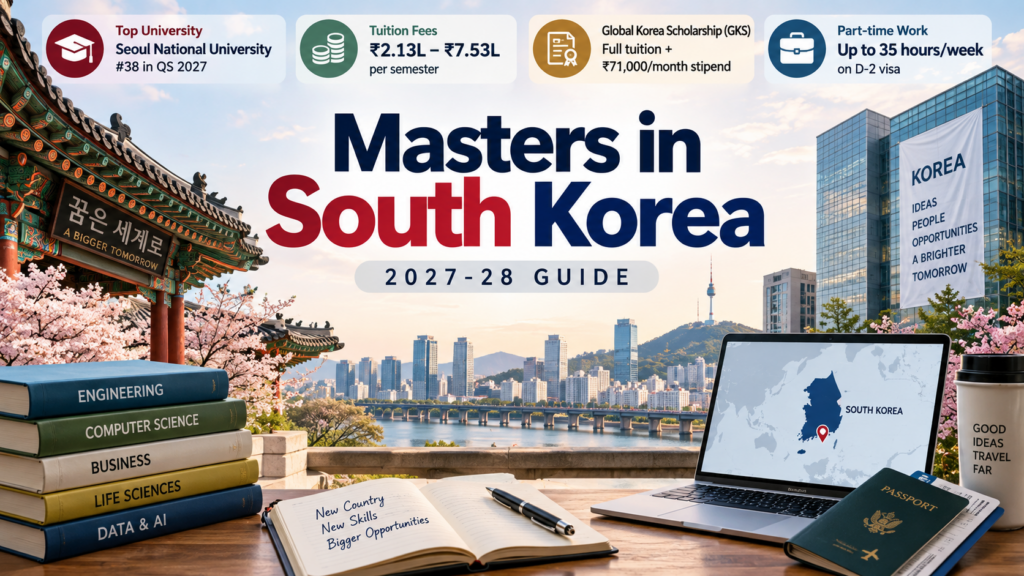
- Seoul National University leads Korea at #38 in the QS World University Rankings 2027, followed by Yonsei (#42) and Korea University (#52).
- Masters tuition runs roughly from ₹2.13 lakh to ₹7.53 lakh per semester, before any scholarship or waiver.
- The Global Korea Scholarship (GKS) covers full tuition plus a stipend of about ₹71,000/month, per NIIED.
- Graduate students on a D-2 visa can work up to 35 hours/week with the right permit, per Study in Korea’s official portal.
Is South Korea Good for Indian Students?
South Korea’s international student count hit 307,464 in 2026, a year ahead of the government’s “Study Korea 300K” target. That success triggered a policy shift: on September 8, 2026, the Ministry of Education moved focus from recruiting more students to screening for quality, cracking down on study-abroad agencies using false advertising and applicants submitting fake degree certificates.
For Indian students, this has both positive and negative implications. Yes, Indian students can study in South Korea confidently right now, as demand is real, English-taught programs are expanding, and government scholarships are well-funded. But document verification is getting stricter, so working directly with university international offices or NIIED, rather than an unverified local agent, matters more in 2027-28 than it did a year ago.

Choose your dream country
 UK
UK
 USA
USA
 Germany
 Australia
 Ireland
 Canada
 UAE
UAE
 France
 Sweden
 Italy
Italy
 Other
Other
When do you want to study abroad?
What's your highest level of education?
Have you completed Class 12th?
What was your Class 12 CGPA/percentage?
Are you a student or a parent/guardian?
What do you want to study?
Select your current city
How Leap will help you

Personalised University Shortlist

Express Applications with Quicker Admits

End-to-End Application Support
Source: Korea Herald -Korea shifts international student policy from numbers to quality
Top Universities for a Masters in South Korea (QS 2027)
Here's the South Korea university fee breakdown in Indian rupees and the Korea university fees for international students for the seven most-searched names:
| University | QS World Rank 2027 | Tuition (per semester) |
| Seoul National University (SNU) | 38 | ₩3.0M-₩6.5M (₹2.13L-₹4.62L) |
| Yonsei University | 42 | ₩4.85M-₩7.48M (₹3.45L-₹5.31L) |
| Korea University | 52 | ₩5.24M-₩8.57M (₹3.72L-₹6.09L) |
| KAIST | 65 | ₩9.56M nominal (₹6.79L); ₩0 effective for most funded students |
| POSTECH | 106 | ₩5.0M nominal (₹3.55L); ₩0 effective for most admitted international students |
| Sungkyunkwan University (SKKU) | 108 | ₩6.74M-₩10.6M (₹4.79L-₹7.53L) |
| Hanyang University | 155 | ₩4.0M-₩8.0M (₹2.84L-₹5.68L) |
KAIST and POSTECH are worth flagging separately: both routinely waive tuition for nearly all admitted international graduate students, regardless of GKS status, which most competitor guides bury deep in text rather than surface upfront.
Conversion note: KRW-INR figures use 1 KRW = ₹0.071 as of September 2026. Exchange rates fluctuate, so verify the current rate before finalizing your budget.
Counselor insight: A lower QS rank doesn't always mean a worse outcome. Hanyang and SKKU have stronger industry placements into Samsung, LG, and SK Hynix for engineering Masters than their global rank alone suggests.
Source: QS World University Rankings 2027, via Korea JoongAng Daily
Eligibility and Documents for Masters Admission in South Korea
What are the requirements for studying for a master's degree in South Korea, or in Korea more generally? The masters degree requirements in South Korea for international students are largely the same whether you go the GKS or self-funded route:
| Document | Requirement | India-Specific Detail |
| Bachelor's degree certificate | Completed or expected before enrolment | Provisional certificate accepted if awaiting final results |
| Academic transcripts | Full record, all semesters | Apostille or Korean consular authentication generally required |
| CGPA proof | Minimum 2.64/4.0 or equivalent | Ask your institution for an official percentage-to-CGPA conversion if your marksheet uses a different scale |
| English or Korean proficiency | IELTS/TOEFL for English-taught programs; TOPIK for Korean-taught | Many GKS-G and university programs don't mandate GRE/GMAT |
| Statement of Purpose | Required for most university-track and GKS-G applications | Should name a specific professor or lab where relevant |
| Recommendation letters | Usually 2 | Give recommenders at least three weeks' notice |
| Financial proof (self-funded route) | Bank balance evidence for the visa stage | Roughly ₩20,000,000 (₹14.20 lakh), held for at least 28 days before applying |
If a scholarship doesn't close the full gap, most families combine it with an education loan.
Is it possible to apply for a student loan for studying abroad, and what are the guarantor requirements covers what lenders ask for.
Counselor insight: The apostille step on Indian academic documents is where applicants lose the most time, not the SOP or recommendation letters. Start it the same week you shortlist universities, not after you get an offer.
Masters in South Korea: Funded vs. Self-Funded, at a Glance
A master's degree in South Korea for international students runs down one of two tracks, whether you call it a masters in Korea, an MS in Korea, or a masters degree in South Korea for international students, and picking the wrong one wastes months.
| Route | How It Works | Best For | Typical Timeline |
| GKS-funded (government) | Full tuition and stipend via NIIED, including 1 year of Korean language training | Strong academic profile, comfortable with a competitive selection process | Apply for ~Feb 2027 for the graduate cycle; the degree starts ~2028 |
| Self-funded, direct university admission | Apply directly to the university; pay tuition, and apply separately for university-specific merit aid | Students wanting a faster timeline or targeting a specific lab/professor | Apply Mar-Nov 2026 for Fall 2027 intake |
For the university-specific fee comparison behind this table, see top universities in South Korea for international students.
If your budget question is really about total cost rather than which track to pick, the cost of studying in South Korea breaks that down separately.
Counselor insight: Students often wait on a GKS decision before applying anywhere else, which burns an entire admission cycle if the scholarship doesn't come through. Apply to at least one self-funded backup in parallel.
Source: NIIED - Study in Korea, GKS Program
Which Track Fits You? A Decision Framework
Before you work out how to apply for a Masters in South Korea, place yourself here first:
- Final-year student with a strong GPA (80%+ or top 20% of class) and 12+ months of runway: You're a strong GKS-G candidate. Start Korean language basics now, since TOPIK scores add bonus points even though they aren't mandatory at the application stage.
- Student who needs to start within the next 6-9 months: Skip GKS-G's long cycle and apply directly to universities for the Fall 2027 intake (deadlines typically fall March-November). Ask each shortlisted university about its own merit-based tuition waivers, which typically cover 30-100% based on your academic record.
Several South Korea masters programs for international students without IELTS accept a Medium of Instruction certificate from your prior university instead, so check each program's language policy before assuming you need a test score.
- Student targeting AI, biotech, or advanced engineering specifically: Factor in the K-STAR visa track before you choose a university. Only 32 designated institutions currently qualify graduates for direct F-2 residency after a Masters or PhD, so this can shape which university you shortlist, not just which scholarship you chase.
Counselor insight: Students frequently pick a university by ranking alone and only discover the K-STAR eligibility question after admission. Check the designated-university list before you finalize your shortlist if a Korea-based STEM career is the actual goal.
Global Korea Scholarship (GKS): Funding Your Masters
The Global Korea Scholarship, run by NIIED (National Institute for International Education), is the main fully funded scholarship for masters in South Korea for Indian students and the clearest answer to "How can I get a scholarship for South Korea?" that doesn't depend on a specific university's own budget.
| Aspect | Details |
| Run by | NIIED, under the Korean Ministry of Education |
| What it funds | Full tuition, monthly stipend, one year of Korean language training, round-trip airfare, settlement allowance, health insurance |
| Stipend value | Approximately KRW 1,000,000/month (₹71,000/month) for graduate scholars |
| Degree duration | 3 years total for a Master's: 1 year Korean language + 2 years degree program |
| Academic eligibility | Minimum GPA 2.64/4.0 (or equivalent); completed Bachelor's degree |
| Age limit | Under 40 as of September 1 of the enrollment year |
| Application tracks | Embassy Track (via the Korean Embassy in New Delhi) or University Track (direct to a GKS-designated university) |
| 2027-28 cycle status | Not yet open; the 2026 GKS-G cycle's final results were announced in June 2026 |
| Next realistic window | GKS-G 2027 applications are expected to open around February 2027 |
Verified timing correction: If you're planning around a "2027-28" label, note that GKS names its cycles by the year formal degree study begins, and the graduate cycle you'd actually apply for right now hasn't opened yet. Confirm live dates at studyinkorea.go.kr before assuming a window is active.
For the full GKS walkthrough, including required documents, LeapScholar's GKS graduate scholarship guide covers the application sequence step by step, and you can read expert answers on which countries offer 100% scholarships, including how GKS compares.
Counselor insight: GKS scholars can't work part-time immediately, even with a D-2 visa, since the permit typically isn't available during the first six months. Budget your first semester on the stipend alone, not on assumed part-time income. If GKS doesn't work out, most of the fully funded scholarships in South Korea for international students Masters applicants actually end up using their university-specific merit waivers rather than a second government scheme, so don't wait on a second national scholarship to appear.
Source: Embassy of the Republic of Korea, GKS-G Notice
D-2 Visa, TOPIK, and Working While You Study
Once admitted, your Masters in South Korea runs on a D-2-3 (Master's degree) visa. Here's the student visa for South Korea from India cost and rules in one place.
| Aspect | Details |
| Visa category | D-2-3 (Master's degree programs) |
| Student visa fees for South Korea | Approximately ₹5,100 for a single-entry visa valid over 90 days, per the Korea Visa Application Centre for India |
| Financial proof required | Approximately ₩20,000,000 (₹14.20 lakh), held for at least 28 days |
| Part-time work rule | Up to 35 hours/week for graduate students, with no restriction on weekends or vacation, once a work permit is granted |
| Wait period before work permit | Typically 6 months from arrival |
| Post-study option | D-10 job-seeking visa, now valid up to 3 years (extended from 2) with 1-year renewal increments |
| Fast-track residency (STEM only) | K-STAR visa track: direct F-2 residency for Master's/PhD graduates from 32 designated universities, no job offer required |
Counselor insight: The K-STAR expansion to 32 universities is recent (designated December 2025, effective February 2026), and most competitor guides on this topic haven't caught up to it yet. If your actual goal is a long-term career in STEM in Korea, this change affects which university is "best" for you more than QS rank does.
For the visa application process itself, the South Korea student visa (D-2) guide has the full document checklist.
Source: Study in Korea - Employment System for Foreigners, Korea.net - Ministry of Justice, K-STAR Visa Track
Visa fee note: convergent visa-agency data puts single-entry, over-90-day student visa fees at approximately ₹5,100; confirm at your nearest Korean Embassy or Consulate before applying, as fees are periodically revised.
Month-by-Month Application Calendar for 2027-28
If you're still working out how to apply for a Masters in South Korea, this calendar is the actual sequence for either track.
| Month | Action |
| Sep-Nov 2026 | Shortlist universities; start Korean language basics if targeting a Korean-taught program or GKS bonus points |
| Oct-Nov 2026 | Submit direct university applications for Fall 2027 (self-funded route); begin the document apostille process |
| Dec 2026-Jan 2027 | Sit TOPIK or IELTS/TOEFL if scores are borderline |
| Feb 2027 | GKS-G 2027 applications are expected to open; confirm exact dates on studyinkorea.go.kr |
| Mar-Apr 2027 | GKS-G Embassy and University Track deadlines typically fall in this window |
| May-Jun 2027 | Receive university admission decisions; arrange financial documentation |
| Jul-Aug 2027 | D-2 visa application, tuberculosis test, flights, and housing |
| Sep 2027 | Semester begins; complete Alien Registration within 90 days of entry |
Counselor insight: Every GKS date above is based on the historical pattern, not a confirmed 2027 notice. Bookmark studyinkorea.go.kr and check it monthly starting December 2026.
What to Do If GKS Doesn’t Come Through or Your Scores Fall Short
Missing GKS for one cycle doesn't end your Masters in South Korea plan; it just removes the fully funded route for that year. Your real options:
- Apply directly to accredited universities for their own tuition scholarships, which commonly range from 30% to 100% based on academic record
- Reapply to GKS the following cycle with a stronger study plan and, if relevant, a TOPIK score
- Consider an education loan while you strengthen your application.
Our expert answer to the question, “Can I get a 100% education loan for studying abroad?” covers how much of the cost that can realistically close
A TOPIK score below what a Korean-taught program prefers doesn't disqualify you from most English-taught Masters programs, since TOPIK is a bonus for GKS applications rather than a hard requirement for the scholarship itself. If your target program is Korean-taught, budget 12-18 months of structured study to reach TOPIK Level 3-4.
Counselor insight: A missed GKS cycle is a timing setback, not a dead end. Students who panic and take an expensive private loan immediately are often worse off than those who wait one cycle and reapply with a stronger profile.
3 Key Takeaways on Masters in South Korea
- Decide your track early: GKS-funded admission and self-funded direct admission run on entirely different timelines, and waiting on one blocks the other.
- Confirm every GKS date directly on studyinkorea.go.kr before planning around it. The 2027-28-labeled cycle hasn't opened as of this writing.
- A missed scholarship cycle or a soft TOPIK score is a timing setback, not the end of your Masters in South Korea plan. University-specific aid, a bridge loan, or the next GKS cycle can all keep it on track.
Verified by: LeapScholar's South Korea counseling team, with hands-on experience guiding Indian students through GKS applications, university admissions, and D-2 visa processing.
Have questions about your Masters in South Korea plan? Book a free session with a LeapScholar counselor.
Frequently Asked Questions About Masters in South Korea
-
How do I get admission for a Masters in South Korea as an Indian student?
Apply either through GKS-G (Embassy or University Track) for funded admission or directly to a Korean university for self-funded admission. Both routes need a completed Bachelor's degree, academic transcripts, a Statement of Purpose, and proof of English or Korean language proficiency, depending on the program's medium of instruction.
-
Is GRE or GMAT required for a Masters in South Korea?
No, most Masters programs in South Korea, including GKS-funded ones, don't require GRE or GMAT. English-taught programs typically ask for IELTS or TOEFL instead, and Korean-taught programs ask for TOPIK.
-
What is the cost of a Masters in South Korea for Indian students?
Masters tuition fees in South Korea range from roughly ₹2.13 lakh to ₹7.53 lakh per semester depending on the university, before any scholarship or waiver, answering the broader "How much does it cost to study in South Korea?" question for most Master's applicants. KAIST and POSTECH effectively charge ₩0 for most admitted international graduate students. Add monthly living costs of roughly ₹53,000 to ₹98,000 depending on the city.
-
Can I do a Masters in South Korea without knowing Korean?
Yes. Many Masters programs, particularly at KAIST, POSTECH, SNU, and Yonsei, are taught fully in English. GKS scholars still complete one year of Korean language training regardless of their program's teaching language.
-
Which is the best university for a Masters in South Korea?
Seoul National University ranks highest overall (#38, QS 2027), but "best" depends on your field. KAIST and POSTECH lead in engineering and applied sciences with near-universal tuition waivers, while Hanyang and SKKU have stronger direct pipelines into Samsung, LG, and SK Hynix.
-
When should I apply for a Masters in South Korea for the 2027-28 intake?
For the self-funded route, apply between March and November 2026 depending on the university's specific deadline. For GKS-G funding, expect the application window to open around February 2027, with results in mid-2027 and the program starting in 2028 after language training.
-
Can I work part-time during a Masters in South Korea?
Yes, once you hold a D-2-3 visa and receive a part-time work permit, typically available after 6 months in Korea. Graduate students can work up to 35 hours per week with no restriction on weekends or vacations.
-
What happens after I finish a Masters in South Korea?
Most graduates move to the D-10 job-seeking visa, now valid up to 3 years. STEM Master's or PhD graduates from 32 K-STAR-designated universities can instead move directly to F-2 residency status without a job offer.
-
What if I miss the GKS application deadline?
You lose that specific year's funded route, not your overall plan. Apply directly to universities for their merit scholarships in the meantime, and reapply to GKS in the next cycle.







Have Questions? Get Guidance to reach your Dream University
Connect with India's finest counsellors and biggest study abroad community.
Get Guidance