
Quick Read
- South Korea’s average salary is about INR 2.8-2.9 lakh per month.
- Annual average pay is roughly INR 33-34 lakh at current rates.
- IT, engineering, and finance pay well above the national average.
- Indian graduates work mainly through the E-7 visa after hiring.
What Is the Average Salary in South Korea in 2027?
Exchange rate used throughout this article: 1 KRW = INR 0.070. This rate moves daily, so treat every rupee figure here as an estimate and check a live converter before you make any financial decision. Looking at the average salary in South Korea in Indian rupees, rather than switching between KRW and USD, makes it far easier to compare against pay back home. The average salary in South Korea for Indian students and working professionals broadly follows the national figures in this guide, with the main difference being which visa category and sector you qualify for.
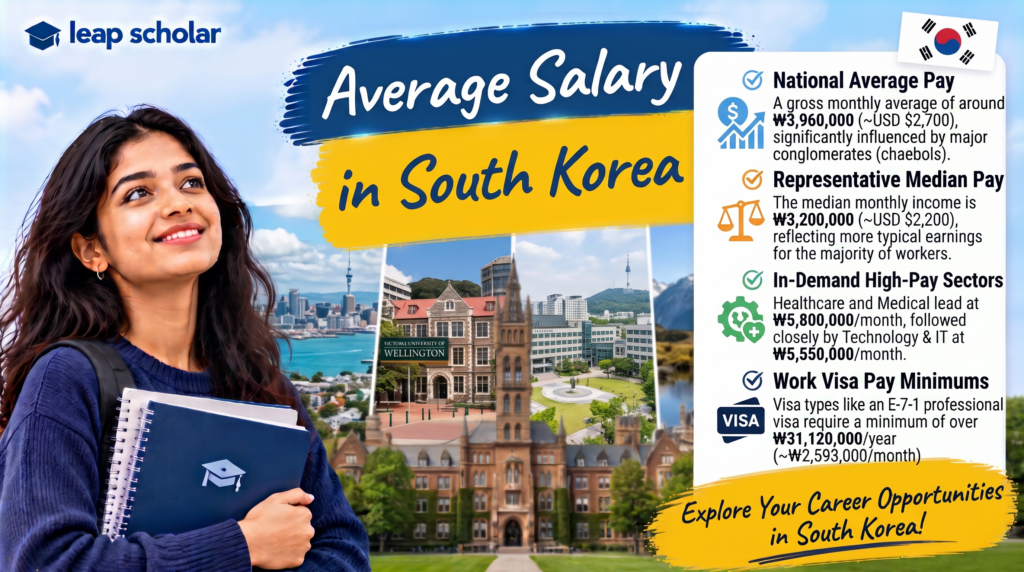
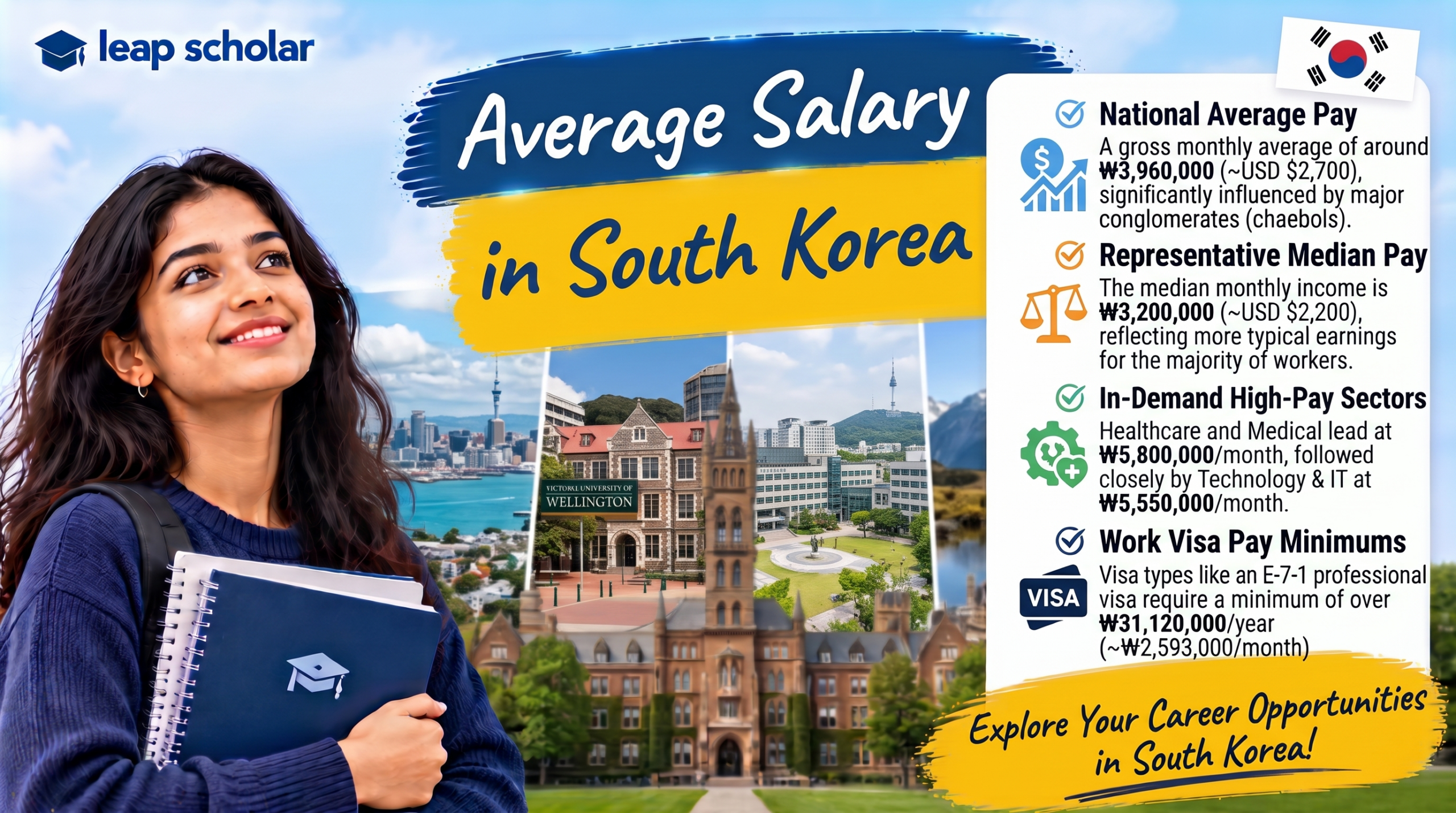
According to Ministry of Employment and Labor (MOEL) wage survey data compiled through KOSIS (source: Employ Some, MOEL/KOSIS 2025 data), the average gross monthly salary in South Korea in 2025-26 is approximately KRW 4,025,000, which works out to about INR 2.8 lakh. Annualized, the figure amounts to KRW 48.3 million, or roughly INR 33.8 lakh per year. This broadly matches the quarterly wage trend reported by Trading Economics, citing South Korea’s Ministry of Employment and Labor.

Choose your dream country
 UK
 USA
 Germany
 Australia
 Ireland
 Canada
 UAE
 France
 Sweden
 Italy
 Other
When do you want to study abroad?
What's your highest level of education?
Have you completed Class 12th?
What was your Class 12 CGPA/percentage?
Are you a student or a parent/guardian?
What do you want to study?
Select your current city
How Leap will help you

Personalised University Shortlist

Express Applications with Quicker Admits

End-to-End Application Support
This is the average salary in South Korea per month across all industries, experience levels, and company sizes. It includes base pay plus regular bonuses, but not irregular one-off payouts. Other wage trackers put the monthly figure anywhere between KRW 3.9 million and KRW 4.2 million depending on the survey period and whether year-end bonuses are included, so treat KRW 4 million as a working midpoint rather than a fixed number.
For context, the minimum wage in South Korea from January 2026 is KRW 10,320 an hour, or about INR 722, as set by South Korea's Minimum Wage Commission. When worked out over a standard 209-hour month, this comes to KRW 2,156,880, which is close to INR 1.51 lakh a month and roughly 54 percent of the national average. South Korea's Minimum Wage Commission has already finalized the next rate: KRW 10,700 an hour, about INR 749, effective 1 January 2027, a 3.7 percent rise. On the same 209-hour month, that works out to KRW 2,236,300, or about INR 1.57 lakh a month.

What Is a Good Salary in South Korea?
Anything meaningfully above the national average of KRW 4 million a month counts as a good salary in South Korea. Wage trackers put the comfortable-living threshold at around KRW 5.5 million a month, close to INR 3.85 lakh, the point at which rent, food, and transport in a mid-size city leaves room for consistent monthly savings. In Seoul, where costs are higher, workers typically need around KRW 6-7 million a month to feel the same level of comfort.
Average Salary in South Korea by Industry and Role
The average salary in South Korea varies sharply by sector. IT, finance, and engineering sit well above the national line, while teaching, hospitality, and entry-level service roles sit below it.
| Industry / Role | Average Monthly Salary (KRW) | Approx. INR |
| Financial services and banking | 6.5M - 7.5M | 4.55L - 5.25L |
| IT and software (senior) | 5.8M - 6.5M | 4.06L - 4.55L |
| Engineering | 4.5M - 7.5M | 3.15L - 5.25L |
| Healthcare and medical (non-doctor) | 4.5M - 5.8M | 3.15L - 4.06L |
| National average (all roles) | 4.0M - 4.2M | 2.80L - 2.94L |
| Education and teaching | 2.3M - 3.1M | 1.61L - 2.17L |
| Hospitality and food service | 2.5M - 2.8M | 1.75L - 1.96L |
Doctors, surgeons, pilots, senior lawyers, and C-suite executives sit well outside this table, often earning KRW 10 million a month or more. These are the highly paid roles in South Korea, but they also come with the steepest entry barriers, long residency requirements, and licensing exams in Korean.
Counselor insight: Students often assume a STEM degree automatically means a top of table salary. In practice, your starting pay depends more on whether your employer is a large conglomerate (chaebol) or a small or mid-size firm than on your degree alone. Large firms routinely pay 30-40 percent more for the same role, so factor in company size in your job search, not just the industry.
Average IT Salary in South Korea
The average IT salary in South Korea is one of the better-paying segments of the job market, and it is also the easiest entry point for Indian graduates because Korean language requirements are often lower in tech teams than in client-facing roles. The average salary in South Korea for foreigners working in tech tends to track these same numbers, since most large employers pay by role and seniority rather than nationality.
The average salary in South Korea for software engineer roles specifically, according to role-wise salary data for the sector, typically runs KRW 3.5 million to KRW 6.5 million a month, depending on experience:
| Experience Level | Annual Salary (KRW) | Approx. INR |
| Entry-level | 30M - 45M | 21L - 31.5L |
| Mid-level | 45M - 80M | 31.5L - 56L |
| Senior-level | 80M - 120M+ | 56L - 84L+ |
Companies like Samsung, SK Hynix, Naver, and Kakao, along with Indian IT firms that operate Korea offices, are the biggest hirers of software developers, data analysts, AI engineers, and chip-design specialists from India. Most of these openings move through the E-7 skilled worker visa once an employer makes an offer.
Average Salary in South Korea by City
Seoul pays a clear premium over the rest of the country, roughly 10 percent above the national average, at close to KRW 4.55 million a month. Busan and Incheon sit a few percent above the national line, while smaller cities like Daegu and Daejeon land closer to the average or slightly below it.
The trade-off is the cost of living. Seoul salaries look attractive until you factor in rent, which is why comparing the cost of living in South Korea against the city-wise salary table above matters more than looking at the headline number alone.
Net Pay and Tax: What You Actually Keep
The average salary in South Korea after taxes is noticeably lower than the gross figure once the national pension, health insurance, employment insurance, long-term care insurance, and income tax are deducted. On the national average gross salary of KRW 4 million a month, take-home pay typically works out to around KRW 3.2 million, about 80 percent of gross.
Foreign workers have one option Korean nationals do not: a flat 19 percent tax rate on gross income for the first few years of employment as an alternative to Korea's progressive tax slabs (6 to 45 percent). For most mid-level salaries, the flat rate works out cheaper, but it is worth running both numbers before you sign a contract, since it depends on your exact salary band and deductions.
Average Salary in South Korea vs India
The gap between the average salary in South Korea and typical postgraduate pay in India is large, often several times over, even after accounting for South Korea's higher cost of living. The INR 2.8-2.9 lakh average monthly pay in South Korea is well above what most fresh postgraduates earn in India across sectors, and IT or engineering roles in South Korea widen that gap even further.
What narrows the gap in practice is spending power. South Korea's rent, transport, and food costs are higher than most Indian cities, so the real increase in disposable income is smaller than the headline salary comparison suggests, particularly in Seoul.
South Korea vs Japan vs Singapore: Which Pays More?
| Country | Approx. Average Monthly Pay | Approx. INR |
| South Korea | KRW 4.0M - 4.2M | 2.80L - 2.94L |
| Japan | JPY 5.15 lakh (full-time professional average) | 2.99L |
| Singapore | SGD 5,070 (Ministry of Manpower) | 3.55L |
Japan figure: full-time professional average salary, independently reported.
Singapore figure: Ministry of Manpower average monthly salary data.
Singapore and Japan edge ahead of South Korea on headline pay, but South Korea's lower cost of living outside its capital, shorter work-visa timelines for skilled roles, and a growing number of English-taught degree programs make it a competitive option, especially for engineering and IT students.
For a closer look at the other two markets, see the average salary in Japan and average salary in Singapore breakdowns.
Can Indians Work in Korea? The Visa Route Explained
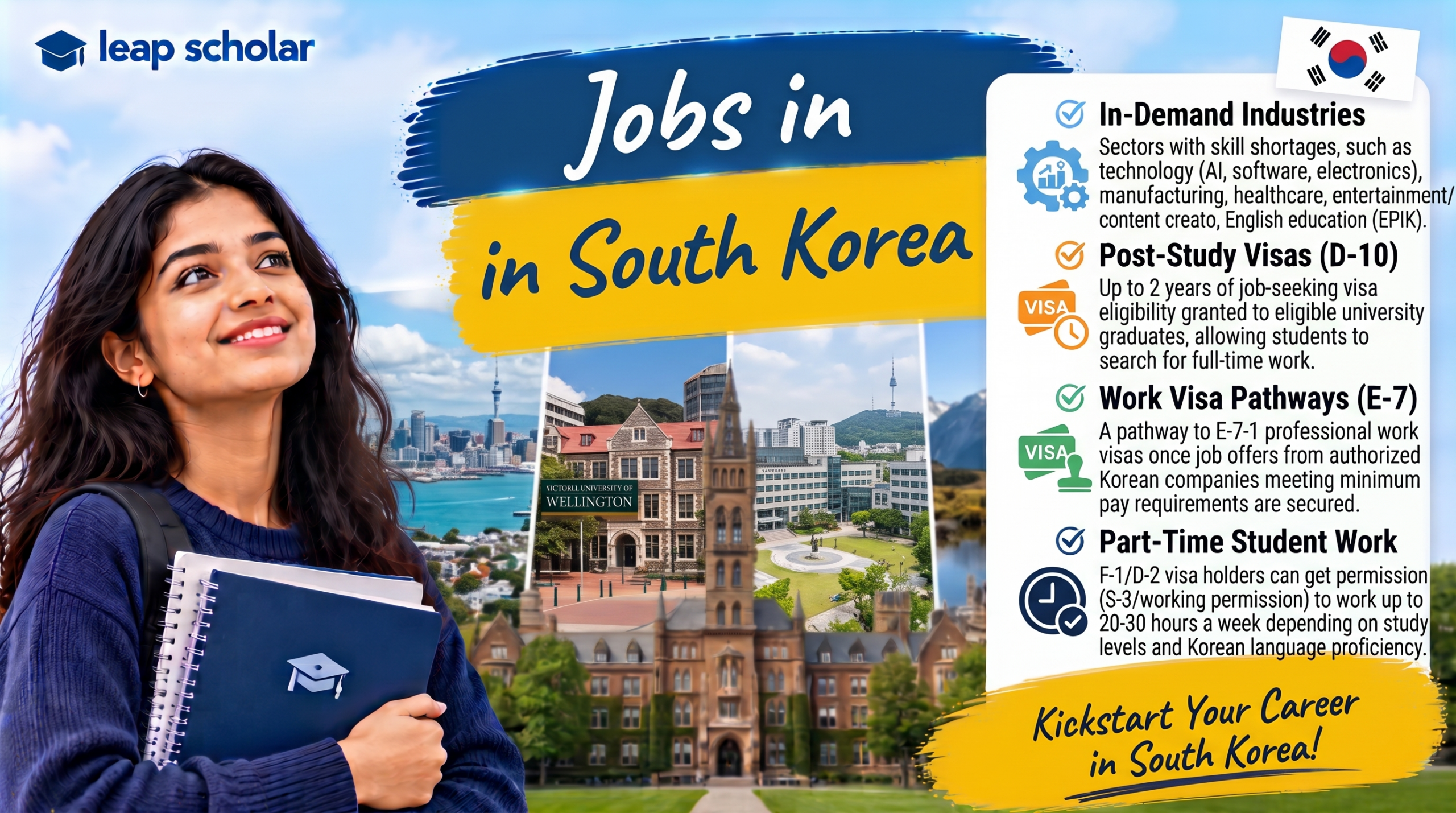
Indian graduates cannot use South Korea's E-9 Employment Permit System, since India is not currently one of the EPS sending countries (that route is open to Nepal, the Philippines, Sri Lanka, Pakistan, Vietnam, and a handful of others, not India, despite a 2023 proposal to add India that has not yet resulted in a signed agreement). For degree holders, the realistic path is
- D-2 student visa, with part-time work permitted once you clear the required TOPIK (Korean language) level.
- D-10 job-seeker visa, valid for up to two years in six-month extensions, to search for a role in your field after graduation.
- E-7 skilled worker visa, once an employer makes you an offer. The E-7 visa is the main route to the average salary in South Korea for international students who complete a degree there.
Salary floors for E-7 roles are reviewed annually by Korea's Ministry of Justice, and they vary by subcategory, so confirm the exact threshold for your role before your employer files your visa.
For the degree and scholarship side of this plan, see LeapScholar's guides on South Korea's student visa and cost of studying in South Korea.
3 Takeaways on Average Salary in South Korea
- Budget around INR 2.8-2.9 lakh a month as the realistic national average, and treat anything above KRW 5.5 million a month as genuinely good pay.
- Target IT, engineering, or finance roles if maximizing salary matters most. These sit well above South Korea's national average and remain the easiest sectors for Indian graduates to break into.
- Plan your visa path early. The D-10 job-seeker visa followed by the E-7 skilled worker visa is the practical route for Indian graduates, since the E-9 route is not currently open to India.
Talk to a LeapScholar counselor to understand which South Korean courses and job roles lead to the best salary and PR outcomes for Indian students, and get help planning your application.
Frequently Asked Questions About Average Salary in South Korea
-
What is a good salary in South Korea?
Anything above the national average of around KRW 4.2 million a month (about INR 2.9 lakh) counts as a good salary in South Korea. Earning KRW 5.5 million or more a month, roughly INR 3.85 lakh, usually covers rent, food, and savings comfortably, even in a mid-size city.
-
What is the average salary in South Korea per month in Indian rupees?
Currently, with the exchange rate, an average monthly pay in South Korea would be around INR 2.8-2.9 lakh for a gross monthly wage of KRW 3.96-4.2 million. This figure varies with the won-rupee rate, so see it as a working estimate, not a fixed number.
-
Which job is highly paid in South Korea?
South Korea’s highest-paying industries include finance, IT, and semiconductors, where IT directors and banking experts can often earn KRW 10 million a month or more. At the highest end of the salary scale are doctors, pilots, and C-suite executives.
-
Can Indians work in Korea?
Indian graduates can and do work in Korea, mainly through the E-7 skilled worker visa after finding a job, or the D-10 job-seeker visa while they search. South Korea's E-9 visa for unskilled work is not open to Indian passport holders yet, so professional, degree-linked roles are the realistic route in.
-
What is the easiest job to get in South Korea?
For students, part-time campus and retail jobs on a D-2 visa are the easiest to land, provided your Korean language score clears the required TOPIK level. For graduates, roles at Indian companies with a Korea office, or IT jobs that do not need fluent Korean, tend to be the quickest to break into.
-
Which job is most demanding in Korea?
IT and semiconductor roles are in the highest demand right now, driven by chip makers like Samsung and SK Hynix. Engineering, biotechnology, and nursing also face steady shortages, which keeps hiring active in these fields.
-
What are the current job vacancies in Korea?
-
What IT jobs are available in Korea for Indians?
Indian IT professionals get hired for software development, data analysis, AI, and chip-design roles at companies like Samsung, SK Hynix, Naver, and Kakao, as well as Indian IT firms with Korea offices. Most of these openings move through the E-7 visa once you have an offer.












Have Questions? Get Guidance to reach your Dream University
Connect with India's finest counsellors and biggest study abroad community.
Get Guidance