
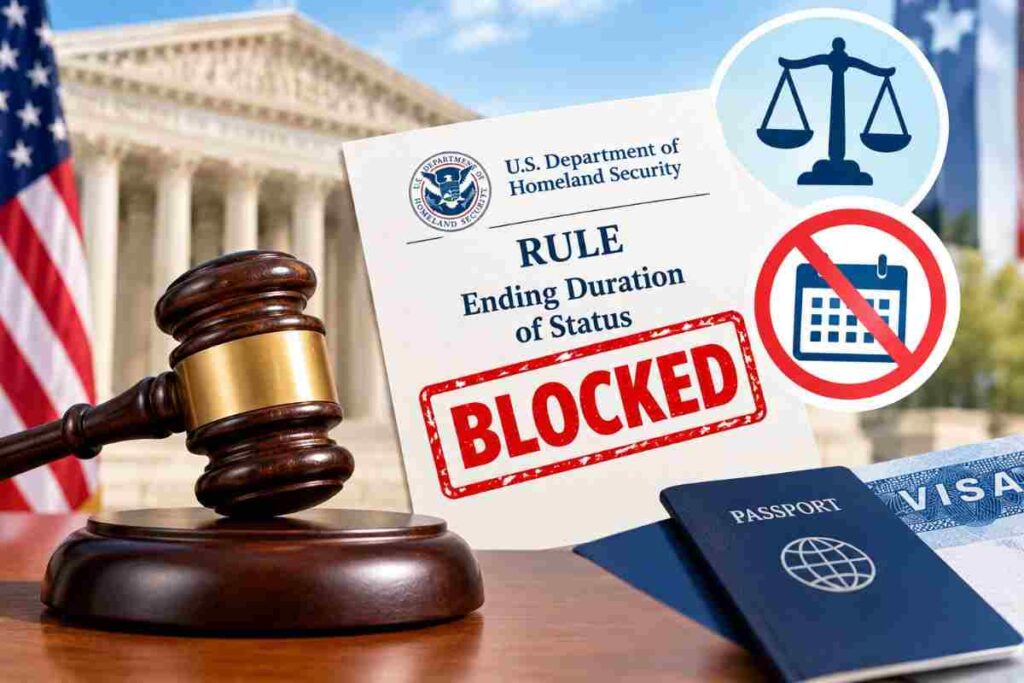
The DHS rule that would have ended “duration of status” for F-1 students, replacing it with a fixed four-year admission period, as we covered when it was finalized in July, will not take effect after all, at least for now. On September 14, 2026, a federal judge in Massachusetts issued a nationwide preliminary injunction blocking the rule less than 24 hours before its scheduled September 15 start date. For now, F-1, J-1, and I nonimmigrants across the country will keep the duration-of-status framework they have always had.
What Actually Happened
- The ruling: U.S. District Judge F. Dennis Saylor IV of the District of Massachusetts granted a nationwide preliminary injunction on September 14, 2026, in Presidents’ Alliance on Higher Education and Immigration, et al. v. U.S. Department of Homeland Security (No. 1:26-cv-13799).
- What it does: postpones the rule’s effective date and bars DHS and ICE from taking any action to implement it while the underlying lawsuit continues.
- Why the judge ruled this way: Saylor found DHS didn’t adequately respond to the roughly 22,000 public comments the rule received (most opposed), failed to properly consider alternatives, and didn’t establish a rational connection between the rule and its stated national-security goals. He wrote that the government’s national-security argument “borders on the absurd,” calling it based on “a small handful of anecdotes, each of which involved incidents that the new rule would do nothing to prevent or even mitigate.”
- Who brought the case: a coalition including NAFSA: Association of International Educators, the Presidents’ Alliance on Higher Education and Immigration, the American Federation of Teachers, the United Auto Workers, and The NewsGuild-CWA, represented by McDermott Will & Schulte. The lawsuit was filed August 18, 2026.
- What the judge did NOT rule on: Saylor was explicit that his decision is based on whether the rule is wise policy, writing, “The role of the judiciary is to ensure that the executive branch does not make unwise decisions.” The injunction rests specifically on procedural violations of the Administrative Procedure Act, not a judgment that the policy itself is bad.
What This Means Right Now
- The duration-of-status framework stays in place nationwide, for now. F-1 students can continue to be admitted for the length of their academic program, not a fixed four-year cap, while this litigation proceeds.
- This is not a final resolution. A status conference is scheduled for October 2, 2026, and the government is expected to appeal. The injunction is a “preliminary” one it pauses the rule while the case is argued, it doesn’t strike the rule down permanently.
- The pause doesn’t retroactively fix anything else. If your status had already lapsed, or your work authorization had already expired, for reasons unrelated to this specific rule, this injunction doesn’t restore or extend those separately. Ongoing SEVIS and visa compliance obligations still apply exactly as before.
- Applies to F-1, J-1, and I nonimmigrants students, exchange visitors including Fulbright scholars, and foreign media representatives.

Choose your dream country
 UK
UK
 USA
USA
 Germany
 Australia
 Ireland
 Canada
 UAE
UAE
 France
 Sweden
 Italy
Italy
 Other
Other
When do you want to study abroad?
What's your highest level of education?
Have you completed Class 12th?
What was your Class 12 CGPA/percentage?
Are you a student or a parent/guardian?
What do you want to study?
Select your current city
How Leap will help you

Personalised University Shortlist

Express Applications with Quicker Admits

End-to-End Application Support
Why It Matters for Indian Students
If you're a current or prospective F-1 student, this is genuinely good news, but treat it as a reprieve, not a resolution. The original rule would have required most Indian graduate and PhD students, whose programs frequently run longer than four years, to file a separate Extension of Stay application with USCIS partway through their degree, including a fee and biometrics. That specific requirement is now paused, not cancelled, so it's worth continuing to track this case rather than assuming the issue is permanently settled.
Two practical takeaways: first, don't make major admissions or transfer decisions based on an assumption that the four-year cap is gone for good; the case could still go either way on appeal. Second, if you're currently enrolled or about to enroll, your day-to-day compliance obligations (maintaining full-time enrollment, keeping your SEVIS record current, following work authorization rules) haven't changed at all. This ruling affects the length-of-admission question specifically, not the underlying rules you're already following.
For our original coverage of the rule itself before this injunction, see our DHS duration of status rule explainer.
Have questions about how this affects your current or upcoming F-1 application? Book a free session with a LeapScholar counselor.







Have Questions? Get Guidance to reach your Dream University
Connect with India's finest counsellors and biggest study abroad community.
Get Guidance