
Quick Read
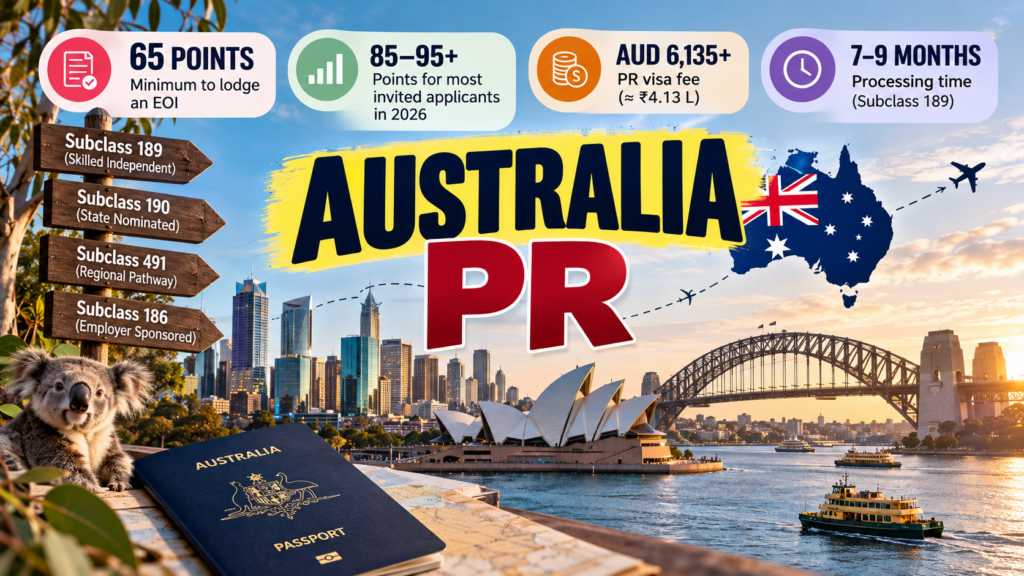
- 65 points is the legal minimum to lodge an EOI; most invited applicants in 2026 score 85–95+
- The 485 fee has changed twice this year, to AUD 4,600 on 1 March and AUD 5,750 on 1 July, and the student and skilled visas rose on 1 July
- Indian nationals get 2 to 4 years on the 485 Temporary Graduate visa under AI-ECTA, longer than most nationalities
- The common route is Student visa (500) → Temporary Graduate visa (485) → Skilled visa (189/190/491)
Australia PR at a Glance
Before going into each pathway, here is what Australia PR looks like in 2026 at a national level.
| Metric | 2026 Figure |
| Total permanent Migration Program | 185,000 places |
| Skill stream share | 132,200 places (71%) |
| Points test minimum (EOI) | 65 points |
| Competitive invitation range | 85–95+ points |
| 189/190/491 visa fee (primary applicant) | AUD 6,135–6,140 (≈₹4.13L) |
| Temporary Graduate visa (485), from 1 July 2026 | AUD 4,600 (≈₹3.87L) |
| 189 processing time (50th / 90th percentile) | 7 months / 9 months |

Choose your dream country
 UK
UK
 USA
USA
 Germany
 Australia
 Ireland
 Canada
 UAE
UAE
 France
 Sweden
 Italy
Italy
 Other
Other
When do you want to study abroad?
What's your highest level of education?
Have you completed Class 12th?
What was your Class 12 CGPA/percentage?
Are you a student or a parent/guardian?
What do you want to study?
Select your current city
How Leap will help you

Personalised University Shortlist

Express Applications with Quicker Admits

End-to-End Application Support
Exchange rate note: All figures use 1 AUD = ₹67.26, fixed for this article as of October 2026. Verify current rates before budgeting.
Source: Department of Home Affairs, Migration Program, planning levels 2025–26
What Is Australia PR, and What Does It Actually Give You
Australia permanent residency, commonly shortened to Australia PR or Aus PR, allows you to live, work, and study in Australia indefinitely. It is not citizenship. A permanent visa comes with a five-year travel facility; after that, you renew your travel rights through a Resident Return Visa rather than reapplying for PR itself.
For Indian students, the appeal is straightforward: an Australian degree, built-in work rights after graduation, and a points-tested system that rewards exactly what a fresh graduate brings to the table age, English proficiency, and a recognized qualification.
If you're still comparing Australia against other study destinations, see what our counselors say about whether studying in Australia guarantees Indian students PR before you commit to a course.
Australia PR Requirements
Before comparing pathways, confirm you clear the baseline eligibility gate that applies across 189, 190, and 491.
| Requirement | What it means |
| Age | Under 45 years at the time of invitation; a hard cutoff, not just a points reduction |
| Points | Minimum 65 on the points test to lodge an EOI |
| Occupation | Must be assessed against an occupation on the relevant skilled occupation list |
| Skills assessment | Positive assessment from the relevant authority (ACS, Engineers Australia, etc.) |
| English | At least Competent English; Proficient or Superior English strengthens your points |
| Health | Medical examination through a Home Affairs panel physician |
| Character | Police clearance certificates from India and any country of 12+ months' residence |
Counselor insight: Age is the one applicants most often overlook. It's assessed strictly at the time of invitation, not application; if you're invited at 44, turning 45 afterward doesn't affect eligibility, but missing the cutoff before an invitation closes the 189/190/491 route entirely regardless of your points score.
Source: Department of Home Affairs, Skilled visa eligibility criteria
Pathways to Australia PR Compared
There is no single procedure that fits everyone. The right pathway depends on your occupation, age, English score, and whether you have a job offer.
| Pathway | Visa | Sponsor needed? | Permanent from grant? |
| Points-tested independent | Subclass 189 | No | Yes |
| State-nominated | Subclass 190 | State/territory | Yes |
| Regional provisional | Subclass 491 → 191 | State/territory or family | No (converts after 3 years) |
| Employer-sponsored | Subclass 186 | Australian employer | Yes |
| Employer-sponsored regional | Subclass 494 → 191 | Australian employer | No (converts after 3 years) |
- Subclass 189 (Skilled Independent): No state or employer nomination required. Selection runs purely on points and your skills assessment. This is the most independent route to Australian permanent residency but also the most competitive.
- Subclass 190 (Skilled Nominated): A state or territory nominates you in exchange for 5 bonus points, usually with a commitment to live and work in that state for a set period.
- Subclass 491 → 191 (Regional pathway): The 491 is provisional for five years and adds 15 points over the 189. After three years of regional work and residence, you become eligible for the permanent Subclass 191.
Should you study in a regional city or a main city? See what our counselors say about how regional study affects your PR points and job prospects.
- Subclass 186 (Employer Nomination Scheme): An Australian employer nominates you directly for permanent residency. This route doesn't depend on the points test but does require continuous employment, often following a 482 Skills in Demand visa.
Source: Department of Home Affairs, Skilled visa subclass listings
Australia PR Points Test Explained
Every points-tested pathway (189, 190, 491) uses the same underlying table.
| Factor | Points |
| Age 18-24 | 25 |
| Age 25-32 | 30 |
| Age 33-39 | 25 |
| Age 40-44 | 15 |
| Superior English (IELTS 8.0+) | 20 |
| Proficient English (IELTS 7.0) | 10 |
| Skilled employment (8+ years, capped combined) | 20 |
| Doctorate degree | 20 |
| Bachelor's/Master's degree | 15 |
| Australian study requirement (2+ years in Australia) | 5 |
| Partner skills (skilled + competent English) | 10 |
| State/territory nomination (190 only) | 5 |
| Regional nomination (491 only) | 15 |
Counselor insight: Age is the most heavily weighted category, so applicants closer to 33 should focus on increasing their English and work-experience points to make up the difference. A score of 65 lets you lodge an EOI, but it won't guarantee an invitation. For the 189 specifically, most invited applicants in 2026 are clearing 85–95 points.
On 17 September 2026, the Government announced a rebuilt points test, with housing trade qualifications to count as a university qualification and no dependants on student and 485 visas. Only the new processing order (Directions 121 and 122) has commenced. Check Home Affairs before relying on any other change.
Source: Department of Home Affairs, Points table for Skilled Independent visa (189)
Study-to-PR Pathway in Australia for Indian Students
For most Indian students, the Australia PR starts long before SkillSelect. The common sequence is:
- Student visa (Subclass 500): Enroll in a CRICOS-registered course
- Temporary Graduate visa (Subclass 485): Work in Australia after graduating. Age 35 or under at application, unless an exception applies.
- Skills assessment: Through the authority relevant to your occupation (ACS for IT, Engineers Australia for engineering, etc.)
- Expression of Interest (EOI) via SkillSelect
- Invitation and visa lodgment: 189, 190, or 491
The 485 is where India gets a genuine advantage. Under the Australia-India Economic Cooperation and Trade Agreement (AI-ECTA), Indian passport holders get longer post-study work rights than most other nationalities.
| Qualification | Standard 485 duration | Indian nationals (AI-ECTA) |
| Bachelor's degree (including honours) | 2 years | 2 years |
| Bachelor's with first-class honours in STEM/ICT | 2 years | 3 years |
| Master's (coursework, extended, or research) | 2–3 years | 3 years |
| Doctoral degree (PhD) | 3 years | 4 years |
That extra year matters: more to build the Australian skilled employment points, meet the 2-year Australian study requirement, and strengthen an EOI before it's time to apply for a skilled visa.
If you're wondering whether studying in Australia for a two-year course guarantees PR, it doesn't; see what our counselors say about getting PR after a 2-year skilled course and the common hurdles involved.
For the full details of how this pathway works after a master's degree, read what our counselors recommend on the main pathways and steps to PR after a master's in Australia.
Before choosing a course, it also helps to work backward from the occupation you want, not the course label. Get expert answers to common questions about choosing a course in Australia with PR in mind, and check our IELTS score requirements for Australian universities and visas early, since your English band directly affects how many points you earn later.
Source: Australia-India Economic Cooperation and Trade Agreement, Temporary Graduate visa provisions
IT PR Australia: The Pathway for Software and Technology Professionals
IT professionals form one of the largest groups of Indian applicants pursuing Australia PR, and for good reason: most core tech occupations sit on the Core Skills Occupation List (CSOL), the single list that now covers employer-sponsored and points-tested migration.
| Occupation | ANZSCO Code | Assessing Authority | CSOL status |
| Software Engineer | 261313 | Engineers Australia / ACS | On CSOL |
| Software and Applications Programmer | 261312 | ACS | On CSOL |
| Cyber Security Engineer | 261315 | ACS | On CSOL |
| DevOps Engineer | 261316 | ACS | On CSOL |
| Computer Network and Systems Engineer | 263111 | ACS | On CSOL |
Being on the CSOL means these roles are eligible for the 482 Skills in Demand visa, the 186 Employer Nomination Scheme, and points-tested visas (189/190/491) alike. The practical first step for an IT PR Australia application is securing a positive skills assessment from the Australian Computer Society (ACS) before lodging an EOI. Job titles don't map perfectly to ANZSCO codes, so a "Software Developer" role, for instance, could be assessed under 261313 or 261312 depending on actual duties, and getting this wrong can cost months in reassessment.
Source: Department of Home Affairs, Core Skills Occupation List
Australia PR Visa Fees: Full Cost Breakdown in AUD and INR
Visa application charges increased sharply through 2026, and budgeting for Australia PR now means accounting for two separate fee hikes, not one.
| Visa | Fee (from relevant 2026 date) | INR equivalent |
| Student visa (500) | AUD 2,500 | ₹1.68L |
| Temporary Graduate visa (485), from 1 July 2026 | AUD 4,600 | ₹3.09L |
| Skilled Independent (189) | AUD 6,135 | ₹4.13L |
| Skilled Nominated (190) | AUD 6,140 | ₹4.13L |
| Skilled Work Regional (491) | AUD 6,140 | ₹4.13L |
| Employer Nomination Scheme (186) | AUD 6,140 | ₹4.13L |
| Skills in Demand (482) | AUD 4,015 | ₹2.70L |
Counselor insight: These are government charges only, paid once per applicant (with reduced fees for dependents). They exclude skills assessment fees (ACS charges roughly AUD 530–800), English test fees, medical examinations, and any migration agent charges. State nomination fees for the 190 and 491 are billed separately by the nominating state.
Source: Department of Home Affairs, Current visa pricing table
Which Australia PR Pathway Suits Your Profile?
Scenario 1: Fresh master's graduate, under 30, IT background, no job offer yet.
Your strongest move is the 485 visa straight after graduation, an ACS skills assessment, and an EOI for 189 or 190 once you clear the Australian study requirement. Age and education points alone can put you close to 65; a Superior English score closes the gap.
Scenario 2: Working professional, 32–35, with a job offer from an Australian employer.
The 186 Employer Nomination Scheme bypasses the points test entirely. If your employer isn't ready to sponsor permanently yet, a 482 Skills in Demand visa followed by 186 after two years is the more common route in 2026.
Scenario 3: Married couple, one partner skilled, planning to apply together.
Claim partner skill points if your partner also holds a skills assessment and competent English. This alone adds up to 10 points, which has decided EOI outcomes at the margin for many applicants.
Scenario 4: Open to regional Australia for faster processing.
The 491 adds 15 points over the 189 and often has a lower practical point threshold. The trade-off is a three-year wait before converting to the permanent 191.
Australia PR Processing Time by Visa Subclass
Processing time varies more by subclass than most applicants expect, and the gap between the fastest and slowest median isn't small.
| Visa | 50th percentile | 90th percentile |
| Subclass 189 | 7 months | 9 months |
| Subclass 190 | 4 months | 16 months |
| Subclass 491 (state/territory nominated) | 5 months | 18 months |
| Subclass 491 (family sponsored) | 4 months | 7 months |
| Subclass 186 (Direct Entry)* | 7–18 months | — |
| Subclass 186 (Temporary Residence Transition)* | 4–10 months | — |
*186 figures are published at the 75th percentile, not the 50th/90th split used for the others, so they aren't directly comparable.
Counselor insight: The 190 and 491 figures look faster at the median but have a far longer tail than the 189, a 190 application can take anywhere from 4 to 16 months depending on your state, occupation, and how complete your documentation is at lodgment. Since 19 September 2026, Ministerial Direction 122 has changed how the Department prioritizes 189, 190, and 491 applications in the queue, including ones already lodged, so a published median can shift mid-processing.
Source: Department of Home Affairs, Global Visa Processing Times
Documents Checklist for a Skilled Visa Application
- Valid passport and passport-sized photographs
- Positive skills assessment from the relevant authority (ACS, Engineers Australia, etc.)
- English test results (IELTS, PTE, or equivalent) within validity
- Educational certificates and transcripts
- Employment reference letters (for claimed work experience points)
- Police clearance certificates (India and any country of 12+ months' residence)
- Medical examination results from a panel physician
- Proof of funds (where applicable)
- Partner's documents, if claiming partner skill points
Australia PR Planning Timeline: 2027–28 Intake Cycle
Australia runs two main intakes, February and July, and your PR timeline is really the sum of two separate clocks: your course length and the time it takes to move from graduation to an EOI invitation. The table below maps a typical run for a February 2027 intake; shift everything by five months for a July intake.
| Stage | Typical window | Why it matters |
| Course research and application | 6–8 months before intake | Course choice now decides your occupation and skills-assessment pathway later; see the Requirements section above before you shortlist |
| IELTS/PTE preparation and test | 3–6 months before intake | Your English band feeds directly into points later; Superior English (IELTS 8.0+) is worth double the points of Proficient |
| Student visa (500) lodgment | 2–3 months before intake | Processing can vary by provider and document completeness; apply early to avoid delaying enrollment |
| Course completion | As per program length (typically 2 years for a master's) | This is also when the Australian study requirement (worth 5 points) is satisfied, provided the course ran 2+ years in Australia |
| 485 visa lodgment | Immediately after course completion | Lodge before your student visa expires; this is also when your AI-ECTA duration (2–3 years) locks in |
| Skills assessment application | Early in your 485 validity, not at the end | ACS and similar assessments can take 8–12 weeks; starting late eats into your work-experience-building window |
| EOI submission via SkillSelect | Once skills assessment is positive | You can submit before reaching your target points; EOIs stay active in the pool and are reconsidered against each new round |
| Invitation and visa lodgment (189/190/491) | Varies by occupation ceiling and points | Invitation rounds run quarterly for 189 in the 2025–26 program year; your occupation's demand tier affects how often it's invited, not just your points score |
Working backward from this, a student starting a two-year master's in February 2027 is typically looking at mid-to-late 2030 before a 189/190/491 invitation becomes realistic, assuming no gaps in the 485-to-EOI transition. Regional (491) applicants should expect roughly three additional years before the visa converts to permanent Subclass 191 status.
Source: Department of Home Affairs, SkillSelect invitation rounds
What If Your Points Fall Short or Your EOI Isn’t Invited
Not receiving an invitation doesn't mean you can't apply again. Common next steps include retaking an English test to move from Proficient to Superior (worth an extra 10 points), accumulating more skilled employment before resubmitting the EOI, considering a 491 regional nomination instead of 189, or exploring a partner's skilled employment and English points if applicable. EOIs don't expire after a single round; they remain active in the pool and are automatically reconsidered against each new invitation round for up to two years.
Counselor insight: The biggest mistake we see Indian students make is choosing a course for the subject alone, without checking whether the resulting occupation sits on the Core Skills Occupation List or has a usable skills assessment pathway. Decide the job first, then pick the course that gets you there.
3 Takeaways on Australia Permanent Residency
- There is no single Australia PR procedure. Your occupation, age, and whether you have a job offer determine whether 189, 190, 491, or 186 is the realistic route.
- Indian students have a built-in advantage on the 485 visa under AI-ECTA, with up to 3 years (4 for PhD) of post-study work compared to the standard 2 years for most other nationalities.
- Budget beyond the headline visa fee. Skills assessments, English tests, and medical checks typically add AUD 1,000–1,500 on top of the AUD 6,135+ visa charge.
Verified by: LeapScholar's Australia counseling team, drawing on direct experience guiding students through Subclass 500 to 485 transitions, ACS and Engineers Australia skills assessments, and SkillSelect Expression of Interest (EOI) lodgments for the 189, 190, and 491 pathways.
Have a specific question about Australia PR? Book a free session with a LeapScholar counselor.
Frequently Asked Questions About Australia PR
-
What is the easiest PR pathway for Indian students in Australia?
There's no universally "easiest" pathway. For fresh graduates under 30 with a CSOL-listed occupation, the 189/190 route after a 485 visa tends to be the most direct, since age and education points do most of the work.
-
How many points do I need for Australia PR?
65 points is the legal minimum to lodge an EOI, but most invited applicants in 2026 score 85–95 points or higher, depending on occupation demand.
-
Can international students get PR in Australia after studying?
Studying in Australia does not guarantee PR. It opens a pathway, typically through the 485 Temporary Graduate visa, followed by a skills assessment and a points-tested visa, but each stage has its own eligibility bar.
-
How much does Australia PR cost in total for an Indian applicant?
In addition to the AUD 6,135–6,140 visa fee, you should also budget for skills assessment (AUD 530–800), English test fees, medical exams, and police clearances. All together, a single applicant should plan for roughly AUD 7,000–8,000 (₹4.7L–₹5.4L) in government and assessment charges alone, excluding migration agent fees if used.
-
What's the best pathway for IT professionals seeking PR?
Most software and cybersecurity roles sit on the CSOL, making them eligible for 189, 190, 491, and 186 alike. An ACS skills assessment is the standard first step for IT PR Australia applications.
-
How long does Australia PR take from India?
Processing time depends heavily on which visa you apply for. As of October 2026, Subclass 189 is taking 7–9 months (50th–90th percentile), while 190 and 491 range more widely, from 4 months at the median up to 16–18 months for the slower cases. Employer-sponsored 186 applications typically take 7–18 months for Direct Entry or 4–10 months via the faster Temporary Residence Transition stream. None of this counts the time spent waiting for an EOI invitation itself, which varies separately by occupation.
-
Is regional Australia easier for PR?
The 491 regional visa adds 15 points over the 189, often resulting in a lower effective threshold, but it requires three years in a regional area before converting to permanent Subclass 191 status.
-
Does a job offer guarantee PR in Australia?
No. A job offer supports the 186 Employer Nomination Scheme or the 482 Skills in Demand visa, but final approval still depends on meeting the specific nomination, skills assessment, and employment criteria for that occupation.
-
Is there an age limit for Australia PR?
Yes. For the 189, 190, and 491 pathways, you must be under 45 years of age at the time of invitation. This is a fixed eligibility cutoff, separate from the age points table, and there is no waiver for points-tested applicants.







Have Questions? Get Guidance to reach your Dream University
Connect with India's finest counsellors and biggest study abroad community.
Get Guidance