
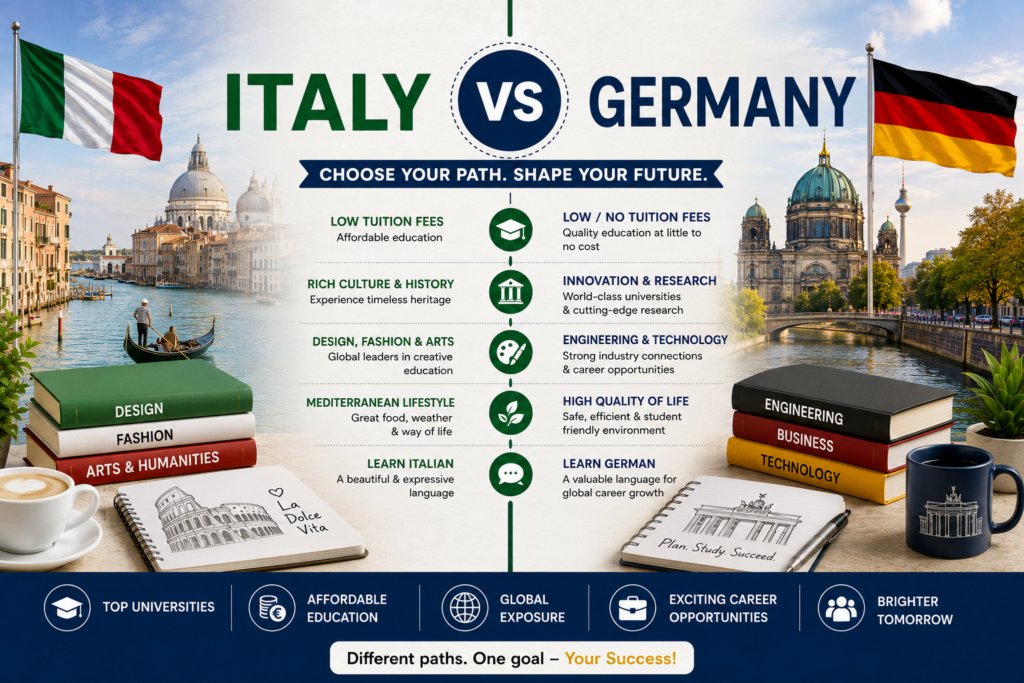
Quick Read
- Germany’s blocked account: Rs.13.1 lakh/year. Italy’s proof of funds: Rs.11.2 lakh/year.
- Germany gives graduates 18 months to job-hunt; Italy gives 12 months.
- Germany’s median salary: Rs.59.5 lakh/year. Italy’s median: Rs.36.9 lakh/year.
- Italy has fewer English-taught programs, so course choice narrows without Italian.
Italy vs Germany: Tuition Fees Compared
Germany’s public universities charge little to no tuition for most bachelor’s and master’s programs. You’ll pay a semester contribution of roughly Rs.16,500 to Rs.38,500 (EUR 150-350), which usually covers a public transport pass. The one exception is Baden-Württemberg, where non-EU students at universities like Heidelberg and KIT pay Rs.1.65 lakh (EUR 1,500) per semester.
For a full breakdown of fees, deposits, and living-cost budgeting, see LeapScholar’s Cost of Studying in Germany guide.

Choose your dream country
 UK
UK
 USA
USA
 Germany
 Australia
 Ireland
 Canada
 UAE
UAE
 France
 Sweden
 Italy
Italy
 Other
Other
When do you want to study abroad?
What's your highest level of education?
Have you completed Class 12th?
What was your Class 12 CGPA/percentage?
Are you a student or a parent/guardian?
What do you want to study?
Select your current city
How Leap will help you

Personalised University Shortlist

Express Applications with Quicker Admits

End-to-End Application Support
Italy's public universities are affordable. Fees are calculated using ISEE, an income-based formula, so tuition typically lands between Rs.22,000 and Rs.4.4 lakh (EUR 200-4,000) a year depending on your family's declared income and the university. Students from lower-income households often pay closer to the bottom of that range.
LeapScholar's Study in Italy for Indian Students guide covers the full cost and university picture, while the Study Masters in Germany guide does the same for Germany's master's programs.
| Category | Germany | Italy |
| Public university tuition | Rs. 0-38,500/semester (EUR 0-350) | Rs. 22,000-4.4 lakh/year (EUR 200-4,000), ISEE-based |
| Exception | Baden-Württemberg: Rs. 1.65 lakh/semester (EUR 1,500) | Private/specialized programs cost more. |
| Private universities/MBA | Rs. 11-33 lakh/year (varies by school) | Rs. 7.7-22 lakh/year (varies by school) |
Counselor insight: Families comparing Study in Germany vs Italy for Indian students usually pick Germany. But Italy's ISEE system means two Indian applicants can pay very different fees at the same university, so ask the admissions office for your specific ISEE-equivalent bracket before ruling Italy out on cost.
Cost of Living: Italy vs Germany
This is where the Italy vs Germany cost of living comparison gets more interesting than tuition alone.
| City tier | Germany (monthly) | Italy (monthly) |
| Major hub (Munich, Frankfurt/Milan, Rome) | Rs. 1.1-1.43 lakh (EUR 1,000-1,300) | Rs. 88,000-1.21 lakh (EUR 800-1,100) |
| Mid-size city (Leipzig, Dresden / Bologna, Turin) | Rs. 77,000-99,000 (EUR 700-900) | Rs. 66,000-88,000 (EUR 600-800) |
| Smaller university town | Rs. 66,000-82,500 (EUR 600-750) | Rs. 55,000-77,000 (EUR 500-700) |
Rent is the biggest swing factor in both countries. A shared flat in Munich or Frankfurt often costs more than the same setup in Bologna or Turin, so the Italy vs Germany cost of living gap narrows or widens almost entirely based on which city you're assigned to, not the country as a whole.
Health insurance adds a further, often-overlooked cost difference. Germany's statutory student health insurance (GKV) runs roughly Rs.15,400-16,500/month (EUR 140-150), mandatory for most students under 30. Italy requires a minimum EUR 30,000 coverage level, met either through the national health service (SSN) at a flat Rs.77,000/year (EUR 700) or a private policy from as little as Rs.2,200-8,800/month (EUR 20-80) depending on the coverage level.
Counselor insight: Don't compare national averages when you already have an admit. Compare the specific city. A student headed to Kaiserslautern will spend less than one headed to Rome, even though Germany is often assumed to be pricier overall.
Financial Proof and Visa Requirements for Italy vs Germany
Germany requires a blocked account (Sperrkonto) with Rs.13.1 lakh (EUR 11,904) deposited before your visa is approved, released at Rs.1.09 lakh (EUR 992) a month once you arrive. This is a fixed, locked structure, not a bank balance you can spend freely before departure. (Source: study.eu, Germany blocked account guide) LeapScholar's Germany Study Visa guide walks through the full application process step by step.
Italy's requirement works differently. The current threshold, set by the Ministry of University and Research's 2026-27 and 2027-28 circulars, is Rs.11.2 lakh (EUR 10,179.85) a year. This is proof of funds, shown through bank statements, a sponsor letter, or a scholarship award, rather than a locked account. Note that this figure rose sharply from the earlier EUR 6,947.33 threshold, so if you've seen a lower number for Italy, it's outdated. (Source: Italian Ministry of University and Research, MUR/MAECI circular, mur.gov.it) .
See LeapScholar's Italy Student Visa guide for the complete document checklist.
| Requirement | Germany | Italy |
| Type | Blocked account (Sperrkonto) | Proof of funds (bank statement/sponsor/scholarship) |
| Amount (2026) | Rs. 13.1 lakh (EUR 11,904/year) | Rs. 11.2 lakh (EUR 10,179.85/year) |
| Structure | Locked, released monthly | Not locked; verified at consulate |
| Health insurance | Statutory, Rs.15,400-16,500/month (EUR 140-150) | Mandatory, minimum EUR 30,000 cover |
Counselor insight: Germany's blocked account is stricter to set up but easier to defend at your visa interview since the amount is fixed and standardized across providers. Italy's proof-of-funds route is more flexible for sponsor-backed applicants, but consulates now scrutinize bank statements and sponsor letters far more closely than they did before this year's revision.
Language and Course Availability
Germany offers a genuinely large pool of English-taught master's programs, especially in engineering, computer science, and business. Bachelor's programs still lean German-medium, but master's applicants can build a full shortlist without needing German at the admission stage, though A1-A2 German helps enormously with daily life, part-time jobs, and landlord conversations.
Italy has fewer English-taught options overall. You'll find strong English-medium choices in MBA programs, some engineering and design master's, and a handful of specialized courses, but the pool shrinks fast once you look at undergraduate options or non-technical fields. Choosing Italy without any Italian usually means picking from a shorter university list.
Counselor insight: If your target course exists at 15 German universities but only 3 Italian ones in English, that's a bigger factor in Italy vs Germany for masters decisions than tuition or living cost. Check course-language availability before comparing fees.
Entrance Exams: dMAT for Germany, IMAT for Italy
Course language isn't the only new admission hurdle in this Italy vs Germany comparison. Both countries have added standardized tests that Indian applicants need to plan around well before they touch a visa application.
dMAT for Germany Master's Applicants
The Digital Master Test (dMAT) is a new academic aptitude test that becomes a mandatory part of your APS documentation from the Summer Semester 2027 intake onward if your bachelor's degree is in engineering, business, commerce, finance, economics, or management. (Source: d-mat.de, official g.a.s.t. dMAT portal) It doesn't replace the APS certificate itself; see how dMAT and APS certification fit together before assuming both apply to you. The test costs Rs.16,500 (EUR 150) and consists of a Core Module and a Subject Module over roughly three and a half hours. LeapScholar's APS Certificate Germany guide covers the separate, mandatory APS documentation process this test sits inside.
You're exempt if you're applying for a bachelor's or PhD, if your APS application was already submitted before 29 June 2026, or if you're coming through an official exchange or double-degree program; check the full dMAT exemption criteria if you're unsure. A low dMAT score doesn't fail your APS or block admission outright; each German university decides independently how much weight to give it. Some students preparing for a Germany master's alongside a GRE-requiring option abroad also ask how dMAT compares to the GRE, since the two tests require completely unique skills.
dMAT quick reference:
- Basics: Exam dates · Registration process · Exam fee · Test centers in India
- Format: Exam pattern · Syllabus · Core Module · Subject Module · General Academic Module
- Preparation: How to prepare for dMAT · Sample questions · Free mock test · Score and results
- Subject Module by Field: Figure Sequences · Latin Squares · Mathematical Equations · Electrical Engineering · Computer Science · Physics · Mechanical Engineering · Chemistry · Battery Science (RWTH Aachen)
IMAT for Italy Medical Applicants (MBBS)
If you're comparing Italy vs Germany specifically for a medical degree, the IMAT (International Medical Admissions Test) is the one exam that decides your shot at an English-taught MBBS equivalent in Italy. It's the sole entrance test for Medicine and Surgery, Dentistry, and Veterinary Medicine at Italian public universities, run under Italy's Ministry of University and Research. (Source: Universitaly, official Italian admissions portal)
Check the full IMAT exam eligibility criteria; you don't need to qualify for NEET to register for IMAT itself, but NEET remains mandatory if you plan to practice medicine in India after your degree, a distinction covered in detail in IMAT vs NEET. Students weighing a UK medical route alongside Italy can also compare IMAT vs UCAT.
The IMAT score is valid only for the year you take it, with no carry-forward to the next cycle, so a missed cutoff means reapplying the following year rather than waiting it out. Tuition at these public medical universities follows the same ISEE-based structure covered earlier, typically Rs.16,500-4.4 lakh (EUR 150-4,000) a year depending on family income.
For the full picture, including universities, fees, and career outcomes, see the MBBS in Italy guide.
IMAT quick reference:
- Basics: Exam date · Registration · Exam fees · Test centres in India · Age limit
- Format: Full syllabus · Biology syllabus · Chemistry syllabus · Physics syllabus · Exam pattern · Marking scheme
- Preparation: IMAT preparation guide · Free mock test · Past papers
- Results and universities: Cutoff · Results · Score calculator · Top universities accepting IMAT · University preference order · Is IMAT compulsory for MBBS in Italy?
Counselor insight: Students often start test prep after their university shortlist is done. For dMAT and IMAT, that order should flip: check whether you're in an affected field or applying to a medical program first since both exams have fixed annual windows that don't wait for your shortlisting process.
Post-Study Work Options: Italy vs Germany
Germany gives graduates an 18-month residence permit to search for a job after finishing their degree. This is one of the more generous windows among European study destinations, and it applies uniformly to bachelor's, master's, and PhD graduates.
Italy's equivalent, the permesso di soggiorno per attesa occupazione, gives graduates 12 months to find employment or start a business, regardless of whether they completed a bachelor's, master's, or PhD. This is a real gap in the Italy vs Germany comparison for students specifically weighing career runway after graduation.
Longer term, the two countries' paths to permanent residency also diverge. Germany's PR routes (including via the EU Blue Card) can take as little as 21 months for qualifying tech and engineering hires. Italy's standard path to long-term EU residency requires 5 years of continuous legal residence, regardless of profession, which is worth weighing if your decision extends beyond your degree and first job.
| Post-study window | Germany | Italy |
| Duration | 18 months | 12 months |
| Varies by degree level | No | No |
| Convert to work permit | Yes, once employed | Yes, once employed |
| Typical path to PR/long-term residency | As fast as 21 months via EU Blue Card (tech/engineering) | 5 years of continuous legal residence |
For Indian engineering and tech graduates specifically weighing Germany, the EU Blue Card route is worth understanding early since it affects both your job search timeline and your path to permanent residency. Read LeapScholar's Software Engineering in Germany guide to see how salary tiers, the Blue Card, and PR in 21 months fit together.
Counselor insight: A 12-month window in Italy may seem shorter, but it rarely determines students' choices. What matters more is how many roles are open to non-Italian speakers in your field, which is usually higher in Germany's tech and engineering sectors than Italy's outside of a few multinational hubs like Milan.
Salaries: Italy vs Germany for Indian Graduates
Germany's national median gross salary sits around Rs.59.5 lakh (EUR 54,066) a year, according to Destatis data. (Source: Destatis, German Federal Statistical Office) Indian IT and engineering graduates with an in-demand specialization typically start between Rs.55 lakh and Rs.66 lakh (EUR 50,000-60,000) a year, before city premiums in Munich or Frankfurt push that higher.
Italy's average gross salary is lower, around Rs.36.9 lakh (EUR 33,500) a year, based on Eurostat and ISTAT figures. (Source: Eurostat) Entry-level graduate roles in Italy typically pay between Rs.23.1 lakh and Rs.30.8 lakh (EUR 21,000-28,000), rising with experience and city.
| Metric | Germany | Italy |
| National average/median | Rs. 59.5 lakh/year (EUR 54,066) | Rs. 36.9 lakh/year (EUR 33,500) |
| Entry-level graduate | Rs. 55-66 lakh (EUR 50,000-60,000, IT/engineering) | Rs. 23.1-30.8 lakh (EUR 21,000-28,000) |
Average salary Italy vs Germany comparisons consistently favor Germany, especially in technical fields, which is one reason so many students still ask whether Study in Germany vs Italy for Indian Students should even be a close call on the finance side. It usually isn't, unless your target field is design, fashion, or the arts, where Italy's industry presence gives it an edge in networking and internships that salary numbers don't capture.
Counselor insight: Don't just compare national averages. A software engineering graduate from Germany and a design graduate from Italy are in different career economies entirely. Compare salary data within your specific field, not the country as a whole.
Scholarships: Italy vs Germany
Germany's most well-known option for Indian students is the DAAD Scholarship, which pays a monthly stipend of roughly Rs.1.03 lakh (EUR 934) for master's students, plus a full tuition waiver (moot at most public universities anyway), health insurance, and a travel allowance. PhD stipends run higher, closer to Rs.1.32 lakh (EUR 1,200) a month.
Explore the full range of funded options in LeapScholar's guide to scholarships in Germany.
Italy's regional DSU scholarships work differently: eligible students (based on ISEE income brackets) receive a full tuition waiver plus an annual cash stipend of roughly Rs.2.75 lakh to Rs.8.7 lakh (EUR 2,500-7,900), along with subsidized or free accommodation and canteen meals where available. National programs like Invest Your Talent add further options for STEM and business fields, typically pairing a tuition waiver with a monthly stipend and a guaranteed internship.
See LeapScholar's guide to Government of Italy scholarships for eligibility and deadlines.
Which One Fits You: A Decision Framework
- Budget-conscious engineering or tech student: Germany, for near-zero tuition and stronger technical salaries.
- Creative, design, fashion, or arts-focused student: Italy, for industry presence and internship access in these fields.
- Student prioritizing job-search runway: Germany's 18-month window beats Italy's 12 months.
- Student wanting a lower upfront financial-proof number: Italy's Rs.11.3 lakh requirement is lower than Germany's Rs.13.2 lakh blocked account.
- Student comfortable learning a new language for daily life: Either works, but Germany's larger English-taught course pool reduces the pressure to learn German before arrival.
Application cycles differ too: Germany runs two intakes a year (Winter Semester and Summer Semester), giving you a fallback if you miss one deadline, while Italy runs a single annual admission cycle through the Universitaly portal, so a missed window typically means waiting a full year.
Compare notes with LeapScholar's UK vs Germany comparison if the UK is also on your shortlist.
3 Takeaways on Italy vs Germany for Indian Students
- If your field is engineering, computer science, or business, Germany wins on tuition, technical salaries, and English-taught course availability.
- If your field is design, fashion, or the arts, Italy's lower financial-proof threshold and industry access make it the stronger fit despite lower average salaries.
- Compare your specific city and course language, not national averages, before making a final Italy vs Germany decision for your 2026 or 2027 intake.
Still weighing Italy vs Germany for your master's? Talk to a LeapScholar counselor before you shortlist universities.
Frequently Asked Questions About Italy vs Germany for Indian Students
-
Is Italy cheaper than Germany for Indian students?
It depends on the university and city. Germany's public university tuition is usually lower or free, but Italy's ISEE-based fees can undercut Germany for lower-income families. Living costs are close once you compare similar city tiers rather than national averages.
-
Which country is better, Germany or Italy, for master's students?
Germany suits engineering, computer science, and business master's students better due to more English-taught programs and stronger technical salaries. Italy suits design, fashion, and humanities-focused students due to stronger industry ties in those fields.
-
Do I need German or Italian to study in either country?
Master's programs in Germany are often available in English, though A1-A2 German helps with daily life. Italy has fewer English-taught programs outside MBA, engineering, and design, so undergraduate applicants especially may need Italian.
-
How much money do I need to show for an Italy vs Germany student visa?
Germany requires a blocked account of Rs.13.2 lakh (EUR 11,904) per year. Italy requires proof of funds of Rs.11.3 lakh (EUR 10,179.85) a year under the current 2026-27 circular, shown via bank statements, sponsor letters, or scholarship awards.
-
What's the average salary difference between Italy and Germany?
Germany's national median is roughly Rs.60 lakh a year, while Italy's average is closer to Rs.37.2 lakh. The gap is widest in technical fields like IT and engineering and narrower in creative fields where Italy has a stronger industry presence.
-
How long can I stay back in Italy or Germany after graduation to find a job?
Germany gives graduates an 18-month job-seeking residence permit. Italy gives 12 months regardless of degree level. Both convert to a work permit once you secure employment.
-
What happens if I don't find a job before my post-study permit expires?
In Germany, you may be able to extend under specific conditions or transition to another visa category if you have a pending job offer; consult an immigration advisor well before expiry. In Italy, the 12-month window does not typically extend, so applying for jobs from month one is essential rather than waiting until the deadline approaches.
-
Are scholarships easier to get in Italy or Germany?
Italy's DSU regional scholarships are income-linked and can cover a large share of costs for eligible students, while Germany's DAAD and university-specific scholarships are merit-based and more competitive. Neither is universally "easier"; eligibility depends heavily on your academic profile and financial background.
-
Is the quality of life better in Italy or Germany for Indian students?
Quality of life depends on personal priorities. Germany offers stronger public infrastructure, safety, and job security, while Italy offers a slower pace, cultural richness, and lower living costs in smaller cities. Neither is objectively better; it depends on your daily priorities.
-
Do I require IELTS to study in Italy or Germany?
Most English-taught programs in both countries ask for IELTS or an equivalent test (TOEFL, PTE, or a Duolingo English Test, where accepted), typically 6.0-6.5 overall. Some German universities waive it if your prior degree was taught entirely in English; Italian universities are less likely to waive it, though exact policy varies by university and program, so check your specific shortlist before assuming either way.









Have Questions? Get Guidance to reach your Dream University
Connect with India's finest counsellors and biggest study abroad community.
Get Guidance