
Quick Read
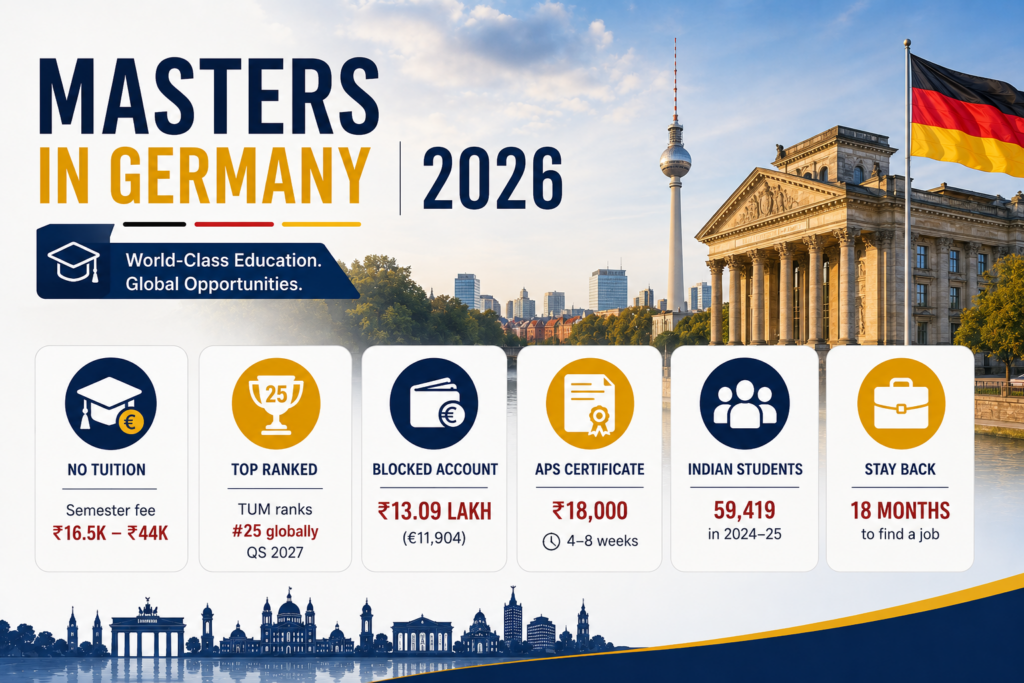
- Public universities charge no tuition; semester fee only: Rs.16,500–Rs.44,000.
- TUM ranks 25th globally, the highest-ranked German university in QS 2027.
- Blocked account required for visa: Rs.13.09 lakh (€11,904), your own money.
- APS certificate: Rs.18,000, non-refundable. Allow 4–8 weeks for processing.
- 59,419 Indian students enrolled in Germany in 2024-25, more than any other nationality.
- Graduates receive 18 months to secure a job before their visa expires.
Best Universities to Study Masters in Germany: QS 2027 Rankings
India is now the largest source country for international students in Germany, with 59,419 enrolled in the 2024-25 winter semester, a 20 percent year-on-year increase, according to DAAD’s Wissenschaft Weltoffen 2025 report.
Among individual institutions, TUM holds the top position, ranking #25 globally in QS 2027, the highest of any German university, a placement confirmed in TUM’s own press release and corroborated by the German Federal Foreign Office.

Choose your dream country
 UK
UK
 USA
USA
 Germany
 Australia
 Ireland
 Canada
 UAE
UAE
 France
 Sweden
 Italy
Italy
 Other
Other
When do you want to study abroad?
What's your highest level of education?
Have you completed Class 12th?
What was your Class 12 CGPA/percentage?
Are you a student or a parent/guardian?
What do you want to study?
Select your current city
How Leap will help you

Personalised University Shortlist

Express Applications with Quicker Admits

End-to-End Application Support
| University | QS 2027 Rank | Semester Fee (EUR) | Semester Fee (INR) | Popular Courses 2026-27 |
|---|---|---|---|---|
| Technical University of Munich (TUM) | #25 | Free to €2,000-€6,000 (non-EU) | Free to Rs.2.2L-Rs.6.6L | Mechanical/Automotive Engineering, Computer Science, AI |
| Ludwig Maximilian University (LMU) Munich | #61 | €150-€300 | Rs.16,500-Rs.33,000 | Data Science, Life Sciences, Medicine |
| Heidelberg University | #86 | €150-€1,500 | Rs.16,500-Rs.1.65L | Life Sciences, Medicine, Natural Sciences |
| Freie Universität Berlin (FU Berlin) | #98 | €300-€400 | Rs.33,000-Rs.44,000 | Political Science, Social Sciences, Finance |
| RWTH Aachen University | #104 | €300-€400 | Rs.33,000-Rs.44,000 | Mechanical/Automotive Engineering, Computer Science |
| Karlsruhe Institute of Technology (KIT) | #110 | €150-€1,500 | Rs.16,500-Rs.1.65L | Computer Science, Engineering, Natural Sciences |
| Humboldt University of Berlin | #140 | €300-€350 | Rs.33,000-Rs.38,500 | Social Sciences, Humanities, Economics |
| TU Berlin | #158 | €300-€350 | Rs.33,000-Rs.38,500 | Renewable Energy, Engineering, Architecture |
Sources: QS World University Rankings 2027; TUM; German Federal Foreign Office.
Note: Heidelberg and KIT sit in Baden-Württemberg, which charges non-EU students an extra tuition fee on top of the semester contribution; confirm current fees with the university. Popular courses reflect each university's known specializations and Germany's shortage occupation list; verify current offerings on the admissions page.
Counselor insight: Rankings should not be the only filter for the best master's programs to study in Germany or for the best universities for master's study in Germany. A student choosing between a masters in AI in Germany and mechanical engineering will find TU Berlin and RWTH Aachen is more highly regarded by recruiters than its overall QS position suggests, since employers look at the specific faculty, not the university average.
Requirements for a Masters in Germany: Eligibility and Documents
Requirements depend on your bachelor's duration, target field, and whether the course is taught in English or German.
Eligibility
| Category | Requirement | Detail for Indian Applicants |
|---|---|---|
| Academic GPA | German grade equivalent of 2.5 or better | Roughly 60-65 percent on the Indian scale; 70 percent or higher for robotics or AI |
| 3-year vs 4-year degree | Varies by university | 4-year degrees preferred; 3-year BCom/BCA graduates can apply, sometimes with a bridge semester |
| BCA graduates | Generally accepted for CS/IT programs | Eligible for computer science or data-adjacent programs if core computing credits are covered |
| English proficiency | IELTS 6.5, no band below 6.0 | For English-taught programs |
| German proficiency | C1 certificate (TestDaF, Goethe-Zertifikat) | For German-taught programs |
| Age limit | None officially set | Working professionals in their thirties are judged on academics and language, not age |
Documents Required For Indian Students
| Document | Requirement | Detail for Indian Applicants |
|---|---|---|
| APS Certificate | Mandatory for Indian applicants | Apply via APS India: Rs.18,000, standard processing 3-4 weeks |
| dMAT (Digital Master Test) | Mandatory from Summer 2027 | For Engineering, Business, Commerce, or Finance backgrounds; €150 (Rs.16,490); not applicable to Winter 2026-27 |
| Consolidated Marksheet | Semester-wise academic record | Submitted with provisional degree certificate |
| Statement of Purpose | 1-2 pages | Program-specific, not generic |
| Letters of Recommendation | Usually 2 | From professors who taught you directly |
| CV | Europass format | Different from an Indian-style resume |
Counselor insight: The document that causes the most delays in a German Masters application isn't the APS certificate; it's the LOR. Most Indian professors treat a recommendation letter as a formality and write one generic paragraph. German admissions committees read these carefully and expect faculty to speak to your specific academic contributions, not your attendance record. Give your referees a briefing note with the program name, why you're applying, and two or three specific moments from your coursework they can speak to. It takes 20 minutes and materially improves what they write.
Visa and Blocked Account for a Masters in Germany
| Requirement | Amount / Timeline | Detail |
|---|---|---|
| APS Certificate processing | 3-4 weeks standard; 6-12 weeks in peak season (May-August) | Mandatory since late 2022, DigiLocker verification speeds this up |
| Blocked Account (Sperrkonto) | €11,904/year, €992/month released | Roughly Rs.13.08 lakhs at 1 EUR = Rs.109.93; your own money, held as proof of funds |
| Visa appointment | Book 4-6 months before intake | Long waits in peak season; book as soon as you have an admission letter |
| Health insurance | Travel cover for visa, student cover after arrival | A minimum of €30,000 travel cover needed for the visa sticker |
Counselor insight: Open the blocked account well before your visa appointment. Providers like Fintiba and Expatrio need a few working days to confirm funds landed, and a delay here is entirely avoidable.
Total Cost of a Masters in Germany in INR
Tuition itself is already free at most public universities, so if you're asking how to study masters in Germany for free, that part is largely solved. What isn't free are the blocked account, rent, and daily living expenses, so budget for those accordingly.
1. Tuition Fees
| University Type | Fee (EUR/semester) | Fee (INR/semester) |
|---|---|---|
| Most public universities | €150-€400 (semester contribution only) | Rs.16,490-Rs.43,970 |
| TUM (non-EU, master's) | €4,000-€6,000 | Rs.4.4L-Rs.6.6L |
| Baden-Württemberg universities (Heidelberg, KIT) | €1,500 extra + semester fee | Rs.1.65L extra + fee |
| Private universities | €5,000-€10,000+ | Rs.5.5L-Rs.11L+ |
Source: TUM official tuition page
2. Cost of Living in Germany
| Expense | Monthly Cost (EUR) | Monthly Cost (INR) |
|---|---|---|
| Living costs excluding rent (single person) | €997.5 | Rs.1.10L |
| 1-bedroom apartment, city centre | €808.59 | Rs.88,880 |
| 1-bedroom apartment, outside city centre | €625.72 | Rs.68,780 |
| Monthly public transport pass | €60.00 | Rs.6,596 |
| Basic utilities (electricity, heating, water) | €306.62 | Rs.33,710 |
Source: Numbeo Cost of Living in Germany, updated June 2026. Actual costs vary significantly by city; Munich runs well above this average, and smaller university towns below it.
Counselor insight: The Numbeo monthly cost figures are national averages. Munich runs 25–35 percent above the figures in this table; Aachen, Freiburg, and Kaiserslautern run 15–20 percent below. The city you pick has more impact on your monthly burn rate than the university rank. If your blocked account is the main financial constraint, shortlisting by city cost before shortlisting by ranking is the smarter sequence.
3. Scholarships for a Masters in Germany
| Scholarship | Coverage |
|---|---|
| DAAD Scholarship | €992/month plus travel and health insurance |
| Deutschlandstipendium | €300/month, merit-based, any nationality |
| TUM International Student Scholarship | €500-€1,800 one-time per semester |
| RWTH High Potential Student Grant | Covers 25 percent of tuition fees |
Applying to two or three scholarships in parallel is standard practice, since any single one has low acceptance odds.
Monthly Planning Calendar for a Masters in Germany
This calendar targets Winter Semester 2027-28 (classes starting October 2027), the most common entry point for master's programs.
| Month | What to do? |
|---|---|
| August 2026 | Shortlist universities and confirm eligibility for your specific degree type |
| September-October 2026 | Start your APS application; book IELTS or German language test; check if dMAT applies to your background |
| November 2026-January 2027 | Prepare SOP, LORs, and transcripts |
| February-April 2027 | Submit applications ahead of the July 15 deadline |
| May-June 2027 | Track admission decisions; open your blocked account once you have an offer |
| July 2027 | Book your visa appointment and arrange health insurance |
| August 2027 | Attend visa interview; finalise accommodation |
| September 2027 | Book flights and complete pre-departure formalities |
| October 2027 | The winter semester begins |
For exact deadlines by semester, check the intakes in Germany for 2026-27.
Which Masters in Germany Path Fits You?
Final-year 4-year B.Tech. student, 75 percent aggregate
Clears the bar at TUM and RWTH Aachen without a bridge course. Start the APS process by January so that it is cleared before the July deadline.
3-year BCom or BCA graduate pivoting into data science
Check each university's admission database individually. An MS in Germany study abroad consultant familiar with German credit-recognition rules is genuinely useful here, since a wrong assumption can cost an entire intake.
Working professional with 2-3 years' experience wanting an MBA
Look at part-time formats at private business schools; public universities rarely support work-and-study masters in Germany formats in management.
Students drawn to niche fields
Programs to study Masters in agriculture in Germany (Hohenheim) or study master architecture in Germany (TU Berlin, Munich) exist, but accreditation rules differ from the general engineering track, so check program-specific requirements before applying.
What to Do If Something Goes Wrong?
Missed the APS deadline
Apply immediately and be upfront with your university; some allow conditional admission while APS is processing.
Marksheet delayed
Universities accepting transcripts showing 80 percent or more completed credits, on the condition you graduate before the term starts, are your best option.
IELTS score short of requirement
Retake the exam; most universities don't accept a promise to improve it later. Budget 4-6 extra weeks.
Visa appointment delayed
Book the moment you have an admission letter, not after your blocked account is fully set up, since the slot itself is usually the bottleneck.
Careers and Salary After a Masters in Germany
Germany's labor shortage is real: the Bundesagentur für Arbeit's official Engpassanalyse found shortages in 163 of the roughly 1,200 occupations it assessed, meaning skilled workers are increasingly difficult to find in about one in every eight professions nationwide.
| Field | Salary (EUR) | Salary (INR) |
|---|---|---|
| Engineering (Automotive/Mechanical) | €52,000-€65,000 | Rs.57.2L-Rs.71.5L |
| IT and Data Science | €55,000-€70,000 | Rs.60.5L-Rs.76.9L |
| Management and Finance | €50,000-€65,000 | Rs.55.0L-Rs.71.5L |
Most students combine their studies with a Werkstudent (working student) role, which often serves as a pipeline to a full-time offer and provides a practical way to earn while studying without falling behind on rent. Once you clear the salary threshold for an EU Blue Card, the path to permanent residency shortens to as little as 21 months with B1-level German. If the 18-month window closes before you receive an offer, the German Job Seeker Visa is another option to consider.
Quick detour: Get PR in 21 months with the EU Blue Card, no lottery. Our complete Software Engineering in Germany guide maps the entire journey, fact-checked against Bitkom, BA Entgeltatlas, and German law.
Counselor insight: The Werkstudent route is the most underused financial and career tool available to Indian Master's students in Germany. The role doesn't count toward the 140-day work cap. Students who land a Werkstudent position in their first semester typically have a full-time offer before graduation, which means their 18-month job-search window functions as a negotiating buffer rather than a job-hunting deadline. Start applying for Werkstudent roles on the university job board from week two of semester one, not after you have your degree.
3 Key Takeaways on Masters in Germany
- Match your degree type to the right path. A 3-year BCom and a 4-year BTech face different admission routes, so confirm eligibility against your transcript before shortlisting universities.
- Start APS at least four months before your deadline. This single document, and the new dMAT test, if it applies to your field, cause more missed intakes than anything else in the process.
- Budget the full blocked account amount honestly. Underestimating the roughly Rs.13 lakh required is why most students scramble in the final month before their visa appointment.
Verified by: LeapScholar's Germany counseling team, with hands-on experience guiding Indian students through APS, blocked account setup, and university applications.
Have questions about your application for Masters in Germany? Book a free session with a LeapScholar counselor.
Frequently Asked Questions About Masters in Germany
-
Is a Masters in Germany really free?
Tuition is free at most public universities, but don't let that word do all the work in your budgeting. You'll still pay a semester contribution of Rs.16,500-Rs.44,000 twice a year, plus a blocked account of roughly Rs.13 lakhs proving you can support yourself, money you get back monthly once you land.
-
What is the age limit to study a Masters in Germany?
There genuinely isn't one. Universities care about your academic record and language score, not your birth year. A working professional in their thirties is assessed like any fresh graduate would be.
-
Can I apply for a Masters in Germany after a BCA?
Yes, largely. Computer science and data-adjacent programs generally accept it, as long as your coursework included enough core computing credits and your language score meets the requirement. Some universities may still ask for a bridge course.
-
How long does the APS certificate actually take?
Standard processing runs 3-4 weeks after your documents and payment are complete and verified. Through DigiLocker, where possible, this speeds this up further. During peak season (May-August) or when institutions are slow to respond to verification requests, the processing time can stretch to 6-12 weeks, so you should plan ahead.
-
Is a 3-year bachelor's degree accepted for a Masters in Germany?
Often, yes, though research universities prefer a 4-year degree. Students with a 3-year degree can still get in, sometimes with a bridge course. Check the specific admission database, since the answer changes by institution.
-
Is it worth studying for a Masters in Germany compared to other countries?
For students prioritizing low debt and strong technical employability, usually yes, given zero tuition and the ongoing skilled-worker shortage. If you'd rather finish faster in an English-only environment, another destination might suit you better.
-
Can students from Bangladesh apply for a Masters in Germany the same way?
Largely, yes. You'll go through your own country's APS office instead of APS India, but everything else, the blocked account, the language requirements, and how admissions work, is basically the same process Indian students go through. Document lists differ slightly, so confirm with the German mission in your home country.
-
What happens if my visa appointment gets delayed past my intake date?
Don't assume you've lost your seat. Contact your university's international office immediately; many allow late registration or deferral to the next intake rather than forfeiting admission outright. Get that confirmation in writing from the specific university.





Have Questions? Get Guidance to reach your Dream University
Connect with India's finest counsellors and biggest study abroad community.
Get Guidance