
Quick Read
- An SOP for admission and an SOP for a student visa serve two different purposes.
- Indian students using a provisional certificate must address degree completion in the SOP.
- Several US universities use AI-detection tools for Statement of Purposes.
- Indian students need Rs. 1.85 lakh ($1,529) per month in London shown in bank for 28 days.
- Begin drafting 10–12 weeks before your earliest application deadline.
- A gap year or backlog must be acknowledged directly in the Statement of Purpose, not omitted.
What Indian students are saying right now: About Statement of Purpose Format
What Is a Statement of Purpose
A statement of purpose is a written essay explaining your academic background, reasons for choosing a specific program, and career goals. Admissions committees use it to assess whether you have a clear direction and whether the program is a genuine fit for you.
It is not the same as a personal statement. Several US universities require both. The Statement of Purpose covers academic and professional trajectory; the personal statement covers who you are as a person. When a program asks for both, read each prompt separately; they want different things.

Choose your dream country
 UK
UK
 USA
USA
 Germany
 Australia
 Ireland
 Canada
 UAE
UAE
 France
 Sweden
 Italy
Italy
 Other
Other
When do you want to study abroad?
What's your highest level of education?
Have you completed Class 12th?
What was your Class 12 CGPA/percentage?
Are you a student or a parent/guardian?
What do you want to study?
Select your current city
How Leap will help you

Personalised University Shortlist

Express Applications with Quicker Admits

End-to-End Application Support
There is also a practical reason it matters: Indian students typically need to write two versions. The admission Statement of Purpose goes to a faculty committee or admissions officer, which makes the case that you are academically prepared and a strong fit for the program. The Statement of Purpose for a student visa goes to a visa officer; it establishes that your study plan is credible, your funding is real, and your ties to India make a return plausible after graduation.
Submitting your admission Statement of Purpose with a visa application is not sufficient for Canada, Australia, or the UK. Each of these countries requires a separate document with different content, written for a different audience. The section below covers the statement of purpose format details.
| Aspect | Admission Statement of Purpose | Visa Statement of Purpose |
|---|---|---|
| Primary audience | Admissions committee or faculty | Visa officer |
| Core question | Why are you a particularly strong fit for this program? | Why do you genuinely need to study in this country? |
| Key content | Academic background, experience, program fit, career goals | Study intent, financial stability, home-country ties, post-study plans |
| Tone | Academic, purposeful | Factual, transparent |
| Typical length | 800–1,000 words | 600–900 words |
| Customization | Different versions per university | Different versions per country |
Statement of Purpose Format Requirements by Country
Universities in the US, UK, Canada, Germany, and Australia do not follow a universal Statement of Purpose format. Each country, and often each university, has its own Statement of Purpose format regarding length, spacing, and structure. Submitting a 1,200-word SOP for a university that wants 500 words, or ignoring font guidelines entirely, signals that you did not read the application instructions carefully. That impression is difficult to recover from.
The table below consolidates the standard statement of purpose format rules by destination. Always cross-check with the specific university's admissions page before you finalize your draft.
| Country | Typical Word Limit | Page Limit | Recommended Spacing | Key Difference to Know |
|---|---|---|---|---|
| USA | 500–1,000 words | 1–2 pages | Double-spaced | Most US universities specify an exact word count in the application portal. Never exceed it. Some top programs (MIT, Stanford) ask for as few as 250 words for a short essay alongside a longer SOP. |
| UK | 500–4,000 words | 1–2 pages | Single or 1.5-spaced | UCAS personal statements for UG are strictly 4,000 characters (not words) roughly 600–700 words. PG SOPs vary by university: LSE asks for 1,000 words; Oxford asks for 500; Imperial has no stated limit but expects concision. |
| Canada | 500–1,500 words | 1–2 pages | Double-spaced | Canadian universities rarely publish a word limit; the convention is 1–2 pages. UBC and the University of Toronto typically expect 1,000–1,200 words. McGill specifies word limits at the program level; always check the individual department page. |
| Germany | 1,500–2,000 words (called "Motivationsschreiben") | 1–2 pages | Single-spaced | German institutions, especially TU Munich and RWTH Aachen, frequently accept German-language SOPs even for English-taught programs. A structured, formal tone is expected; narrative-style writing is less common here than in Anglo-American applications. |
| Australia | 500–1,000 words | 1–2 pages | Single or double-spaced | Australian universities (University of Melbourne, ANU, and UNSW) often call the document a "personal statement" rather than an SOP, and the expected tone is slightly less formal than in the US. Some programs also ask for a separate research proposal alongside the SOP. |
Font and formatting defaults (apply where the university has not specified otherwise): 12pt Times New Roman or Arial, 1-inch margins on all sides, PDF submission unless otherwise stated.
Statement of Purpose Format Samples
Undergraduate: BSc Computer Science, University of British Columbia, Canada
Profile: Priya Sharma | CBSE Class XII, Pune | JEE Mains 98.6 percentile | Applying for Fall 2025
Growing up in Pune, I watched my father, a civil engineer, solve infrastructure problems using spreadsheets and hand-drawn diagrams. At sixteen, I rebuilt his workflow into a Python script that cut his calculation time from four hours to under twenty minutes. That evening, he looked at the screen for a long time and said, quietly, that I should do programming for a living. I intend to.
I am applying to the Bachelor of Science in Computer Science program at the University of British Columbia because I want a rigorous, research-oriented undergraduate education that pushes me beyond competitive exam preparation and into genuine problem-solving at scale.
Academic background
I will complete my Class XII CBSE examinations in March 2025 with a focus on mathematics, physics, and computer science. In Class X, I scored 97.4% and ranked first in my school district. In Class XII mock examinations conducted by FIITJEE, Pune, I have consistently scored above 94% in mathematics and 91% in computer science. I cleared JEE Mains 2025 in the 98.6 percentile.
While this result would secure me admission to several NITs, I want an environment that combines classroom rigor with undergraduate research opportunities, industry exposure, and a multicultural peer group. I completed Harvard's CS50x online in Grade 11. My computer science teacher, Ms. Vandana Kulkarni, encouraged me to go beyond the NCERT syllabus, and the course transformed how I approach memory management and algorithmic complexity.
Projects and extracurricular profile
In Grade 11, I built a model to predict traffic density using real-time CCTV feeds from Pune Municipal Corporation's open data portal. The model, written in Python using OpenCV and a basic convolutional neural network, achieved 82% accuracy on test data and won the Best Technology Project award at my school's annual science fair. I did not use a pre-labeled dataset; I scraped, cleaned, and labeled the data myself, which taught me more about data preprocessing than any textbook chapter.
Approach: I also led a four-member team to develop Sahayak, a voice-based helpline navigation app for elderly users unfamiliar with smartphone interfaces. We presented it at Smart India Hackathon 2024 (school level) and advanced to the district finals. Designing for users with zero technical literacy shaped how I approach human-centered computing.
Outside of technology, I have been secretary of my school's debate club for two years and represented the Pune district at the Maharashtra State Youth Parliament. These experiences taught me to construct arguments under pressure, a skill I believe is as essential to a computer scientist as writing clean code.
Why UBC
UBC's Department of Computer Science ranks among the top 40 globally and is particularly strong in human-computer interaction research. Professor Joanna McGrenere's work on adaptive interfaces connects directly to what I explored in the Sahayak project. I am keen to contribute to her lab as an undergraduate research assistant and eventually pursue a thesis-based fourth year.
Canada's Post-Graduation Work Permit pathway, combined with UBC's proximity to Amazon, Microsoft, and SAP offices in Vancouver, offers an internship pipeline that most Indian universities cannot match.
I am also applying for UBC's International Major Entrance Scholarship. The first-year tuition for international students in the CS program is approximately CAD 45,000 (roughly Rs. 27 lakh at current exchange rates). My family has planned for these expenses through a combination of savings and an SBI education loan.
Career goals
In five years, I want to be a software engineer working on accessibility technology tools that make computing usable for people with physical or cognitive disabilities, as the assistive technology market significantly under-serves them. India has over 26 million people with disabilities (Census 2011), and the assistive technology market significantly underserves them. After gaining international experience and skills, I intend to return and build or join a company that addresses this problem at scale.
A UBC Computer Science degree, which combines theoretical rigor, research exposure, and co-op work terms, provides the most direct path to achieving this goal. A UBC Computer Science degree, with its combination of theoretical rigor, research exposure, and co-op work terms, is the most direct path to getting there.
Word count: ~620 words | Target university word limit: Check UBC portal typical 500–700-word for UG personal statements
Statement of Purpose Format Guidelines
Use this Statement of Purpose format for maximum results:
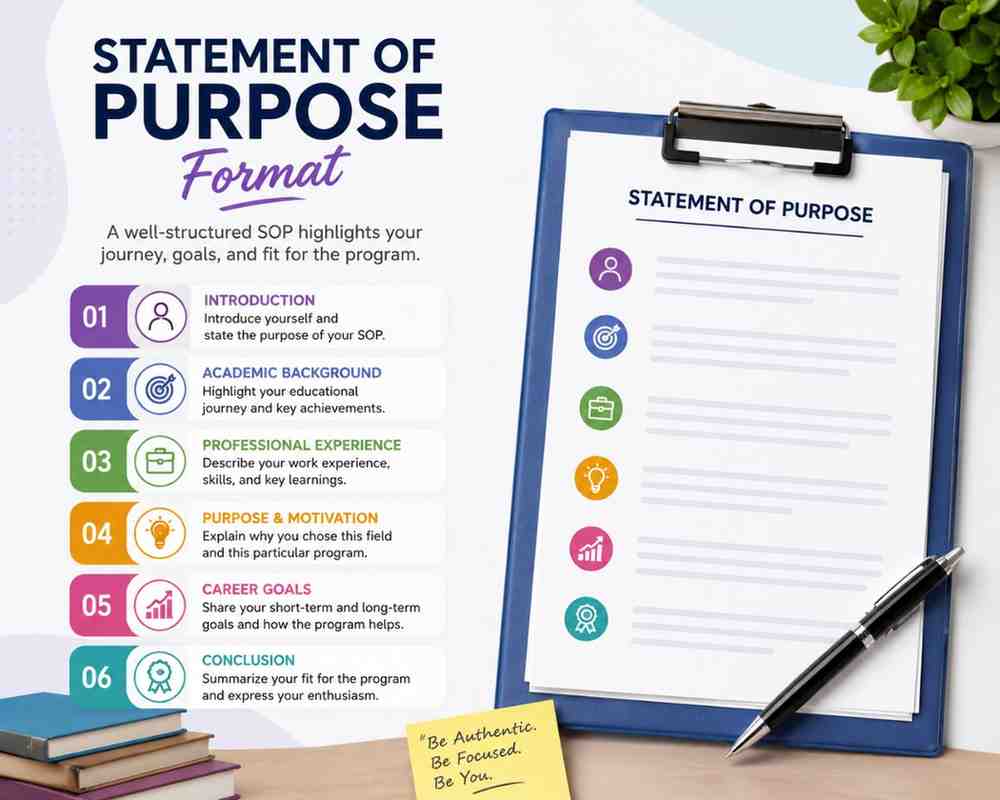
1. Open with intent, not introduction: Your first sentence should clearly state what you want to do and why you are interested in this program. The reader should know your purpose before the first paragraph ends.
2. Show impact, not activity: When describing internships, research, or projects, lead with what you contributed and what you learned. "Reduced API response time by 40%" says more than any job title.
3. Contextualize your academic record: If your CGPA looks low, provide context, such as class median, grading norms, or an upward trend. Numbers without context can mislead.
4. Customize for every application: Name a faculty member whose research connects to yours. Name a course or lab unique to that program. This paragraph should be impossible to reuse elsewhere.
5. Set goals that follow logically from the degree: State a short-term goal (1–3 years) and a longer-term vision (5–10 years). Both should only make sense with this specific program.
6. End with connection, not repetition: Use 3–4 sentences to tie your background, goals, and the program together. No new information. It should feel like a conclusion, not a summary.
7. Read the prompt before you write: Some universities want a free-form essay. Others ask specific questions. If it's question-based, answer each one directly and in order.
Statement of Purpose Format Mistakes to Avoid
1. Opening with a cliché. "Since childhood, I have been fascinated by..." or "I am a final-year student from India..." appears in most statement of purposes that an admissions officer reads in a day.
2. Writing a job description. Listing duties tells the reader nothing. Write the outcome and the insight, not the role.
3. List every course or grade. Include only what connects directly to the program you're applying to. Everything else is noise.
4. Generic praise for the university, "World-class education and highly ranked faculty," is easy to spot and adds nothing. Specific is credible; vague is forgettable.
5. Goals that could belong to anyone. If your career goals fit any applicant in any country applying to any program, rewrite them.
6. Using the same Statement of Purpose everywhere, especially a copy-pasted paragraph 4, is the most obvious sign of a template. It weakens even a strong profile.
7. Ignoring the prompt format. If the application asks distinct questions, answer them in order; don't merge them into a flowing essay.
8. Relying on your CGPA to carry the Statement of Purpose. Your grades are already in the transcript. The Statement of Purpose's job is to show direction, research fit, and intent that numbers alone cannot.
For program-specific Statement of Purpose format guidance: Statement of Purpose for Master's, Statement of Purpose for MBA.
Counselor insight: A strong Statement of Purpose typically requires 4–6 weeks and 5–8 rounds of revision from the first draft to the final submission. Students who start in October for a December deadline are writing under pressure. Students who start in June have time to get it right. The quality difference is visible in the final draft.
What to Do When Things Go Wrong
SOP flagged as AI-generated
AI-detection tools are now used by admissions offices at several US universities, and a high AI-probability score can trigger closer scrutiny or rejection in competitive programs. If you used AI to generate sections, rewrite them entirely in your own voice before any remaining submissions. The markers detectors look for are not just vocabulary; they include sentence rhythm, hedged phrasing ("it is worth noting that..."), and over-structured paragraph progression. A genuine statement of purpose written by someone who knows their story does not sound like a content generator.
If an application has already been submitted and flagged, please reach out to the admissions office before they contact you. Acknowledge the extent of AI usage and offer to resubmit or be interviewed. Silence after a flag reads worse than disclosure.
Gap year or academic backlogs
Address them in the SOP. Admissions committees and visa officers compare your essay to your transcripts. A gap that appears in the transcript but not in the Statement of Purpose reads as evasion rather than a clean record. A gap that is addressed transparently indicates self-awareness. The same applies to backlogs: if they are cleared, attach the clearance certificate; if pending, state the situation directly in the Statement of Purpose.
The consolidated marksheet or provisional certificate is delayed.
Indian universities sometimes issue provisional certificates 4–8 weeks after the last exam. If your application deadline falls during this window, contact each target admissions office before the deadline, submit a letter from your registrar confirming your expected graduation date, and add one sentence in your SOP: "I expect to receive my consolidated marking sheet and provisional certificate by [month]. A letter from my registrar is enclosed." US and Canadian admissions offices deal with this situation for Indian applicants every cycle.
Application rejected; reapplying next cycle.
Do not reapply with the same SOP. Review whether your "why this program" paragraph was genuinely specific, whether career goals were concrete, and whether the Statement of Purpose actually answered the program's stated prompt. Most Indian applicants who reapply unsuccessfully have made only surface edits. A stronger second-round SOP usually requires a new story: a new experience gained in the intervening year, a clearer research direction, or a faculty contact made since the first application.
Missed a deadline
Some US and Canadian universities accept late applications on a rolling basis if seats remain. Directly email the admissions coordinator, acknowledge the missed deadline, and inquire about the possibility of considering a late application. If yes, submit promptly with your strongest SOP. If not, redirect your energy toward programs with later deadlines or the next application cycle.
3 Takeaways About Statement of Purpose Format
Three things to do before starting on your Statement of Purpose format:
1. Decide whether you are writing for admission, for a visa, or both, and treat each as a separate document. The admission Statement of Purpose and visa Statement of Purpose go to different audiences with different goals. Canada and Australia require a separate visa. Statement of Purpose: The USA does not. Before you start, find out which documents you need for each country and include them in your timeline.
2. The structure of your Statement of Purpose is not a universal template. A US research program Statement of Purpose is front-loaded with research interests; a UK UCAS statement has a strict 4,000-character ceiling; and a Canadian college Statement of Purpose centers on career relevance. Review the official program prompt before you write a single word.
3. If your profile has a gap year, a backlog, or a field mismatch, address it directly in the body of the Statement of Purpose. Admissions officers notice a gap in your transcript and draw their own conclusions if you don't provide an explanation in the Statement of Purpose. A direct explanation, even of an imperfect record, reads better than silence.
Verified by: LeapScholar's admissions counseling team, with hands-on experience guiding Indian students through writing SOP for university shortlisting, and visa applications for the US, UK, Canada, and Australia.
Have questions about Statement of Purpose Format? Book a free session with a LeapScholar counselor.
Frequently Asked Questions About Statement of Purpose Format
-
1. What is the difference between an SOP and a personal statement?
A statement of purpose focuses on your academic and professional trajectory: what you have studied, what you have done, and where you are headed. A personal statement focuses on you as a person: values, formative experiences, and personal qualities. Some US universities require both. When a program uses the terms interchangeably, read the actual prompt; it will indicate whether they want a research-focused essay or a personal narrative. Do not assume they want the same content.
-
2. How long should a Statement of Purpose be for a US university?
Most US graduate programs expect 500–1,000 words. Stanford recommends a maximum of 1,000 words on their official admissions page. If a program states no limit, 800–900 words is a reliable target. Always check the specific program website; some ask for 500 words, and others have no stated cap.
-
3. Can I use Chat GPT or other AI tools to write my statement of purpose?
Using AI to generate your Statement of Purpose is a meaningful risk. Admissions offices at US universities increasingly use detection tools, and high AI-probability scores are growing as grounds for rejection in competitive programs. Using AI to brainstorm or outline is lower risk. Using it to write full paragraphs you submit as your own is not advisable; the Statement of Purpose's value comes from its voice being genuinely yours. An imperfect statement of purpose written in a specific, human voice will score higher than a polished AI-generated one.
-
4. How do I explain a gap year in my Statement of Purpose?
Write one paragraph covering three things: what you did, what you learned, and how it connects to your current application. Be specific. "Preparing for GATE" is a credible and honest gap explanation. A startup stint, family circumstances, or illness each has a different explanation; all can be framed constructively. What damages your application is vagueness. Avoid "I was exploring my options" without supporting detail.
-
5. What does the student visa Statement of Purpose format include?
Explain why you chose that country, what you plan to do after the program in India, how you'll pay for your studies, and what ties you have to India (family, property, and job prospects). Visa officers assess immigration intent. A statement of purpose that acknowledges these concerns directly works better than a copy of your admission. Statement of Purpose. Keep it factual and specific.
-
6. What is the difference in Statement of Purpose format between Canada and the UK?
For Canada, you need to write a standard Statement of Purpose for the university application and a separate Letter of Explanation for the study permit, which are two different documents. For the UK on UCAS, the personal statement has a strict 4,000-character limit; postgraduate applicants on non-UCAS routes write a supporting statement per university. Canadian programs weigh career goals and program fit heavily; UK programs prioritize academic preparedness and subject motivation.
-
7. My Statement of Purpose was flagged as AI-generated. What do I do?
Contact the admissions office before they contact you. Acknowledge how you used AI, and offer to resubmit or be interviewed. For any pending applications, rewrite the relevant sections in your own voice and submit promptly. Going forward: use AI only for structural brainstorming or grammar review, and rewrite anything it produces before submitting.
-
8. How do I write a Statement of Purpose if my undergraduate degree is in a different field?
Build an explicit bridge. In the academic background paragraph, highlight any coursework, certification, or project that touches the target field. In the experience paragraph, identify the moment that shifted your direction. In the "why this program" section, explain what this specific program offers for making that transition. Admissions committees accept career pivots when the reasoning is coherent; what they do not accept is an unexplained jump with no connecting narrative.
-
9. Do I need a separate Statement of Purpose for each university?
At minimum, the "why this university and program" paragraph must be rewritten for each application with specific references to faculty, courses, or labs. The core narrative, academic background, experience, and career goals can remain consistent across applications. Generic sections that could apply to any institution are easy to identify and weaken the overall application.
-
10. How early should I start writing my Statement of Purpose for the Fall 2027 intake?
If you are graduating in May/June 2026, begin your first draft no later than September–October 2026. This gives you 3–4 months before the December 2026 to January 2027 application window. Students who start in November for a December deadline consistently produce weaker Statements of Purpose because there is not enough time for the necessary revision rounds. Starting in September also allows time to make meaningful faculty contact, which strengthens the "why this program" paragraph significantly.









Have Questions? Get Guidance to reach your Dream University
Connect with India's finest counsellors and biggest study abroad community.
Get Guidance