
Quick Read
- The 2025 IMAT exam fees was Rs.14,526 for all candidates.
- Italy publishes the 2026 fee on Universitaly at registration opening.
- Pre-enrolment on the Universitaly portal costs Indian students nothing.
- Pavia charges non-EU students Rs.43,579 to Rs.5,08,417 yearly.
- The registration fee is not refundable if you skip the exam.
- Document legalisation adds roughly Rs.10,000 to Rs.20,000.
What are the IMAT Exam Fees in 2026
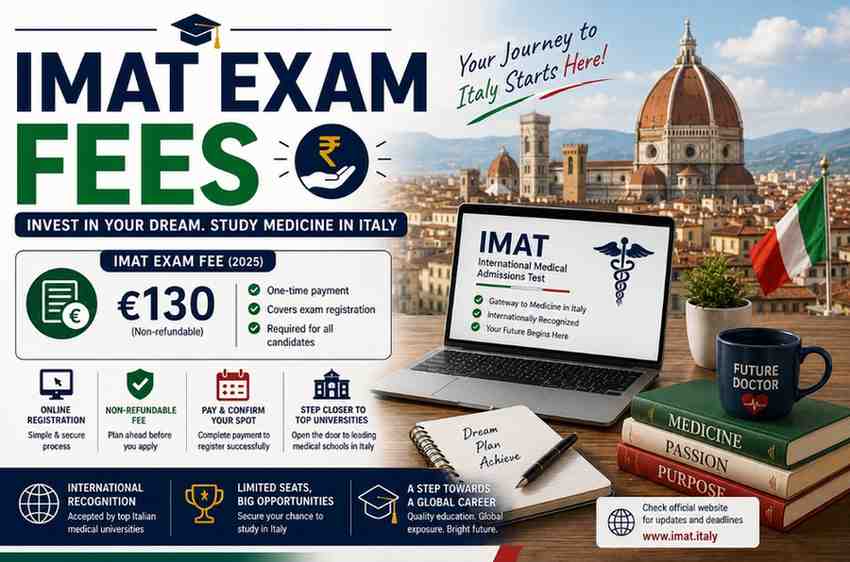
The 2025 IMAT exam fees was Rs.14,526 (€130), paid once, online, through the Universitaly portal.
For 2026, that figure is not yet an official number. The ministerial decree of 6 August 2026 creates the participation contribution in Article 5 but does not state an amount. Annexe 1 says only that payment methods are published on Universitaly when registration opens. Almost every Indian website currently displays €130 as a confirmed 2026 fee. It is last year’s figure, carried forward.

Choose your dream country
 UK
UK
 USA
USA
 Germany
 Australia
 Ireland
 Canada
 UAE
UAE
 France
 Sweden
 Italy
Italy
 Other
Other
When do you want to study abroad?
What's your highest level of education?
Have you completed Class 12th?
What was your Class 12 CGPA/percentage?
Are you a student or a parent/guardian?
What do you want to study?
Select your current city
How Leap will help you

Personalised University Shortlist

Express Applications with Quicker Admits

End-to-End Application Support
One detail from the decree that no fee guide mentions: Rs.7,263 (€65) of each candidate's contribution is paid to the Italian university hosting that candidate's test, as reimbursement for the logistics of running the exam. The rest funds the national organisation of the paper. That is where your money actually goes.
If you want the exam itself explained first, start with our full IMAT exam guide.
Counsellor insight: Treat every headline announcing a "confirmed 2026 fee" as a 2025 number until you see it on the payment screen yourself. Budget Rs.15,000 and be pleasantly surprised, not caught short.
What the IMAT Exam Fees Cover and Do Not Cover
The fee buys exactly one thing: one attempt at one test centre, in one admission cycle.
It does not cover pre-enrollment, document legalization, coaching, travel to the test centre, tuition, or your visa. It does not carry forward. Your IMAT score is valid only for the year you sit the exam, so a retake next year means paying the full fee again.
Two rules from the decree matter financially:
- Payment alone does not register you. The decree states plainly that a payment not accompanied by the online registration receipt gives no right to sit the test. If your card goes through but you never completed the registration steps, you have donated money to the Italian treasury and you cannot enter the hall.
- There is no refund route in the decree. This is a participation contribution, not a deposit. If you fall ill, miss your flight, or decide not to appear, the amount is gone.
Counsellor insight: Every year some students pay first, assume that is registration, and never download the receipt. Finish the full flow in one sitting, then re-open your Universitaly account the next day and confirm the status still reads as registered.
How Indian Students Pay the IMAT Exam Fees
Payment happens only inside the Universitaly portal, using the methods published there when registration opens. There is no bank challan, no agent-collected payment, and no offline route.
The practical problems are Indian banking problems, not Italian ones:
- International transactions are usually disabled by default on Indian debit and credit cards. Enable both international transactions and e-commerce in your banking app, or by calling the bank.
- Prepaid wallet-style cards frequently fail on European government payment gateways. Use a regular bank debit or credit card.
- Some banks add tax or a forex markup on the transaction, so the amount debited may be slightly more than the euro figure converted at the day's rate.
- Download the receipt immediately and keep several digital copies. You carry a printed copy to the test centre.
Counsellor insight: Test the card on a small international purchase two days before registration opens. Discovering a block at 11 pm on the deadline day is the most avoidable way to lose a year.
The Costs Before the IMAT Exam that Nobody Mentions
The registration fee is the smallest cheque you will write. The costs that surprise Indian families sit around it.
| Item | Approximate cost | India-specific detail |
|---|---|---|
| Universitaly pre-enrolment | Free | No portal fee exists. Agents charging for this step are charging for nothing |
| MEA apostille of Class 10 and 12 documents | Rs.5,000 to Rs.15,000 | State HRD attestation first, then MEA apostille. Allow 4 to 8 weeks |
| Certified Italian translation | Rs.3,000 to Rs.8,000 | Required alongside the apostille for the Declaration of Value |
| CIMEA statement of comparability | Around Rs.10,000 | Often faster than a Declaration of Value. Check which your university accepts |
| Declaration of Value | Embassy fee, varies | Issued by the Italian Embassy in New Delhi. Costs time more than money |
| Passport (fresh or renewal) | Rs.1,500 to Rs.3,500 | Must be valid well beyond your enrolment date |
| Travel to the test centre | Rs.5,000 to Rs.25,000 | India has a listed test centre; exact city is announced by MUR before the exam |
| Coaching or question banks | Rs.0 to Rs.1,50,000 | Entirely optional. Past papers from 2024 to 2026 are free |
Counsellor insight: Get the apostille chain started before you have any admission news. It is the one item that cannot be rushed with money, and it is the reason students who clear the exam still miss enrolment.
Tuition Costs After You Clear the IMAT Exam
This is where "MBBS in Italy is almost free" turns out to be partly true and partly misleading, because Italy has two different tuition mechanisms and Indian students can choose between them.
Route one, the flat rate. Non-EU students can pay a fixed annual amount set by citizenship and subject area, with no financial documents submitted. The University of Pavia's official fees page sets its 2026-27 non-EU flat rate at Rs.43,579 to Rs.5,08,417 (€390 to €4,550) per year across three brackets.
Route two, the ISEE parificato. You submit your family's Indian income and asset documents, they are converted into Italy's equivalent economic indicator, and your fee is calculated from that. For most Indian families the resulting figure is lower than the flat rate, sometimes dramatically so, because Italian thresholds are set against Italian incomes.
| University | Fee structure for 2026-27 |
|---|---|
| Pavia | Non-EU flat rate Rs.43,579 to Rs.5,08,417 (€390 to €4,550) per year, or ISEE-based |
| Milan (Statale) | First instalment Rs.17,431 (€156), being €140 regional study tax and €16 stamp duty; the variable part follows |
| Padova | First-year instalment Rs.23,242 (€208), being €192 regional tax and €16 stamp duty |
| Bologna | Calculated on the 2026 ISEE, with full exemption of the variable part for low incomes |
| Private universities in the IMAT list | Substantially higher, in the lakhs per year, and not income-linked in the same way |
Exchange rate used: 1 Euro equals 111.74 Indian Rupee. Verify the current rate before finalising your budget.
Note what the Milan and Padova figures actually are. That first instalment is the regional right-to-study tax plus stamp duty, which almost every student pays regardless of income. The tuition on top of it is what varies. A low-income international student at a public university can end up paying close to that first instalment and little more.
For a university-by-university view, see our guides to MBBS in Italy for Indian students and public universities in Italy.
Counsellor insight: Choose the flat rate if your documents are not ready by the university's cut-off, since missing it usually means being charged the maximum by default. Start the ISEE parificato only if you can finish it in time.
Visa, Living Costs and Proof of Funds
The Italian Type D study visa costs around Rs.5,587 (€50), which is trivial next to what the consulate asks you to demonstrate.
You must show you can support yourself: a bank balance with a visible history rather than a lump sum deposited the week before, proof of accommodation, and health cover. Students with a study residence permit can register with Italy's national health service for an annual fee, which Bologna lists at a minimum of €700 per year for those on a study permit.
Living costs vary sharply by city. Milan and Rome sit at the top; Messina, Catania, Ancona and Pavia are considerably cheaper. Budget for rent, food, transport and books separately from tuition, because in Italy the living cost usually exceeds the tuition by a wide margin.
For the full picture, see our guide to studying in Italy as an Indian student and our breakdown of Italy intakes and visa deadlines.
Counsellor insight: Consulates look at the pattern of your bank statement, not just the closing balance. Build the balance over three to six months rather than parking money in the account days before the appointment.
What Goes Wrong With IMAT Exam Fees, and What It Costs You
Your card is declined on registration day. Enable international transactions in advance and keep a second card ready. There is no offline payment route and no extension.
You paid but did not complete registration. The payment gives you nothing without the online registration receipt. Log back in, check your status, and finish the flow before the window closes.
You missed the fee deadline. IMAT exam registration closes at a fixed time with no exceptions written into the decree. Your next opportunity is the following year, at full cost again.
Your ISEE parificato documents are not ready. Universities apply a cut-off date. Miss it and you are billed at the maximum bracket for the year, with limited scope to revise it afterwards.
You missed the DSU deadline. Regional bandi describe their deadlines as non-extendable. Missing one costs you a full year of grant, tuition exemption and housing.
Your visa funds are questioned. A large recent deposit with no history is the most common reason for additional scrutiny. Bring statements covering several months.
3 Takeaways on IMAT Exam Fees
IMAT exam fees are one small line in a much larger budget, and the mistake Indian families make is planning around that line alone. Three things to act on:
- Budget around Rs.15,000 for registration but confirm the 2026 amount on Universitaly yourself, because every currently published figure is last year's.
- Start apostille and translation months early, since documentation is the cost that cannot be solved with money at the last minute.
- Compare the non-EU flat rate against the ISEE parificato route before enrolment, and apply for DSU regardless of what you assume your family earns.
Verified by: LeapScholar's Europe counselling team, with hands-on experience guiding Indian students through Universitaly payments, document legalisation and Italian study visa applications.
Have questions about IMAT exam fees or funding medicine in Italy? Book a free session with a LeapScholar counsellor.
Frequently Asked Questions About IMAT Exam Fees
-
What are the IMAT exam fees for Indian students?
Indian candidates pay the same participation contribution as everyone else, with no separate international rate. In 2025 that was Rs.14,526 (€130), paid online through Universitaly. The 2026 amount is published on the portal when registration opens, since the ministerial decree creates the fee without naming a figure.
-
What does the Italian student visa cost?
The Type D study visa fee is around Rs.5,587 (€50). The larger financial requirement is proof that you can support yourself, shown through bank statements with a genuine history, plus accommodation proof and health cover. Registering with Italy's health service on a study permit carries its own annual fee.
-
Is medicine in Italy actually cheaper than a private Indian college?
For public universities, generally yes on tuition, especially at the lower flat-rate brackets or with DSU support. The comparison changes once living costs in Italy are included, and private Italian universities in the IMAT list are not cheap at all. Compare total six-year outlay, not tuition alone.
-
How much is tuition after clearing the IMAT exam?
It depends on the university and on which fee route you choose. Pavia's official non-EU flat rate for 2026-27 runs Rs.43,579 to Rs.5,08,417 (€390 to €4,550) per year. Submitting family financial documents through the ISEE parificato often produces a lower figure than the flat rate for Indian families.
-
What is the total IMAT cost for one attempt?
A self-preparing student testing in India typically spends Rs.43,000 to Rs.73,000 in total: registration of about Rs.15,000, apostille and translation of about Rs.15,000, and travel of Rs.10,000 to Rs.25,000. Coaching, which is optional, can add Rs.40,000 to Rs.1,50,000 on top.
-
Does pre-enrolment on Universitaly cost anything?
No. The Universitaly pre-enrolment application, which is the step that supports your study visa and determines which university's ranking you compete in, carries no portal fee. Any agent charging a fee specifically for pre-enrolment is charging for a free government process.
-
Can I pay the IMAT exam fees from an Indian bank card?
Yes, provided international transactions and e-commerce are enabled on the card. Indian banks disable these by default. Regular debit and credit cards work; prepaid wallet-type cards often fail on European government gateways. Test the card on a small international transaction before registration day.
-
Is the IMAT exam fees refundable?
The decree treats the amount as a participation contribution rather than a deposit, and sets out no refund mechanism. If you do not appear, withdraw, or fail to secure a seat, the money is not returned. It also does not carry forward to the following year's attempt.
-
How much is the IMAT exam fees in rupees?
At an exchange rate of Rs.111.74 per euro, the 2025 fee of €130 works out to Rs.14,526. Older Indian pages quote figures between Rs.12,000 and Rs.14,500 because they used different exchange rates. Your bank may also add a forex markup or transaction tax on top.








Have Questions? Get Guidance to reach your Dream University
Connect with India's finest counsellors and biggest study abroad community.
Get Guidance