
Quick Read
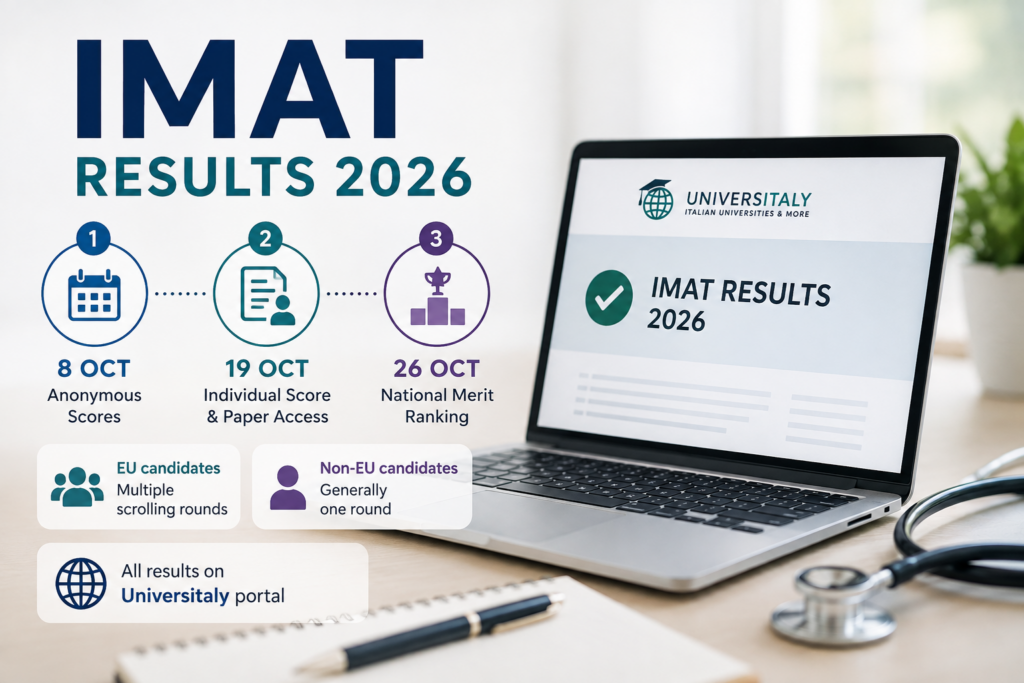
- IMAT results 2026 are released in three separate stages, not one.
- Anonymous scores by label code will be published on 8 October 2026.
- Individual score and paper access opens on 19 October 2026.
- The named national merit ranking will be published on 26 October 2026.
- EU candidates get multiple scrolling rounds; non-EU candidates generally get one.
- All IMAT exam results are accessed through the Universitaly portal.
When Will IMAT Results 2026 Be Released? The Three-Stage Timeline
Most guides talk about IMAT results as if it’s a single date. It isn’t. The official decree splits IMAT results into three separate releases, each showing you something different, and knowing which one you’re looking at matters more than most students realize.
| Stage | Date | What it shows |
|---|---|---|
| Anonymous score | 8 October 2026 | Your score against your label code only, no name attached |
| Individual paper access | 19 October 2026 | Your actual answer paper, your score, and your personal data sheet |
| Named national ranking | 26 October 2026 | Your name, position, and university placement |

Choose your dream country
 UK
UK
 USA
USA
 Germany
 Australia
 Ireland
 Canada
 UAE
UAE
 France
 Sweden
 Italy
Italy
 Other
Other
When do you want to study abroad?
What's your highest level of education?
Have you completed Class 12th?
What was your Class 12 CGPA/percentage?
Are you a student or a parent/guardian?
What do you want to study?
Select your current city
How Leap will help you

Personalised University Shortlist

Express Applications with Quicker Admits

End-to-End Application Support
Why the gap between stage one and stage three?
- CINECA needs time to match label codes back to candidate identities before publishing a named list
- A number next to a barcode on 8 October is expected behaviour, not a glitch
- Your identity is deliberately withheld until 26 October, for data protection reasons written into the decree
Source: MUR Decreto Ministeriale n. 1005 del 06-08-2026, Allegato n. 2, points 4, 6, and 7
My insight: Every year, a wave of anxious messages arrives on 8 October from students who assume the anonymous score is the final word. It isn't even close to final. Treat this first release as a checkpoint to confirm the exam was scored, not as the moment to judge your outcome.
How to Check Your IMAT Exam Results on Universitaly?
Every stage of your IMAT results is accessed the same way, through your personal account on the Universitaly portal. There is no separate results website, no email attachment, and no third-party app that shows this information before Universitaly does.
- Log in to your Universitaly account using the credentials you created at registration
- Go to your reserved candidate area, not the public part of the site
- On 8 October, look for your score next to your label code
- On 19 October, the same area will show your scanned answer paper alongside your score
- On 26 October, check the national ranking section for your name, rank, and assigned or booked university
- If nothing appears on the exact date, wait a few hours rather than assuming an error on your account
Publication times have varied by a few hours across past cycles, and refreshing constantly will not speed anything up.
Anonymous Score vs Named Ranking
These two releases answer entirely different questions, and mixing them up is where most of the confusion starts.
| Detail | Anonymous score (8 Oct) | Named ranking (26 Oct) |
|---|---|---|
| Identifies you by | Label code only | Full name |
| Tells you | Your raw score | Your rank and university placement |
| Useful for | Estimating your outcome early | Knowing exactly where you stand |
| Action required | None yet | Enrol or confirm interest within days |
My insight: A raw score on 8 October means very little on its own, since you don't yet know where that score lands you against everyone else. Wait for the named ranking before deciding whether your result is good or bad.
Minimum Score vs Real Admission Score
This is the distinction that trips up almost every first-time IMAT candidate.
| Detail | Minimum eligibility score | Real admission outcome |
|---|---|---|
| Set by | MUR decree | That year's ranking position |
| Fixed every year? | Yes | No |
| EU threshold | 20 or above | Depends on rank and seats available |
| Non-EU threshold | Above 0 | Depends on rank and seats available |
| Guarantees a seat? | No | Yes, if your rank falls within available seats |
What this means in practice:
- Meeting the minimum score only means your name appears in the ranking
- A seat is only confirmed once your rank falls within the number of places a university has that year
- The same score can result in a seat at one university and a waiting position at another, purely based on how many seats each has
Source: MUR Decreto Ministeriale n. 1005 del 06-08-2026, Article 3, comma 2 and 3
My insight: Students frequently compare their scores to a friend's and assume they will get the same outcome. Two candidates with the same score can end up in very different places once the specific seat counts at each university are taken into accountJudge your result against the seats at your actual preferred universities, not against another candidate's number.
What Happens After the Ranking: Scrolling and Seat Confirmation
Getting ranked is not the end of the process for anyone checking their IMAT results this cycle. What happens next depends heavily on whether you're an EU or non-EU candidate.
| Step | EU candidates | Non-EU candidates abroad |
|---|---|---|
| Number of rounds | Multiple scrolling rounds | Generally one round |
| Time to enrol or confirm interest | 4 working days per round | Set by individual university |
| If you miss the deadline | Removed from that round's placement | Removed from consideration |
| Next scrolling round | Roughly every 5 working days | Not applicable |
What this looks like for EU candidates specifically:
- The first scrolling round for 2026 follows on 3 November 2026
- If assigned to your first-choice university, you must enrol within 4 working days or lose the place
- If placed lower on your list, you can accept it, or stay in the ranking and wait for a better option in a later round
- Subsequent rounds repeat the same 4-day enrolment rule until seats are filled
Source: MUR Decreto Ministeriale n. 1005 del 06-08-2026, Allegato n. 2, points 8 and 10
Is There a Retry Option? What Happens Next After IMAT Results
Once your IMAT results are final, a few questions come up almost immediately, especially for students who didn't get the outcome they hoped for.
| Situation | What the decree says |
|---|---|
| Can I retake IMAT this year if I'm unhappy with my score | No. The exam is held once per academic year, as a single dedicated admission test |
| Can I request a re-check of my paper | The decree sets out a fixed scoring process via CINECA; there is no separate re-evaluation request built into this year's procedure |
| What if I don't get a seat during scrolling | You remain eligible only for as long as you confirm interest each round; once scrolling ends without a seat, that cycle is closed |
| Can I apply again next year | Yes. IMAT runs annually under a new decree each year, so a fresh application is possible for the next academic year |
If this cycle doesn't work out, the realistic options are the following: Wait through scrolling in case a seat opens up, or plan for next year's IMAT with a stronger preparation timeline. Neither of these requires urgent decisions on results day itself.
My insight: Sometimes, students hold off on any backup planning while scrolling is still active, hoping a seat will eventually appear. It's worth doing both at once, staying in the ranking while quietly researching your next-cycle options, rather than treating them as sequential decisions. That way, a disappointing final scrolling outcome doesn't cost you months of lost preparation time.
Source: MUR Decreto Ministeriale n. 1005 del 06-08-2026, Article 2, comma 1 and 3
What to Do Once Your IMAT Results Are Out
| Situation | What to do | Why it matters |
|---|---|---|
| Not assigned your top choice | Confirm your interest in the ranking each round | Failing to confirm drops you from later scrolling rounds |
| Assigned a seat | Start visa document collection immediately | The Italy student visa process runs on its own separate timeline |
| Cleared a public university seat | Check regional scholarship eligibility early | Scholarship applications like the DSU scholarship open on a different schedule |
| Rank looks unlikely to clear this year | Decide between waiting out scrolling or planning for next cycle | Avoids last-minute decisions once scrolling closes |
My insight: Indian students often wait for the final scrolling round before starting visa paperwork, assuming there's no rush until a seat is fully confirmed. This backfires because visa appointment slots and document processing both take real time. Students who begin gathering documents as soon as their IMAT results show any placement, even a lower-preference one, end up far less rushed later on.
Related reading: Italy student visa requirements and the DSU scholarship for students who secure a public university seat.
3 Takeaways on IMAT Results
Three things to remember about IMAT results 2026:
- Treat 8 October, 19 October, and 26 October as three different checkpoints, not one results day
- A passing score gets you ranked; it doesn't get you a seat, so don't react to the anonymous score alone
- Visa and scholarship steps run on their own clocks, so start them the moment you have a placement, not after scrolling ends
Verified by: LeapScholar's Italy counseling team, with hands-on experience guiding Indian students through IMAT results, ranking movement, and post-admission steps for MBBS in Italy.
Have questions about your IMAT results or what comes next? Book a free session with a LeapScholar counselor.
Frequently Asked Questions About IMAT Results
-
When do IMAT 2026 results actually come out?
In three parts, not one. You'll see a score against your label code on 8 October, followed by your actual answer paper and personal data sheet on 19 October, and finally, your name appearing on the national ranking on 26 October. Each date unlocks a different piece of information, so mark all three separately rather than waiting for a single "results day."
-
My score is up, but I don't see my name anywhere. Is something wrong?
No, that's exactly how the process is designed to work. Names aren't attached to any score until the 26 October ranking goes live. Before that date, every score sits against a label code only, partly for data protection reasons and partly because CINECA needs that window to match codes back to candidates accurately.
-
Where exactly do I check my results?
Universitaly, and nowhere else. You'll need to log into the same account you originally used to register for the exam, then navigate to your reserved candidate area rather than the public-facing part of the site. There is no separate results portal, and no legitimate third-party site will show your score before Universitaly does.
-
What's the actual difference between my score and my ranking?
Your score is just a raw number, the points you earned based on correct and incorrect answers. Your ranking is what that number actually means once it's placed alongside every other candidate competing for the same limited seats that year. A student with a high score can still rank lower than expected if that year's applicant pool performed unusually well overall.
-
If I clear the minimum score, am I in?
Not automatically, and this is the single most common misunderstanding around IMAT results. Clearing the minimum score only earns you a spot in the ranking itself. Whether that translates into an actual seat depends on your position relative to everyone else and how many seats your chosen university has allocated for that admission cycle.
-
I got offered a university that wasn't my first choice. What now?
You have two realistic paths. You can accept the offer and enroll within the deadline, or you can hold your position and stay in the ranking in case a higher preference opens up during a later scrolling round. Just be aware that if your actual first-choice university does come through afterward, you'll only have a short window to accept it before it's offered to someone else.
-
How long does scrolling usually run for?
There's no fixed end date built into the process. Scrolling happens in rounds roughly every 5 working days and keeps going until either all seats are filled or candidates stop confirming their interest in remaining on the list. In past cycles, this has stretched across several weeks depending on how quickly higher-ranked candidates made their decisions.
-
Can I sit for the IMAT again this year if my results disappoint me?
No, and this rule catches a lot of first-time candidates off guard. IMAT is administered once per academic year as a single dedicated admission test, with no retake option built into the same cycle. If this year's outcome isn't what you hoped for, the only realistic path forward is preparing for and registering for next year's IMAT under the following year's decree.
-
What if I made a mistake filling in my answer sheet? Can that affect my results?
Yes, and the issue is worth taking seriously before results day rather than after. Marking errors, like an unclear X or an improperly blacked-out correction, can affect how CINECA's automated scoring reads your paper. Once results are published, there is no separate appeal process for marking issues described anywhere in this year's decree, so the safest approach is to be careful with your answer sheet on exam day itself.








Have Questions? Get Guidance to reach your Dream University
Connect with India's finest counsellors and biggest study abroad community.
Get Guidance