
Quick Read
- NEET remains mandatory for Indian students studying medicine abroad.
- IMAT admits you to Italian universities; NEET licenses you in India.
- NEET has 180 questions in 180 minutes; IMAT has 60 in 100.
- Italy reserves 1,362 English medicine seats for non-EU applicants abroad.
- Your NEET scorecard stays valid three years for abroad admission.
- IMAT 2026 registration runs 26 August to 9 September.
IMAT vs NEET: Are they Alternatives, or Do you Need Both?
For an Indian student who intends to practise medicine in India, they are not alternatives. You need both.
This is the single most misunderstood point in the entire IMAT vs NEET comparison, and almost every page online gets it wrong by framing the two as a choice. They do different jobs:

Choose your dream country
 UK
UK
 USA
USA
 Germany
 Australia
 Ireland
 Canada
 UAE
UAE
 France
 Sweden
 Italy
Italy
 Other
Other
When do you want to study abroad?
What's your highest level of education?
Have you completed Class 12th?
What was your Class 12 CGPA/percentage?
Are you a student or a parent/guardian?
What do you want to study?
Select your current city
How Leap will help you

Personalised University Shortlist

Express Applications with Quicker Admits

End-to-End Application Support
- NEET is your licensing gate for India. It is also, separately, the admission route to Indian medical colleges.
- IMAT is only an admission gate. It gets you into an English-taught medicine course at an Italian public university and nothing more.
The National Medical Commission's rules for students studying abroad are unambiguous. Indian citizens and Overseas Citizens of India who obtain a primary medical qualification from any institution outside India, on or after May 2018, must mandatorily qualify NEET. The NEET result itself is treated as the eligibility certificate. That result stays valid for three years for the purpose of pursuing an MBBS or equivalent course abroad.
If you skip it, the consequence is permanent rather than inconvenient. Without a qualifying NEET score you cannot sit the FMGE or the NExT when you return, and without that you cannot register with any state medical council. Six years and a substantial sum, and no licence at the end.
There is exactly one honest exception. If you genuinely intend to practise in Italy or elsewhere in the EU and never in India, the NMC requirement does not apply to you. That is a real path, but it is a decision about where you will live your working life, and it should not be made at eighteen to avoid one exam.
New to the Italian route entirely? Start with our explainer on what is IMAT exam
Counsellor insight: Some agents will tell you NEET is not required because the Italian university does not ask for it. Both halves of that sentence are true and the conclusion is still wrong. The university's admission requirement and the NMC's licensing requirement are two separate rules, enforced by two different bodies, at two different points in your life.
IMAT vs NEET Exam Pattern and Marking Compared
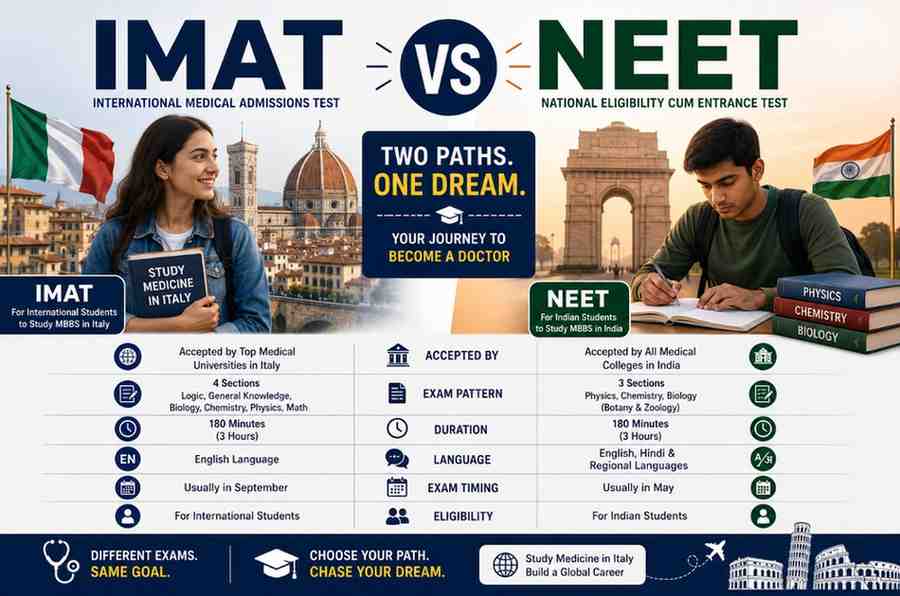
The two exams differ on almost every structural variable, and the differences favour different kinds of candidates.
| NEET UG | IMAT | |
|---|---|---|
| Conducted by | National Testing Agency (NTA) | Italy's Ministry of University and Research, with CINECA |
| Frequency | Once a year | Once a year |
| Mode | Pen and paper, OMR | Pen and paper, OMR |
| Questions | 180 to be answered (200 given) | 60 |
| Duration | 180 minutes | 100 minutes |
| Time per question | Roughly 60 seconds | Roughly 100 seconds |
| Maximum marks | 720 | 90 |
| Marking | +4 correct, -1 wrong, 0 unanswered | +1.5 correct, -0.4 wrong, 0 unanswered |
| Language | 13 languages | English only |
| Sections | Physics, Chemistry, Biology | Biology, Chemistry, Physics and Maths, Logic, Reading and General Knowledge |
| Where you sit it | 551 Indian cities and 14 abroad in 2026 | Italian universities and 25 designated countries, India included |
| 2026 date | Re-exam held 21 June 2026 | 29 September 2026 |
Two things in that table deserve more weight than they usually get.
First, IMAT gives you about 100 seconds per question against NEET's 60. That sounds generous until you remember that the reading and logic questions are designed to consume time, and that the entire paper, including biology, is in scientific English.
Second, the marking looks gentler and is not. Losing 0.4 from a ceiling of 90 costs you the same proportion of your total as losing 1 from a ceiling of 720. But because IMAT has only 60 questions, a handful of careless guesses moves your position in the ranking far more sharply than it would in NEET.
For the complete breakdown, see our guide to the IMAT exam 2026 dates and pattern.
Counsellor insight: Students see "100 minutes for 60 questions" and assume a relaxed paper. In practice most of that extra time gets eaten by reading in a second language. Time your mocks in English from day one.
NEET vs IMAT Syllabus: What Overlaps and What Does Not
The scientific content overlaps heavily. The non-scientific content does not overlap at all.
NEET draws entirely from the Class 11 and Class 12 NCERT syllabus in Physics, Chemistry and Biology. IMAT splits its 60 questions as follows:
- Biology: 23 questions
- Chemistry: 15 questions
- Physics and Mathematics: 13 questions
- Logical Reasoning and Problem Solving: 5 questions
- Reading Skills and Knowledge Acquired During Studies: 4 questions
So 51 of the 60 questions sit in territory a NEET-prepared student already knows. That is the genuine good news in any NEET vs IMAT syllabus comparison, and it is why the Italy route is realistic for Indian students in a way it is not for students from systems with lighter science schooling.
The remaining 9 questions are worth 13.5 marks out of 90, which is 15% of the paper. They test logical reasoning, reading comprehension of unfamiliar and often abstract English prose, and general knowledge covering historical and cultural topics, national and international institutions, law, economics and contemporary public debate. There is no NCERT chapter for any of it.
The depth also runs differently. NEET biology goes deeper than IMAT biology, but IMAT expects a wider spread across chemistry, physics and mathematics relative to the number of questions, with no calculator and no periodic table provided.
Counsellor insight: Every year students dismiss the logic and general-knowledge block because it is "only nine questions," then lose ten or more marks there. In a ranking decided by two or three marks, that block is where Indian candidates most often lose seats they had earned on science.
Is IMAT Easier than NEET?
Neither exam is simply easier. They are hard in different places, and the competition works in completely different shapes.
What makes NEET harder: the volume. 180 questions in 180 minutes across two full years of NCERT content, with biology tested at real depth, against a field of roughly 20 lakh candidates.
What makes IMAT harder: the unfamiliarity. Everything is in scientific English, 15% of the paper has no Indian curriculum equivalent, the negative marking bites harder against a small total, and you get one attempt a year with no second window.
Now the arithmetic that actually decides your odds, which most IMAT vs NEET articles skip entirely.
On the NEET side. Around 20 lakh candidates appeared for the 2026 examination. About 11.21 lakh qualified. The National Medical Commission's seat matrix released on 13 July 2026 shows 1,36,939 MBBS seats in India, of which 63,296 are in government colleges and 73,643 in private ones, excluding the Institutes of National Importance.
On the IMAT side. Table B of the 2026 ministerial decree allocates 1,362 English-taught Medicine seats to non-EU candidates resident abroad, plus 11 in Dentistry and 7 in Veterinary Medicine. A separate pool of 2,430 Medicine seats goes to EU candidates and non-EU candidates resident in Italy. As an Indian student living in India, only the 1,362 concerns you.
Here is the mechanic that changes everything. You do not compete for all 1,362. As a non-EU candidate resident abroad, you compete only within the local ranking of the single university where you completed pre-enrolment. Those university-level allocations range from as few as 10 seats to 320 at Tor Vergata's Tirana campus and 225 at UniCamillus in Rome.
Which means the question "is IMAT easier than NEET" has a slightly uncomfortable answer: it depends far less on the paper than on which university you chose months earlier. Our guide to MBBS in Italy for Indian students covers how to make that choice properly.
Counsellor insight: Students spend eight months improving their score by ten marks and eight minutes choosing their pre-enrolment university. Reverse that ratio. The university choice moves your odds more than the marks will.
IMAT vs NEET Eligibility, Scores and Thresholds
The eligibility rules are close on paper and behave very differently in practice.
| Requirement | NEET UG | IMAT | India-specific detail |
|---|---|---|---|
| Age | 17 years by 31 December of admission year | Completed secondary schooling | No upper age bar on either |
| Schooling | 10+2 with Physics, Chemistry, Biology and English | Completed high school diploma | Italian universities do not ask for NEET; the NMC does |
| Minimum marks | 50% aggregate in PCB for General, 40% for reserved categories | Not prescribed for entry to the test | The 50% PCB rule still applies to you for NMC purposes |
| English certificate | Not required | Not required to sit the test | IELTS or TOEFL only breaks ties in the ranking |
| Ranking threshold | Category qualifying percentile | 20 points for EU and Italy-resident candidates | For non-EU candidates resident abroad: a score above zero with at least one question attempted |
| Score validity | 1 year for Indian admission, 3 years for abroad admission | Valid only for that year's cycle | Your 2026 scorecard can support a 2027 or 2028 Italy admission |
That "above zero" threshold causes real confusion. It does not mean IMAT is easy to pass. It means the ministry sets no national floor for your category, so the only bar that exists is your chosen university's cut-off, decided each year by how many people applied there against how many seats it holds.
Equally, on the NEET side, no foreign university sets a NEET score cut-off. For abroad purposes you need to have qualified, not to have ranked well.
Counsellor insight: Families read "above zero" and stop worrying. Read it the other way round: there is no published safety line, so you cannot know your target until you know your university, and you cannot change your university after pre-enrolment.
IMAT vs NEET Costs, from Exam Fee to Degree
The exam fees are trivial next to the decision they lead to, but they are the first number families ask for.
NEET's application fee for 2026 is reported at Rs.1,700 for General and NRI candidates, Rs.1,600 for EWS and OBC-NCL, and Rs.1,000 for SC, ST, PwD and third-gender candidates. Candidates choosing an exam centre outside India pay Rs.9,500 regardless of category.
IMAT's participation contribution is published on the Universitaly portal when registration opens. In 2025 it was €130, which works out to roughly Rs.14,560. Confirm the 2026 figure yourself on Universitaly from 26 August rather than trusting any published number. It is non-refundable, and paying without completing the online registration gives you no right to sit the exam.
On top of that, budget for travel to your test centre if you are not in the host city, and for document legalisation later.
Exchange rate used: Rs.112 per euro. Verify the current rate before finalising your budget.
The real cost comparison is downstream, and it is where most families make their actual decision: an Indian private MBBS seat against tuition and living costs at an Italian public university, over six years. Those figures vary sharply by state, by college and by Italian university income bracket, so build that comparison from the specific institutions on your shortlist rather than from a national average. Our breakdown of IMAT exam fees covers the full cost chain on the Italy side.
Counsellor insight: The exam fee is noise. Build the six-year spreadsheet for both routes before registration opens, not after results, because after results you will be deciding under a four-day clock.
Can you Prepare for NEET and IMAT in the Same Year?
Yes, and the calendar makes it more workable than most students assume.
NEET runs from February registration through a May or June exam to counselling from August. IMAT registration opens 26 August 2026 and closes at 15:00 GMT+2 on 9 September, with the exam on 29 September and Italian rankings running from late October into March. The two preparation loads barely overlap in time.
The three-year validity of your NEET scorecard for abroad admission also means you do not have to attempt both in the same calendar year. Qualify NEET once, and you have until 2029 to use it for an Italian admission.
If you are a Class 12 student who has just qualified NEET but is unhappy with your allotment, you have a narrow, genuine window right now. Registration opens in days, your science base is current, and eight weeks is enough to convert a NEET-prepared brain to the IMAT format.
If you are a drop-year student repeating NEET in 2027, do not attempt both this year. Sit NEET properly, then use the three-year validity to plan Italy for 2027 or 2028 with a full preparation runway.
If you are in Class 11 and your parents are asking about Italy, prepare for NEET as your primary. It covers 51 of IMAT's 60 questions and it is the licensing requirement anyway. Add English reading and logic practice in Class 12.
See our IMAT exam registration guide for the exact steps once you decide.
Counsellor insight: The eight weeks between a NEET result and the IMAT are enough to convert a prepared student, but only on format, logic and English. They are not enough to build the science from scratch. Be honest with yourself about which of those two you actually need.
3 Takeaways on IMAT vs NEET
The IMAT vs NEET comparison only makes sense once you accept that they are not rival exams. One decides where you can study; the other decides where you can practise.
Three things to act on:
- Qualify NEET regardless of your Italy plans. It is the NMC's licensing gate, it stays valid for three years for abroad admission, and there is no route back if you skip it.
- Choose your pre-enrolment university before you obsess over your score. As a non-EU candidate resident abroad you compete only within that one university's ranking, and its allocation may be 10 seats or 320.
- If you are in counselling right now, decide about IMAT this week. Registration opens 26 August 2026 and closes 9 September, and there is no second sitting until 2027.
Verified by: LeapScholar's Europe counselling team, with hands-on experience guiding Indian students through IMAT registration, Universitaly pre-enrolment and NMC compliance for foreign medical degrees.
Have questions about IMAT vs NEET or studying medicine in Italy? Book a free session with a LeapScholar counsellor.
Frequently Asked Questions on IMAT vs NEET
-
I studied abroad without NEET. What are my options now?
The NMC provides no exemption route and no appeal mechanism for this, and the requirement has been in force since May 2018. Your degree remains valid where you studied, so the practical option is registering and practising in that country or another that recognises it. Reattempting NEET does not retroactively fix an admission already taken.
-
Which is more competitive, IMAT or NEET?
The competition works differently rather than simply being higher or lower. NEET puts around 20 lakh candidates against 1,36,939 MBBS seats nationally. IMAT puts you against only the other applicants to your single pre-enrolled university, for an allocation that may be as small as 10 seats. Concentration matters more than the headline ratio.
-
Is the IMAT held in India or do I have to travel?
India is a designated testing country in the 2026 decree, so you can sit the exam without leaving the country. Seats at overseas centres are limited and allotted first come, first served, so register early. If Indian seats fill, you can select another listed country, with Dubai being the common fallback for Indian candidates.
-
Can I prepare for both NEET and IMAT in one year?
Yes. The calendars barely overlap, with NEET in the first half of the year and IMAT at the end of September. Because your NEET scorecard remains valid for three years for abroad admission, you can also qualify NEET one year and attempt IMAT in a later cycle without repeating it.
-
How many seats do Indian students compete for through IMAT?
Italy allocated 1,362 English-taught medicine seats to non-EU candidates resident abroad for 2026-27, plus 11 in dentistry and 7 in veterinary medicine. You do not compete for all of them. You compete only within the ranking of the one university where you completed pre-enrolment.
-
What NEET score do I need for MBBS in Italy?
Only a qualifying score for your category. No Italian university sets a NEET cut-off, because they do not use NEET at all. The requirement comes from the NMC, and it asks whether you qualified, not how high you ranked.
-
How much of the neet vs imat syllabus overlaps?
Substantially. Of IMAT's 60 questions, 51 cover biology, chemistry, physics and mathematics, which a NEET-prepared student already knows. The nine remaining questions test logical reasoning, English reading comprehension and general knowledge spanning history, institutions, law and economics, and require separate preparation.
-
Is IMAT easier than NEET?
Neither is straightforwardly easier. IMAT has a quarter of the questions and more time each, but runs entirely in English and includes nine questions of logic and general knowledge with no NCERT equivalent. NEET tests far more volume against a much larger field. The IMAT vs NEET difficulty gap depends on whether volume or unfamiliarity is your weakness.
-
Is NEET mandatory if I clear IMAT and study in Italy?
Yes, if you intend to practise in India. The NMC requires every Indian citizen and OCI holder obtaining a medical qualification abroad from May 2018 onward to have qualified NEET. Your NEET result serves as the eligibility certificate. Without it you cannot sit FMGE or NExT or register with a State Medical Council.





Have Questions? Get Guidance to reach your Dream University
Connect with India's finest counsellors and biggest study abroad community.
Get Guidance