
Quick Read
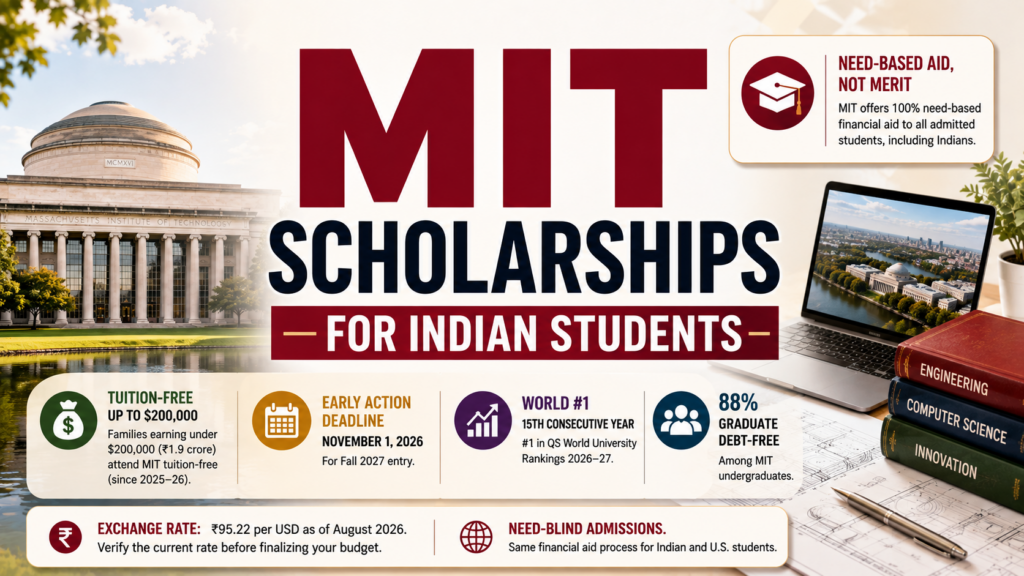
- MIT offers only need-based aid to Indian students, not merit scholarships.
- Families earning under $200,000 (₹1.9 crore) attend MIT tuition-free.
- Early Action for Fall 2027 entry closes November 1, 2026.
- Inlaks Shivdasani, a common suggestion, excludes engineering and CS applicants.
MIT at a Glance: Key Facts Before You Plan Your Scholarship
| Fact | Data |
| Global ranking | #1 in the QS World University Rankings 2026-27, 15th consecutive year at the top |
| Admissions difficulty | Among the most selective in the US, recent cycles have run in the 4-5% range |
| Average starting salary (graduates entering industry) | $145,820 (₹1.39 crore) |
| Undergraduates graduating debt-free | 88% (Class of 2025) |
| Median debt for those who do borrow | $20,288 (₹19.3 lakh), below the US national average |
Exchange rate used: ₹95.22 per USD as of August 2026. Verify the current rate before finalizing your budget.
This ranking is confirmed by MIT News’ official QS ranking announcement, and the salary and debt figures come directly from MIT Admissions’ Cost & Affordability page.
If you are chasing Massachusetts Institute of Technology scholarships for Indian students, unlearn the idea of a “scholarship exam” or merit award first. MIT runs neither. Whether you are searching for MIT scholarships for international students at the undergraduate level or MIT grants for international students at the graduate level: the system is the same need-based aid model, applied the same way to a student in Chennai as one in Chicago.
Does MIT Give Scholarships to Indian Students?
MIT does not offer merit-based MIT scholarships. There is no essay contest, no scholarship exam, and no separate application form that hands out money for grades or extracurriculars. What MIT offers instead is need-based financial aid, decided purely by what your family can afford to pay.
For undergraduates, MIT is one of only nine US colleges that is need-blind and full-need for every applicant, Indian or American. “Need-blind” means your family’s income has zero bearing on your admission decision. Full-need means that once you are admitted, MIT commits to covering 100% of your demonstrated financial need through grants and scholarships that never have to be repaid.
Counselor insight: The single most common mistake Indian applicants make is assuming a strong profile increases their MIT scholarship amount. It doesn’t. Two students with identical SAT scores and extracurriculars will receive very different aid packages: one from a family earning ₹15 lakh and the other from a family earning ₹1.5 crore, because MIT focuses on family contribution rather than merit.
MIT Scholarship Cost of Attendance 2026-27: What Indian Families Actually Pay
The full published cost of an MIT education for the 2026-27 academic year is $92,760 (₹88.3 lakh). Almost nobody pays that number. The median price paid by an undergraduate who received an MIT scholarship in the most recent year with full official data (2024-25) was just $10,268 (₹9.78 lakh) for the entire year.
| Cost Component | Who It Applies To | Amount (USD)/(INR) |
|---|---|---|
| Full cost of attendance, 2026–27 | Students without aid | $92,760/year (₹88.3 lakh/year) |
| Median price paid with MIT Scholarship, 2024–25 | Aided undergraduates | $10,268/year (₹9.78 lakh/year) |
| Family income threshold for tuition-free attendance | Families with typical assets | Under $200,000 (Under ₹1.9 crore) |
| Family income threshold for $0 parent contribution | Families with typical assets | Under $100,000 (Under ₹95.2 lakh) |
| Total MIT need-based scholarships, 2025–26 (planned) | Undergraduate aid pool | $176 million (₹1,676 crore) |
| First-year transition grant (low-income students) | First-year students only | $2,000 (₹1.9 lakh) |
Exchange rate used: ₹95.22 per USD as of August 2026. Verify the current rate before finalizing your budget.
The full cost of attendance and tuition-free/$0-parent-contribution thresholds are published on MIT Admissions’ Cost & Affordability page. MIT planned to award $176 million in need-based scholarships for 2025-26, up from $162 million in 2024-25, per MIT SFS: Making MIT Affordable, which also confirms 57% of undergraduates received an MIT scholarship in 2024-25 and 88% of students graduate debt-free.
Itemized cost breakdown (most recent official figures, 2025-26 academic year):
| Expense | Amount (USD) | Amount (INR) |
| Tuition (includes basic health coverage) | $64,310 | ₹61.24 lakh |
| Student life fee | $420 | ₹40,000 |
| Housing (most expensive double room) | $13,614 | ₹12.96 lakh |
| Food | $7,650 | ₹7.28 lakh |
| Books, supplies, personal expenses (est.) | ~$3,346 | ~₹3.19 lakh |
MIT had not published the full 2026-27 itemized split at the time of writing; the 2026-27 total cost of attendance is $92,760 (₹88.3 lakh). Check the SFS Annual Student Budget page for the latest breakdown before finalizing your numbers.
Two changes matter for 2027-28 planning. Since 2025-26, MIT has made itself tuition-free for families with typical assets and income under $200,000 and removed the parent contribution for families under $100,000, per MIT Student Financial Services: Our Assessment Process. If your family falls under either bracket, that changes your MIT scholarship math before you even apply.
Counselor insight: Don’t budget off the $92,760 headline figure and then panic. That number is the ceiling, not what an aided Indian family typically pays. Run MIT’s own net price calculator with real numbers before you rule the school out on cost alone.
MIT Scholarships for Indian Undergraduate Students: Eligibility and Process
There is no separate MIT scholarship application, and the MIT scholarships requirements are identical for every undergraduate. Financial aid is assessed through two forms, both required regardless of nationality.
| Documents Required for MIT Scholarships | Purpose | India-Specific Detail |
| CSS Profile | The primary financial aid application, assesses family income and assets | Available in English; Indian bank statements and tax documents must be translated/converted if not already in English/INR format |
| IDOC (via College Board) | Verifies CSS Profile data with actual tax documents | Indian families submit ITR (Income Tax Return) copies instead of a US tax return, since there is no FAFSA equivalent for non-US filers |
| Parent’s income tax statements | Confirms taxed and untaxed income | Include Form 16 or ITR-V for salaried parents; self-employed parents should include audited business statements |
| Proof of assets | Used to calculate expected family contribution | Property, fixed deposits, and investment statements count; MIT does not require these to be notarized |
Both domestic and international applicants, including Indians, must submit financial aid materials by February 15 for the following academic year. There is no separate, later deadline for international students, and there is no penalty for filing late, though late filers get their decision after everyone else.
Note: The CSS Profile carries an application fee, and MIT’s own FAQ confirms there are no fee waivers available for international students, unlike the automatic waivers US-based low-income applicants can get through the College Board, per MIT SFS: Financial Aid FAQ. Budget for this cost separately when planning your application timeline.
Counselor insight: Indian families often under-report untaxed income like agricultural earnings or rental income because it isn’t taxed in India. MIT’s aid formula asks for total family income, taxed or not. Leaving it out doesn’t help your MIT scholarship case; it just risks a mismatch if flagged later.
MIT Scholarships for Indian Graduate and PhD Students: How Funding Actually Works
MIT graduate scholarships work nothing like the undergraduate system. Whether you’re researching MIT scholarships for international students masters programs or MIT scholarships for international students PhD tracks, there is no centralised graduate scholarship application. Funding flows through three separate channels of MIT fellowships for international students, decided department by department.
- Research and Teaching Assistantships (RA/TA): The dominant route for PhD students. A faculty advisor hires you onto a funded project, typically covering tuition plus a living stipend.
- Departmental and OGE fellowships: MIT’s Office of Graduate Education and individual schools nominate incoming students directly. You don’t apply separately, your department nominates you.
- Program-specific fellowships: MIT Sloan runs its own lines, including the Legatum Fellowship for entrepreneurial students from emerging markets and the Leaders for Global Operations Fellowship, both of which have supported Indian applicants before.
If a department doesn’t fully fund you, MIT’s graduate loan process determines the maximum amount an international student can borrow, based on the same cost-of-attendance framework used for undergraduates, as outlined in the MIT SFS Graduate Financial Aid Guide for the 2026-27 cycle.
Counselor insight: If you’re targeting a PhD, your MIT scholarship conversation should start with the professor, not the financial aid office. Departments nominate their own incoming cohort for fellowships, so the strength of your fit with a specific lab matters more than a generic funding application ever will.
External Scholarships Indian Students Can (and Can’t) Use for MIT
This is where most guides mislead Indian applicants. The most commonly recommended option, Inlaks Shivdasani, explicitly excludes Computer Science, Engineering, Business/Finance, and Management (MBA), per the Foundation’s own published exclusion list. Since most MIT applicants are in engineering or CS, this scholarship is not usable for most MIT-bound students.
| Scholarship | What It Covers | Who Can Actually Use It for MIT |
| Inlaks Shivdasani Foundation Scholarship | Up to $100,000 (₹95.2 lakh) for tuition, living, travel, and health cover | Only humanities, social sciences, fine arts, law, architecture, and pure sciences; not engineering, CS, business, or MBA |
| Fulbright-Nehru Master’s Fellowship | Full tuition, living stipend, travel, and health insurance for up to two years | Applicants with at least 3 years of work experience and a bachelor’s degree at 55%+; not suited to fresh undergraduates |
| JN Tata Endowment Loan Scholarship | Interest-free loan up to ₹20 lakh, repayable over 7 years from year 3 | Open to all disciplines including engineering; Indian citizens under 45 with 60%+ in their prior degree |
Inlaks’ subject exclusions are confirmed on the Inlaks Foundation’s official scholarship eligibility page. Fulbright-Nehru eligibility comes from USIEF’s official Fulbright-Nehru Master’s Fellowships page, and the JN Tata loan amount and terms are confirmed on the JN Tata Endowment’s official FAQ page.
Counselor insight: If you’re an engineering or CS applicant, cross Inlaks off your list immediately and put your energy into JN Tata and your department’s own fellowship nominations instead. Chasing an external scholarship you’re not eligible for wastes weeks you don’t have during application season.
MIT Scholarship Application Timeline for the 2027-28 Intake
| Milestone | Date | What Happens |
| Early Action (EA) application deadline | November 1, 2026 | All application components, including SSR and recommendations, due |
| EA decision release | Mid-December 2026 | Admission decision, not financial aid decision, released |
| Regular Action (RA) application deadline | January 4, 2027 | All application components due for non-EA applicants |
| Financial aid materials (CSS Profile, IDOC) deadline | February 15, 2027 | Required for both EA and RA admits, domestic and international |
| RA decision release | Mid-March 2027 | Admission decision released |
| Financial aid offer release | Late May to early June 2027 | Aid package released alongside or shortly after admission |
| Enrollment decision deadline | May 1, 2027 | Admitted students confirm enrollment |
These dates are confirmed on MIT Admissions’ official Deadlines & Requirements page, which MIT updates each cycle; recheck closer to your application season in case of any last-minute shift.
Counselor insight: Indian applicants often delay the CSS Profile while waiting on admission news. Don’t. The aid deadline is fixed regardless of your decision date, and filing early gives MIT’s aid office more time to resolve queries on Indian income documentation before the April-May crunch.
Which MIT Scholarship Path Fits Your Situation?
- If you are a Class 12 student from a family earning under ₹95 lakh a year, applying for Fall 2027 undergraduate entry: Your path is the standard need-based process. File the CSS Profile and IDOC by February 15, 2027, and expect a $0 parent contribution if your numbers hold. Treat Inlaks or JN Tata as backup, not primary funding, since MIT’s own aid should cover most of your needs.
- If you are a final-year B.Tech. student applying for a Fall 2027 master’s in Computer Science or Engineering: There is no centralized MIT scholarship for you. Funding depends on whether your target department offers a Research or Teaching Assistantship, or nominates you for an OGE or School of Engineering fellowship. Contact potential faculty advisors before you apply. Inlaks is not an option here; JN Tata’s interest-free loan can bridge any gap.
- If you are a working professional with 3+ years of experience applying for a PhD or Sloan program: The Fulbright-Nehru Master’s Fellowship becomes realistic alongside department funding, since it targets applicants with your profile. Combine it with an RA/TA offer rather than relying on it alone, since Fulbright funding may not stretch across an MIT program’s full duration.
What to Do If You Don’t Get MIT Financial Aid or Miss a Deadline
Missing the February 15 deadline does not disqualify you from MIT scholarships. MIT’s policy states there is no penalty for late applications, only a delayed decision, since late filers are reviewed after the main pool. If you’re missing paperwork, especially Indian income documents needing translation, submit what you have by the deadline and follow up.
If your aid package does not fully meet your need, you have three realistic options:
- Appeal the aid decision directly with MIT’s Student Financial Services if your family’s circumstances changed after you filed the CSS Profile, such as a parent’s job loss.
- Apply for the graduate or undergraduate loan that MIT itself facilitates, which MIT calculates against your specific cost-of-attendance gap.
- Use JN Tata’s interest-free loan scholarship as a bridge, since it is open to all disciplines and doesn’t require you to have exhausted every other option first.
Counselor insight: Don’t sit on an aid shortfall hoping it resolves itself. MIT’s aid office genuinely reviews appeals with updated documentation, but only if you flag the change quickly, not after you’ve already committed to enrollment.
3 Takeaways on MIT Scholarships for Indian Students
- MIT scholarships for Indian students work entirely through need-based aid, not merit, so your family’s income documentation matters more than any exam or test score.
- Check external scholarship exclusions before counting on them. Inlaks does not cover engineering, CS, business, or MBA, which rules it out for most MIT applicants.
- The February 15, 2027 financial aid deadline has no late penalty, but filing on time gets you a faster, less stressful decision alongside your admission outcome.
Verified by: LeapScholar’s USA counseling team, with hands-on experience guiding Indian students through MIT and Ivy League financial aid applications.
Have questions about MIT scholarships or your own financial aid strategy? Book a free session with a LeapScholar counselor.
Frequently Asked Questions About MIT Scholarships for Indian Students
-
Does MIT give scholarships to Indian students?
MIT gives financial aid to Indian students through a need-based process, not through a merit scholarship or a separate international student scholarship. Indian applicants go through the exact same CSS Profile and IDOC process as domestic students, and MIT commits to meeting 100% of demonstrated financial need for admitted undergraduates regardless of nationality.
-
Is MIT free for international students?
It can be, depending on family income. Since the 2025-26 academic year, families with typical assets and income under $200,000 (₹1.9 crore) attend MIT tuition-free, and families under $100,000 (₹95.2 lakh) pay no parent contribution at all. This policy applies equally to Indian applicants.
-
Is there an MIT scholarship exam for Indian students?
No such exam exists. MIT does not award scholarships based on any test, competition, or merit exam. This notion is a common misconception carried over from India’s domestic scholarship culture; MIT financial aid depends entirely on demonstrated family financial need, verified through the CSS Profile and IDOC.
-
What GPA or percentage is needed for MIT financial aid?
None specifically. Financial aid eligibility at MIT is not tied to a minimum GPA, percentage, or test score. Academic performance affects your admission chances, but once admitted, your MIT scholarship amount is calculated purely from your family’s financial documentation, not your marks.
-
Can Indian PhD students get full funding at MIT?
Most MIT PhD students are funded through Research or Teaching Assistantships arranged by their department, which typically cover tuition plus a living stipend. There is no separate application for such funding; funding depends on department budgets and faculty research grants, so it’s worth contacting potential advisors directly before applying.
-
Is the Inlaks Shivdasani Scholarship valid for MIT engineering or CS applicants?
The Inlaks Foundation’s official eligibility list explicitly excludes Computer Science, Engineering, Business and Finance, and Management/MBA programs. Since most MIT applicants are in these fields, Inlaks is not usable for the majority of MIT-bound Indian students; JN Tata Endowment or department fellowships are better-fitting alternatives.
-
What happens if I miss the CSS Profile deadline for MIT financial aid?
There is no financial penalty for filing late, but your aid decision will arrive after applicants who met the February 15 deadline. MIT reviews all applications regardless of timing, provided they arrive before the end of the academic year, so submit as soon as possible rather than skipping the process entirely.
-
How much does an MIT undergraduate actually pay after financial aid?
The median price paid by an aided undergraduate in the most recent year with full official data (2024-25) was $10,268 (₹9.78 lakh) for the full year, against a full published cost of $92,760 (₹88.3 lakh) for 2026-27. Actual amounts vary significantly by family income and assets.
-
Do I need a specific IELTS or TOEFL score to qualify for MIT financial aid?
English proficiency scores are part of MIT’s admissions requirements for certain non-native English speakers, not a factor in financial aid eligibility. Aid is calculated independently of test scores once you’ve been admitted, based solely on your family’s demonstrated financial need through the CSS Profile and IDOC documents.
-
Is the MIT Manipal scholarship the same as MIT scholarships for Indian students?
No, these are entirely different institutions. MIT Manipal (Manipal Institute of Technology) is a private Indian engineering college under Manipal Academy of Higher Education, with its separate merit scholarships and fee structure. MIT in this article refers to the Massachusetts Institute of Technology in Cambridge, USA, which has no admission or funding connection to MIT Manipal.
-
Can I access MIT’s education for free without enrolling?
MIT’s OpenCourseWare (OCW) offers free access to course materials from most MIT departments, including lecture notes, problem sets, and some video lectures, though it does not lead to an MIT degree or credential. It’s a genuinely useful way to preview MIT-level coursework before applying, but it is not a substitute for enrolled MIT scholarships or financial aid.





Have Questions? Get Guidance to reach your Dream University
Connect with India's finest counsellors and biggest study abroad community.
Get Guidance