
Quick Read
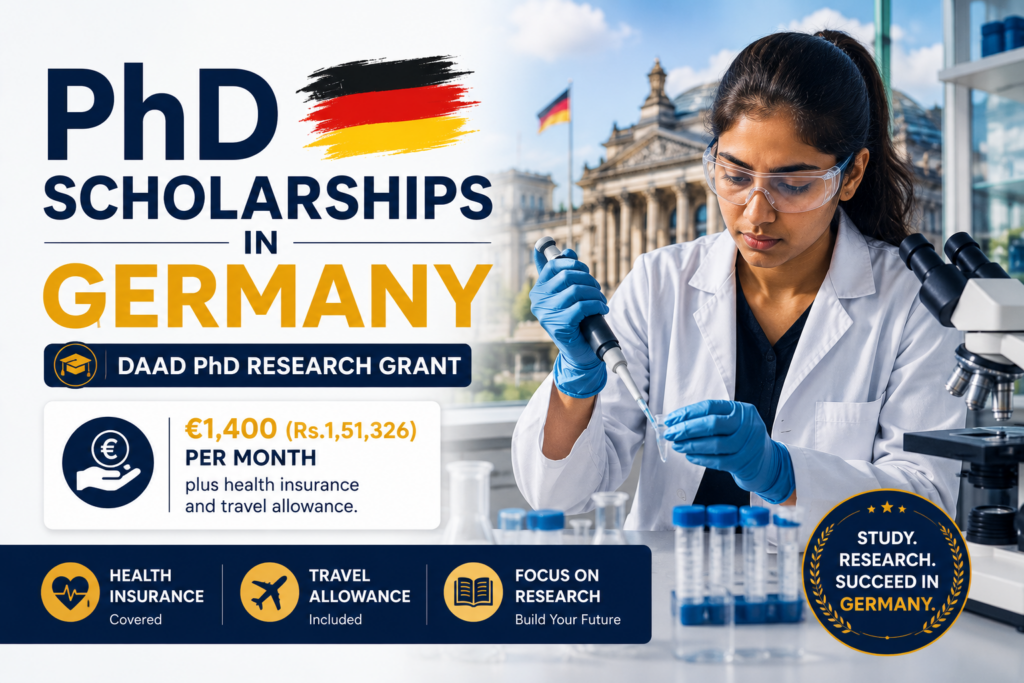
- DAAD PhD Research Grant pays €1,400 (Rs.1,53,384/month) per month plus health insurance and travel allowance.
- Most German PhDs are salaried employment contracts paying Rs.2,02,686-2,30,076 per month net.
- APS certificate (Rs.18,000) is mandatory for Indian students before applying for a German student visa.
- Public universities in Germany charge no tuition for PhD programs, regardless of nationality.
Why Do PhD Scholarships in Germany Matter for Indian Doctoral Students?
Germany is one of the few countries where a PhD can actually pay you. Here’s what makes it different:
- Zero tuition fees: Public universities charge no PhD fees in Germany for Indian students. You only pay a semester contribution of €100 to €350 (Rs.10,956 to Rs.38,346), usually including a public transport pass.
- You get paid to research: Most paid PhD programs in Germany receive either a monthly stipend or a full employment salary.
- Research-first contracts: Unlike the US, where a funded PhD typically involves 20+ teaching hours per week, a German employment contract focuses on your research.
- Post-PhD pathway: Graduates get an 18-month job-seeker visa. TV-L salaried years count toward German Permanent Residency.
- India advantage: DAAD has an active New Delhi office and a long record of selecting Indian scholars.
Exchange rate used throughout this article: 1 EUR = Rs. 109.56. Exchange rates fluctuate regularly; always verify from official sources before making any transaction.
Counselor insight: German PhD funding is a two-step process: secure a supervisor first, then apply for funding. Starting with funding first means months of applying to the wrong programs.
Two Types of PhD Scholarships in Germany: Stipend vs Salary
Model 1: Salaried PhD Position (Employment Contract)
Hired as a Research Associate (Wissenschaftlicher Mitarbeiter) under the TV-L E13 pay scale. At a 65% contract, you take home approximately Rs.2,02,686 to Rs.2,30,076 per month net. You are a full employee with health insurance, pension, and unemployment coverage. Those contribution years count toward German PR.
Model 2: External Scholarship (Stipend)
You apply to DAAD or a foundation and receive a monthly tax-free stipend. Social security contributions are not included. You arrange health insurance separately.
Budget for that cost from the start, and expect it to change if you later move onto an employment contract. As Pooja Kale, a Management master’s graduate from SRH Heidelberg who contributed to LeapScholar’s Germany guide, explains: “As a student, mandatory health insurance costs around €120 per month. Once you transition to full-time employment, the cost increases significantly because it scales with your salary.”
Salaried Position vs Scholarship Stipend
| Factor | Salaried Position | Scholarship Stipend |
|---|---|---|
| Monthly income | Rs.2,02,686-2,30,076 net | Rs.1,53,384-1,91,730 |
| Tax | Taxable | Generally tax-free |
| Health insurance | Included | Arrange separately |
| PR contribution years | Yes | No |
| Who offers | Universities, Max Planck, Helmholtz, Fraunhofer, Leibniz | DAAD, Studienstiftung, Böll, KAS, FES |
| APS exemption | Check with the university. | Exempt if German/EU public funds |
Counselor insight: Search for “PhD position” or “Doctoral Researcher” on academics.de, not just “scholarships.” Most funded opportunities are employment roles, not named grants.
Check PhD stipend in Germany guide for a detailed salary breakdown.
Top PhD Scholarships in Germany for Indian Students 2027
DAAD Research Grant
The DAAD scholarship for a PhD in Germany for Indian students is the most accessible route, with an active New Delhi office and India-specific application guidelines.
| Detail | Value |
|---|---|
| Monthly stipend | €1,400 (Rs.1,53,384/month) |
| Annual research allowance | €460 (Rs.50,398) |
| Additional benefits | Health insurance, travel allowance, rent subsidy, family allowance |
| Eligibility | Master’s completed within 6 years of deadline; doctorate started within 3 years |
| Duration | Up to 4 years, reviewed annually |
| Deadline | October-November each year (current cycle: 21 October 2027, per the official DAAD India database) |
DAAD Cotutelle/Sandwich: Funds 2-24 months of research in Germany for students already enrolled in an Indian PhD, without leaving their Indian registration.
Studienstiftung des deutschen Volkes
Germany’s most prestigious talent foundation, funding 350 doctoral students per year across all disciplines.
| Detail | Value |
|---|---|
| Monthly stipend | €1,750 (Rs.1,91,730): base €1,650 + €100 research allowance (corrected, see note below) |
| Additional benefits | Health insurance contribution (up to €100/month), family allowance, travel grants for research and conferences |
| Eligibility | Last degree within 4 years; strong dissertation project |
| Duration | 42 months standard, up to 54 months with children |
| Deadline | Rolling, apply at any time |
Correction note: The previous version of this article listed €1,550/month (€1,450 base + €100 research allowance). Per Studienstiftung’s own current page (studienstiftung.de/en/finanzen0), the doctoral stipend is now €1,750/month (€1,650 base + €100 research allowance). The duration was also corrected from a flat “3 years” to the foundation’s actual standard funding period of 42 months (initial 3 years, extendable by up to 6 months on application), extendable to 54 months for scholars with children.
Foundation PhD Scholarships in Germany
These scholarships assess civic engagement and value alignment as rigorously as academic merit.
| Foundation | Stipend (non-EU PhD) | Key Requirement | Deadline |
|---|---|---|---|
| Heinrich Böll Foundation | €1,500 (Rs.1,64,340) | B2 German; Green/ecological values | March 1 and September 1 |
| Konrad-Adenauer-Stiftung | €1,400 (Rs.1,53,384) | B2 German; pro-democracy leadership | July 15 each year |
| Friedrich Ebert Stiftung | €1,200 (Rs.1,31,472) | C1 German; social-democratic values | Rolling, apply up to ~2 years before dissertation submission |
All three are open to Indian students. FES excludes medical disciplines. Heinrich Böll’s rate applies specifically to non-EU candidates on the AA (Federal Foreign Office) funding track.
Counselor insight: Each foundation funds fewer than 200 international doctoral students per year. A generic application will not clear the first stage. Invest heavily in your motivation letter and research fit.
Research Organisation Salaried Positions
These are employment contracts under the TV-L E13 scale. Approximate net monthly pay at a 65% contract:
| Organisation | Research Focus | Approx. Monthly Net |
|---|---|---|
| Max Planck Society | Fundamental and theoretical research | Rs.2,07,616-2,33,472 |
| Helmholtz Association | Large-scale scientific infrastructure | Rs.2,02,686-2,30,076 |
| Fraunhofer Society | Applied and industry-linked research | Rs.2,20,216-2,56,809 |
| Leibniz Association | Interdisciplinary research | Rs.1,97,865-2,25,255 |
Disclaimer: Figures are approximate. Actual pay depends on state, contract percentage, and step level. Confirm exact details with your institute before accepting. Source: TV-L E13 Pay Scale
Eligibility and Documents Checklist for PhD Scholarships in Germany
| Document | India-Specific Notes |
|---|---|
| APS Certificate | The APS Certificate costs Rs.18,000, takes 3-4 weeks to process, and must be sent only by courier to APS India in New Delhi. You are exempt from this requirement if you are receiving German/EU public funds or if your university does not require it for a PhD. |
| Master’s Degree / Provisional Certificate | Provisional accepted if degree not yet issued; must not be older than 1 year from issue date |
| Academic Transcripts | English translation required for regional language documents; notarise translated documents only |
| Research Proposal (5-10 pages) | It must be agreed with your proposed supervisor before submission to DAAD or foundations |
| Supervisor Acceptance Letter | Required for Individual Doctorate track; not needed for structured doctoral programs. |
| Language Certificate | IELTS 6.5+ or TOEFL 90+ for English; TestDaF/DSH B2 for German (mandatory for humanities and all foundation scholarships) |
| CV (max 3 pages) | Europass format preferred by DAAD; include publications and civic engagement |
| Letter of Motivation (1-2 pages) | Be specific: what do you hope to gain professionally and personally from Germany? |
| Two Letters of Recommendation | DAAD generates the form in its portal; send to referee and upload on receipt |
| Blocked Account Proof | €11,904 (Rs.13,04,202) for 2027-28. Only required if you do not have a scholarship or TV-L contract |
How to Apply for a PhD in Germany with a Scholarship
Step 1: Secure a Supervisor
Without a confirmed supervisor, DAAD and most foundations will not process your application. Search academics.de, GERiT, and departmental pages at TU Munich, Heidelberg, and KIT. Email professors with your CV, a one-page proposal, and a specific reason for choosing their lab.
Counselor insight: A targeted email showing you know the professor’s recent work beats ten generic ones every time.
Step 2: Complete APS Certification
Begin immediately after your supervisor responds positively. Processing takes 3-4 weeks; all submissions are by courier to APS India, New Delhi, only.
Step 3: Apply for Funding
For DAAD: Apply through the DAAD portal (window: June to October). Submit the supervisor letter and research proposal before the deadline.
For foundations: register six to eight weeks before the deadline to allow time for recommendation forms.
For salary appointments: Apply on the institute job portal with a cover letter, CV, and research statement.
Step 4: Visa Application
Apply at the German Mission in India after receiving your scholarship letter or contract. Processing takes 4-12 weeks.
For full details, refer to the Germany study visa guide.
Plan around the upper end of that range, not the lower. As Pooja Kale, who contributed to this guide, recalls: “My visa processing took longer than expected, so even though the course began in mid-October, I only arrived in Germany on November 3rd.”
Which Path Fits Your Situation While Applying to PhD Scholarships in Germany?
Final-year MTech/MSc graduating June 2027: Start supervisor outreach July-August. Apply for APS in September. Submit the DAAD application in October-November 2027.
PhD start: October 2028.
Master’s completed 2024-25, currently working: Within DAAD’s six-year window. Work experience strengthens foundation applications. Start outreach and APS with your first positive supervisor response.
Already in an Indian PhD program: Apply for DAAD Cotutelle. It funds 2-24 months in Germany while keeping your Indian registration.
What To Do When Things Go Wrong?
If you don’t get a reply from your supervisor after 4-6 weeks: Follow up once after two weeks, then move on. Target at least 15 professors, not five.
DAAD rejected the application, with no detailed feedback provided: Apply in the next cycle with a stronger proposal. Meanwhile, apply to foundations and search at academics.de for salaried roles.
APS got delayed: Respond to any document requests promptly. If your visa appointment is near, contact APS India directly.
Visa refused with scholarship letter: Rare but possible. Germany abolished the remonstration procedure in July 2025, so you get one attempt. Contact the International Office of your host institution immediately.
Planning Calendar: 2027-28 PhD Scholarships in Germany Timeline for Indian Students
| Month | Action |
|---|---|
| June-July 2027 | Research supervisors; draft proposal |
| August 2027 | Begin targeted supervisor outreach |
| September 2027 | Apply for APS certificate |
| October-November 2027 | Submit DAAD application and apply to foundations |
| Dec 2027-Feb 2028 | Await responses; search salaried positions on academics.de |
| March-April 2028 | Receive scholarship letter; prepare visa application |
| May-June 2028 | Submit visa application (allow 8-12 weeks) |
| July-August 2028 | Open blocked account if needed; arrange accommodation |
| October 2028 | Winter Semester begins |
Note for the students: May-June is the typical Indian graduation month. Begin supervisor outreach during your final semester.
Monthly Costs: What Your PhD Stipend Covers in Germany
| Expense | EUR/month | INR/month (approx.) |
|---|---|---|
| Rent (shared flat or student dorm) | €350-650 | Rs.38,346-71,214 |
| Health insurance (mandatory in Germany) | €120 | Rs.13,147 |
| Groceries and eating in | €200-250 | Rs.21,912-27,390 |
| Semester admin fee (usually includes a city transport pass) | €50 | Rs.5,478 |
| Phone, travel top-ups, and daily miscellaneous | €100-150 | Rs.10,956-16,434 |
| Monthly Total (estimated) | €820-1,220 | Rs.89,839-1,33,663 |
One thing many students miss: if your scholarship or TV-L contract does not cover your finances on paper, the German student visa requires a blocked account with €11,904 (Rs.13,04,202) deposited for the year. Once you arrive, you can withdraw up to €992 (Rs.1,08,684) each month.
For a full breakdown of costs and other expenses in each city, check our blog Cost of Living in Germany for Indian students.
3 Takeaways Before You Apply for PhD Scholarships in Germany
- Contact potential supervisors before applying for any scholarship. Every DAAD and foundation scholarship requires a written supervisor confirmation. Without one, your application will not be processed.
- Apply to DAAD (€1,400/month) and salaried research positions simultaneously. These are the two most reliable funding routes for Indian PhD applicants in Germany, and the timelines overlap.
- Start APS certification (Rs.18,000, 3-4 weeks processing) the moment your supervisor responds positively. It is the most common cause of delay for Indian students applying for a German student visa.
Verified by: LeapScholar’s Germany counseling team, who have hands-on experience helping Indian students with PhD applications, DAAD submission, APS certification, and the German student visa process.
Have questions about PhD scholarships in Germany? Book a free session with a LeapScholar counselor.
Frequently Asked Questions About PhD Scholarships in Germany
-
Is a PhD in Germany free for Indian students?
Public universities in Germany charge no tuition for PhD programs regardless of nationality. You only pay a semester contribution of €100 to €350 (Rs.10,956 to Rs.38,346), usually including a public transport pass. Living expenses are covered by your stipend or salary.
-
Do PhD students get paid in Germany?
PhD students in Germany are funded in one of two ways. Those on TV-L E13 employment contracts take home approximately Rs.2,02,686 to Rs.2,30,076 per month net at a 65% contract. Those who are recipients of scholarships from DAAD or foundations receive monthly stipends in the range of Rs.1,53,384-1,91,730 which are usually tax-free.
-
What is the average PhD scholarship amount in Germany per month?
DAAD pays €1,400 (Rs.1,53,384/month). Studienstiftung pays €1,750 (Rs.1,91,730/month). Heinrich Böll pays €1,500 (Rs.1,64,340) for non-EU PhD candidates on its AA-funded track. KAS pays €1,400 (Rs.1,53,384) and FES pays €1,200 (Rs.1,31,472) for eligible international students.
-
Is it easy to get a PhD scholarship in Germany?
The process is competitive, but with thorough preparation it is achievable. The main differentiator is not grades alone but the quality of your research proposal and your supervisor’s active support. A supervisor who endorses your application is the single most important factor.
-
Can I do a PhD in Germany without knowing German?
In natural sciences, engineering, data science, and computer science, English is the standard working language, and you can complete your PhD entirely in English. For humanities, social sciences, and law, B2 German is typically required. Foundation scholarships from Böll, KAS, and FES require B2 to C1 German, regardless of the subject.
-
How do I apply for a PhD in Germany with a scholarship?
Secure a supervisor first. Then complete APS certification (Rs.18,000, 3-4 weeks). Then apply through the DAAD portal (window: June to October each year) or a foundation’s portal. Your supervisor must provide a written confirmation letter. Without it, DAAD and most foundations will not process the application.
-
Is a PhD in Germany free for international students?
Public German universities charge no tuition for PhD programs to students of any nationality. The semester contribution of €100 to €350 (Rs.10,956 to Rs.38,346) covers administrative costs and usually includes regional public transport.
-
Can I stay and work in Germany after completing my PhD?
Graduates from non-EU countries, including India, are eligible for an 18-month job-seeker visa after their PhD. TV-L contract years count toward German Permanent Residency.
-
What happens if I miss the DAAD deadline or my supervisor stops responding?
Missing a DAAD deadline means waiting for the next cycle, typically six months later. Use that time to strengthen your proposal and expand your supervisor list. If a supervisor goes quiet after an initial positive response, move on immediately.








Have Questions? Get Guidance to reach your Dream University
Connect with India's finest counsellors and biggest study abroad community.
Get Guidance