
Quick Read
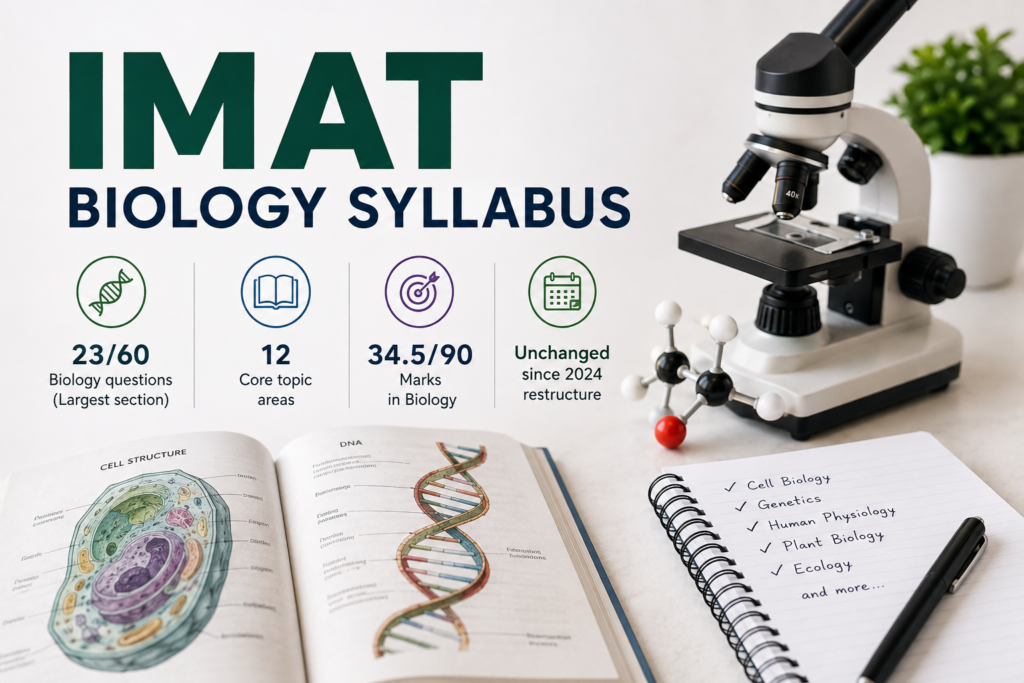
- Biology carries 23 of the 60 IMAT questions, the largest single section.
- The official IMAT biology syllabus covers 12 core topic areas.
- Genetics alone spans three layers: Mendelian, molecular, and human genetics.
- Biology accounts for 34.5 of the 90 total IMAT marks.
- The syllabus has not changed since the 2024 restructure.
IMAT Biology Weightage: How Many Questions and Marks
If you’re preparing for MBBS in Italy through the IMAT route, the biology section will determine most of your admission chances. Before opening a single textbook, it helps to know exactly how much of the biology exam actually determines.
| Metric | Value |
|---|---|
| Biology questions | 23 out of 60 |
| Maximum biology marks | 34.5 out of 90 |
| Share of total exam | Just over 38 percent |
| Marking per question | +1.5 correct, -0.4 incorrect, 0 unanswered |

Choose your dream country
 UK
UK
 USA
USA
 Germany
 Australia
 Ireland
 Canada
 UAE
UAE
 France
 Sweden
 Italy
Italy
 Other
Other
When do you want to study abroad?
What's your highest level of education?
Have you completed Class 12th?
What was your Class 12 CGPA/percentage?
Are you a student or a parent/guardian?
What do you want to study?
Select your current city
How Leap will help you

Personalised University Shortlist

Express Applications with Quicker Admits

End-to-End Application Support
A few things this table tells you:
- No other subject on the IMAT carries close to 23 questions
- Biology alone is worth more marks than Physics and Mathematics combined
- This is why the IMAT biology weightage matters more for your final score than any other single subject
Source:MUR Decreto Ministeriale n. 1005 del 06-08-2026, Article 2, comma 2
My insight: Students often split their prep time evenly across subjects because it feels fair. Given that biology alone determines over a third of your score, an even split usually means under-preparing the one section that matters most.
The Complete IMAT Biology Syllabus: Official Topic List
This is the actual IMAT biology topics list published in Allegato A, the official annex to the 2026 admissions decree, not a paraphrased version. Twelve areas are covered.
| Topic area | What it includes |
|---|---|
| Chemistry of living things | Biological importance of weak interactions between molecules |
| Organic molecules and enzymes | Molecules in organisms and their functions, the role of enzymes |
| The cell as the basis of life | Cell theory, cell size, prokaryotic vs eukaryotic cells, animal vs plant cells, viruses |
| Cell membrane and structures | Membrane structure, transport across membranes, cell organelles and their functions |
| Cell cycle and reproduction | Mitosis, meiosis, chromosome sets and chromosome maps |
| Reproduction and heredity | Life cycles, sexual and asexual reproduction |
| Genetics | Mendelian genetics, classical chromosomal theory, molecular genetics, human genetics |
| Mutation and evolution | Natural and artificial selection, evolutionary theories, and the genetic basis of evolution |
| Biotechnology | Recombinant DNA technology and its applications |
| Anatomy and physiology | Animal tissues, human systems and their interactions, homeostasis |
| Bioenergetics | ATP, oxidoreduction reactions, photosynthesis, glycolysis, respiration, fermentation |
My insight: The list above looks short until you realize each row hides several exam-worthy sub-concepts. Treat every row of the IMAT biology topics list as a chapter, not a single flashcard, or you'll walk in thinking you covered a topic you've only skimmed.
Genetics on the IMAT Biology Syllabus: Three Layers in One Topic
Genetics deserves its own section because the decree bundles three genuinely different levels of difficulty under one heading.
| Layer | What's tested |
|---|---|
| Mendelian and classical genetics | Mendel's laws and their applications, chromosomal theory of heredity, inheritance patterns |
| Molecular genetics | DNA structure and replication, the genetic code, protein synthesis, gene expression regulation |
| Human genetics | Transmission of single-gene and multi-gene traits, autosomal and X-linked hereditary conditions |
Students who prepared genetics for board exams usually have Mendelian genetics covered well. Molecular genetics and human genetics tend to need separate revision, since they ask you to apply mechanisms rather than recall laws.
What Kind of IMAT Biology Questions Are Asked?
The IMAT biology syllabus is tested entirely in English, which affects how questions read even when the underlying concept is familiar.
- Every biology question is written in English, including ones that use symbolic or diagram-based language
- Questions lean toward application rather than pure recall, asking you to interpret a scenario using a concept rather than just state a definition
- There is no separate English-language section for biology; comprehension of scientific English is treated as part of answering the question correctly
- Five options are given per question, with only one correct answer, and the same negative marking applies as in every other section
Source: MUR Decreto Ministeriale n. 1005 del 06-08-2026, Allegato A, Section 1
My insight: A candidate who fully understands a concept in their own language can still lose marks if unfamiliar English phrasing slows them down mid-exam. Practicing biology questions in English specifically, not just translating your existing notes, closes this gap early.
Topics Sometimes Wrongly Listed as Part of the IMAT Biology Syllabus
A few guides online include topics that don't actually appear in the official decree, and it's worth knowing the difference before you spend prep time on them.
| Commonly claimed topic | Actually in Allegato A? |
|---|---|
| Immunology (innate and adaptive immunity) | No |
| Ecology and ecosystems | No |
| Plant biology as a separate topic | No |
| Human anatomy and physiology | Yes, explicitly listed |
| Biotechnology | Yes, explicitly listed |
Homeostasis and human physiology are closely related, so a question could indirectly involve immunology or ecology. Even so, neither is a separately listed, examinable topic the way genetics or bioenergetics are. A full immunology or ecology chapter takes time away from the twelve areas the decree actually names.
My insight: This confusion usually starts with students copying a study checklist from a forum without checking it against the decree itself. A quick cross-check against the official IMAT biology topics list before building your revision plan saves weeks of misdirected effort.
How to Plan Biology Prep Around the IMAT Syllabus?
Once the syllabus is clear, sequencing matters almost as much as coverage.
| Phase | Focus |
|---|---|
| First pass | Cell biology, biomolecules, and enzymes: the foundation every later topic builds on |
| Second pass | All three layers of genetics are treated as separate study blocks, not one combined topic |
| Third pass | Anatomy, physiology, and bioenergetics, which reward diagram-based revision |
| Final pass | Mixed practice questions in English, timed, covering all twelve areas together |
My insight: Candidates who revise genetics as one block instead of three often do well on Mendelian questions and poorly on molecular or human genetics ones in the same sitting. Splitting genetics into its three layers during revision, not just during the first study, tends to fix this.
IMAT Biology Preparation Tips for Students
Knowing the syllabus is one thing. Studying it in a way that actually holds up under exam conditions is a different problem, and this is where most candidates lose time without realizing it.
| Tip | Why it works |
|---|---|
| Study from official past papers first, not summarised notes | Past IMAT papers from 2023 onward reflect the current 12-topic structure and application-based question style, which generic revision notes often don't match |
| Draw the mechanism instead of reading about it | Cell division, DNA replication, and protein synthesis are tested through diagrams and scenarios, so sketching the process yourself builds faster recall than re-reading text |
| Practice questions in English from day one | Translating your board-exam notes into English later wastes time; learning the biology terms in English alongside the concept avoids a second translation step during the actual exam |
| Time yourself on biology sections specifically | With 23 questions carrying real weight, running out of time on biology costs more than running out of time on a smaller section, so practice pacing this section on its own |
| Revisit genetics in short, repeated sessions rather than one long block | The three genetics layers blur together in a single sitting; spaced repetition across separate sessions keeps them distinct |
| Treat bioenergetics and anatomy as diagram subjects | Both reward being able to label and trace a process (like the stages of respiration or a physiological pathway) rather than recite definitions |
My insight: The students who improve fastest aren't the ones who read the most material twice. They're the ones who convert each topic into a diagram, a worked example, or a timed question set before moving to the next one. Passive rereading feels productive but rarely shows up in the actual score.
If your question is more specific than what's covered here, say, whether your NEET biology score is enough to skip ahead on certain topics or whether a particular university weighs biology differently, browse similar questions answered by counselors on LeapScholar Questions.
3 Key Takeaways on IMAT Biology Syllabus
- Biology is 23 of 60 questions and over a third of your total score, so it deserves more than an equal share of your prep time
- Genetics is really three separate topics in one heading, and revising them together often hides gaps that show up on exam day
- Stick to the twelve topics actually listed in Allegato A rather than broader categories like immunology or ecology that some guides mistakenly include
Verified by: LeapScholar's Italy counseling team, with hands-on experience guiding Indian students through IMAT preparation and MBBS admissions in Italy.
Have questions about the IMAT biology syllabus or your prep plan? Book a free session with a LeapScholar counselor.
Frequently Asked Questions About IMAT Biology Syllabus
-
What exactly is covered in the IMAT biology syllabus?
Twelve official topic areas: the chemistry of living things, organic molecules and enzymes, cell biology, membranes, cell division, reproduction and heredity, genetics, evolution, biotechnology, anatomy and physiology, and bioenergetics. Each of these comes directly from Allegato A of the 2026 admissions decree, not a third-party summary, so this list is the actual IMAT biology syllabus rather than someone's interpretation of it.
-
How many questions on the IMAT come from biology?
23 out of 60 total questions, which works out to 34.5 of the 90 marks available on the exam. This makes biology the single largest section by a wide margin, ahead of chemistry's 15 questions and physics and mathematics' 13.
-
Is the IMAT biology syllabus the same every year?
The IMAT biology syllabus has stayed the same since the 2024 restructure, and the 2026 decree confirms no changes for this cycle. Older guides sometimes reference a different section split from before 2024, so double-check that any resource you're using reflects the current structure.
-
Does the IMAT biology syllabus include immunology?
No, not as a separately listed topic. Some online guides mention immunology or ecology as IMAT biology topics, but neither appears in the official decree annex. Your prep time is better spent thoroughly covering the twelve areas that are actually listed.
-
What's the difference between IMAT biology questions and NEET biology questions?
Both draw from similar underlying content, but IMAT questions are written entirely in English and tend to test application of a concept rather than direct recall. A student strong on NEET-style recall questions may still need practice adjusting to how IMAT phrases the same idea.
-
Which biology topic is hardest for most IMAT candidates?
Molecular and human genetics tend to trip up more students than Mendelian genetics, since they require applying mechanisms like gene expression or inheritance patterns rather than just stating a law. Bioenergetics is a close second for candidates who studied it only briefly at school.
-
How much of my total IMAT score depends on biology?
Just over 38 percent of the maximum possible score comes from biology alone. No other single subject contributes as much, which is why most successful candidates prioritize biology prep over an even split across all sections.
-
Are IMAT biology questions purely theoretical, or do they include application-based problems?
Both types appear. Some questions test direct conceptual understanding, like the role of a specific enzyme, while others present a scenario and ask you to apply a principle, such as interpreting a genetics cross or reading a physiological process from a description.
-
Where can I find the official IMAT biology syllabus instead of a summarized version?
You can find it in Allegato A of the current year's Decreto Ministeriale, which is published on MUR's official site alongside the main decree. It's the only source that reflects exactly what can be examined, rather than a prep site's interpretation of it.










Have Questions? Get Guidance to reach your Dream University
Connect with India's finest counsellors and biggest study abroad community.
Get Guidance