
Quick Read
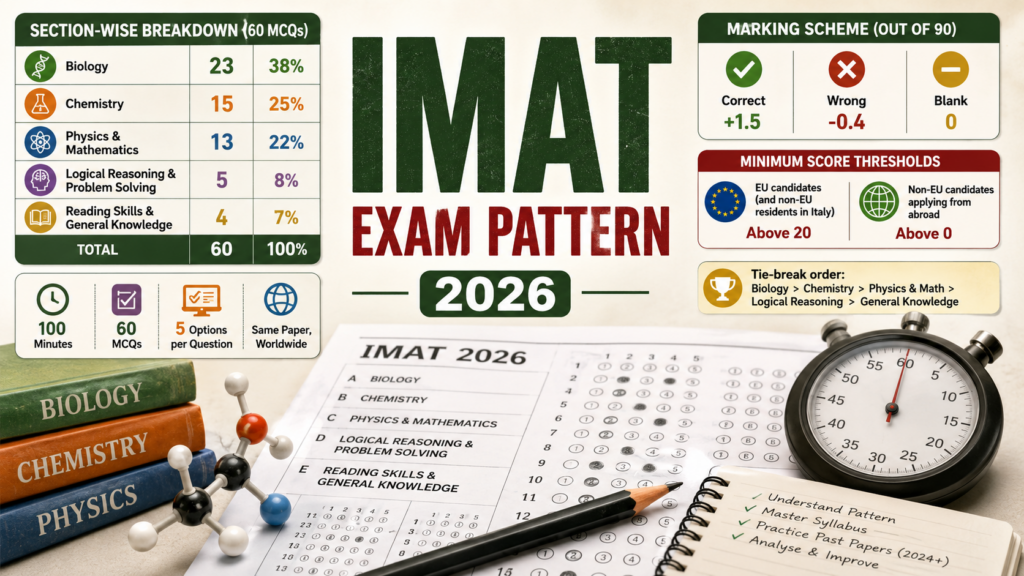
- Structure: IMAT 2026 has 60 MCQs in 100 minutes, 5 sections, and 5 answer options per question.
- Section weightage: Biology 23, Chemistry 15, Physics & Mathematics 13 (combined), Logical Reasoning 5, General Knowledge 4.
- Marking: +1.5 correct, -0.4 wrong, 0 blank, out of 90 maximum.
- Minimum thresholds: Above 0 to enter the non-EU ranking, above 20 to enter the EU ranking.
- What changed in 2024: Science sections (Biology, Chemistry, Physics & Math) went from 38 to 51 questions; Logical Reasoning and General Knowledge shrank from 22 to 9 combined.
What Is the IMAT Exam Pattern?
The IMAT exam pattern is a fixed structure: 60 multiple-choice questions, 100 minutes, no breaks, and a single national merit ranking based on your final score. Every candidate sits for the same paper, at the same time, worldwide.
The IMAT paper pattern has stayed unchanged since 2024, so the 2025 and 2026 exams use identical section weightage, timing, and marking. This makes recent past papers a reliable guide, unlike pre-2024 papers, which followed a different structure.

Choose your dream country
 UK
UK
 USA
USA
 Germany
 Australia
 Ireland
 Canada
 UAE
UAE
 France
 Sweden
 Italy
Italy
 Other
Other
When do you want to study abroad?
What's your highest level of education?
Have you completed Class 12th?
What was your Class 12 CGPA/percentage?
Are you a student or a parent/guardian?
What do you want to study?
Select your current city
How Leap will help you

Personalised University Shortlist

Express Applications with Quicker Admits

End-to-End Application Support
Counselor insight: Students often confuse "syllabus" and "exam pattern." The pattern tells you how many questions come from where and how they're scored. The syllabus tells you which topics in each subject are examinable. You need both to prepare effectively.
IMAT Exam Pattern 2026: Section-Wise Breakdown
Here's the current IMAT question pattern, confirmed by MUR for the 2026 cycle.
| Section | Questions | Share of Paper |
| Biology | 23 | 38% |
| Chemistry | 15 | 25% |
| Physics & Mathematics | 13 | 22% |
| Logical Reasoning & Problem Solving | 5 | 8% |
| Reading Skills & General Knowledge | 4 | 7% |
| Total | 60 | 100% |
Biology and Chemistry alone account for 38 of the 60 questions, so they have the greatest impact on your final score. Physics and Mathematics are combined into a single 13-question block rather than tested separately.
Counselor insight: If you only have time to double-check one thing before exam day, make it this table. Students who prepare using an outdated section breakdown routinely misallocate months of study time to the wrong sections.
Source: MUR official syllabus documents, Universitaly portal.
IMAT Marking Scheme and Minimum Thresholds
The IMAT exam pattern uses negative marking, which changes how you should approach uncertain questions.
| Answer type | Marks |
| Correct | +1.5 |
| Wrong | -0.4 |
| Blank | 0 |
| Maximum possible | 90 |
Minimum score thresholds to enter the ranking:
| Applicant category | Minimum score required |
| EU candidates (and non-EU residents in Italy) | Above 20 |
| Non-EU candidates applying from abroad | Above 0 |
Tie-break order (used when two candidates score identically): Biology score first, then Chemistry, then Physics & Mathematics, then Logical Reasoning & Problem Solving, and finally Reading Skills & General Knowledge.
Blind guessing on five options has a negative expected value because a wrong answer costs 0.4 marks, while a correct answer gains 1.5 marks. Only guess once you've eliminated at least two of the five options.
A quick look at the IMAT marking scheme can help you decide when it's smarter to attempt a question and when it's better to leave it blank.
Counselor insight: Don't let the negative marking make you overly cautious either. Leaving too many questions blank out of fear of losing marks costs you more than a well-reasoned guess would. The rule is simple: guess only once you've ruled out at least two options, not zero.
IMAT Exam Syllabus 2026: Subject-Wise Topics
The IMAT exam syllabus 2026 is expected to closely match 2025, as it has remained stable since MUR took over exam administration in 2023.
| Subject | Key topics |
| Biology | Cell biology, genetics, human physiology, ecology, molecular biology |
| Chemistry | Atomic structure, bonding, organic chemistry, chemical calculations |
| Physics & Mathematics | Mechanics, algebra, functions, geometry, basic probability and statistics |
| Logical Reasoning | Pattern recognition, argument analysis, logic puzzles, numerical reasoning |
| General Knowledge | Current affairs, science, history, literature, reading comprehension |
MUR publishes the official IMAT exam syllabus PDF as an annex to its admission decree each year, released via the Universitaly portal, typically in July or August.
Once you've covered the syllabus, start solving IMAT past papers from 2024 onward under timed conditions, since they reflect the current 60-question, 100-minute format much more accurately than older papers.
Counselor insight: Don't treat the syllabus PDF as a checklist to memorize line by line. IMAT questions are application-based, so understanding a concept well enough to use it in an unfamiliar scenario matters more than recalling definitions.
IMAT vs NEET: How the Patterns Compare
Most Indian IMAT candidates come from a NEET preparation background, so it helps to see the pattern differences directly.
| Feature | NEET | IMAT |
| Total questions | 200 (180 attempted) | 60 |
| Duration | 200 minutes | 100 minutes |
| Sections | Physics, Chemistry, Biology | Adds Logical Reasoning and General Knowledge |
| Marking | +4 correct, -1 wrong | +1.5 correct, -0.4 wrong |
| Question style | Largely recall-based | Application and reasoning-based |
Roughly 70% of the IMAT's science content overlaps with NEET syllabus coverage. What NEET doesn't prepare you for is the Logical Reasoning section and the current-affairs-driven General Knowledge questions, both of which are important for the final ranking even though they make up a smaller share of the paper.
Counselor insight: Don't assume NEET prep transfers one-to-one. NEET rewards fast recall of memorized facts, while the IMAT rewards applying the same facts to an unfamiliar scenario. Even strong NEET scorers need dedicated practice with IMAT-style application questions, not just a content refresher.
If you're still comparing Italy against other MBBS destinations, read MBBS in Italy for Indian students before committing your prep time to this specific exam pattern.
Using This Pattern Based on Your Prep Stage
The same IMAT exam pattern data means something different depending on where you are in your preparation. Here's how to apply it.
Scenario 1: NEET-background beginner
- Your Biology, Chemistry, and Physics & Math foundation already covers most of the 51 science questions
- Budget dedicated time for Logical Reasoning and General Knowledge from week one, since NEET doesn't touch either
- Use the section weightage table to confirm you're not over-revising a 4-question section at the cost of a 23-question one
Scenario 2: Repeat IMAT attempter
- Pull your previous score breakdown and check it against the current 23/15/13/5/4 split
- If your last attempt used older prep material, confirm it matches the post-2024 pattern before reusing it
- Weight your revision toward whichever section underperformed relative to its question count
Scenario 3: Non-science-stream or late-starting candidate
- Prioritize Biology and Chemistry first, since together they're 63% of the paper
- Treat Physics & Mathematics as a smaller, focused block rather than trying to master it in full depth
- Don't skip Logical Reasoning even under time pressure. At 5 questions, it's small, but scoring well here is achievable without a science background
Counselor insight: Students often ask how to split study hours across sections. A reasonable starting split mirrors the question weightage: roughly 38% of your hours on Biology, 25% on Chemistry, 22% on Physics & Math, and the rest split between Reasoning and General Knowledge. Adjust from there based on your actual mock scores, not just the paper's weightage.
How the IMAT Paper Format Changed Since 2023
The IMAT exam pattern looked different before MUR took over from Cambridge Assessment in 2023. Knowing this matters if you're using older past papers to practice.
| Section | Pre-2024 format | Current format (2024 onward) |
| Biology | 18 | 23 |
| Chemistry | 12 | 15 |
| Physics & Mathematics | 8 | 13 |
| Logical Reasoning & General Knowledge (combined) | 22 | 9 |
The shift moved weight decisively toward science and shrank the reasoning and general knowledge block. If you're working through IMAT question papers from 2023 or earlier, treat them as useful for topic familiarity but not as an accurate rehearsal of the current weightage.
Counselor insight: Students who train heavily on old Cambridge-era logic puzzles sometimes overinvest in a section that's now worth far less. Check the publication year of any practice paper before building your study plan around it.
Sample Question Types by Section
Each section of the IMAT paper pattern tests differently, even within the same subject.
| Section | Typical question style |
| Biology | Multi-step questions combining two or three concepts, such as cell type plus organelle function |
| Chemistry | Calculation-based questions and structural/bonding identification |
| Physics & Mathematics | Formula application to a described scenario, not pure formula recall |
| Logical Reasoning | Seating arrangements, constraint puzzles, deductive reasoning from short passages |
| General Knowledge | Short passages on current events or science history, followed by comprehension or inference questions |
Documents and Prep Checklist Before You Register
Knowing the IMAT exam pattern is only useful once you can act on it. Keep these ready before registration and before your final revision push.
| Check | What to confirm |
| Official syllabus PDF | Downloaded from Universitaly, matched against the current 23/15/13/5/4 weightage |
| Past papers | 2024 and 2025 papers prioritized over pre-2024 ones |
| Score calculator | Your own +1.5/-0.4/0 tracking sheet, matching the official formula |
| Passport and ID | Valid and matching the name you'll use at Universitaly registration |
| Test centre choice | New Delhi confirmed as your primary option, Dubai noted as backup |
Planning Your Prep Calendar Around the Pattern
Build your revision calendar around the section weightage rather than splitting time equally across five sections.
Before you lock in this revision plan, check the IMAT exam date 2026 so you can work backwards from the official test day, registration window, and key admission deadlines.
| Timeframe | Focus, based on question weightage |
| Months 1-2 | Biology fundamentals (23 questions), since it's over a third of the paper |
| Months 3-4 | Chemistry (15 questions) alongside continued Biology revision |
| Month 5 | Physics & Mathematics (13 questions), application-style practice |
| Month 6 | Logical Reasoning and General Knowledge (9 questions combined), plus full-length timed mocks across all sections |
Adjust the exact split once your mock scores show which sections need more time than the weightage alone suggests.
A few full-length IMAT Mock Tests will tell you whether you're actually finishing all 60 questions in 100 minutes, something subject-wise practice alone rarely reveals.
Common Mistakes When Reading the IMAT Exam Pattern
Misreading the pattern itself, not just weak subject knowledge, costs students marks.
| Mistake | Why it hurts |
| Studying from a pre-2024 pattern breakdown | You'll over-prepare Logical Reasoning and General Knowledge, and under-prepare Biology and Chemistry |
| Assuming the pattern changes every year | It hasn't changed since 2024. Don't discard a good study plan just because a new year starts |
| Ignoring the minimum threshold rule | Crossing 0 or 20 marks gets you ranked, but ranking position still decides your seat, so don't stop pushing once you cross the minimum |
| Treating all five sections as equal in prep time | Biology and Chemistry are 63% of the paper combined. Equal time across sections wastes hours on lower-weightage areas |
| Skipping the tie-break order | If you're on the edge of an IMAT cutoff, your Biology and Chemistry scores matter most in a tie, so don't neglect them even after feeling "done." |
3 Takeaways on IMAT Exam Pattern
- The current IMAT exam pattern weights Biology (23), Chemistry (15), and Physics & Mathematics (13) far more heavily than Logical Reasoning (5) and General Knowledge (4), a shift that took effect in 2024.
- Negative marking of -0.4 per wrong answer means guessing is only worth it once you've eliminated at least two of the five options.
- Minimum thresholds to enter the ranking are above 20 for EU candidates and above 0 for non-EU candidates, but your ranking position, not just crossing the threshold, decides your seat.
Verified by: LeapScholar's Italy counseling team, with hands-on experience guiding Indian students through IMAT registration, Universitaly pre-enrollment, and MBBS admissions in Italy.
Have questions about the IMAT exam pattern or studying medicine in Italy? Book a free session with a LeapScholar counselor.
Frequently Asked Questions About IMAT Exam Pattern
-
What is the IMAT exam pattern for 2026?
It's 60 multiple-choice questions spread across 5 sections, and you get 100 minutes to finish all of them. Every correct answer earns you +1.5, every wrong one costs -0.4, and leaving a question blank costs nothing. Biology carries the heaviest weight at 23 questions, so it's worth knowing that going in.
-
What is the IMAT paper format, computer-based or pen and paper?
If you're sitting the exam in India, chances are you'll be filling in bubbles with a pencil, not clicking through a screen. Most centres, including New Delhi, have stuck with pen-and-paper so far. That said, formats can shift by location, so it's worth confirming with your specific test centre as exam day gets closer.
-
Where can I find the IMAT exam syllabus PDF?
Go straight to the source: MUR releases it as an annex to the official admission decree, and you'll find it on the Universitaly portal, usually sometime in July or August. Third-party summaries floating around online can be handy for a quick refresher, but always cross-check them against the official document before you build your study plan around them.
-
How many questions come from each subject in the IMAT question pattern?
Biology leads with 23 questions, followed by Chemistry at 15, and Physics & Mathematics combined at 13. Logical Reasoning gets 5 questions, and General Knowledge rounds it off with 4. Add it all up and you land at 60.
-
Is the IMAT exam pattern the same every year?
Not always, and this is exactly where a lot of students trip up on outdated prep material. The current pattern has held steady since 2024, but anything from 2023 or earlier followed a noticeably different weightage, with fewer science questions and a much bigger chunk given to Logical Reasoning and General Knowledge.
-
What is a good IMAT model paper to practice with?
Stick to anything from 2024 onward if you want your practice to genuinely reflect what you'll face on exam day. Older papers from 2023 or before are still fine for getting comfortable with topics, but they won't give you an accurate feel for how the questions are actually distributed now.
-
Does the IMAT exam pattern include negative marking?
Yes, and it's worth internalizing early. A wrong answer pulls 0.4 marks off your score, while a correct one adds 1.5. Do the math on that and you'll see blind guessing across five options generally isn't in your favor, unless you've already ruled out at least two choices.
-
What is the minimum score needed under the IMAT exam pattern?
It depends on where you're applying from. EU candidates and non-EU residents already in Italy need to cross a score of 20 to make it into the ranking. If you're a non-EU candidate applying from abroad, that bar drops to above 0. Either way, clearing the threshold just gets you into the running; it doesn't guarantee a seat on its own.
-
How should I split my study time across the IMAT exam pattern sections?
A sensible starting point is to let the question weightage guide your hours: roughly 38% on Biology, 25% on Chemistry, and 22% on Physics & Mathematics, with what's left going to Logical Reasoning and General Knowledge. From there, let your mock scores tell you where to actually spend more or less time.







Have Questions? Get Guidance to reach your Dream University
Connect with India's finest counsellors and biggest study abroad community.
Get Guidance