
Quick Read
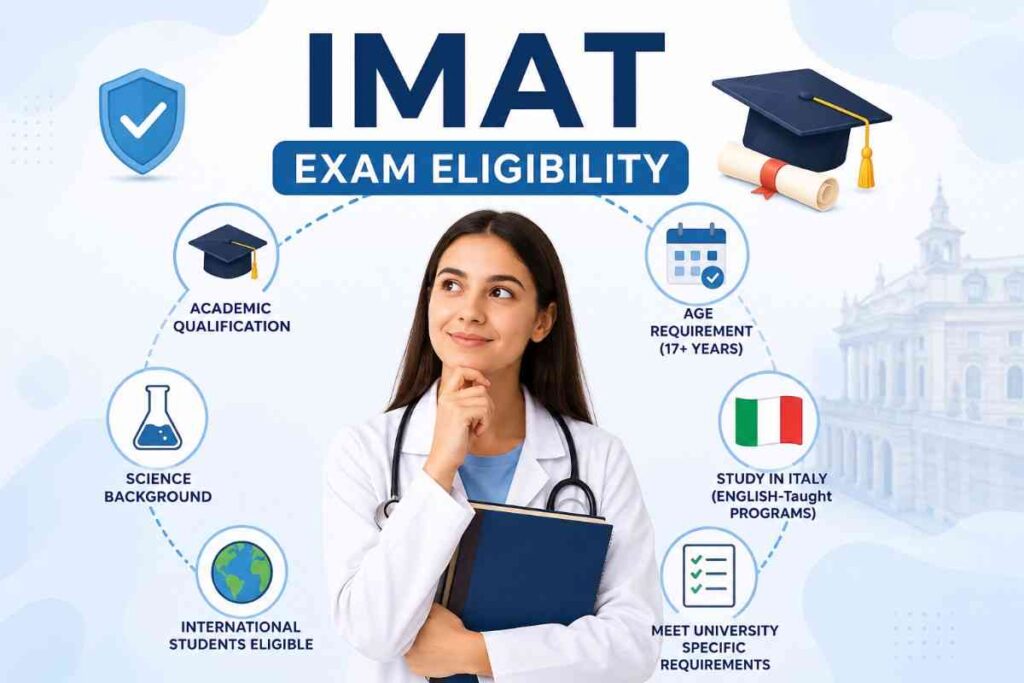
- IMAT eligibility needs 12 years of completed schooling, nothing more.
- There is no minimum or maximum age limit for the IMAT.
- NEET is not required to register for or sit the IMAT.
- NEET-UG qualification is mandatory later for FMGE or NExT.
- Indian applicants are classified as non-EU residing abroad.
- No Italian language requirement exists for IMAT registration.
What is the IMAT Exam Eligibility in 2026
IMAT exam eligibility for Indian students comes down to one core requirement: 12 years of completed schooling. There is no minimum percentage attached to that requirement, no mandatory subject combination beyond a general science background, and no separate entrance test for eligibility itself.
There is no Italian language requirement to register for the IMAT. A small number of universities ask for an English language certificate only as a tiebreaker between candidates who finish with identical scores, not as a condition of entry. There is also no age limit, upper or lower, so a student attempting the IMAT for the second or third time faces no additional restriction based on age alone.

Choose your dream country
 UK
UK
 USA
USA
 Germany
 Australia
 Ireland
 Canada
 UAE
UAE
 France
 Sweden
 Italy
Italy
 Other
Other
When do you want to study abroad?
What's your highest level of education?
Have you completed Class 12th?
What was your Class 12 CGPA/percentage?
Are you a student or a parent/guardian?
What do you want to study?
Select your current city
How Leap will help you

Personalised University Shortlist

Express Applications with Quicker Admits

End-to-End Application Support
Counselor insight: Families often assume IMAT eligibility works like NEET, with a minimum qualifying percentage or a fixed subject combination. It doesn't. The bar is genuinely just a completed Class 12 education, which surprises most first-time applicants once they check.
If you want the complete picture of the exam itself, including scoring and structure, what the IMAT exam actually involves covers that separately, so this page stays focused on eligibility.
IMAT Exam Eligibility Checklist
| Criterion | Requirement | India-Specific Note |
|---|---|---|
| Academic qualification | Completed 12 years of schooling | Standard CBSE, ICSE, or state board Class 12 satisfies this directly |
| Age limit | None, upper or lower | Repeat attempts carry no additional age restriction |
| Language proficiency | Not required for registration | Only used as a tiebreaker at some universities for identical scores |
| Citizenship/residency category | EU or non-EU classification required | Indian citizens applying from India are classified as non-EU residing abroad |
| NEET-UG | Not required for IMAT registration itself | Required separately for FMGE/NExT eligibility in India after graduating |
| Universitaly registration | Mandatory within the annual window | Non-EU candidates also need university-specific pre-enrollment |
This table covers the criteria that apply to every applicant. The sections below go deeper into the two areas that trip up Indian students most often: how your specific education system counts toward the 12-year requirement, and what your EU or non-EU category actually changes.
How Your Education System Affects Your IMAT Exam Eligibility
Most Indian students complete a standard 10+2 board structure, whether CBSE, ICSE, or a state board, which adds up to 12 years of schooling and satisfies IMAT eligibility directly, with no additional requirement.
Students from 11-year education systems need to complete one additional year of university study, or a recognized foundation year, before they meet the 12-year threshold. Students from 10-year systems need two additional years of university study to reach the same bar. This distinction rarely applies to mainstream Indian boards but is relevant for students who studied under certain state or international curricula structured differently from the standard 10+2 model.
Counselor insight: Students from IB or IGCSE backgrounds sometimes assume their qualification needs separate verification before it counts toward IMAT eligibility. In practice, IB and IGCSE Diploma completions map to the standard 12-year requirement without extra steps, but it's still worth confirming your specific board's classification with your target university before registration opens, since interpretation can vary slightly by institution.
EU vs Non-EU: Why Your Category Matters More Than You Think
Every IMAT applicant falls into one of two categories: EU or non-EU. Indian citizens applying from India are classified as non-EU residing abroad, a category that has real consequences beyond a mere paperwork label.
Non-EU candidates compete only within the seat quota of the single university where they completed pre-enrollment, not against the full national applicant pool. This means your rank is only ever compared to other non-EU candidates who chose the same university, which is a smaller and often more competitive pool than the EU ranking.
IMAT cutoff scores for non-EU applicants show how differently the process plays out university by university.
Dual citizens holding both an EU nationality and an Indian passport must apply under their EU citizenship, since Italian administrative rules give EU status automatic precedence. Applying as non-EU while holding EU citizenship is treated as a serious registration violation, not a strategic choice. Non-EU citizens who hold a valid long-term Italian residence permit for work, family reasons, or asylum are generally treated as EU-equated, though some universities apply additional residency-duration conditions, so this status is worth confirming directly with your target university rather than assuming it by default.
Who Meets the IMAT Exam Eligibility? Three Scenarios
If you're a CBSE or ICSE Class 12 student with no gap year, your academic eligibility is already satisfied the moment your board results are declared. Your main remaining task is confirming your EU or non-EU category, which for most Indian applicants is simply non-EU residing abroad, and completing pre-enrollment at your chosen university ahead of the IMAT registration window.
If you took a one- or two-year gap after Class 12 before deciding on IMAT, the gap itself does not affect your eligibility, since there is no age limit and no rule requiring immediate progression after school. Focus instead on making sure your Class 12 marksheet, provisional certificate, and Declaration of Value paperwork are ready well in advance, since older documents sometimes take longer to trace and legalize.
If you're studying under an international board like IB or IGCSE or completed schooling through a foreign curriculum, confirm your specific qualification's equivalency status with your target university's admissions office before registration opens. Most standard international diplomas satisfy the 12-year requirement without additional steps, but university-level interpretation can vary, and it's a five-minute email that prevents a late-stage surprise.
Is NEET Required for the IMAT? The Distinction That Confuses Everyone
NEET is not required to register for or take the IMAT. Italian universities do not ask for a NEET scorecard as part of IMAT registration, and your IMAT score alone determines your admission chances at your chosen university.
The confusion arises from a separate, later requirement. India's National Medical Commission mandates NEET-UG qualification under the Foreign Medical Graduate Licentiate Regulations, 2021, for any Indian citizen who wants to practice medicine in India after completing a medical degree abroad. Without a valid NEET-UG qualification, you cannot sit for FMGE or NExT, the licensing exams required to register as a doctor in India, regardless of how well you scored on the IMAT itself.
The NEET-UG qualifying bar is a percentile, not a high rank: the 50th percentile for General category candidates and the 40th percentile for SC/ST/OBC candidates. A NEET scorecard is valid for three years for this specific purpose, so timing your NEET attempt relative to your IMAT preparation matters if you plan to eventually practice in India.
Counselor insight: Students frequently ask whether skipping NEET entirely is a viable shortcut if they're confident about studying and working abroad permanently. It's a valid path for some, but it closes the door to practicing in India for good, so it's worth deciding deliberately rather than defaulting into it by accident.
For the full licensing picture once you're back in India, see the FMGE exam guide.
Documents That Prove IMAT Exam Eligibility
| Document | India-Specific Detail |
|---|---|
| Class 12 marksheet and provisional certificate | Confirms the core 12-year academic eligibility requirement |
| Passport | Name and date of birth must match your Universitaly registration exactly |
| Declaration of Value (DoV) | Issued by the Italian Embassy in New Delhi; certifies your Class 12 education is equivalent to the Italian qualification |
| NEET-UG scorecard | Not needed for IMAT itself; keep it ready for FMGE/NExT eligibility later |
| Universitaly account | Required for both IMAT registration and university pre-enrollment |
For the visa and pre-enrollment process that runs alongside these documents, see the Italy student visa guide.
What to Do If You Don’t Meet a Criterion Yet
If you haven't completed Class 12 yet, most universities allow provisional attendance for students awaiting final results, but this needs direct confirmation from your specific university's admissions office, since practice varies. Don't assume a provisional allowance without written confirmation.
If you're studying under an 11-year or 10-year education system without the additional university years completed, your IMAT eligibility isn't satisfied yet. Confirm exactly which additional coursework your specific system requires before investing in IMAT preparation, so you can register for the exam before you prepare.
If your EU or non-EU status is unclear due to dual citizenship or a pending long-term residence permit, resolve this before registration, not during it. Applying under the wrong category is treated as a serious violation, not a correctable mistake.
If you missed NEET this cycle and want to keep the option to practice in India open eventually, remember that NEET has no attempt limit, so you can plan your next attempt around your IMAT timeline.
For a fuller picture of this path, see MBBS abroad without NEET.
Key Takeaways on IMAT Exam Eligibility
- IMAT eligibility is genuinely simple: completed Class 12 schooling, no age limit, and no Italian language requirement stand between most Indian students and registration.
- NEET is not required for the IMAT itself, but NEET-UG qualification is mandatory separately for FMGE or NExT recognition if you plan to practice medicine in India later.
- Your EU or non-EU citizenship category, not your academic score, decides which seat quota and competition pool you're actually eligible against, so confirm it before registering.
Verified by: LeapScholar's Italy counseling team, with hands-on experience guiding Indian students through IMAT eligibility checks, Universitaly pre-enrollment, and Italian university admissions.
Have questions about IMAT exam eligibility or studying medicine in Italy? Book a free session with a LeapScholar counselor.
Frequently Asked Questions About IMAT Exam Eligibility
-
What is the IMAT exam eligibility criteria
IMAT eligibility requires 12 years of completed schooling, with no minimum percentage or fixed subject combination beyond a general science background. There is no age limit and no Italian language requirement for registration. Applicants also need to confirm their EU or non-EU citizenship category, since this determines which seat quota and competition pool applies at their chosen university.
-
Is there an age limit for the IMAT exam?
The IMAT has no minimum or maximum age limit. Candidates attempting the exam for a second or third time face no additional age-based restriction. The only requirement tied to timing is having completed 12 years of schooling before registering, regardless of how many years have passed since finishing Class 12.
-
Is NEET required for the IMAT exam?
NEET is not required to register for or sit the IMAT itself, and Italian universities do not ask for a NEET scorecard during admission. However, India's National Medical Commission separately requires NEET-UG qualification for any Indian citizen who wants to sit for FMGE or NExT and practice medicine in India after completing a foreign medical degree.
-
Can 11-year or 10-year education system students apply for the IMAT?
Students from 11-year systems need one additional year of university study or a recognized foundation year to meet the 12-year requirement. Students from 10-year systems need two additional years. Standard Indian 10+2 boards already satisfy the requirement directly, so the new rule mainly affects students from less common education structures.
-
Are Indian students classified as EU or non-EU for the IMAT?
Indian citizens applying from India are classified as non-EU residents abroad. This category means competing only within the seat quota of the single university where pre-enrollment was completed, rather than in a broader national ranking. Dual citizens holding EU nationality must apply as EU citizens, regardless of their preferences.
-
Can I appear for the IMAT if I'm still completing Class 12?
Some universities allow provisional attendance for students awaiting final Class 12 results, but this varies by institution and needs direct written confirmation from the specific university's admissions office. Assuming provisional eligibility without confirmation risks a late-stage registration problem once results are due.
-
Do I need an English language certificate to be eligible for the IMAT?
An English language certificate is not required for IMAT registration. Some universities use it only as a tiebreaker between candidates who finish with identical scores. If you hold one already, it's worth including in your application, but its absence does not affect your core eligibility.
-
What happens if I don't qualify NEET before studying MBBS in Italy?
Studying MBBS in Italy without qualifying NEET-UG does not affect your IMAT eligibility or Italian university admission. It does mean you cannot sit FMGE or NExT afterward, which makes practicing medicine in India as a registered doctor impossible, regardless of how strong your Italian degree is.
-
Can a gap year affect my IMAT eligibility?
A gap year of any length does not affect IMAT eligibility, since there is no age limit and no rule requiring immediate progression after Class 12. The main practical consideration during a gap year is keeping your academic documents, including your Declaration of Value paperwork, ready and up to date for whenever you decide to register.








Have Questions? Get Guidance to reach your Dream University
Connect with India's finest counsellors and biggest study abroad community.
Get Guidance