


 Blogs
Blogs  Leap Digest
  Events
  About Us
The highest-probability route to a full-time job in Germany is not applying for jobs after graduation. It's already inside a company when they need someone. That single idea runs through this entire guide: everything from your first semester onward, coursework, part-time work, internships, and your CV, is either building toward that position or it isn't.

Introduction

Academic Workload and Expectations
Prepare for a genuinely different academic model: attendance is often optional, there's little or no continuous assessment, one heavily weighted final examination decides most of your grade, and the responsibility for structuring your learning sits entirely with you. Professors are formal, addressed with Sie and their title, and are not there to chase you.
What the data says: Read your Prüfungsordnung in week one. It's a legal document specifying how many attempts you have at each examination, what happens if you fail, deregistration rules, and thesis requirements. Failing a compulsory module the maximum permitted number of times can end your enrolment in that programme and, in some cases, bar you from that subject at any German university. This regulation is the highest-consequence rule most students never read.
Students used to India's system of ongoing internal assessment consistently misjudge Semester 1 as a result, treating it as the easy semester when it's usually the hardest one, precisely because there's no early feedback loop telling them otherwise.
Exams, Projects and Time Management
- Join a Lerngruppe (study group) in your first semester. German students form them early, and the group is where the actual exam preparation happens.
- Use the professor's Sprechstunde (office hours), which almost no international student uses and which exists exactly for this purpose.
- Treat Semester 1 as the hardest, not the easiest, and build your work and internship search around that reality rather than assuming you'll have more spare time early on than you actually will.
What the data says: The academic and career tracks in this guide are not sequential. The conversion ladder in section 4 explicitly expects you to be building a Werkstudent search from Semester 1 at the same time you're adjusting to a harder-than-expected academic model. Plan your first two semesters around both realities at once, not one after the other.
Part-Time Work In Germany
International students may work up to 140 full days or 280 half days a year, or 20 hours a week during term time, without additional permission. A full day is more than 4 hours of paid work; a half day is 4 hours or less. The annual limit resets on 1 January.
| Rule | Detail |
|---|---|
| Annual limit | 140 full days or 280 half days a calendar year |
| Term-time weekly limit | 20 hours a week during the lecture period |
| Semester break limit | Up to 40 hours a week, subject to the annual cap |
| Statutory minimum wage | €13.90 an hour from 1 January 2026 |
What the data says: The Werkstudentenprivileg exempts you from health, long-term care, and unemployment insurance contributions, worth roughly €330 to €370 a month, as long as you stay a genuine student first, meaning you don't regularly exceed 20 hours a week during term time. Breaching this rule isn't just a technicality. It can cost you both the insurance privilege and your student health insurance status, a far bigger financial hit than the extra work hours were worth.
The statutory minimum wage rises to €14.60 an hour from 1 January 2027. Note that the Werkstudentenprivileg doesn't cover pension: Werkstudenten still pay Rentenversicherung at about 9.3% of gross wages, matched by the employer.
Working-Student Opportunities In Germany
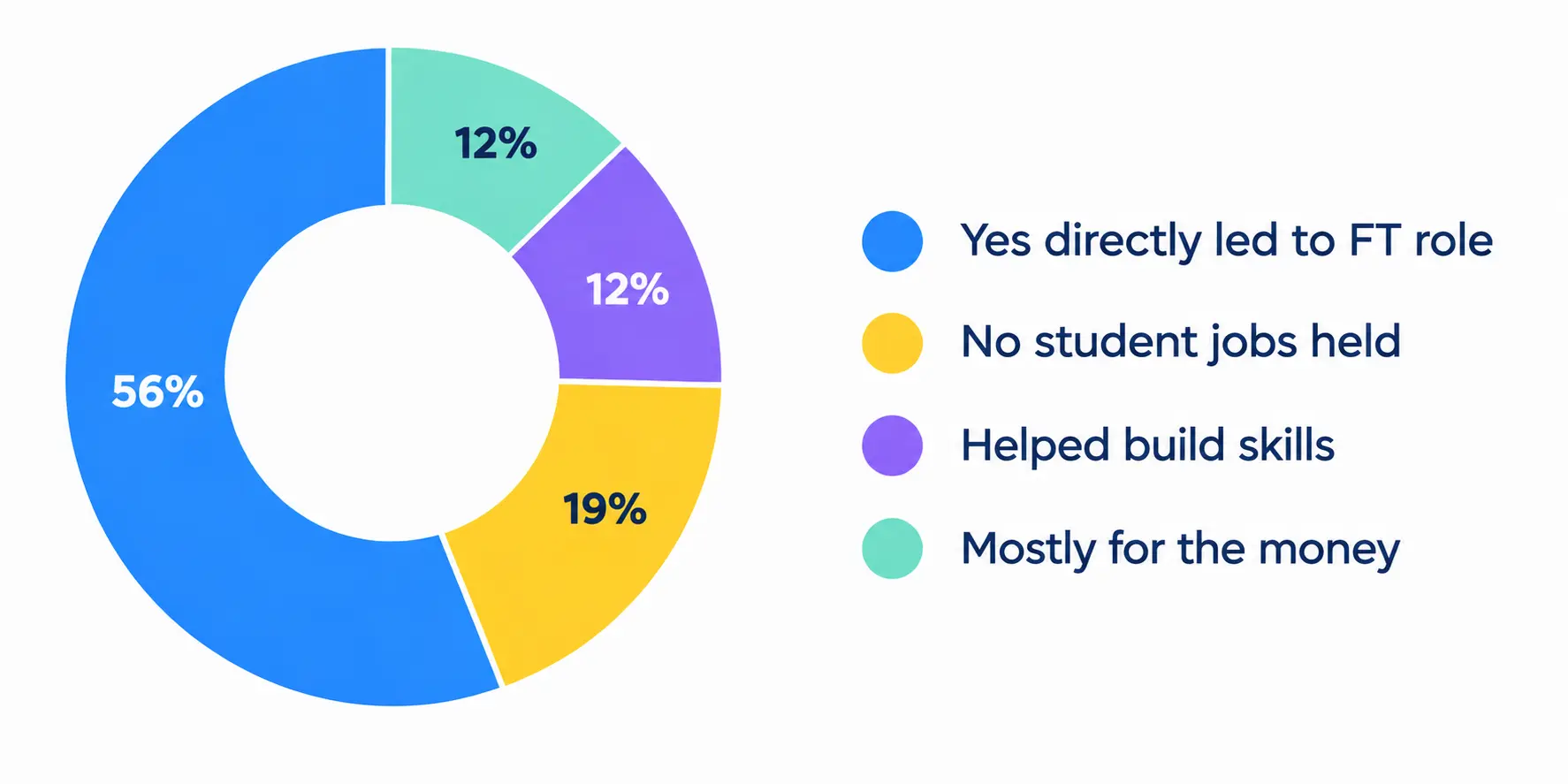
This process is the decisive mechanism in this entire guide, so it's worth stating plainly: the highest-probability route to a full-time job in Germany is not applying for jobs. It's already being inside a company when they need someone.
The conversion ladder
- Semester 1: a HiWi role or any legal job for cash flow, German practice, and a campus network.
- Semester 2: a Werkstudent role in your field. This is the decisive step.
- Semester 3: continue as a Werkstudent and propose your Master's thesis at the same company.
- Semester 4: the Abschlussarbeit (thesis), supervised jointly by the company.
- Pre-graduation: an offer, negotiated before you graduate.
- Post-graduation: convert your student permit directly to an EU Blue Card, skipping the 18-month §20 job search entirely.
What the data says: A student who follows this ladder never needs the 18-month §20 permit because they have an offer before graduating. That removes the single largest risk in the entire German plan. Industry reporting suggests a high conversion rate from Werkstudent to full-time offer at the same employer, with a commonly cited figure above 60 percent, though the figure couldn't be verified against an official federal statistic and shouldn't be treated as a confirmed fact. The directional point holds regardless: internal candidates are hired at far higher rates than external applicants.
Leveraged Werkstudent (working student) positions during university and completed a Master's thesis within an industrial company rather than an academic lab to gain practical engineering experience and build local professional connections.
— Mriganka Das, Mechanical Engineering graduate, working in Germany since 2019
Converting a Werkstudent role into a thesis
In Semester 3, approach your supervisor at the company and your professor at the university with a proposed thesis topic that solves a real problem for the company. German companies routinely host and partially fund Master's theses, and it converts you from "student who works here" to "person who solved something for us." You'll need a university supervisor willing to co-supervise, a company supervisor, and a topic that satisfies your Prüfungsordnung's thesis requirements. Start this conversation three months before your thesis registration deadline.
If you can't get a Werkstudent role
Realistic alternatives, in order of career value: a HiWi position with a professor whose research is industry-facing; a Pflichtpraktikum if your programme includes one, which doesn't count against your 140 days; a documented personal or open-source project with real users; or a working-student role in an adjacent function at a company in your target industry. In most cases where a technically competent student can't get a Werkstudent role, the binding constraint is German language level, not skill, and that's fixable.
The professionals who advance into senior, principal, or staff roles become recognized for solving business problems rather than technical problems alone. Throughout my work in digital transformation, I have observed that the willingness to learn continuously, embrace uncertainty, and manage personal growth has become one of the strongest predictors of long-term success.
— Prof. Dr. Stefan Gröner, Dipl.-Kfm.
Student Work Rules and Limitations
- Get your tax ID (Steuer-Identifikationsnummer) immediately after your Anmeldung. Without it, your employer applies the highest withholding tax bracket by default, and you lose real money every month until it's corrected.
- Most student earnings sit under the annual income tax-free allowance (€12,348 in 2026), so most of that income comes with no income tax owed, and any tax withheld is usually refunded in full when you file. File a tax return (Steuererklärung). It's voluntary for most students and almost always worth several hundred euros.
- Work income can close your monthly budget gap once it arrives. It cannot substitute for the blocked account itself: a visa officer will never accept a future job as financial proof.
- Don't budget as if a Werkstudent role is guaranteed from day one. For a large share of students, the realistic timeline is a Minijob or campus job in Semester 1, converting to a Werkstudent role in Semester 2.
- If you hold two jobs at once, both draw from the same 20-hour term-time week and the same 140-day annual count, so track every job's days from your first shift.
- HiWi roles and mandatory degree internships don't count toward the 140-day limit. Freelancing or self-employment is not allowed on a student permit without separate written approval from the Ausländerbehörde, so take a Werkstudent or Minijob contract for paid design, writing or IT work instead.
Finding Part-Time and Working-Student Jobs
What the data says: Search in German. This is the single most important tactical instruction in this entire guide. Use the terms "Werkstudent," "Werkstudentin," "Praktikant," "Pflichtpraktikum," "Abschlussarbeit," "Masterarbeit," "Masterand," and "studentische Hilfskraft," combined with your discipline in German: Softwareentwicklung, Maschinenbau, Elektrotechnik, Bauingenieurwesen, Verfahrenstechnik, Datenanalyse, Supply Chain, Controlling, and so on.
Where to actually search
- Company career portals directly. Bosch, Siemens, Continental, ZF, BASF, SAP, and every large German firm run their own Werkstudent portals, and much of that inventory never appears on LinkedIn.
- The Bundesagentur für Arbeit job board: the official federal job board, the largest in Germany, and dramatically under-used by international students.
- StepStone, Indeed.de, Xing (the German professional network, still relevant for the Mittelstand), and LinkedIn.
- Your university's career portal and Fachschaft noticeboards.
- Career fairs on campus. German firms recruit Werkstudenten directly at these, and turning up with a printed German-format CV works.
- Your professors, especially applied professors at FH/HAW, have direct industry contacts and are often asked for recommendations. Ask in Semester 1.
The application itself
- Anschreiben (cover letter): one page, specific, in German if the posting is in German. A German-language cover letter for a German-language posting, even an imperfect one, dramatically outperforms an English one.
- Lebenslauf (CV): one to two pages, reverse chronological, with a professional photograph (still conventional, though no longer legally expected), date of birth, and no unexplained gaps.
- Zeugnisse (certificates): your degree, transcripts, language certificates, and any reference letters, attached as a single PDF.
- Enrolment certificate (Immatrikulationsbescheinigung), since Werkstudent status legally requires it.
Internships
A Pflichtpraktikum (a mandatory internship built into your programme) doesn't count against your 140-day annual work limit, which makes it one of the most efficient ways to gain real experience without spending down your legal work allowance. Whether secured through university partnerships or independent corporate applications, treat it with the same seriousness as a Werkstudent search: apply in German, target the Mittelstand, and use it as a stepping stone toward a thesis placement at the same company where possible.
Balancing Work and Studies
The 20-hour term-time limit exists partly to protect your studies, and treating it as a target rather than a ceiling is a common mistake. Regularly working right up to the legal limit while also carrying a full course load, especially in Semester 1 while you're still adjusting to independent study, is how students end up failing a module they could otherwise have passed.
- Use semester breaks, when you can legally work up to 40 hours a week, to bank both income and experience, rather than spreading the same total hours thinly across term time.
- If a Werkstudent role and your coursework genuinely conflict in a given week, most German employers, used to the Werkstudent system themselves, expect studies to come first and will accommodate exam periods if you communicate early.
- The goal isn't maximum hours worked. It's a Werkstudent role secured and sustained long enough to convert into a thesis placement and then an offer, which requires protecting your academic standing along the way, not just your paycheck.
Building a Professional CV and LinkedIn Profile
| Element | Convention |
|---|---|
| Length | 1 to 2 pages maximum |
| Photograph | A professional headshot, top right, still conventional, though no longer legally required |
| Personal data | Name, address, phone, email, date of birth, nationality |
| Structure | Reverse chronological: education, then experience, or the reverse if experience dominates |
| Gaps | Must be explained. Unexplained gaps are read as concealment |
| Skills | Specific and honest. State CEFR levels for languages (Deutsch B1, Englisch C1), since they will be tested |
| References | "Referenzen auf Anfrage" is fine; German practice relies on written Arbeitszeugnisse rather than referee calls |
What the data says: The German CV convention is fuller and more complete than the Indian or American one. German recruiters expect a structured, complete, honest application, not a one-page highlight reel. This is not a soft preference: incomplete applications are frequently read as a red flag rather than a formatting choice.
While active on LinkedIn for global professional networking, with around 500 to 600 connections, regional job portals such as Xing and Indeed are heavily utilized alongside LinkedIn for job hunting in Germany and broader Europe.
— Raj Sinha, Simulation Engineer, medical technology sector
On LinkedIn specifically: keep your profile in German and English where possible, list your Werkstudent and internship roles with the same seriousness as full-time positions, and connect with your professors and company supervisors. Xing remains a live, active network for the Mittelstand in a way LinkedIn often isn't, and is worth maintaining alongside LinkedIn rather than instead of it.
Networking and University Career Services
- Use your university's career service and alumni network. German career services run employer events specifically to place their own graduates, and international students consistently under-attend them.
- Attend career fairs on campus with a printed, German-format CV in hand. This is a live recruiting channel, not a formality.
- Ask your professors directly, especially applied professors at FH/HAW, since they maintain direct industry contacts and are routinely asked for recommendations.
- Join a Verein or a Fachschaft-organised group. Beyond the social value, these are genuine, if indirect, professional networks in Germany's relationship-driven Mittelstand economy.
The most important career asset in Germany's future will not be your CV, but your professional reputation. This reputation is built through continuous improvement, reliability, consistency, and genuine collaboration over many years.
International engineers often focus purely on technical skills, overlooking the importance of understanding German business culture, communicating clearly with diverse stakeholders, and building trust across organizations.
— Prof. Dr. Stefan Gröner, Dipl.-Kfm.
German Language and Employability
In the majority of cases where a technically competent student can't get a Werkstudent role, the binding constraint is German language level, not skill. That's fixable, and it's worth treating as a career investment rather than an academic requirement.
- A2 to B1 is usually the minimum to be genuinely competitive for a Werkstudent role outside the most English-tolerant fields.
- B1 to B2 opens most Mittelstand and industrial roles, which is where the bulk of Germany's actual hiring volume sits.
- Apply in German, to German-language postings, at companies with no English career page. This single strategic move removes most of your competition, since most international applicants never do it.
Recognised early on that the primary obstacle to studying in Germany is the language barrier. Started learning German (A1, A2) during undergraduate studies in India and continued through B1 and B2 levels after arriving in Germany.
— Hemanth Kiran, Process Engineer, North Germany; graduate, TU Bergakademie Freiberg
Preparing for the Graduate Job Market
The timeline that works
| When | Action |
|---|---|
| 12 months before graduation | Werkstudent secured. CV in German format. German at B1 |
| 9 months before | A thesis with a company arranged, or an internship in the target industry |
| 6 months before | Start applying. German firms recruit with long lead times |
| 3 months before | Interviews. Negotiate. Aim to sign before graduating |
| Graduation | Convert straight to a Blue Card, or apply for the §20 permit as a fallback |
| Post-graduation | 18-month §20 window if needed, non-renewable |
What the data says: Apply while enrolled. Students who wait for graduation surrender the strongest signal they have: being immediately available and already partly trained.
The market you're actually applying to
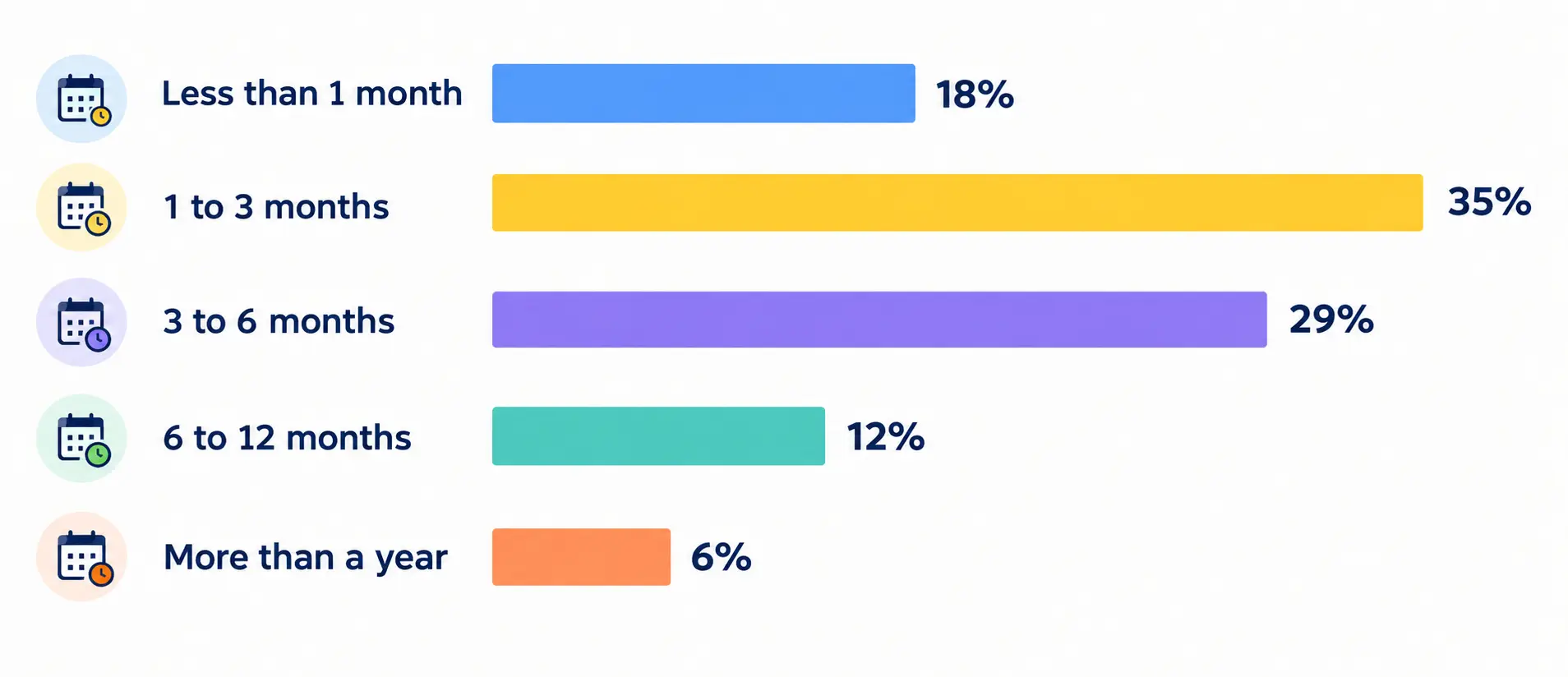
Fewer total vacancies than a few years ago, over 160 bottleneck occupations, and roughly a quarter of German companies advertising IT roles receiving effectively no usable applications at all. Your competitive problem isn't that Germany has no jobs. It's that you and every other international graduate are applying to the same narrow slice of employers.
Many companies still evaluate engineers primarily by programming languages, certifications, or years of experience, while underestimating other qualities such as adaptability, curiosity, and the ability to collaborate effectively with AI. The engineers who will create the greatest value are those who combine technical depth with business understanding, communication skills, and ethical judgment.
— Prof. Dr. Stefan Gröner, Dipl.-Kfm.
Five moves that actually change your odds
- Apply in German to German-language postings at companies with no English career page. This alone removes most of your competition.
- Target the Mittelstand. Germany's economy is built on mid-sized specialist manufacturers, many world leaders in a narrow niche (Hidden Champions), most with 200 to 3,000 employees, most in towns you haven't heard of, most hiring continuously, and most receiving almost no international applications.
- Go where the industry cluster is, not where the nightlife is: Erlangen, Ingolstadt, Ludwigshafen, Tuttlingen, Braunschweig, Chemnitz, Paderborn, and Friedrichshafen.
- Use the job board of the Bundesagentur für Arbeit. It's the largest job board in Germany, and it's where Mittelstand firms actually post.
- Use your university's career service and alumni network. International students consistently under-attend the events these services run specifically to place their graduates.
As AI moves from chatbots into factories, autonomous production systems, predictive maintenance, digital twins, and collaborative robotics, engineers who understand both software and industrial processes will become exceptionally valuable. The defining capability, however, will also be working effectively with AI and maintaining uniquely human qualities.
— Prof. Dr. Stefan Gröner, Dipl.-Kfm.
I believe Germany remains one of the most attractive countries for building a long-term technology career. In particular, the famous German "Mittelstand," the country's "hidden champions" that are often market leaders in highly specialized manufacturing solutions, is now entering the era of intelligent production systems. For young engineers who cultivate technical excellence, self-leadership, entrepreneurial thinking, and a human-centered approach to AI, Germany offers more than just jobs; it offers the opportunity to help shape the future of the industry itself.
— Prof. Dr. Stefan Gröner, Dipl.-Kfm.
Sources and Data Provenance
Every factual claim in this guide comes from either the Complete Guide (the primary research document behind this series) or an official source cited directly below. Figures the Complete Guide itself flags as industry-sourced or unverifiable, such as the Werkstudent-to-offer conversion rate, are presented here with the same caveat, not as confirmed statistics.
From the Complete Guide
- Academic culture, the Prüfungsordnung and the Lerngruppe system (Sections 1 and 2)
- Part-time work rules: the 140-day limit, weekly caps and the Werkstudentenprivileg (Sections 3 and 5)
- The Werkstudent conversion ladder, thesis conversion, and fallback options (Section 4)
- Job-search channels, the German-language application convention, and the German CV (Sections 6, 7 and 9)
- The graduate job market timeline and the five strategic moves that improve hiring odds (Section 12)
- University career services and the Mittelstand hiring pattern (Sections 10 and 12)
Official sources, cited directly
Bundesagentur für Arbeit, official job board: https://www.arbeitsagentur.de/jobsuche/
Bundesagentur für Arbeit, Fachkräfteengpassanalyse (shortage occupations): https://statistik.arbeitsagentur.de/DE/Navigation/Statistiken/Interaktive-Statistiken/Fachkraeftebedarf/Fachkraefteengpassanalyse-Nav.html
Make it in Germany, prospects after graduation (§20 permit): https://www.make-it-in-germany.com/en/study-vocational-training/studies-in-germany/prospects-after
Make it in Germany, EU Blue Card: https://www.make-it-in-germany.com/en/visa-residence/types/eu-blue-card
Deutsches Studierendenwerk, student support services overview: https://www.studierendenwerke.de/en
The pull quotes from Prof. Dr. Stefan Gröner, placed throughout sections 4, 10, and 12, are direct, first-hand commentary supplied for this guide series and are presented as expert opinion and professional perspective rather than as independently verified data. The remaining named pull-quotes throughout this guide are drawn from a separate set of interview transcripts with Indian engineering students and professionals in Germany, also supplied for this guide series, and are likewise presented as first-hand testimony rather than as independently verified statistics.
Table of content
