
Quick Read
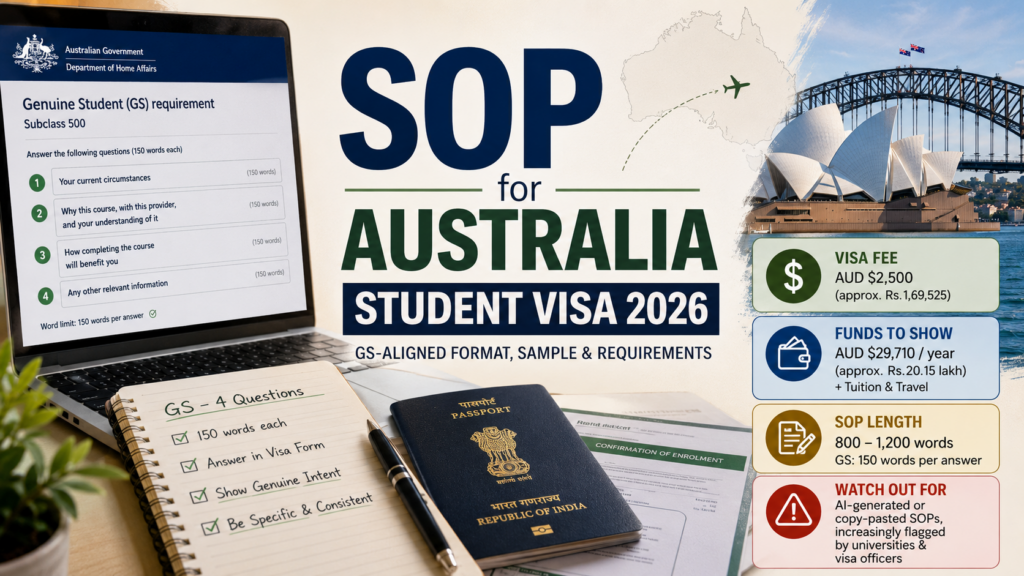
- Rule change: GTE is gone. Since 23 March 2024, your SOP for Australia student visa works through the Genuine Student (GS) requirement, 4 questions, 150 words each, inside the visa form itself.
- Visa fee: AUD $2,500 (approx. Rs.1,69,525)
- Funds to show: AUD $29,710/year (approx. Rs.20.15 lakh) for a single applicant, on top of tuition and travel
- SOP length: 800-1,200 words for the admissions SOP; under 150 words per GS answer, no repeats
- Watch out for: AI-generated or copy-pasted SOPs, increasingly flagged by both universities and visa officers
What Is an SOP for Australia Student Visa?
A Statement of Purpose (SOP) explains your academic background, career goals, and reasons for choosing a specific course and university. For Australia, the SOP now works at two separate levels that most guides still blur together:
- Your admissions SOP goes to the university as part of your program application, especially for business, arts, and education courses. It stays narrative, similar to what most Indian students already know from Canada or UK applications.
- Your Genuine Student (GS) statement is submitted inside your Subclass 500 visa application on ImmiAccount. It replaced the old GTE requirement on 23 March 2024, and it isn’t an essay: it’s four specific questions with a 150-word limit each. This form is the document visa officers actually assess your intent against.

Choose your dream country
 UK
UK
 USA
USA
 Germany
 Australia
 Ireland
 Canada
 UAE
UAE
 France
 Sweden
 Italy
Italy
 Other
Other
When do you want to study abroad?
What's your highest level of education?
Have you completed Class 12th?
What was your Class 12 CGPA/percentage?
Are you a student or a parent/guardian?
What do you want to study?
Select your current city
How Leap will help you

Personalised University Shortlist

Express Applications with Quicker Admits

End-to-End Application Support
Still unclear on how an SOP differs from a personal statement or a cover letter? Our counselors have answered that in detail on the LeapScholar Questions Hub.
Counselor insight: Students often write one document and submit it twice, once to the university and once as the GS statement. Don't. The university SOP can be personal and story-driven. The GS answers need to be tight, factual, and mapped exactly to what the Department of Home Affairs is asking.
GTE vs GS: What Actually Changed for Your Australia Student Visa SOP
| Feature | Old GTE (until 23 March 2024) | New GS (from 23 March 2024) |
| Format | One free-form statement, often 600-1,000 words | Four structured questions, 150 words each |
| Core focus | Proving you intend to leave Australia after study | Proving your primary purpose is genuine study |
| Where it's submitted | Attached as a document | Answered directly inside the ImmiAccount visa form |
| Mentioning post-study work (Subclass 485) | Often treated as a red flag | Acceptable, as long as study remains your stated primary purpose |
| Assessment basis | Assessed broadly, case officer discretion | Assessed against the factors in Ministerial Direction 106 |
Source: Department of Home Affairs, Genuine Student requirement
Format of an SOP for Australia Student Visa (2026)
Australia doesn't publish a single fixed SOP template for admissions, but a structure aligned with what the GS requirement actually tests works best:
- Introduction: Your current qualification, the course you're applying for, and your one-line career objective. Avoid storytelling; be direct in the first two sentences.
- Academic Background: Grades, relevant coursework, projects, and any research experience tied to your chosen field.
- Work Experience: Roles, responsibilities, and skills gained. No experience yet? Lean on internships, certifications, or academic projects instead.
- Course and University Choice: Why this specific course at this specific institution, referencing faculty, labs, or industry tie-ups where relevant.
- Why Study in Australia: What Australia offers that your home country doesn't, specifically tied to your field and not generic praise.
- Career Goals: Short-term and long-term plans, and how the course bridges the two.
- Financial Preparedness: Who is funding your studies and how (savings, education loan, sponsor), matched to the financial documents you'll actually submit.
- Return Intent / Home-Country Ties: Family, career plans, or assets that anchor you to India, framed as part of your genuine study intent, not as a defensive statement.
- Conclusion: A short, confident closing that reiterates your commitment to the course.
Recommended length: 800-1,200 words for the admissions SOP.
Sample SOP for Australia Student Visa
Here's a sample admissions SOP for an Indian student applying for a Master's in Mechanical Engineering:
I am applying for the Master of Engineering (Mechanical) at RMIT University to build on four years of academic training and two years of hands-on industry experience in manufacturing systems.
I completed my B.Tech in Mechanical Engineering from Delhi Technological University in 2023 with a CGPA of 8.2, with a final-year project on CNC machining optimization that was shortlisted for my department's best-project award. Since graduating, I have worked as a Graduate Engineer Trainee at a Gurugram-based auto-components manufacturer, where I was part of a team that reduced production downtime by 12% through preventive-maintenance scheduling.
I chose RMIT's Mechanical Engineering program specifically for its Advanced Manufacturing Precinct and its industry-linked capstone project structure, which lets students work directly with manufacturing partners in Victoria. This matches my interest in smart manufacturing and Industry 4.0 applications, areas where Australian research output has grown significantly in the past five years.
On completing this degree, I plan to return to India and take on a manufacturing systems design role, applying the automation and lean-manufacturing frameworks I will study at RMIT to the growing Indian auto-components sector, which is projected to scale significantly under the government's production-linked incentive schemes.
My father, a mechanical contractor, and my mother, a schoolteacher, will fund the first year of my tuition and living costs through savings and a fixed deposit, supplemented by an education loan of Rs.18 lakh sanctioned by our family bank for the remaining duration.
I am committed to completing this program within its scheduled duration and returning to India to apply what I learn, both to my own career and to the manufacturing ecosystem I currently work in.
This is an illustrative sample. Do not copy it verbatim; universities and visa officers routinely run SOPs through plagiarism and AI-detection checks.
Sample Genuine Student (GS) Statement Answers
The Department of Home Affairs asks four core questions in the GS form. Here's how to approach each, with a sample answer for the same applicant above (each capped at 150 words per the official limit).
1. Your current circumstances (ties to family, community, employment, and economic circumstances)
I currently live with my parents in Gurugram, India, where I work as a Graduate Engineer Trainee. My father runs a mechanical contracting business and my mother teaches at a local school; both are based permanently in India. I have strong family ties here, including responsibility toward my younger sibling's education. My current role has given me two years of practical manufacturing experience, and my employer has indicated a position would be available on my return. My economic circumstances are stable: my family owns our home, and my education is being funded through a combination of family savings and a sanctioned education loan, which requires timely completion of my studies and return to India for repayment.
2. Why this course, with this provider, and your understanding of it
I am applying for the Master of Engineering (Mechanical) at RMIT University because of its Advanced Manufacturing Precinct and industry-linked capstone structure, which directly builds on my current work in manufacturing systems. I have researched the course structure, including core units in advanced materials and automation, and understand that it requires two years of full-time study, with a capstone industry project in the final semester. I have also reviewed RMIT's course requirements and campus location in Melbourne and understand the cost of living and OSHC obligations that come with studying there.
3. How completing the course will benefit you
This course will give me formal training in automation and lean-manufacturing systems that I currently apply only informally at work. On returning to India, I intend to move into a manufacturing systems design role, applying these frameworks to the Indian auto-components sector, which is expanding under current government incentive schemes. The qualification will also make me eligible for more senior technical roles at Indian manufacturers that increasingly look for internationally trained engineers with exposure to Industry 4.0 practices.
4. Any other relevant information
I have no prior visa refusals from Australia or any other country. This is my first international study application. I have already secured a Confirmation of Enrolment from RMIT University and have arranged Overseas Student Health Cover for the full duration of my course.
Counselor insight: Don't repeat the same sentence across two GS answers just to hit the word count. Officers read all four together, and repetition reads as padding rather than genuine detail. Onshore applicants (those already in Australia) answer a 5th question, which is generally about their visa history.
Which SOP Approach Fits Your Profile?
| Your profile | What to emphasize |
| Fresh graduate, no full-time work experience, applying for a Master's | Academic projects, research work, and a clear, specific reason for choosing this course over similar options at home |
| Working professional (3+ years) with a career gap or break | Address the gap directly in your GS "current circumstances" answer; connect your work progression logically to the course you're now choosing |
| Family income is modest and you need an education loan or sponsor | Be specific about the loan amount, sanctioning bank, and repayment plan; this strengthens both your admissions SOP's financial-preparedness section and your GS "economic circumstances" answer |
| Reapplying after a previous visa refusal | Use the additional GS question available to returning applicants to directly address the refusal reason; consistency with your earlier application matters more than a fresh narrative |
Documents Checklist for Australia Student Visa SOP and GS Statement
| Document | Why it matters | Tip |
| Confirmation of Enrolment (CoE) | Confirms your course and provider; referenced in your GS answers | Get this before drafting your GS statement, not after |
| Academic transcripts and certificates | Support the academic-background claims in your SOP | Keep digital copies matched exactly to what you state in your SOP |
| Proof of English proficiency (IELTS/PTE/TOEFL) | Required alongside the GS requirement | Scores must be from an active test centre, not self-reported |
| Financial documents (bank statements, loan sanction letter, sponsor affidavit) | Backs your "economic circumstances" GS answer and financial-preparedness SOP section | Must show access to at least AUD $29,710/year (approx. Rs.20.15 lakh) plus tuition and travel |
| Overseas Student Health Cover (OSHC) confirmation | Referenced in GS answer 2 (understanding of course and living costs) | Cover must span your full intended stay |
| Work experience letters (if applicable) | Supports GS answer 1 and the SOP's work-experience section | Include role, duration, and responsibilities, not just a designation |
| Passport | Basic eligibility document | Must remain valid for the duration of your course |
Exchange rate used: 1 AUD = Rs.67.81, as of September 2026. Exchange rates move daily, so confirm the live rate before you pay.
Source: Department of Home Affairs, Student visa (Subclass 500)
When to Start Your Australia Student Visa SOP and GS Statement
| Timeline before intake | What to do |
| 4-5 months before | Shortlist courses and universities; start researching each provider's specific program structure for your GS answer 2 |
| 3-4 months before | Apply to universities, receive an offer letter, and begin your admissions SOP draft |
| 2-3 months before | Secure Confirmation of Enrolment; finalize financial documents and loan/sponsor paperwork |
| 6-8 weeks before | Draft and refine your four GS answers against the official word limits; book OSHC |
| 4-6 weeks before | Lodge your Subclass 500 application on ImmiAccount with GS answers, financial evidence, and CoE |
| After lodgement | Track status through ImmiAccount; keep documents ready in case Home Affairs requests additional information |
For a fuller week-by-week breakdown, see our guide on the processing time for an Australia student visa.
What If Your SOP for Australia Student Visa or GS Statement Gets Flagged?
- Vague or generic answers: If your GS responses could apply to any student or any course, they will be seen as unconvincing. Rewrite with specific course units, provider details, and your own work history.
- Inconsistency with your interview: If Home Affairs requests an interview, your answers are checked directly against your GS statement.
Review our breakdown of common interview questions for the Australian student visa before your file is finalized, not after.
- Financial gaps: If your bank statements don't clearly support the AUD $29,710/year (₹20.15 lakh/year) figure plus tuition, expect delays or refusal, regardless of how well-written your SOP is.
- Unexplained prior refusal: If you've been refused an Australian visa before, silence on it in your GS statement is worse than addressing it directly through the additional question available to returning applicants.
- Signs of AI generation or plagiarism: Overly polished, generic phrasing without specific personal detail is a growing refusal trigger. Write your draft first, then edit for clarity.
Exchange rate used: 1 AUD = Rs.67.81, as of September 2026. Exchange rates move daily, so confirm the live rate before you pay.
SOP for Australia Student Visa vs Canada, UK, and the US
| Country | Document type | Typical length | Core focus |
| Australia | GS statement (visa) + separate admissions SOP | GS: 150 words x 4 questions; SOP: 800-1,200 words | Structured, evidence-based; assessed against Ministerial Direction 106 |
| Canada | Statement of Purpose / Letter of Explanation | 800-1,200 words | Free-form narrative; genuine intent to study and return, or transition through valid pathways |
| UK | Personal Statement (UCAS) | Up to 4,000 characters (~600-700 words) | Course fit and academic motivation; the visa itself doesn't require a separate SOP for most applicants |
| USA | SOP / Personal Statement | 500-1,000 words | Narrative and personality-driven; often the primary basis for admissions decisions |
Australia Student Visa SOP Mistakes to Avoid
- Copying a template SOP or GS answer from the internet. Admissions readers and visa officers both see the same templates repeatedly; generic phrasing is a direct signal, not a neutral risk.
- Contradicting your documents. If your SOP says you're self-funded but your bank statements show a sponsor, or your GS answer omits a career gap your transcripts show, that inconsistency does more damage than the gap itself would have.
- Overselling migration intent. GS allows mentioning post-study work, but leading with a permanent residency plan rather than a study plan undermines the "genuine student" framing you're supposed to establish.
- Treating the GS answers as a shorter version of your SOP. Different questions, different formats, and different word limits; each needs to be written on its own terms.
3 Takeaways on SOP for Australia Student Visa
- Your admissions SOP and your GS statement are two separate documents with different formats and audiences, so don't submit one as the other.
- Back every claim, academic, financial, or career-related, with documents you can actually produce.
- Keep your language specific and your own, since generic or AI-sounding text is now a genuine risk factor in both admissions and visa assessment.
Verified by: LeapScholar's Australia counseling team, with hands-on experience guiding Indian students through Subclass 500 visa applications.
Have questions about your SOP or Genuine Student statement? Book a free session with a LeapScholar counselor.
Frequently Asked Questions About SOP for Australia Student Visa
-
What is the Genuine Student (GS) requirement for Australia?
The GS requirement is the assessment the Department of Home Affairs uses for every Subclass 500 student visa application. It replaced the Genuine Temporary Entrant (GTE) requirement on 23 March 2024 and consists of four structured questions, each limited to 150 words, submitted directly through your ImmiAccount visa application.
-
Is the GTE statement still required for the Australia student visa?
The GTE requirement was fully replaced by the GS requirement for all applications lodged on or after 23 March 2024. Any guide still referencing GTE as a current requirement is outdated, so double-check the publish date before relying on it.
-
How long should an SOP for Australia be?
Your admissions SOP, the document you send to the university, should typically run 800 to 1,200 words. This is separate from your GS statement, which has a strict 150-word limit per question.
-
What is the word limit for each GS answer?
Each of the four GS questions has a maximum of 150 words. The ImmiAccount form won't accept anything over this limit, so draft and trim before submitting.
-
Can I mention the Temporary Graduate (485) visa in my GS statement?
Under the GS requirement, mentioning your intention to apply for a post-study work visa like the Subclass 485 is not treated as a red flag, as long as your stated primary purpose remains genuine study.
-
How much money do I need to show for financial capacity?
As of 2026, a single primary applicant must demonstrate access to at least AUD $29,710 per year (approx. Rs.20.15 lakh) for living costs, in addition to your first year's tuition fees and return travel costs. This figure is reviewed periodically by the Department of Home Affairs.
-
What is the current Australia student visa application fee?
The Subclass 500 visa application charge is AUD $2,500 (approx. Rs.1,69,525) for the primary applicant as of 1 July 2026, per StudyAustralia.gov.au. This is non-refundable even if your application is unsuccessful, so confirm the current figure on the official Home Affairs site before paying.
-
What happens if I have a gap in my education or employment?
Address it directly in your GS "current circumstances" answer with a brief, honest explanation. Unexplained gaps invite scrutiny; a clearly stated reason, whether it's exam preparation, a family circumstance, or upskilling, is usually accepted without issue.
-
Can I write my own SOP, or should I use an agent?
You can and should write it yourself, or at minimum, ensure the final draft reflects your voice and specific details. Both universities and visa officers are increasingly able to identify AI-generated or templated SOPs, and a generic draft written by someone else can hurt your genuine-student assessment.






Have Questions? Get Guidance to reach your Dream University
Connect with India's finest counsellors and biggest study abroad community.
Get Guidance