
Quick Read
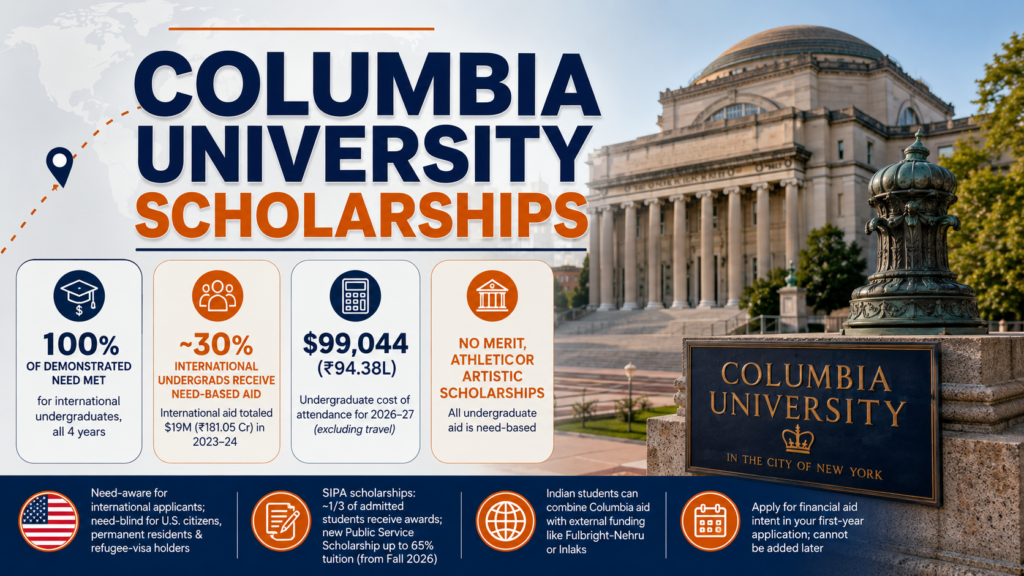
- Columbia gives no merit, athletic, or artistic scholarships; all undergraduate aid is need-based.
- Columbia meets 100% of demonstrated financial need for admitted international students.
- Indian students can combine Columbia aid with external funding like Fulbright-Nehru or Inlaks.
- Total undergraduate cost of attendance for 2026-27 is $99,044 (₹94.38L) plus travel.
Does Columbia University Offer Scholarships to International Students?
Not in the way most guides describe it. Here’s what’s actually true, according to Columbia’s own financial aid office:
- Columbia University scholarships for international students don’t include merit, athletic, or talent-based awards at the undergraduate level.
- Columbia College and Columbia Engineering do not offer academic, athletic, or artistic merit scholarships.
- What Columbia does offer is substantial need-based financial aid, plus school-specific graduate funding that varies significantly depending on which of Columbia’s schools you’re applying to.
Sources: Fees, Expenses, and Financial Aid, Columbia College official bulletin
Is Columbia Need-Blind for International Students?
This is the single most misunderstood fact about Columbia University scholarships for international students.
- Columbia is need-blind for US citizens, permanent residents, and students granted refugee visas: admission decisions ignore financial need entirely for those groups.
- For international and non-domestic applicants, Columbia is need-aware: financial need is a factor considered during admission.
- Once admitted, Columbia meets 100% of demonstrated financial need for international students for all four undergraduate years, the same commitment it makes to domestic students.
| Applicant Type | Admissions Policy | Financial Aid Commitment |
| US citizens, permanent residents, refugee-visa holders | Need-blind | 100% of demonstrated need met |
| Undocumented students residing in the US | Need-blind | 100% of demonstrated need met |
| International / non-domestic students | Need-aware | 100% of demonstrated need met, once admitted |
Note: Roughly 30% of Columbia’s international undergraduates receive need-based financial aid, and international financial aid totaled $19 million (₹181.05 crore) for the 2023-2024 academic year, one of the largest pools of international student scholarships at Columbia University.
Sources: International Financial Aid, Columbia Undergraduate Admissions, Is financial aid available for foreign students at Columbia College and Columbia Engineering
Columbia University Scholarships and Funding: Full Comparison
Columbia University scholarships and funding sources differ sharply by degree level and school, so use this table as your starting map before reading the details below.
| Funding Source | Degree Level | Type | Coverage |
| Columbia need-based grants | Undergraduate | Need-based only, no merit awards | Up to 100% of demonstrated need; more than 50% of Columbia College students receive a Columbia grant |
| SIPA Fellowships/Scholarships | Master’s (MIA, MPA, MPA-DP) | Merit + need, holistic review | Roughly one-third of admitted students receive an award; amounts vary by year |
| SIPA Public Service Scholarship (new, Fall 2026) | MIA, MPA, MPA-DP | Merit-based | Up to 65% of tuition |
| GSAS Fellowships | PhD (mainly); limited for MA | Academic merit | Varies by program; MA funding is limited |
| CBS Need-Based Scholarship | MBA | Need-based | Average award around $20,000 (₹19.06L); range $7,500–$30,000 (₹7.15L–₹28.59L) |
| CBS Merit-Based Fellowship | MBA (August entry only) | Merit, no separate application | The amount varies; it is automatically considered from Round 1/2 applications |
| Fulbright-Nehru Master’s Fellowship | Master’s (restricted fields only) | Fully funded, external | Tuition, fees, living costs, airfare, health insurance for up to 2 years |
| CUSDS (Columbia University Scholarship for Displaced Students) | Undergraduate and graduate, any degree | Fully funded, eligibility-restricted | Full tuition, housing, and living assistance for the full duration of the degree |
Exchange rate used throughout this article: $1 = ₹95.29 as of August 2026. Verify the current rate before finalizing your budget.
Counselor insight: Students often assume Columbia’s name recognition comes with automatic scholarship money the way some UK or Australian universities offer. It doesn’t. Every dollar of Columbia-specific funding above is either strictly need-based or tied to a specific graduate program’s own fellowship pool, not a university-wide merit scheme.
Sources: SIPA & Columbia University Funding, Columbia SIPA, Financial Aid, GSAS Columbia University, Institutional Funding, Columbia Business School
Columbia University Scholarship for Displaced Students (CUSDS): Full Funding, Any Degree Level
This is a genuinely fully funded, Columbia-wide scholarship, distinct from every school-specific fund above. CUSDS started in 2016 as a Columbia Business School initiative for Syrian students and has since grown into the first university-wide scholarship at Columbia, open across undergraduate and graduate degrees at all participating schools.
- Coverage: Full tuition, housing, and living assistance for the entire duration of the degree, funded jointly by the participating Columbia school and Columbia Global.
- Scale: Up to 30 new students per year, with up to $6 million (₹571.74 crore) in support committed per cohort.
- Eligibility: Foreign nationals who are refugees anywhere in the world; have received or applied for US asylum; hold Temporary Protected Status; are Internally Displaced Persons; or fall under specific country-based categories such as Afghan nationals on humanitarian parole or Ukrainian nationals on parole.
- Application: You must apply to a participating Columbia degree program first, then separately to CUSDS, with both applications due before the degree program’s own deadline. Eligibility requirements are reassessed each cycle; the 2025-26 cycle expanded eligibility to include Internally Displaced Persons.
Note: This scholarship isn’t aimed at Indian applicants specifically; its eligibility ties to displacement status, not nationality or need alone. It’s relevant only if your circumstances match the categories above.
Sources: Columbia University Scholarship for Displaced Students, Columbia Global Centers official page
Undergraduate Financial Aid at Columbia: How It Actually Works
Columbia College and Columbia Engineering fund undergraduates entirely through need-based grants and student work, never loans, as part of an initial aid package. This need-based structure is the backbone of Columbia University scholarships for undergraduate students.
- Financial aid is based on your family’s demonstrated ability to pay, assessed through the CSS Profile.
- International applicants must indicate they are applying for financial aid on their admission application. If you don’t, you cannot apply for aid in any later year unless your citizenship status changes.
- Aid renews each year based on a fresh financial aid application; since costs rise annually, aid packages typically increase to match.
- There are no institutional scholarships for grades, sports, or artistic talent at the undergraduate level.
Counselor insight: The “indicate aid intent on your first application” rule catches Indian families off guard more than any other Columbia policy. If your family’s financial situation changes in year two or three and you didn’t apply for aid as a first-year, Columbia will not consider you for aid later unless your citizenship status changes. Apply for aid in year one even if you think you won’t need it immediately.
Sources: Our Financial Aid Program, Columbia Financial Aid and Educational Financing, How Aid Works, Columbia Financial Aid and Educational Financing
Graduate Funding by School: SIPA, GSAS, and Columbia Business School
Columbia University scholarships for international students at the graduate level are not centralized. Each school runs its funding, so a fellowship at SIPA has no bearing on funding at CBS or GSAS.
SIPA (School of International and Public Affairs):
- Scholarships apply toward tuition with no work commitment; assistantships include a salary alongside a work commitment.
- Roughly one-third of admitted students receive an award, based on merit, need, and career background.
- Decisions are communicated in March.
- A new SIPA Public Service Scholarship, launching Fall 2026 for MIA, MPA, and MPA-DP applicants, covers up to 65% of tuition for students committed to public service careers.
GSAS (Graduate School of Arts and Sciences):
- Fellowships go mainly to PhD candidates, awarded on academic merit.
- Funding for standalone MA students is limited.
- Most Indian students pursuing a terminal MA at GSAS should plan on self-funding or external fellowships.
Columbia Business School (MBA):
- CBS runs both need-based scholarships and merit-based fellowships.
- Need-based awards require the CSS Profile after an interview invitation; roughly half of applicants receive an award, averaging around $20,000 (₹19.06L).
- Merit fellowships have no separate application, but only August-entry students qualify for merit consideration in their first year.
Sources: Funding your Education, Columbia SIPA, Fellowships, CBS Academics
External Scholarships Indian Students Can Combine With Columbia Aid
Columbia University’s own funding may not cover the full cost of attendance, so many Indian students combine external scholarships with Columbia university scholarships and institutional aid.
| Scholarship | Coverage | Key Restriction |
| Fulbright-Nehru Master’s Fellowship | Tuition and fees, living expenses, round-trip airfare, and health insurance for up to two years | Limited to specific fields: Economics, Environmental Science, Higher Education Administration, International Affairs, International Legal Studies, Journalism, Public Administration, Public Health, Urban and Regional Planning, and Women’s/Gender Studies.Not available for STEM, engineering, or business programs. |
| Inlaks Shivdasani Foundation Scholarship | Tuition, living expenses, and one-way travel | Highly competitive; intended for exceptionally talented Indian students, typically under 30 |
| J.N. Tata Endowment | Merit-based loan scholarship | Can be applied for before receiving an admission offer; broadly applicable to strong applicants targeting institutions such as Columbia and other top universities |
Counselor insight: The Fulbright-Nehru field restriction trips up more applicants than any other eligibility rule. If your target Columbia program is an MBA, an MS in Computer Science, or most engineering degrees, Fulbright-Nehru is not an option for you, regardless of your profile strength. Check the eligible fields list before building a funding plan around it.
Sources: Fulbright-Nehru Master’s Fellowships, USIEF official page
Columbia University Cost of Attendance 2026-27
Knowing the full cost helps you see what any scholarship or aid package is actually offsetting.
| Cost Component | Undergraduate (per year) |
| Tuition | $72,800 (₹69.37L) |
| Mandatory fees | $3,430 (₹3.27L) |
| Average room and board | $19,650 (₹18.72L) |
| Books and personal expenses | $3,164 (₹3.01L) |
| International Services Charge (non-resident visa holders) | $350 (₹0.33L) per year |
| Total (excluding travel) | $99,044 (₹94.38L) |
Note: The ISC is billed separately and isn’t included in the $99,044 figure.
Graduate tuition varies significantly by school: GSAS MA programs, SIPA’s MIA/MPA programs, and CBS’s MBA each publish separate per-term or per-credit rates rather than one university-wide figure.
Exchange rate used: $1 = ₹95.29. Verify the current rate before finalizing your budget.
Sources: Columbia, Barnard raise tuition, sending cost of attendance over $100,000, Columbia Daily Spectator
Which Columbia Funding Route Fits Your Profile?
- If you are an undergraduate applicant from a household that cannot fund the full $99,044 (₹94.38L) annual cost: Indicate financial aid intent on your very first Columbia application. Your admission decision will be need-aware as an international applicant, but once admitted, Columbia commits to covering 100% of your demonstrated need for all four years.
- If you are applying to SIPA for an MIA, MPA, or MPA-DP and are drawn to public service: Apply by the priority deadline and select “yes” for funding consideration on your SIPA application. Check whether the new Public Service Scholarship’s Fall 2026 eligibility criteria match your target career path before you count on it.
- If you are applying for a terminal MA at GSAS: Do not expect substantial internal funding. Build your budget around external scholarships or self-funding, and check whether your specific field qualifies for Fulbright-Nehru before assuming it will help.
- If you are applying to Columbia Business School for an MBA starting in August: You are automatically screened for merit-based fellowships once you submit by Round 1 or Round 2. If you need need-based aid on top of that, prepare your CSS Profile and income documentation for submission after you receive an interview invitation.
Documents You Need for Columbia Financial Aid and Scholarship Applications
Every serious application for Columbia University scholarships and financial aid draws on the same core documentation, with a few additions depending on which school you’re applying to.
| Document | Required For | India-Specific Detail |
| CSS Profile | Undergraduate need-based aid, CBS need-based scholarships | Available in English only; convert Indian income figures to USD using a documented exchange rate |
| Confirmation of financial aid intent on admission application | Undergraduate international applicants | Must be indicated in your first year; cannot be added later unless citizenship status changes |
| Income proof (ITR, salary slips, bank statements) | All need-based aid applications | Columbia does not accept informal income declarations; official tax and bank documentation is expected |
| SIPA/GSAS/CBS-specific funding application | Graduate program funding | Each school has its own form; a SIPA application does not cover CBS or GSAS funding |
| Fulbright-Nehru eligibility documentation | External fellowship applicants | Bachelor’s degree with at least 55% marks, minimum three years of professional work experience |
Columbia University Scholarship and Funding Deadlines: 2027-28 Planning Calendar
| Month (Indian academic calendar) | Action |
| September–October | Finalise your Columbia program shortlist; begin your CSS Profile if applying to undergraduate or CBS need-based aid |
| November–January | Submit undergraduate Early Decision/Regular Decision applications with financial aid intent indicated |
| Round 1/Round 2 (CBS-specific, check current cycle dates) | Submit CBS MBA application for merit fellowship consideration |
| March | SIPA scholarship and fellowship decisions typically communicated |
| Spring | Undergraduate financial aid decisions typically follow admission decisions closely |
What to Do If Columbia University Scholarships Don’t Meet Your Full Financial Need
Even with a full-need policy, some Indian families find the assessed contribution higher than expected.
- Request a financial aid appeal. If your family’s circumstances have changed since submitting the CSS Profile, contact the relevant financial aid office with updated documentation.
- Check school-specific emergency or supplemental funds. Some Columbia schools maintain smaller, named scholarship funds beyond the main need-based pool; ask what else you may be eligible for.
- Apply to external scholarships in parallel, not as a backup. Fulbright-Nehru, Inlaks, and the J.N. Tata Endowment run on independent timelines and should be pursued alongside your Columbia application.
- Consider an education loan against your Columbia offer. Many Indian lenders offer loans specifically for Ivy League admits; a confirmed offer letter is typically sufficient to begin the process.
- Reassess program choice if the gap is structural. A terminal MA at GSAS with limited funding is a different financial proposition than a funded PhD track.
3 Takeaways on Columbia University Scholarships
- Columbia gives no merit, athletic, or artistic scholarships at the undergraduate level; every claim of a small fixed-dollar “merit scholarship” circulating online about Columbia University scholarships is incorrect.
- Columbia is need-aware, not need-blind, in admitting international students, but still meets 100% of demonstrated need once you’re admitted.
- Graduate funding is entirely school-specific: check SIPA, GSAS, or CBS funding pages directly rather than assuming a university-wide scholarship exists.
Verified by: LeapScholar’s US counseling team, with hands-on experience guiding Indian students through Ivy League applications, CSS Profile submissions, and F-1 visa documentation.
Have questions about Columbia University scholarships? Book a free session with a LeapScholar counselor.
Frequently Asked Questions About Columbia University Scholarships
-
Does Columbia University offer scholarships to international students?
Columbia offers need-based financial aid to international undergraduates and school-specific graduate funding, but no merit, athletic, or artistic scholarships. Admitted international undergraduates get 100% of demonstrated need covered for all four years.
-
Is Columbia University need-blind for international students?
No, Columbia is need-blind only for US citizens, permanent residents, and refugee-visa holders. International applicants are evaluated need-aware, though Columbia still meets 100% of demonstrated need once admitted.
-
Does Columbia give merit-based scholarships for undergraduates?
No. Columbia’s financial aid policy states there are no academic, athletic, or artistic merit scholarships at Columbia College or Columbia Engineering. All undergraduate aid is need-based.
-
What scholarships are available for graduate students at Columbia?
It depends entirely on which school you’re applying to. SIPA offers scholarships and assistantships to about a third of admitted students, GSAS funds PhD candidates more than MA students, and CBS offers both need-based and merit-based MBA funding.
-
Can Indian students get a full scholarship at Columbia?
A small number receive close to full funding through external fellowships like Fulbright-Nehru or Inlaks combined with need-based Columbia aid. A guaranteed full ride from Columbia alone is uncommon outside CUSDS or specific graduate fellowships.
-
How much does it cost to study at Columbia University for Indian students?
Undergraduate cost of attendance for 2026-27 is $99,044 (₹94.38L), excluding travel. Graduate costs vary by school, since Columbia doesn’t publish one university-wide graduate tuition figure.
-
Does Columbia Business School give scholarships for MBA students?
Yes. CBS offers need-based scholarships requiring the CSS Profile and merit-based fellowships automatically considered for August-entry applicants who apply by Round 1 or Round 2.
-
Is the Fulbright-Nehru Fellowship available for all courses at Columbia?
No. It’s restricted to specific fields such as International Affairs, Public Administration, and Journalism. It doesn’t cover MBA, engineering, or most STEM programs at Columbia.
-
What happens if Columbia’s financial aid doesn’t cover my full need?
Your admission remains valid regardless. Options include a financial aid appeal with updated documentation, external scholarships in parallel, or an education loan against your confirmed offer letter.
-
Does Columbia University give athletic or sports scholarships?
No. Columbia and every other Ivy League school have prohibited athletic scholarships since 1954, including for football and every other sport. Student-athletes at Columbia receive the same need-based financial aid as any other student, with no separate athletic funding pool.
-
Does Columbia University give scholarships to transfer students?
Columbia is need-blind when admitting transfer students, but its financial aid budget for transfers is limited. Unlike first-year applicants, Columbia cannot guarantee meeting the full demonstrated need of every admitted transfer student, so transfer aid is awarded on a more constrained, case-by-case basis.
-
Can I get scholarships for grad school at Columbia?
Yes, but which one depends entirely on your school. SIPA, GSAS, and Columbia Business School each run separate funding processes, and a scholarship at one school doesn’t apply to programs at another. Check the specific school’s financial aid page rather than searching for one university-wide graduate scholarship.
-
Is “University of British Columbia” the same as Columbia University?
No. The University of British Columbia (UBC) is a public university in Vancouver, Canada, entirely separate from Columbia University in New York City. Their scholarship programs, application processes, and eligibility rules don’t overlap; search results sometimes conflate the two because of the shared “Columbia” name.







Have Questions? Get Guidance to reach your Dream University
Connect with India's finest counsellors and biggest study abroad community.
Get Guidance